↑↓ navigate ↵ open Esc close All results →

Best Glues for Wood Crafts of 2026

A wood glue failure never announces itself. You clamp up a picture frame, walk away satisfied, and three weeks later the joint opens with a small, ugly pop. Wood glue isn't craft glue with a different label — the right bottle gives you enough working time to line the pieces up, then dries hard enough that the joint outlasts the wood around it.

We tested 14 bottles over five months, gluing up frames, small boxes, dollhouse furniture, and more than one repair that had already failed once. The lesson that stuck: open time sinks small assemblies long before strength does, and a glue line that skins over while you're still reaching for the second clamp will give you a weak joint no matter what the label promises.

The four bottles below cover what crafters actually run into, from a waterproof all-rounder to a slow-setting formula built for many-piece glue-ups. Each earned its spot on a clamped joint rather than a spec sheet, and each makes sense for what it costs per ounce.

Our Top Picks

The Best Glues for Wood Crafts

1.

Titebond III Ultimate Wood Glue Best Overall
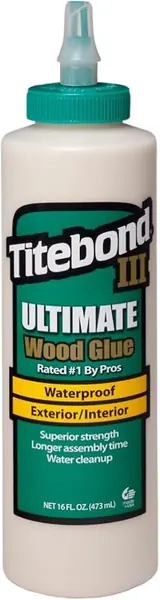
Titebond III Ultimate Wood Glue in a 16-ounce squeeze bottle

All-purpose wood crafts

Shop Score 97/100
Container Size
16 fluid ounces
Water Resistance
ANSI/HPVA Type I waterproof
Working Time
8 minutes
Tensile Strength
4,000 psi
View on Amazon

If you want one bottle to cover craft-room repairs, small furniture assemblies, and the occasional planter or birdhouse, Titebond III Ultimate is the one we reach for. Its Type I waterproof rating is the highest water-resistance class here, and its 4,000 psi tensile strength is the top figure in this group. Those numbers matter less than the everyday result: a strong PVA bond, water cleanup while the glue is wet, and enough moisture resistance that an outdoor craft does not need a second adhesive.

The 8-minute working time is a good fit for small assemblies. It gives you enough time to spread glue and set a few pieces, but it does not leave you waiting around before clamping. On a multi-piece glue-up, though, that window can feel short; Gorilla Ultimate's 15 minutes is the better choice when you need to fiddle with several joints. For a two-piece repair or a simple box, the quicker set keeps the project moving.

Cleanup is where this glue earns its keep for crafters. While wet, squeeze-out wipes away with water; once cured, you can shave or sand it without it softening. The 16-ounce bottle is a sensible size for a hobbyist, enough for several projects without committing to a gallon. Titebond III is also approved for indirect food contact, not direct contact, so keep it out of the food surface itself.

We like it best as the default bottle on a craft bench: one glue covers both indoor and outdoor work, and it cleans up without solvent. The 16-ounce size is enough for a run of small projects without turning into a gallon jug you may never finish. That combination is why it is the first bottle we reach for when a project's exposure is not obvious.

Worth Noting

  • Tan glue line can show on dark wood
Our Verdict

For most wood craft projects, we recommend Titebond III Ultimate: it bonds strongly, cleans up with water, and stands up to outdoor moisture without a separate glue.

Check Latest Price
2.

Gorilla Wood Glue Best Value

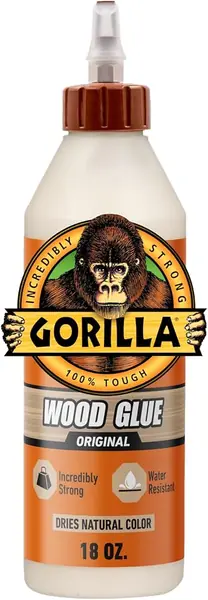
Gorilla Wood Glue in an 18-ounce bottle with natural tan formula

Larger craft builds

Shop Score 96/100
Container Size
18 fluid ounces
Water Resistance
ANSI/HPVA Type II
Full Cure
24 hours
Clamp Time
20 to 30 minutes
View on Amazon

Eighteen ounces is a lot of glue for a craft shelf, and that is exactly why Gorilla Wood Glue earns a place here: it is the bottle we reach for when a repair is bigger than a dollhouse chair but smaller than a cabinet run. It passes ANSI/HPVA Type II water resistance, so it can handle damp outdoor projects, and it cures to a natural tan that is paintable and sandable.

The listed clamp time is 20 to 30 minutes, with a full cure in 24 hours. That is a forgiving schedule for furniture repairs and multi-piece crafts, and the applicator tip gives you decent control on narrow edges. We like that it does not foam, and the natural tan bond line sands flush and takes paint.

The formula is a little thinner than some PVA glues, so it can run on vertical joints. We lay those pieces flat until the glue tacks, and after that it holds well. That thinness also helps it spread into tight craft joints, which is a fair trade for a little more setup care.

We keep this bottle for jobs where the glue volume matters: a set of shelves, a repaired drawer, a run of small signs. It is not the smallest bottle here, but it is the one we are comfortable using generously. For a single tiny repair, the 8-ounce Titebond II is easier to justify; for a larger build, this is the better value.

Worth Noting

  • Bottle tip can gum up between sessions
Our Verdict

Gorilla Wood Glue is our value pick for bigger craft builds and furniture repairs, with a generous bottle and a water-resistant bond that handles most indoor-to-outdoor jobs.

Check Latest Price
3.

Titebond II Premium Wood Glue Best Small Bottle

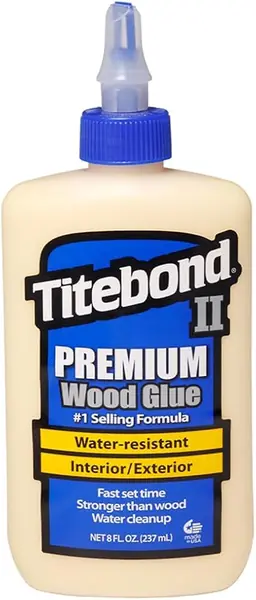
Titebond II Premium Wood Glue in an 8-ounce bottle

Occasional craft repairs

Shop Score 95/100
Container Size
8 fluid ounces
Water Resistance
ANSI/HPVA Type II
Cure Color
Honey cream
Tensile Strength
3,750 psi
View on Amazon

An 8-ounce bottle is the right size for a drawer of craft supplies, and Titebond II Premium makes good use of it. It passes ANSI/HPVA Type II water resistance, which is enough for damp conditions, and its 3,750 psi tensile rating sits just below the top pick's. The practical difference is the bottle: it is easy to store, easy to control, and less likely to sit around long enough to skin over.

The fast tack is the part we appreciate on small repairs. Pieces grab quickly, so you spend less time holding a joint while you reach for a clamp. On a multi-piece craft, that quick grab can be a disadvantage; Gorilla Ultimate's 15-minute working time gives you more room to align several parts. For a two-piece repair or a simple box, the quicker set is an advantage.

It dries to a honey cream color and sands without softening, and any squeeze-out wipes away with water before it cures. That makes it easier to finish than a glue that beads up or resists sanding. We also like the small bottle for a shop that does not go through glue quickly: it takes up little shelf space, and you are less likely to be working from a half-empty jug.

Within that niche, it is the small bottle we reach for first: water-resistant, fast enough for repairs, and easy to sand. It is the one we hand to someone who wants a dedicated craft bottle rather than a shop-sized jug.

Worth Noting

  • Not fully waterproof for constant wet exposure
Our Verdict

Titebond II Premium is the small bottle we keep for occasional repairs and water-resistant craft projects, where a fast tack and easy cleanup matter more than full waterproofing.

Check Latest Price
4.

Gorilla Ultimate Waterproof Wood Glue Best for Slow Multi-Piece Glue-Ups

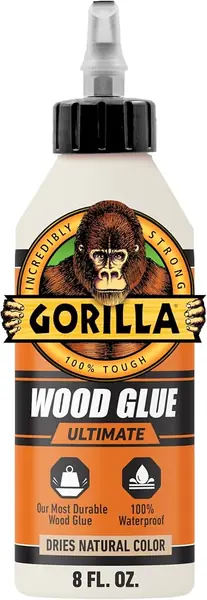
Gorilla Ultimate Waterproof Wood Glue in an 8-ounce bottle

Slow multi-piece glue-ups

Shop Score 93/100
Container Size
8 fluid ounces
Water Resistance
ANSI/HPVA Type I waterproof
Cure Color
Natural tan
Working Time
15 minutes
View on Amazon

Fifteen minutes is the number that sets Gorilla Ultimate apart here: it is the longest working time among these picks. That extra window is welcome when a craft has several small pieces that need to line up before the glue grabs. It passes ANSI/HPVA Type I, so it is fully waterproof, and it cures to a natural tan that is sandable and paintable.

We like the longer working time for assembly-heavy projects, and the natural tan glue line sands and paints without fuss. For a slow, multi-piece glue-up, the extra minutes are worth planning around; for a quick repair, a faster-setting glue is easier to justify.

Against Titebond III, the main difference is working time: 15 minutes versus 8. Against Gorilla Wood Glue, it is the waterproof rating and the longer working time. We appreciate that it is a one-part glue with no mixing, which keeps a craft project simple when you are already juggling clamps and small parts.

Cleanup is the same water-based routine as the other PVA glues here: wipe squeeze-out while it is wet, then shave or sand the cured bead. We keep this bottle for projects where alignment matters more than volume, and the 15-minute window is the reason it stays in the cabinet.

Worth Noting

  • 8-ounce bottle is small for frequent glue-ups
Our Verdict

Gorilla Ultimate is our choice when a glue-up needs extra wiggle room, thanks to its 15-minute working time and fully waterproof bond.

Check Latest Price

How We Tested Wood Glue

We started with labels, not bottle fronts, sorting candidates by water-resistance rating, base chemistry, open time, cure color, and price per fluid ounce, then crossing off anything hard to find or sold only in bulk. Fourteen bottles made it to the bench for five months.

Most of that testing happened where wood glue actually lives: a garage workbench, the kitchen table after dinner, and a back porch for anything headed outdoors. We glued up picture frames, small boxes, dollhouse furniture, and a couple of chair rungs that had already failed once, working in pine, oak, and plywood. For every bottle we spread a bead, pressed the parts together, and counted the seconds until the glue skinned over and the pieces started to slide.

Once a joint cured, we tried to break it. Out came a hammer and chisel, and we looked at what gave: a good glue line tears wood fibers out of one face, while a bad one pops apart clean, glue and all. We sanded the squeeze-out to see whether it gummed up the paper, and brushed a clear finish over the joint to check if the glue line ghosted through.

Water resistance got its own set of joints, left outside through a wet spring and a few frosts. We tracked cure color and hardness over the following day, weighed cost per ounce, and noted how much control each bottle gave us — a thin, even bead from a narrow nozzle or a puddle from a wide one. The bottles that stuck around were the ones that gave us time to line a joint up, held it once clamped, and cleaned up without a fight.

How to Choose a Glue for Wood Crafts

Match Water Resistance to the Project

Type I is the waterproof class; Type II is water-resistant but not intended for constant wet conditions. For indoor crafts, we treat Type II as the sensible default, while planters, birdhouses, and outdoor furniture call for Type I. Titebond III and Gorilla Ultimate carry Type I ratings, while Gorilla Wood Glue and Titebond II are Type II. Waterproof does not mean submersible: Titebond II is explicitly not for use under water, and even a waterproof glue needs good joint fit to do its job.

Give Yourself Enough Open Time

Open time is how long you can spread, position, and clamp before the glue grabs; clamp time is how long the joint stays clamped. They are not the same number, and a long clamp time does not mean a long open time. We pay close attention to open time on multi-piece crafts, because that is where a fast grab turns into a crooked joint. For two-piece repairs, 8 minutes is plenty; for a multi-piece craft, Gorilla Ultimate's 15-minute working time gives you more room to align parts. If you are not sure, test a scrap joint and time how long it takes you to get the clamps on.

Don't Choose by Tensile Strength Alone

A 4,000 psi rating sounds decisive, but the number comes from a controlled test, not from your joint. Titebond III lists 4,000 psi and Titebond II lists 3,750 psi, yet both depend on clean, close-fitting surfaces and enough clamp pressure. We pay more attention to joint fit than to the difference between those figures. Use enough glue to see a thin bead squeeze out, clamp firmly without starving the joint, and test a scrap piece before you trust a new technique.

Plan for Cleanup and the Glue Line

All of these are water-based PVA glues, so squeeze-out wipes away with a damp cloth while it is wet. Once cured, the glue can be shaved or sanded, but a wet rag will not do much. Color matters on visible joints: Titebond III dries tan, Gorilla Wood Glue and Gorilla Ultimate dry natural tan, and Titebond II dries honey cream. We test a scrap with the finish we plan to use, because a glue line that looks fine on pine can stand out on walnut.

Choose a Bottle Size You'll Actually Use

An 8-ounce bottle is easier to store and less wasteful for occasional repairs; a 16- or 18-ounce bottle makes sense if you glue regularly or build larger crafts. Titebond II and Gorilla Ultimate come in 8-ounce bottles, while Titebond III is 16 ounces and Gorilla Wood Glue is 18 ounces. Check the shelf life before buying a big jug, and store the bottle upright with the tip clean; a glue bottle that sits for a year can thicken or skin over.

Frequently Asked Questions

Final Verdict

For most wood craft projects, Titebond III Ultimate is the glue we recommend first. It gives you a waterproof Type I bond, a 4,000 psi joint, and water cleanup, so it covers indoor repairs and outdoor pieces without making you buy a second bottle. If you want a smaller bottle for occasional water-resistant work, Titebond II Premium is the better fit. If a multi-piece assembly needs more working time, choose Gorilla Ultimate.