↑↓ navigate ↵ open Esc close All results →

Best Glues for Teak of 2026

The same natural oils that keep teak outdoor benches from rotting also push conventional wood glues away from the surface, letting a joint that clamps tight on Saturday pop open by the first cold snap. Lasting repairs on oily tropical hardwood require both solvent wipe-downs before assembly and an adhesive engineered to wet out and cure reliably.

Evaluating 14 glues on teak across six months—spanning weather-exposed patio seating and indoor chair rungs—put waterproof classification ahead of every other spec. Open working time, how cleanly cured squeeze-out sands without gumming abrasives, and realistic yield per bottle separated dependable exterior bonds from indoor-only formulas.

Surface prep still decides more failures than chemistry, and these four adhesives cover distinct repair scenarios from sun-baked outdoor joinery to tight indoor rungs without demanding razor-perfect millwork.

Our Top Picks

The Best Glues for Teak

1.

Titebond III Ultimate Wood Glue Best Overall
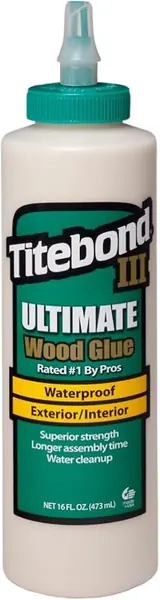
Bottle of Titebond III Ultimate waterproof wood glue, 16 fluid ounces, tan adhesive

Outdoor teak furniture

Shop Score 96/100
Size
16 fluid ounces
Water Resistance
ANSI/HPVA Type I waterproof
Tensile Strength
4,000 psi
Working Time
8 minutes
View on Amazon

Glue bottles throw the word waterproof around loosely, so we look at the rating underneath it. Titebond III is the only adhesive here that passes ANSI/HPVA Type I, the classification for a glue line that survives repeated soaking, and that is what makes it our default for teak that lives outdoors: a garden bench, a planter, a cap rail on a small boat. It also posts the highest tensile figure in this group at 4,000 psi, and it cures to a tan that sits quietly against teak's own golden brown.

In the shop it behaves like a well-mannered PVA. Eight minutes of open time is enough to run a bead on a mortise and tenon, seat the joint, and get a clamp on without rushing, and squeeze-out wipes off with a damp rag if you catch it before it skins. Sanding is where we noticed the difference most: it powders off instead of balling up the paper, and it takes a stain or a topcoat without a fight.

Against the polyurethane below, this is the tidier choice for joinery that closes properly — no foaming, no gloves, no hardened bead to chisel off a visible face. What it cannot do is fill. If a joint has opened up or the two faces do not meet along their length, there is nothing for the glue to bridge, and that is the point where you switch bottles. Keep a damp rag within reach, too: the eight-minute clock starts when the bead goes down, not when you pick up the clamp.

Worth Noting

  • Thinner body than the other PVA glues here
Our Verdict

Type I waterproof, eight minutes of open time, and water cleanup — that combination is why we recommend Titebond III for teak that lives outdoors.

Check Latest Price
2.

Gorilla Original Polyurethane Glue Best for Oily and Weathered Teak

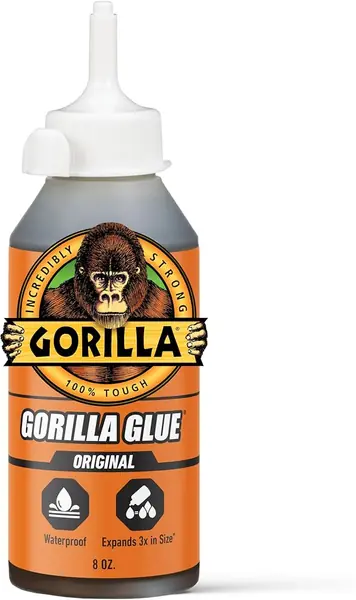
Bottle of Gorilla Original waterproof polyurethane glue, brown, 8 fluid ounces

Oily weathered teak

Shop Score 95/100
Size
8 fluid ounces
Water Resistance
100% waterproof when cured
Cure Time
24 hours
Expansion
Expands 3 times
View on Amazon

This is the glue that foams, stains your hands brown, and leaves a hardened bead wherever you were careless. We keep a bottle anyway, because on teak that has been oiled, weathered, or cut with a joint that will not quite close, it does what a PVA cannot: it cures 100 percent waterproof, expands into the gap as it sets, and grabs a surface that is less than perfect.

It is a polyurethane, so it cures by reacting with moisture rather than drying out. Dampen one face, clamp firmly, and give it a full day before you put load on the joint. The expansion is roughly three times what you apply, which is how it bridges voids and also why a heavy bead will push a tight joint apart and foam out across a finished face. We spread it thin for exactly that reason, and we keep it well away from anything we care about staining.

On teak it is the forgiving option. A face that has been handled, oiled, or left a little rough still gives it something to bite, where a PVA wants clean, freshly machined wood and a close fit. What you pay for that is patience and a color: it cures brown and does not dry clear, so it hides in a dark joint and shows on pale sapwood. Use it where the joint is hidden or where holding matters more than a flawless face.

Worth Noting

  • Foams and leaves messy squeeze-out on faces
Our Verdict

On weathered, gappy, or salt-water teak, we want this polyurethane: it cures fully waterproof and expands into the joint instead of demanding a perfect fit.

Check Latest Price
3.

Gorilla Wood Glue Best Budget

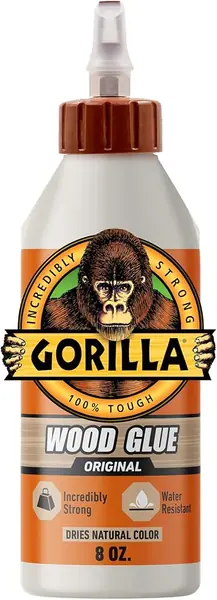
Bottle of Gorilla Wood Glue, 8 fluid ounces, natural wood color PVA adhesive

Budget indoor repairs

Shop Score 94/100
Size
8 fluid ounces
Water Resistance
ANSI/HPVA Type II water resistant
Full Cure
24 hours
Clamp Time
20 to 30 minutes
View on Amazon

It is the least expensive glue here that carries a water-resistance rating, and that combination is why we suggest it for a first teak project or a run of small repairs. Gorilla passes ANSI/HPVA Type II, the classification for a joint that gets wet and dries out again: outdoor furniture under a porch roof, a repair on a piece that comes inside at night. It is not the rating for a joint that stays submerged.

Half an hour in the clamps is the number that matters here. Twenty to thirty minutes is short enough to glue up a side table after work and long enough that you are not racing the bottle, and the cured line comes out a natural wood color that sands and takes paint. Cleanup is water while the glue is wet, and a putty knife or a razor takes off what you missed.

Where it sits for us is the quick-repair shelf. It is the bottle we grab when the waterproof glue would be overkill for a drawer runner and the polyurethane would be too much mess for a job that takes ten minutes. It is not the glue for a joint that sits in water, and it is not the glue for a gap, but a clean close repair on teak asks nothing more of it.

Worth Noting

  • Tip can gum up between sessions
Our Verdict

We hand this to anyone gluing teak on a budget: it is the cheapest bottle here with a water-resistance rating, and it clamps in half an hour.

Check Latest Price
4.

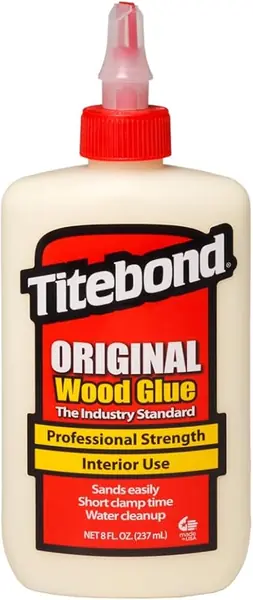
Titebond Original Wood Glue

Bottle of Titebond Original Wood Glue, 8 fluid ounces, yellow aliphatic resin adhesive

Indoor furniture

Shop Score 93/100
Size
8 fluid ounces
Water Resistance
Not water resistant
Tensile Strength
3,600 psi
VOC Content
Under 0.2 g/L
View on Amazon

Where our top pick earns its place with a Type I waterproof rating, this one earns it by being the easiest glue here to live with indoors: quickest grab, cleanest sanding, smallest bill. For teak that stays inside — a dining table, a cabinet, a repair in a dry room — that is a fair trade, because what you give up in water resistance comes back at the sander.

The fast set is what we noticed first. Strong initial tack grabs a joint and holds it while you reach for the clamp, which takes the fuss out of the fiddliest part of a repair, and the glue dries to a translucent film instead of a bright line. Sanding flatters it: it powders off cleanly rather than softening and loading the paper, and stain and finish go on without the glue telegraphing through. At 3,600 psi it is not the strongest bottle here, but it is stronger than the teak it holds.

It is also the easiest of the four to live with in a small shop: low VOC, nonflammable, water cleanup, and the cheapest way into a joint you can trust indoors. Dry-fit every part before the bottle comes out, because the tack that makes it pleasant to clamp is the same tack that grabs a piece a hair out of place.

Worth Noting

  • Not water resistant; limited to indoor teak
  • Grabs fast, leaving little room to adjust
Our Verdict

Interior teak gets Titebond Original from us — the fastest tack and the cleanest sanding of the four, for the least money.

Check Latest Price

How We Chose the Best Glue for Teak

We built the shortlist by reading labels rather than marketing copy: water-resistance class first, then PVA or polyurethane chemistry, open time and clamp time, gap-filling claims, bottle size, and shelf life. That narrowed the field to 14 glues, from thin interior-only formulas to expanding polyurethane, and we spent six months with them in a garage workshop and on a patio.

Every glue got two sets of teak offcuts, one wiped down with denatured alcohol and one left as it came with its surface oil intact. We spread, clamped, and timed how long each stayed workable and how soon the clamps could come off without the joint sliding. Squeeze-out was sanded the next day on teak scraps so we could see which glue lines vanished and which left a dark stripe or balled up on the paper. The outdoor pieces stayed on the patio through rain and sprinkler season, and we checked the seams after every wet stretch.

Once each glue hit full cure, we broke the joints with a mallet and looked at what gave: torn wood fibers meant the bond held, a clean glue line meant it didn't. We also tracked how far a bottle stretched across identical repairs, checked date codes for shelf life, and graded gap filling by gluing joints we deliberately left a hairline open. Polyurethane went on with nitrile gloves every time, and when we thinned a PVA we stayed inside the maker's stated limit. The list came down to the joints that were still tight in month six.

How to Choose a Glue for Teak

Water Resistance Comes First

Teak ends up outdoors more often than most hardwoods, so we start with the rating rather than the brand. ANSI/HPVA Type I is the waterproof classification, and it is what we want for garden furniture, planters, and anything that gets rained on and left wet. Type II is water resistant: fine for a sheltered porch or a piece you bring in, not for a joint that sits in water.

Plain interior PVA carries no rating at all. That is not a flaw, but a wet joint will eventually let go, so keep those bottles for furniture that stays in the house.

Take the Oil Off the Joint

Teak's reputation for rejecting glue comes mostly from its own extractives, not from the adhesive. Freshly planed or machined faces bond far better than sanded ones, because sandpaper burnishes the surface and packs the pores. Wipe both faces with acetone or lacquer thinner and glue as soon as it flashes off — an oil-based solvent just adds another contaminant.

If the piece has been oiled or sealed before, the finish has to come off the joint faces entirely. Glue applied over teak oil is the most common reason a repair fails a second time.

PVA or Polyurethane?

PVA is the easier glue: water cleanup, no foaming, strong on a tight joint with good clamp pressure. It is also unforgiving of a joint that does not close, and it creeps under sustained load. Polyurethane cures waterproof, fills gaps as it expands, and is more tolerant of a weathered or slightly oily surface, but it foams, stains, and leaves squeeze-out you have to chisel off.

Our rule: tight, clean joinery gets PVA; a loose, weathered, or gappy repair gets polyurethane.

Working Time and Clamp Time

Open time is how long you have to assemble before the glue grabs; clamp time is how long the piece stays in the clamps. Titebond III gives about eight minutes of open time, generous for a single joint and tight for a chair with six of them, so glue up in stages rather than trying to beat the clock. If speed is the problem, dry-fit everything first and clamp in sub-assemblies.

Keep the work warm, too. Cold glue lines go chalky and weak, so bring the piece indoors the night before if the shop is near freezing, and never let a bottle freeze.

Frequently Asked Questions

Final Verdict

Teak does not need a specialty bottle so much as the right class of glue and a properly wiped joint, and Titebond III covers the most ground: Type I waterproof, eight minutes of open time, water cleanup, and a tan line that disappears into the wood. For most teak projects, that is the bottle we buy.

Reach for Gorilla Original instead when the joint is gappy, weathered, or headed for salt water — the polyurethane is messier but far more forgiving of a joint that does not close. And for teak that never leaves the house, Titebond Original is faster, cheaper, and easier to sand.