↑↓ navigate ↵ open Esc close All results →

Best Wood Glue for MDF of 2026

MDF is the rare sheet good that punishes you for trusting it. Its faces are dense and resin-heavy, its edges are compressed dust, and a glue line that looks generous going on can starve out before the second piece is seated. What you want from a wood glue for MDF is a formula that stays open long enough to work, sits on the surface instead of vanishing into it, and holds in a room that gets humid.

We tested 14 wood glues over four months on MDF shelves, a shop cabinet, and a kitchen cart that had wobbled since spring. On MDF, a good bond shows up as torn fibers at the glue line rather than a clean release, and we timed open and clamp time with a stopwatch because this material gives you one shot at positioning. The lesson that cost us the most scrap: MDF edges need a second coat.

The glues below cover a small repair, a gallon for shop work, and the damp-room cases. None of them make MDF an exterior material, so keep mechanical fasteners on anything that carries a load.

Our Top Picks

The Best Wood Glue for MDF

1.

Titebond II Premium Wood Glue Best Overall
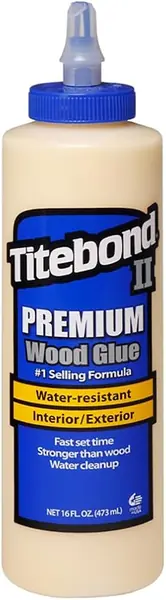
Titebond II Premium wood glue in a 16-ounce squeeze bottle with honey-cream color

Indoor MDF furniture

Shop Score 96/100
Container Size
16 fluid ounces
Water Resistance
Type II water-resistant
Full Cure Time
24 hours
Tensile Strength
3,750 psi
View on Amazon

The balance we want in a default MDF glue is a strong initial tack, a set that does not keep us waiting, and enough water resistance for a kitchen or a humid garage. Titebond II Premium hits all three without the price of a fully waterproof formula. The listed 3,750 psi is impressive, but the practical appeal is how the glue holds a shelf edge in place while you get a clamp on it.

MDF is thirsty, especially on cut edges, so we paid attention to whether a glue stays where you put it long enough to close the joint. The medium viscosity and fast set of Titebond II are a good match: you can run a bead, spread it across both faces, and clamp before the surface skins over. It also sands without softening, which matters when an MDF edge fuzzes under a sander.

The 16-ounce bottle is a sensible size for furniture work: enough for a cabinet carcass or a run of shelves, small enough to keep the tip clean between sessions. If you build often, a gallon of Gorilla Wood Glue is cheaper per ounce; for occasional furniture, the 16-ounce bottle is the right amount to finish before it ages out.

Worth Noting

  • Not waterproof for exterior projects
Our Verdict

For most MDF projects, this is the wood glue we reach for: strong tack, a fast set, and enough water resistance for kitchens and humid rooms.

Check Latest Price
2.

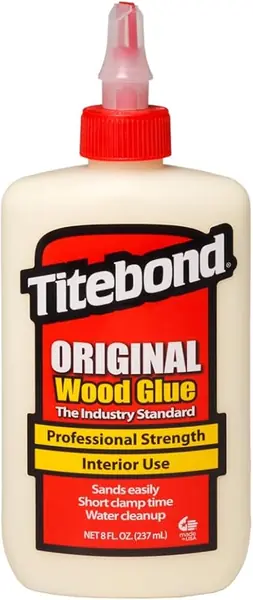
Titebond Original Wood Glue Best Budget

Titebond Original wood glue in an 8-ounce yellow squeeze bottle

Small indoor repairs

Shop Score 95/100
Container Size
8 fluid ounces
Water Resistance
Not water resistant
Full Cure Time
24 hours
Tensile Strength
3,600 psi
View on Amazon

A low price and a small bottle make Titebond Original the easy first glue for occasional MDF work, and it is the one we hand to someone making a first shelf. The 8-ounce size is enough for a shelf repair or a drawer box, and the narrow tip lets you lay a controlled bead along a narrow edge. Titebond Original has been the workshop standard for decades because it offers strong initial tack, a fast set, and a bond that sands flush without gumming up the paper.

On MDF, the fast set is a real convenience. We liked that a small repair could be clamped and left without the joint sliding around, and the glue dries to a translucent film that does not fight a stain or topcoat. The Original is not the glue we choose for a bathroom vanity or a garage shelf; that is a job for a water-resistant formula. For the majority of indoor MDF repairs, paying for that extra protection is unnecessary. It also has very little odor, which makes it comfortable for a repair at the kitchen table.

Worth Noting

  • Small bottle empties quickly on large builds
Our Verdict

This is the bottle we keep for small indoor MDF repairs, where a fast set and easy sanding matter more than a big container.

Check Latest Price
3.

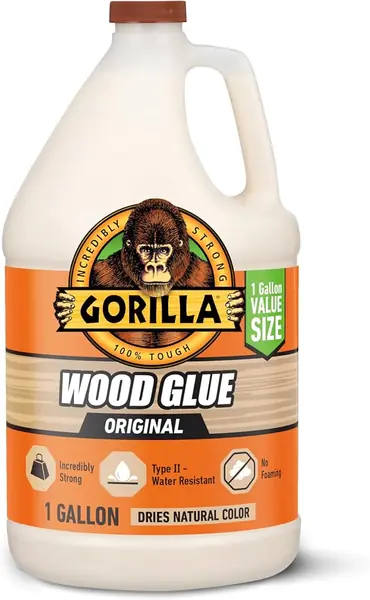
Gorilla Wood Glue Best Bulk Value

Gorilla Wood Glue in a one-gallon jug with a natural wood color formula

Bulk shop use

Shop Score 94/100
Container Size
1 gallon
Water Resistance
Type II water-resistant
Full Cure Time
24 hours
Clamp Time
20 to 30 minutes
View on Amazon

A gallon jug works best as a refill reservoir, not a one-off bottle, and that is how we use this Gorilla Wood Glue. We like it for a shop that goes through MDF shelves, jigs, and cabinet parts regularly, because decanting it into a small squeeze bottle keeps application controlled while the cost per ounce stays low. The formula is a standard PVA that passes ANSI/HPVA Type II water resistance and cures to a natural tan color, so it covers the same indoor and occasional damp jobs as the smaller bottles.

On MDF, the 20-to-30-minute clamp time is the useful number. It gives you enough room to spread glue on both faces and line up a shelf without the joint grabbing too early, and full cure comes in 24 hours. We found the glue a little thinner than some formulas, which helps it wet out porous MDF edges but can make a vertical bead slide; a light hand on the bottle is better than a heavy line.

The bottle is the weak point. A gallon jug is not a precision applicator, so we decant it into a smaller squeeze bottle and treat the original as a bulk supply. That is a workflow step, not a dealbreaker, but it is the reason this pick is about value rather than convenience.

Worth Noting

  • Cap can gum up between sessions
Our Verdict

We recommend the gallon for frequent MDF work: it keeps a refillable bottle on the bench at a low cost per ounce, and the PVA formula suits composite wood.

Check Latest Price
4.

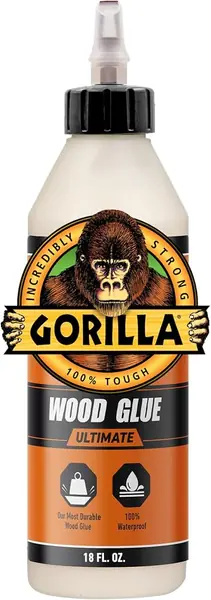
Gorilla Ultimate Waterproof Wood Glue Best for Complex Waterproof Glue-Ups

Gorilla Ultimate waterproof wood glue in an 18-ounce bottle with natural color

Complex waterproof glue-ups

Shop Score 93/100
Container Size
18 fluid ounces
Water Resistance
Waterproof
Clamp Time
20 to 30 minutes
Open Time
Up to 15 minutes
View on Amazon

Fifteen minutes of open assembly time is a luxury in an MDF glue-up. We appreciate it on projects with several parts—a drawer box, a small cabinet, a set of shelves—where a fast-setting glue can grab before everything is square. Gorilla Ultimate is a PVA that is fully waterproof, cures to a natural tan color, and can be used at lower temperatures than some formulas, which makes it a reasonable choice for a cold shop or a joint that might see moisture.

The waterproof claim is the headline, but the working time is what changes the experience. You can spread glue, assemble, and adjust without the panic that comes with a fast tack. We also like that it does not foam, so the bond line stays clean and sands flush. The 20-to-30-minute clamp time and 24-hour full cure are straightforward to plan around.

For general indoor MDF, Titebond II is the easier default; it sets faster and costs less. Gorilla Ultimate earns its place when open time or water exposure is the deciding factor, and it is the one we reach for when a glue-up has more than two or three parts.

Worth Noting

  • Nozzle can clog between uses
Our Verdict

We keep this for complex glue-ups that need extra open time or a waterproof bond; it is a specialist, not our everyday bottle.

Check Latest Price

How We Tested Wood Glue on MDF

We started with every wood glue sold for furniture assembly and panel work, then narrowed by formula first — PVA unless a joint would regularly see standing water — and after that by bottle size, applicator style, and price per ounce. From that shortlist we bought 14 glues and spent four months using them in the shop and on small repairs at the kitchen table.

Each one got the same round of glue-ups: face-to-face MDF panels, edge-to-face joints on shelf stock, and one deliberately awkward joint where we spread a thin film and pressed the second piece in at two-minute intervals, checking for wet transfer instead of a dry, starved film. We released clamped joints at intervals to see whether the pieces crept, and because MDF edges drink glue, we noted whether a single coat survived long enough to bond or left the second piece nearly dry.

Beads squeezed along a 12-inch edge told us how much control each tip gave and whether it clogged between sessions, and we decanted the gallon bottle into a smaller squeeze bottle to see how a refill actually went. Cured squeeze-out got sanded with 150-grit to see whether it gummed the paper or flaked off clean. For water resistance we soaked cured coupons for an hour and kept others in a damp basement for a week, never outdoors — no glue makes MDF an exterior material — and we used mechanical fasteners on any joint that carried a load. Last, we divided bottle price by ounces and counted how many small repairs a bottle covered.

How to Choose Wood Glue for MDF

Start with PVA, not polyurethane

MDF is a dense engineered panel with thirsty cut edges, and the adhesive that handles it best is a standard PVA glue. These water-based formulas spread easily, clean up with water before curing, and sand without clogging the paper. Polyurethane glue is the wrong tool here: it needs moisture to cure, foams as it reacts, and can push a thin MDF joint apart. We choose a PVA labeled for wood and wood composites, then test a scrap edge before committing to a whole cabinet.

Match water resistance to the room

We treat water resistance as a room-by-room decision, not an all-or-nothing feature. A no-resistance glue like Titebond Original is fine for dry indoor shelves and drawer boxes. A Type II glue like Titebond II or Gorilla Wood Glue adds protection for a kitchen cabinet, a bathroom vanity, or a humid garage. A fully waterproof Type I glue like Gorilla Ultimate is the choice for exterior wood, but it cannot make MDF itself weatherproof—MDF swells and loses strength when it gets wet. Keep MDF indoors and use exterior-rated wood for outdoor projects.

Give yourself enough open time

We plan around open time first, because that is where MDF glue-ups go wrong. Open time is how long the glue stays workable after spreading; clamp time is how long the joint needs pressure. MDF edges soak up adhesive, so a glue that sets too fast can skin over before you finish. For a simple shelf repair, a fast-set PVA is an advantage. For a drawer box or small cabinet with several parts, the 15-minute open time on Gorilla Ultimate gives you room to align. Clamp for 20 to 30 minutes and leave the piece for 24 hours before loading it.

Apply glue to both surfaces

MDF faces and edges are porous, and a thin coat on both surfaces gives you a better bond than a heavy bead on one side. We spread the glue with a small brush or finger, press the parts together, and look for a uniform bead of squeeze-out; if one spot stays dry, add a little more before clamping. Too much glue can act like a hydraulic and keep the joint from closing. A 16-ounce bottle is a good bench size, while a gallon is best decanted into a smaller applicator.

Frequently Asked Questions

Final Verdict

For most MDF work, Titebond II Premium is the easy call. It has the tack and fast set we want on shelf edges, and its Type II water resistance covers kitchens and humid garages without the premium of a fully waterproof glue. If you are building only small indoor repairs, Titebond Original saves money. If you buy glue by the gallon, Gorilla Wood Glue is the refill. For a complex glue-up that needs extra open time, Gorilla Ultimate is the specialist.