↑↓ navigate ↵ open Esc close All results →

Best Wood Glue for Guitar Repair of 2026

A lifting bridge is a small problem with an expensive failure mode. If the glue lets go once the strings are back up to pitch, you're not fixing a bridge anymore — you're looking at a separated top and a repair bill to match. The right glue keeps a brace, a bridge, or a headstock crack closed while the guitar takes load again.

We tested 16 wood glues over six months, and the strength number on the bottle turned out to be the least useful thing about any of them. What decides a guitar repair is whether the glue stays workable long enough to slide a bridge into position, whether it reaches the inside of a closed crack, and whether you might ever want the joint apart again. A friend's acoustic sat unplayed for a year because nobody wanted to touch the bridge.

The picks below run from a structural workhorse to a slow-set glue you can reverse, to a medium-body one built for filling cracks. Different joints, same standard: reach, working time, and a clean line under finish.

Our Top Picks

The Best Wood Glue for Guitar Repair

1.

Titebond Original Wood Glue Best Overall
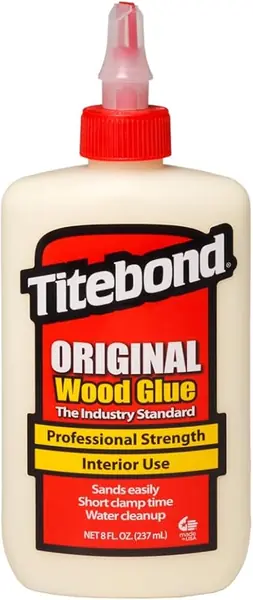
Titebond Original Wood Glue in a yellow 8-ounce squeeze bottle

Structural guitar joints

Shop Score 96/100
Adhesive Type
Aliphatic resin (PVA)
Container Size
8 fluid ounces
Tensile Strength
3600 psi
Water Resistance
Not water resistant
View on Amazon

Most of the repairs that bring a guitar to the bench are wood-to-wood joints: a brace that let go inside the box, a bridge lifting at the back edge, a headstock split along the grain. Titebond Original is the bottle we hand someone for those jobs. It is an aliphatic resin glue rated at 3600 psi, and it grabs fast enough that a brace stays where you set it while you get a clamp in place.

What we care about more than the number is how it behaves at the repair line. The glue dries to a translucent film that sands without balling up or softening under the paper, and it takes stains and lacquer without leaving a pale ring around the patch. On a repair under a clear finish, that is the difference between a joint you have to point out to someone and one they have to hunt for.

The trade-off is speed, and it is real. The fast set that makes clamping a brace easy makes a bridge that has to be slid into alignment unforgiving, so dry-fit the part, tape your clamp blocks where you want them and commit in one pass. Cleanup is a damp rag before the glue skins or a scraper afterward. It also costs less than the hide glue and the CA glue here, which suits a bottle you will use a few ounces at a time.

Worth Noting

  • Not water resistant for damp settings
Our Verdict

We recommend it as the default for structural guitar repair, because it bonds hard, sands into an invisible patch and cleans up with water.

Check Latest Price
2.

Titebond Liquid Hide Glue Best for Reversible Joints

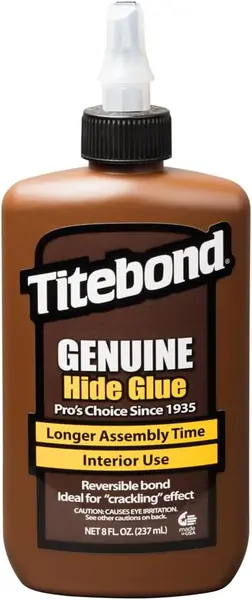
Titebond Liquid Hide Glue in a tan 8-ounce squeeze bottle

Reversible repairs

Shop Score 95/100
Adhesive Type
Liquid hide glue
Container Size
8 fluid ounces
Tensile Strength
3207 psi
Set Speed
Slow set for precise assembly
View on Amazon

Some joints are chosen for how they let go. Hide glue releases with warmth and moisture, so the next person to open a neck or reglue a brace can do it without cutting wood away, and that is the reason the glue never left instrument work after stronger synthetics arrived. This is that glue in a form you can use straight off the shelf, with no glue pot, no pellets to soak and nothing to mix.

We like the working time best. A long open assembly is what a repair through a soundhole actually needs: you can fit the brace, check it through the hole, nudge it once and only then reach for the clamps, instead of racing a glue that has already begun to tack.

Cured, it is rated at 3207 psi and sands clean, and squeeze-out wipes off with a wet rag. Two things to plan around: it runs thinner than a PVA, so keep the rag in hand while you work, and it sets slowly, which means a full clamp cycle before anything takes string tension. A joint rushed into service can creep open under load, so leave it clamped overnight rather than an hour.

Worth Noting

  • Short shelf life once opened
Our Verdict

We like it for any joint you may need to open again, since hide glue releases with warmth and moisture instead of fighting the next repair.

Check Latest Price
3.

Starbond Light Brown Medium CA Glue Best for Crack Repair

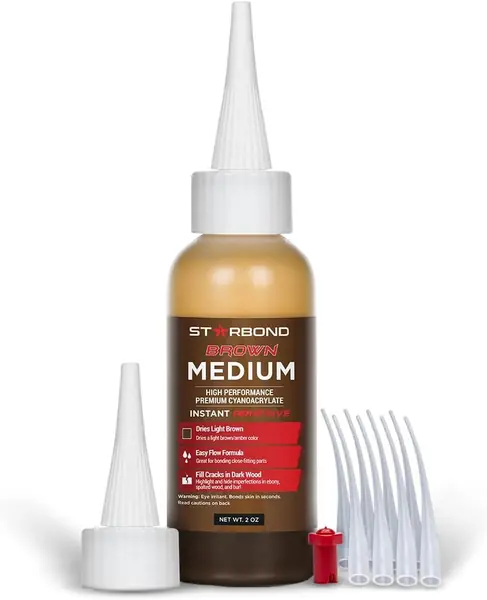
Starbond light brown medium CA glue in a 2-ounce bottle with micro-tips

Cracks and fills

Shop Score 94/100
Adhesive Type
Cyanoacrylate (CA)
Container Size
2 fluid ounces
Viscosity
Medium
Full Cure Time
40 seconds
View on Amazon

A hairline crack running out from a soundhole, or a chip missing beside a fretboard, is not a job for a bottle with a nozzle on it. PVA sits on the surface of a closed crack; a medium-viscosity CA wicks down into it and, at this thickness, still builds a fill where the void is deeper than a stain. The listed cure is about 40 seconds, so you work in short passes and layer up rather than trying to do it in one flood.

The tint is what we appreciate most. Light amber-brown pigment disappears into maple, cherry, oak, ash and beech, so a filled crack reads as a shadow in the grain instead of a gray line you notice from across the room. The micro-tips and spare nozzles in the kit matter as much as the glue does: you can lay a bead along a bound edge or drop a controlled amount into a fret slot without flooding the finish beside it.

Think of this as a filler and a fast tack, not a structural adhesive. A bridge, a brace or a headstock break wants a PVA or hide glue and a set of clamps; the CA is for cracks, knots, inlay and fret work, where a hard fill that sands level is exactly right. It cures rigid, which is what a fill needs and what a flexing joint does not.

Worth Noting

  • Priciest glue per ounce here
  • Can harden in the bottle between uses
Our Verdict

Our pick for cracks and fills: the tinted medium CA wicks into places a PVA cannot reach and sands level in a matching brown.

Check Latest Price
4.

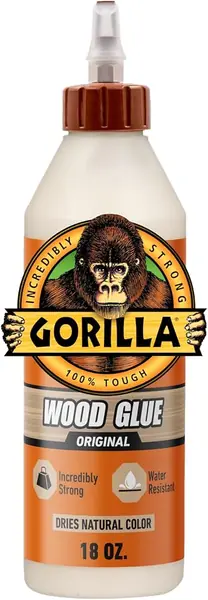
Gorilla Wood Glue Best Water-Resistant Pick

Gorilla Wood Glue in an 18-ounce bottle of natural tan PVA adhesive

Water-resistant repairs

Shop Score 93/100
Adhesive Type
PVA
Container Size
18 fluid ounces
Clamp Time
20 to 30 minutes
Water Resistance
ANSI/HPVA Type II
View on Amazon

Water resistance is the reason to pick this bottle over the others here. Gorilla Wood Glue passes the ANSI/HPVA Type II water-resistance standard, which is enough for a guitar that lives in a garage, a van or a screened porch, and for the damp cloth you run over a grimy top. It is not a waterproof rating, so it will not shrug off a soaking, but it is more protection than an interior PVA gives you.

There is a lot to like beyond the rating. Clamp time runs 20 to 30 minutes, generous enough to get a bridge seated and lined up before anything sets. The cured glue is a natural tan that sands and takes paint, and it does not foam, so the bond line stays where you put it. It is a PVA, so cleanup is warm water while the glue is still wet.

We treat this as the shop bottle rather than the luthier's first choice. For a bridge plate or a headstock on a good instrument, we want the Titebond and its finer sanding film; for the guitar that gets knocked around, plus the chair rung and the plywood shelf in the same weekend, the 18-ounce bottle is the one that earns its shelf space. Keep a pin in the tip between sessions and it stays usable.

Worth Noting

  • Applicator tip gums up between sessions
Our Verdict

We recommend this water-resistant bottle for a guitar that lives in a garage or a van, and for the household repairs that come with it.

Check Latest Price
5.

Elmer's E7000 Carpenter's Wood Glue Best for One-Off Repairs

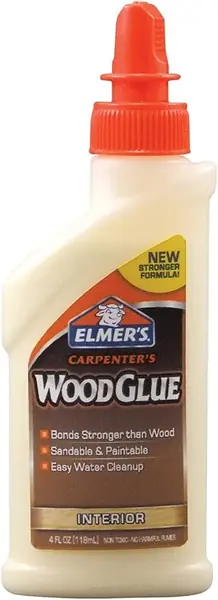
Elmer's E7000 Carpenter's Wood Glue in a 4-ounce yellow bottle

One-off repairs

Shop Score 92/100
Adhesive Type
Carpenter's wood glue
Container Size
4 fluid ounces
Clamp Time
20 to 30 minutes
Full Bond Time
24 hours
View on Amazon

Four ounces is about what one repair takes, and we think that is the right amount of glue to have on hand: enough for a bridge reglue and a couple of crack fills, without a container that outlasts the job. If the guitar in front of you has one loose brace and you do not want to buy a bottle you will use twice, this is the sensible size.

Nothing exotic is happening here. It is a standard water-based carpenter's glue with a 20- to 30-minute clamp time and a 24-hour full bond, the same schedule the other PVA picks ask for, and it cleans up with soap and water while it is wet or scrapes and sands off once it is hard. For a clean break with good surface contact, that is all you need.

Where we hesitate is a joint that carries real load. A bridge holding string tension or a split headstock is worth the Titebond and its finer sanding film, which we trust more around a repair that will show. Save this bottle for the simpler jobs: the loose brace, the cracked kerfing, the drawer in the kitchen and the toolbox that lives in the closet.

Worth Noting

  • Less suited for high-load joints like bridges or split headstocks
  • Sanding film is coarser than Titebond on visible repairs
Our Verdict

For one straightforward repair on a workhorse guitar, we think the small bottle makes more sense than a jug you will never finish.

Check Latest Price

How We Tested Wood Glue for Guitar Repair

We started with the repair bench, not the hardware aisle: luthier supply catalogs, repair forums, and the spec sheets for every adhesive sold in a bottle small enough to live within reach of a clamp. That narrowed to 16 products across four chemistries — aliphatic resin, PVA, liquid hide glue, and cyanoacrylate — and we skipped construction adhesives and expanding foams, which have no business near a soundboard.

Over six months we used each one on real repairs and on scrap: regluing a lifting bridge, closing a headstock crack, cleating a brace, filling a fretboard split. We timed how long each glue stayed slippery enough to slide a bridge into position by hand, and how long the clamps had to stay on before the joint held on its own. Application got its own pass: whether the bottle nozzle or a fine tip could lay a bead inside a hairline gap without running down the top.

Once cured, we looked at the repair line — whether the dried glue read darker, lighter, or nearly invisible under finish, and whether it sanded to powder or balled up and pulled at the surrounding wood. Capped bottles went back on the shelf between sessions, and some skinned over in the nozzle; a glue that seals itself shut after one repair is no bargain.

We left cured samples in a humid room and wiped others with a damp cloth to see which joints shrugged off moisture and which went soft, and we opened a hide glue joint with warm water to confirm it reversed. Cyanoacrylate stayed on gloved hands and pointed away from faces, and nothing got strung to pitch until its full clamp and cure time had passed — strings under tension are the only honest strength test.

How to Choose Wood Glue for Guitar Repair

Start With the Joint, Not the Strength Rating

In a well-fitted wood joint the glue is stronger than the wood around it, so a higher psi number rarely decides a repair. The fit and the clamp do. Aliphatic PVA such as Titebond Original is the default for braces, bridges and headstock breaks: strong, sandable and easy to clean up.

Hide glue earns its place where a joint may need to come apart. Medium-viscosity CA is a filler and a fast tack for cracks, frets and inlay, not a structural adhesive. Pick the chemistry first and the brand second.

Match the Open Time to the Repair

Open time is how long you have to position the part before the glue grabs; clamp time is how long it stays under pressure; full cure is when it is safe to string up. A brace glued through a soundhole is a slow, awkward reach, and a fast-setting PVA turns that into a one-shot operation.

Liquid hide glue gives you the longest working window here. Gorilla Wood Glue asks for 20 to 30 minutes under clamps, and every PVA on this list wants a full day before string tension.

Decide Whether the Joint Should Ever Come Apart

Guitars get repaired more than once, and a joint that cannot be opened costs the next repairer wood. Hide glue releases with heat and moisture, which is why it survives in instrument work.

Water-resistant PVA formulas are the least willing to let go, so treat them as a choice for a beater instrument or damp storage rather than for a bridge on a good guitar. The trap is assuming waterproof means better. On an instrument it usually means permanent.

Get the Glue Into the Joint, Not Around It

A thin, even film on both surfaces beats a puddle every time, and on a closed crack the glue has to be able to travel. Medium-viscosity CA with a micro-tip wicks into a hairline and lets you build a fill in layers.

PVA needs a tight joint and a nozzle you can steer into a soundhole, so a length of flexible tubing or a syringe helps. Whatever you use, dry-fit the part before any glue comes out of the bottle.

Look at the Repair Line

Glue color matters as much as glue strength when the joint sits under a clear finish. Aliphatic PVA dries translucent and sands into an invisible patch, hide glue dries tan, and CA comes tinted so you can push a fill toward maple or walnut instead of leaving a gray streak.

On a light top, a tinted medium CA is usually the better cosmetic match than clear super glue, which dries hard and glassy.

Frequently Asked Questions

Final Verdict

We recommend Titebond Original as the glue to keep on the bench. It handles structural joints, sands into a patch you have to hunt for, and costs less than the hide glue or the CA here, which is why it is the bottle we reach for first.

Add the liquid hide glue if you work on instruments that may need to be opened again, and the tinted Starbond CA for cracks and fills. Those three cover nearly every repair that comes across a guitar.