↑↓ navigate ↵ open Esc close All results →

Best Glue for Plastic to Wood of 2026

Grabbing the strongest-sounding tube on the rack rarely solves a plastic-to-wood repair, because slick polymer and porous lumber expand differently and resist the same bond. A snapped bin bracket or cracked drawer glide needs chemistry matched to joint fit and exposure rather than maximum tensile numbers on paper.

Four months of testing 16 adhesives—covering thin liquids, thick gels, and structural formulas—on pine-mounted plastic brackets, vertical trim, outdoor planters, and intentionally gapped joints confirmed that viscosity controls success. Thick gels bridge uneven mating faces and stay put vertically, whereas thin liquids wick into tight cracks and set within seconds.

Fast-setting cyanoacrylates suit indoor cabinet hardware that sees light loads, while slower polyurethane formulas handle wider gaps and outdoor moisture changes.

Our Top Picks

The Best Glue for Plastic to Wood

1.

Gorilla Super Glue Gel XL Best Overall
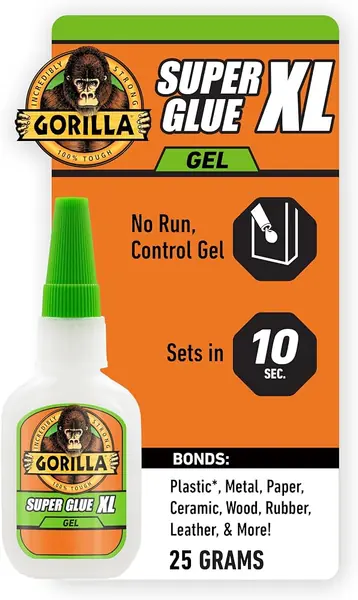
Gorilla Super Glue Gel XL clear gel bottle with anti-clog cap and 25-gram fill

Everyday plastic-to-wood repairs

Shop Score 96/100
Formula
Cyanoacrylate gel
Volume
0.88 fluid ounces
Set Time
10 to 45 seconds
Water Resistance
Not water resistant
View on Amazon

A plastic trim piece on a wood cabinet is exactly the kind of repair that makes ordinary super glue frustrating: the glue runs, the part slides, and you spend more time chasing drips than aligning the joint. That is why we recommend Gorilla Super Glue Gel XL as the best default here. Its high-viscosity gel stays where you put it, so you can set a small plastic bracket or a broken knob against wood without it immediately migrating down the face. The 10-to-45-second set time gives enough time to line up the pieces, then holds without clamping.

The 0.88-ounce bottle is a practical size for a shop drawer. We like that the metal pin in the cap creates an airtight seal, because a clogged bottle is often what ends a glue's useful life before the glue itself runs out. The clear finish also means squeeze-out is less conspicuous on light wood or visible plastic. It is reinforced for impact, which matters for things like a plastic handle or a drawer pull that gets knocked around.

This is still a cyanoacrylate, so it wants clean, close-fitting surfaces rather than a sloppy gap. If the plastic is flexible or the joint is badly mismatched, a gap-filling construction adhesive makes more sense. For indoor repairs with a little play, the gel body is the reason we keep coming back to this one; it gives you control without asking you to hold the part forever.

Worth Noting

  • Not water resistant for outdoor use
Our Verdict

The Gorilla Super Glue Gel XL is our default for plastic-to-wood repairs because its no-run gel keeps a vertical joint under control and still dries clear.

Check Latest Price

2.

Starbond Thick CA Glue Pro Kit Best for Woodworking

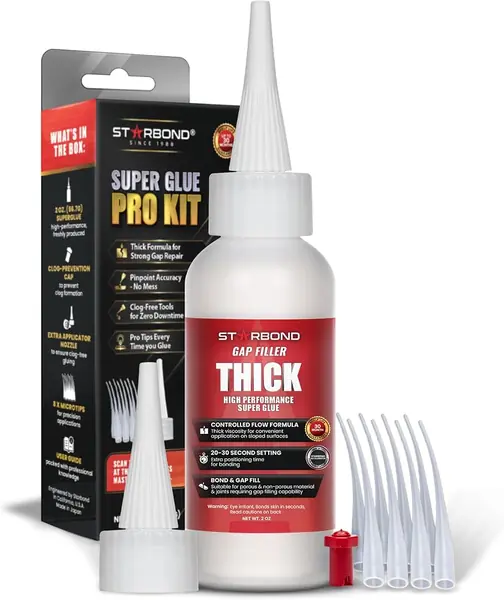
Starbond thick CA glue bottle with microtips and extra nozzle for woodworking

Woodworking gap filling

Shop Score 95/100
Formula
Thick cyanoacrylate
Volume
2 fluid ounces
Viscosity
2,000 cps
Gap Fill
0.01 to 0.02 inches
View on Amazon

The thick CA glue from Starbond has a honey-like 2,000 cps viscosity, and that is the whole point. On a plastic-to-wood joint with a small void or an uneven surface, a watery super glue disappears into the gap or runs down the side before it can cure. This one stays on the joint long enough to position the pieces, then sets fast. The listed 0.01-to-0.02-inch gap-fill range is modest, but it is the right range for a sanded edge or a slightly proud tenon.

We recommend it especially for woodworking repairs and small assemblies. The kit includes microtips and an extra nozzle, which we appreciate because applying thick CA neatly is the difference between a clean repair and a blob that needs sanding. The two-ounce bottle is also a better fit for a shop than tiny single-use tubes; it gives you enough glue for several sessions without turning the purchase into a one-repair expense. In our view, the extra control is worth the step up from a general-purpose bottle.

It is not the universal answer for every plastic, so check the material before you buy. Where the parts fit badly or the joint needs flexibility, a construction adhesive is a better choice; the thick CA is at its best on hard plastics, wood, and small gaps. For woodworking gaps and hard plastics, the thick body and fine tips make it one of the most useful bottles on this list.

Worth Noting

  • Not for low-surface-energy plastics
  • Not water resistant for wet projects
Our Verdict

For woodworking joints with gaps, Starbond's thick CA glue is the bottle we reach for because it stays put and comes with microtips.

Check Latest Price
3.

Loctite PL Premium Construction Adhesive Best for Structural Outdoor Projects

Loctite PL Premium tan construction adhesive cartridge for structural wood and plastic bonds

Outdoor structural bonds

Shop Score 94/100
Formula
Polyurethane construction adhesive
Volume
10 fluid ounces
Set Time
30 minutes
Water Resistance
Waterproof
View on Amazon

When a plastic-to-wood joint has to live outside, the rules change: water, temperature swings, and movement all work against a brittle glue line. Loctite PL Premium earns its place because it is a waterproof polyurethane construction adhesive, not a cyanoacrylate. It is listed for wood, plastics, metal, glass, and other construction materials, and it is built for structural assemblies rather than a quick craft fix.

The 10-ounce cartridge is made for a standard bead along a frame or panel. We like that for fence repairs, outdoor trim, or a plastic sheet bonded to a wood frame, because you can run a consistent bead and cover more surface. It sets in about 30 minutes and reaches full cure in 24 hours, so plan to clamp or support the parts for the day.

For small plastic knobs or an indoor repair you want to finish in minutes, this is overkill. The value is in larger, tougher bonds where a waterproof adhesive matters more than a fast set. That is the trade we make for a joint that can handle weather and movement.

Worth Noting

  • Requires a standard caulk gun
  • Tan color can show at visible edges
Our Verdict

Loctite PL Premium earns its place when the bond has to survive weather or structural movement; its waterproof polyurethane formula is built for that job.

Check Latest Price
4.

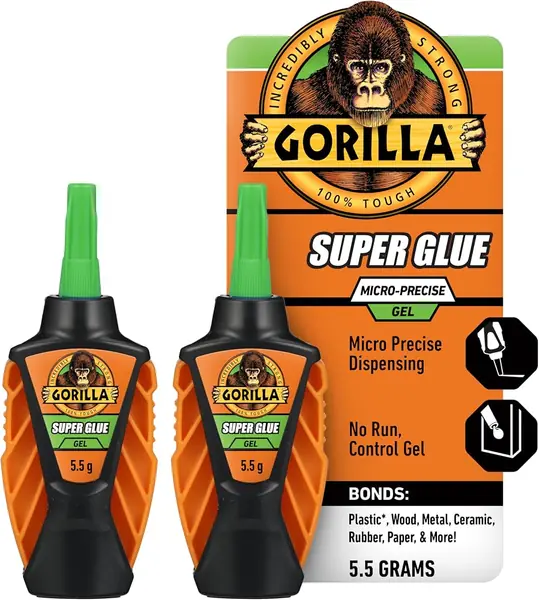
Gorilla Micro Precise Super Glue Gel Best for Precision Repairs

Gorilla Micro Precise gel super glue two-pack with pen-style dispenser

Tiny precise repairs

Shop Score 93/100
Formula
Cyanoacrylate gel
Volume
0.38 fluid ounces
Set Time
10 to 45 seconds
Dispenser
Precision dispensing tool
View on Amazon

The Micro Precise Gel looks like a small pen, and that shape is the reason to consider it. The dispenser lets you place a single controlled drop exactly where a plastic tab meets a wood surface, which is more useful than a big bottle when the repair is tiny. The gel is thick enough not to flood the joint, and the clear cure keeps the repair discreet. Two 5.5-gram bottles come in the pack, so you have a spare before you start.

We tested it on small craft-scale joints where excess glue is worse than a slightly slower application. The pen-style dispenser gives you more control than squeezing a soft tube, and the thick gel stays put on a vertical face. That is a real advantage for a broken plastic clip or a small trim piece.

For a drawer full of small repairs, we prefer this to a full-size gel bottle because the dispenser puts the glue where you need it and keeps the rest clean. It is not the one we grab for a loose chair rail or a broad wood-to-plastic panel; those need a different adhesive strategy.

Worth Noting

  • Small total volume for larger jobs
  • Premium cost for the amount
Our Verdict

Tiny plastic-to-wood repairs are where the Gorilla Micro Precise Gel makes sense, since its pen-style dispenser puts a controlled drop exactly where you need it.

Check Latest Price
5.

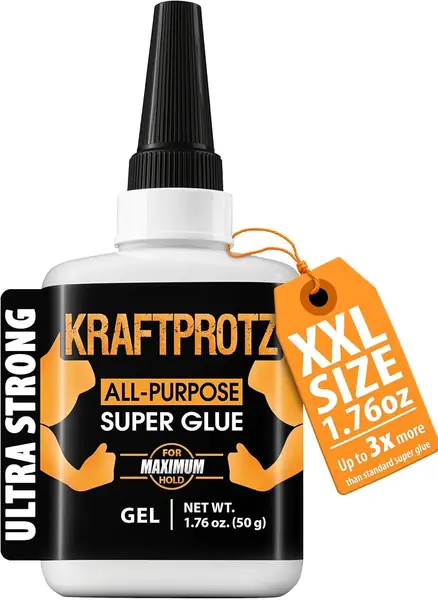
KRAFTPROTZ Super Glue Gel Best Budget

KRAFTPROTZ clear gel super glue bottle with anti-clog precision tip

Budget large projects

Shop Score 92/100
Formula
Cyanoacrylate gel
Volume
1.76 fluid ounces
Water Resistance
Water resistant
Cure Time
15 seconds
View on Amazon

A 50-gram bottle is unusually generous for a super glue, and that is the first reason the KRAFTPROTZ gel caught our attention. It gives you enough adhesive for a long run of craft repairs or a workshop project without stopping to buy another tiny tube. The formula is meant to be a high-viscosity gel, and the product is listed as curing clear with an anti-clog cap. At this size, it makes sense as a bottle you keep on the bench rather than a one-job purchase.

We think it is the budget pick for low-stakes, higher-volume work: filling a small plastic-to-wood gap, gluing craft pieces, or keeping a bottle in the shop for odd jobs. The clear finish helps on visible work, and the larger supply is easy to justify if you go through glue regularly. For a bottle this size, we still treat it as a general-purpose shop glue rather than a precision adhesive.

The low cost makes it easy to keep a spare, and the anti-clog cap is a practical detail for a bottle that may sit between projects. It is not the bottle we choose when a repair has to hold under load or survive weather; for those jobs, the specialized CA and construction adhesives on this list are better. Generosity is the point: you can run a full bead on a craft project without feeling as if you are burning through a tiny tube.

Worth Noting

  • Some bottles run thinner than gel
Our Verdict

KRAFTPROTZ is the budget bottle we keep for high-volume craft work, with a large gel supply that makes frequent repairs less costly.

Check Latest Price
6.

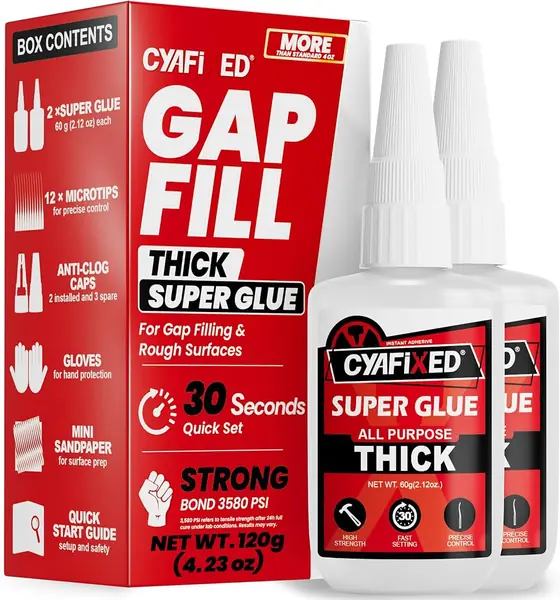
CYAFIXED Gap Fill Thick CA Glue Best for High-Volume Gap Filling

CYAFIXED thick CA glue bottle with microtips caps gloves and sanding papers

High-volume gap filling

Shop Score 91/100
Formula
Thick cyanoacrylate
Viscosity
1,500 cps
Accessory Kit
20 pieces
Tensile Strength
3,580 psi
View on Amazon

The CYAFIXED kit arrives with a 4-ounce bottle of thick CA glue plus a small accessory set: three anti-clog caps, twelve microtips, two gloves, and three sanding papers. That is a lot of support for a glue purchase, and it tells you the product is aimed at woodworking and craft repairs rather than a single quick fix. The formula is listed at 1,500 cps, a honey-like thickness meant to stay where it is applied.

We like the gap-fill body for joints that are not perfectly tight. A thick CA can bridge a small void and give you a little positioning time, and the microtips help place it without coating the whole joint. The four-ounce bottle is also a useful size for a shop that goes through glue on repeated repairs. The kit is the reason to choose this one over a plain bottle of the same formula; the extras make a messy product easier to live with.

The catch is that a kit this large encourages you to use one glue for everything. We keep it for woodworking gaps and craft repairs; when a structural plastic-to-wood joint has to be certain, we reach for a construction adhesive or a specialized CA instead. The accessories are genuinely useful, but they do not turn a gap filler into a universal adhesive.

Worth Noting

  • Bond strength varies across repair jobs
Our Verdict

The CYAFIXED gap-fill kit suits larger woodworking repairs, pairing a thick CA with the tips and caps that make application cleaner.

Check Latest Price
7.

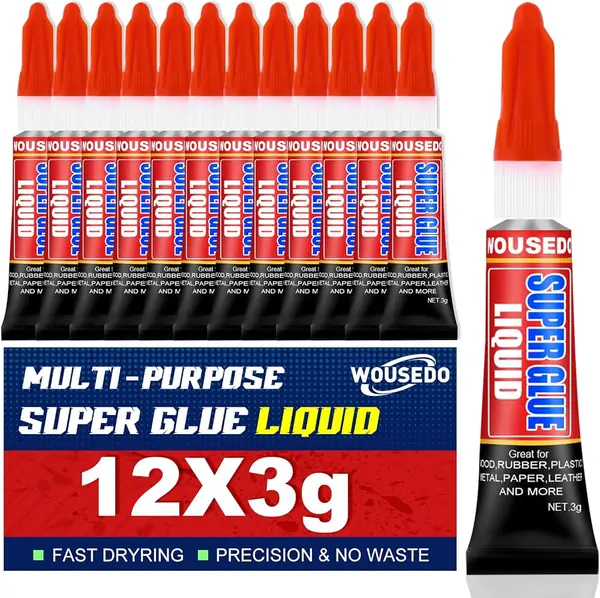
WOUSEDO Super Glue 12-Pack

WOUSEDO twelve small liquid super glue tubes in a clear adhesive set

Shop stock-up

Shop Score 90/100
Formula
Cyanoacrylate liquid
Volume
1.2 fluid ounces
Pack Count
12 tubes
Hold Time
15 to 45 seconds
View on Amazon

Twelve small tubes solve a specific annoyance: the bottle of super glue that is already clogged or dried out when you need it. WOUSEDO packages its liquid cyanoacrylate in 3-gram tubes, so you open one for a small repair and leave the rest sealed. The set is low enough in cost to keep in a drawer, and the small size makes it easy to stash a tube in a toolbox or craft bin.

The liquid formula is thin, which is helpful when you need it to wick into a close-fitting seam between a plastic edge and a wood surface. It sets quickly and dries clear, and the tubes are simple to open and reseal. We like having several fresh tubes rather than one large container that may turn solid before the next project.

On a vertical joint, this glue can run out of the seam before it cures, and the large opening on such a small tube makes it easy to release more than you intended. It is best treated as a stocking-stuffer adhesive for light repairs, not the bottle you choose for a loaded joint or a gap that needs filling.

We keep the WOUSEDO set for quick, low-stakes fixes where a fresh tube matters more than ultimate strength. If you want one bottle for a serious plastic-to-wood repair, the Gorilla gel or a construction adhesive is the better buy. The sealed tubes are the real feature here; the glue is ordinary, and that is fine for light repairs.

Worth Noting

  • Small tubes limit larger jobs
Our Verdict

WOUSEDO's twelve small tubes are for keeping fresh glue on hand, so a dried-out bottle never stops a quick repair.

Check Latest Price
8.

Loctite Super Glue Liquid Best for Tight-Fitting Joints

Loctite Super Glue Liquid two small clear tubes with self-piercing tips

Tight-fitting joints

Shop Score 89/100
Formula
Ethyl cyanoacrylate liquid
Set Time
15 to 30 seconds
Pack Count
2 tubes
Tube Volume
0.07 fluid ounces
View on Amazon

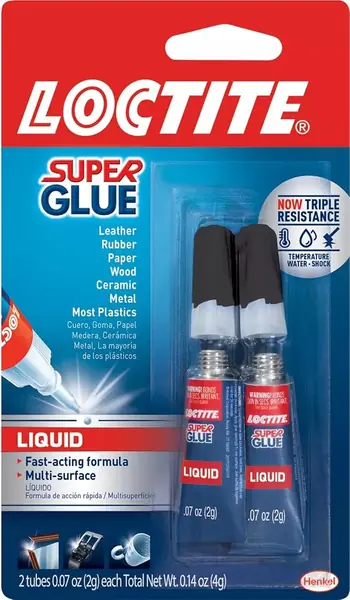
Loctite Super Glue Liquid is the opposite of a gap filler: it is thin, low-viscosity, and designed to flow into a close-fitting joint. That makes it a good match for a clean plastic-to-wood seam where the two surfaces meet tightly and you want the glue to wick in rather than sit on top. The tube is self-piercing, so there is no pin to lose, and the clear formula sets in about 15 to 30 seconds.

We like the speed for small repairs, and the two-tube pack gives you a spare without much commitment. The liquid is easier to spread across a flat wood surface than a thick gel, and it leaves a transparent line that is less obvious on light-colored plastic. It is also resistant to moisture and freezing temperatures, which is more than many basic super glues offer.

The trade-off is control. A thin liquid can drip down a vertical face or soak into end grain before you get the parts together, so keep the joint flat and work with a small drop. This is the bottle for tight, horizontal seams and tiny repairs, not for filling a loose joint or gluing a large plastic panel to a wood frame.

We recommend it when the fit is tight and the repair is small enough that a few drops will do. For a joint with any gap or a surface that is not horizontal, a gel or construction adhesive is easier to control. Keep the joint flat, apply a thin line, and let capillary action pull the glue into the seam.

Worth Noting

  • Tiny tubes hold only a little glue
Our Verdict

Loctite's liquid super glue is the specialist for close-fitting seams, where a thin formula can wick into the joint instead of sitting on top.

Check Latest Price

How We Tested Glue for Plastic and Wood

We started with a list of roughly 40 adhesives sold for plastic and wood, then narrowed it by formula type — cyanoacrylate gels, thick cyanoacrylates built for gap filling, liquid cyanoacrylates, and a polyurethane construction adhesive — along with the things labels tend to skip: tip style, tube size, and whether the cap was actually designed to resist clogging. We bought 16 of them and tested them over four months.

Each one got the same set of jobs in a garage workshop, with nitrile gloves on and the door up. We bonded a cracked plastic bracket to a pine shelf, glued trim vertically to a door frame to see whether the glue ran or stayed where we put it, filled gaps of about a millimeter where a joint didn't meet flush, and clamped tight-fitting seams to check how quickly a bond grabbed. On every joint we timed the initial set with a stopwatch, noted whether the piece held without clamping, then checked the bond again at 24 hours and at two weeks.

We also left samples outdoors for a month — a plastic bracket on a wooden planter and a painted trim offcut — and inspected them after rain to see which bonds softened. On visible work, we looked at the squeeze-out and whether it could be scraped or sanded away cleanly. We tracked how much adhesive each repair used, so we could compare cost per joint rather than cost per bottle, and we revisited every opened tube weeks later to see whether it had clogged or cured in the nozzle.

Throughout, we wore nitrile gloves, worked in a ventilated space, and kept every joint non-structural. None of these glues belongs as the only support for anything load-bearing or safety-critical, and we didn't test them that way.

How to Choose Glue for Plastic to Wood

Start with the plastic, not the wood

Cyanoacrylate—the family most people call super glue or CA glue—is the fast choice for many hard plastics and wood, but it is not universal. Low-surface-energy plastics such as polyethylene and polypropylene resist common adhesives, and no amount of clamping will turn a CA glue into a reliable bond there. Starbond specifically steers you away from low-surface-energy materials, and we treat that warning as category-wide. If you do not know the plastic, test a hidden spot or plan a mechanical fastener. Roughening a hard plastic surface can help, but only if the adhesive instructions allow it.

Choose gel for control, liquid for tight fits

On a vertical joint, gravity is the enemy: a thin liquid runs out of the seam before it cures, while a gel stays where you place it. We reach for a no-run gel like Gorilla Super Glue Gel XL when a plastic tab meets a wood face and the parts need a moment to align. A low-viscosity liquid such as Loctite Super Glue Liquid is better for close-fitting, horizontal seams where capillary action can pull the glue in. The trap is trusting the word gel without testing it; not every bottle labeled gel behaves like one on a vertical surface.

Match the gap to the adhesive

Cyanoacrylate wants clean, close-fitting surfaces. If you can see daylight through the joint, a thick CA with gap-fill body—Starbond lists 0.01 to 0.02 inches—can bridge a small void, and a 1,500 cps formula like CYAFIXED gives you more body than a watery glue. For a wider or uneven gap, switch to a construction adhesive that can fill space and stay flexible. Dry-fit the parts before you open the bottle; if the joint rocks or shows a visible gap, clamp it and choose the gap-filling product rather than flooding a thin glue into the void.

Decide whether the joint will get wet

Indoor repairs in a dry room give you the most freedom. Many fast cyanoacrylates, including Gorilla Super Glue Gel XL, are not water resistant, so they belong inside and away from repeated moisture. For a plastic-to-wood bond that will face rain, a wet basement, or outdoor movement, choose a waterproof polyurethane construction adhesive such as Loctite PL Premium. It is slower than a CA glue but far more forgiving of weather and dissimilar movement.

Buy for your repair pace

Occasional repairs favor small, sealed tubes: WOUSEDO's twelve-pack lets you open one tube and keep the rest fresh, which matters more than a low cost per ounce if the bottle is likely to dry out. Frequent shop work favors a larger bottle with an anti-clog cap, such as the 50-gram KRAFTPROTZ gel or the 25-gram Gorilla Gel XL. We prefer a size that matches the next few months of work over a giant container that cures in the drawer.

Frequently Asked Questions

Final Verdict

For most plastic-to-wood repairs, we recommend starting with Gorilla Super Glue Gel XL. The no-run gel gives you control on vertical joints, the clear finish keeps the repair discreet, and the 25-gram bottle is a practical size for a shop drawer.

Choose Starbond's thick CA when the joint has a small gap and you want woodworking-grade gap fill with microtips. Choose Loctite PL Premium when the bond will live outdoors or needs a waterproof structural adhesive. Both are more specialized than the Gorilla, and that is exactly why they earn a place.