↑↓ navigate ↵ open Esc close All results →

Best Glues for Wood to Concrete of 2026

Gluing a furring strip to a basement wall only to find it lying on the slab the next morning is a classic masonry failure mode. Concrete is dusty, uneven, and alkaline, and general-purpose "heavy duty" adhesives rarely hold unless the substrate is cleaned and the chemistry is actually rated for masonry.

Four months of testing 16 construction adhesives on below-grade walls and wet exterior stoops showed that back-label compatibility outranks front-label marketing. Formulas listing concrete handle surface alkalinity, flexible cured beads absorb seasonal wood movement better than rigid ones, and gun-grade cartridges speed up long framing runs compared with squeeze tubes.

Open times range from 30-second instant grab to 20-minute slide windows for dialing in plumb lines, which determines how much temporary bracing a wall job requires.

Our Top Picks

The Best Glues for Wood to Concrete

1.

Loctite PL Premium Max Best Overall
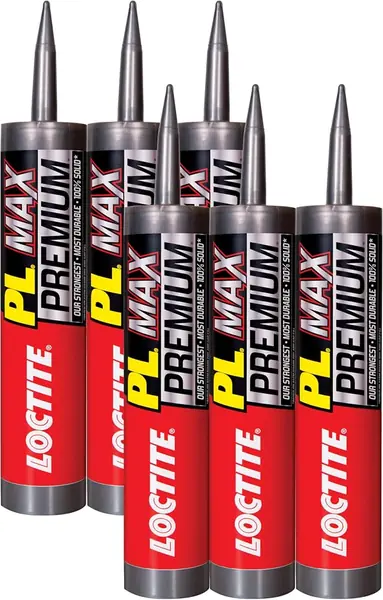
Loctite PL Premium Max gray polyurethane construction adhesive, six 9-ounce cartridges

Exterior wood-to-masonry joints

Shop Score 92/100
Cartridge Volume
9 fluid ounces
Water Resistance
Waterproof
Pack Size
6 cartridges
Repositioning Time
20 minutes
View on Amazon

Wood on a concrete wall is a joint with two problems: the concrete does not move and the wood does, and outdoors there is water in the argument as well. Loctite PL Premium Max is where we start because it answers all three on its own label — wood, concrete, brick, masonry and stone are all named as bonded materials, and the cured bead is waterproof. When someone asks us what to buy for a wood-to-concrete repair, that combination is the reason for the recommendation.

The formula is a high-solids polyurethane, which is the practical difference between this and a cheaper tube. It cures to a solid instead of shrinking back as a carrier evaporates, so the joint does not open up the way a shrinking bead will. You get roughly twenty minutes to reposition, the number that matters when you are fitting a sill or a ledger and checking it against a level, and it will go onto wet or frozen surfaces from 10°F to 120°F.

It is a thick bead, so plan on a real caulk gun rather than a squeeze tube; expect the last third of a cartridge to take some hand strength. Shelf life is the other thing we watch with any polyurethane — buy what a project will use instead of stockpiling, and check the date stamped on the cartridge before you cut the tip.

The six-pack is the honest frame for the decision: this is a project-sized purchase, not a repair-sized one. Load it for a deck, a stair run or a season of exterior fixes, and keep a single tube of something cheaper for the loose step you notice on a Saturday. Where the joint is outside and meant to stay, this is the one we reach for.

Worth Noting

  • Six-cartridge pack is more than one repair needs
Our Verdict

We start here for wood on concrete outdoors: it is the pick that names concrete, brick and masonry and still tolerates wet or frozen surfaces.

Check Latest Price

2.

Gorilla Heavy Duty Construction Adhesive Best Fast Grab

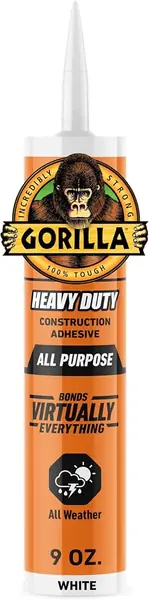
Gorilla Heavy Duty Construction Adhesive white cartridge, 9 ounces, indoor and outdoor use

Fast vertical installations

Shop Score 91/100
Cartridge Volume
9 fluid ounces
Full Cure Time
24 hours
Working Time
10 minutes
Grab Time
30 seconds
View on Amazon

Thirty seconds is how long this bead takes to grab, and on a vertical run that number is worth more than any strength rating on the tube. Press a panel or a piece of trim against the wall and it stays there while you find the next fastener. Gorilla gives you about ten minutes of working time after that, so there is a short window to slide the piece into line before it locks.

Where we like it most is the work you do alone — overhead, on a ladder, with no third hand available for a clamp. The formula is gap-filling, so it bridges the roughness of a brick or block face instead of starving the joint on the high spots, and it sands and paints, which matters when the wood side is prefinished. It is also fully waterproof and rated through temperature swings, so a wet winter does not undo the work.

Put it in a good caulk gun. The cartridge is stiff enough that hand-squeezing is a losing fight, and a steady gun gives you a cleaner bead with less squeeze-out to wipe. On a poured concrete wall we go to the top pick, whose material list names concrete outright; this one earns its place on brick, subfloor, trim and panels, and on any joint that has to hold itself while it sets.

Worth Noting

  • Material list stops short of naming concrete
Our Verdict

The cartridge we suggest for anyone working alone: thirty seconds of grab means a piece holds itself while you get a fastener in, indoors or out.

Check Latest Price
3.

Liquid Nails Heavy Duty Construction Adhesive Best Budget

Liquid Nails Heavy Duty Construction Adhesive tan cartridge, 10 ounces

Budget repair work

Shop Score 90/100
Cartridge Volume
10 fluid ounces
Water Resistance
Waterproof
Working Time
10 minutes
Coverage
30+ linear feet with a 1/4-inch bead
View on Amazon

The lowest price per cartridge in this group is the argument for Liquid Nails, and we think it is a good one: a tube that lives on the shelf means the loose step or the shimmed furring strip gets fixed the day you notice it, not the next time you are at the hardware store.

What that money buys is a heavy-duty formula with ten minutes of working time, enough gap bridging to sit on a rough block face, and coverage of about 30 linear feet at a quarter-inch bead — more than most household repairs will use. Concrete and brick veneer are named on the label, and it meets ASTM C-557, so there is no guesswork about whether it belongs on masonry. Flat, clean, dry surfaces and an overnight cure are the conditions it wants.

Treat this as the repair adhesive rather than the structural one. Wire-brush the concrete, wipe the dust off, and clamp or weight the piece instead of trusting the bead to hold it while it sets. Check the consistency on a scrap before you commit a cartridge — a tube that runs thin is not the tan heavy-duty formula we want behind a stair tread.

Worth Noting

  • Weakest hold of these picks on smooth concrete
Our Verdict

For a small dry repair this is the tube we reach for: it names concrete on the label, bridges gaps and costs the least of anything here.

Check Latest Price
4.

SikaBond Construction Adhesive Best for Outdoor Flexibility

SikaBond waterproof polyurethane construction adhesive, gray 10.1 fluid ounce cartridge

Moving exterior joints

Shop Score 89/100
Cartridge Volume
10.1 fluid ounces
Water Resistance
Waterproof
Full Cure Time
5 to 7 days
Tensile Strength
225 psi
View on Amazon

Permanently elastic is the phrase that sells SikaBond, and it is also the reason to think before you buy it. A bead that flexes is exactly right for a door sill, a paver cap or a piece of trim on a wall that moves with the seasons, and exactly wrong where you want the assembly to behave like one solid piece.

The case for it is weather. It cures waterproof and can be immersed once fully cured, it resists shrinking and cracking, and it takes water-, oil- or rubber-based paint, so a cap or a veneer detail can be coated and forgotten. Sika's own list of uses — masonry veneer, paver caps, floor mouldings, door sills — is a fair description of where a flexible wood-to-masonry joint belongs.

The schedule is the catch. Full cure runs five to seven days, the longest of the picks here, so plan on bracing or clamping well past the point where you are tempted to load the joint. On an exterior sill that is a day or two of clamps plus a week of not leaning on it, which is worth knowing before you start.

For an exterior joint that expands and contracts, we make that trade without hesitation. A bead that stays pliable and keeps water out of the seam is worth more than a stronger number on a label that cracks at the first hard freeze. Where the connection has to be rigid and carry a load, we go back to the top pick and add a mechanical fastener.

Worth Noting

  • Lowest stated tensile of these cartridge adhesives
Our Verdict

Choose this when the joint has to move with the weather; we accept its slow cure and modest tensile for a bead that stays sealed and pliable.

Check Latest Price
5.

Loctite Power Grab Ultimate Best Clear Finish

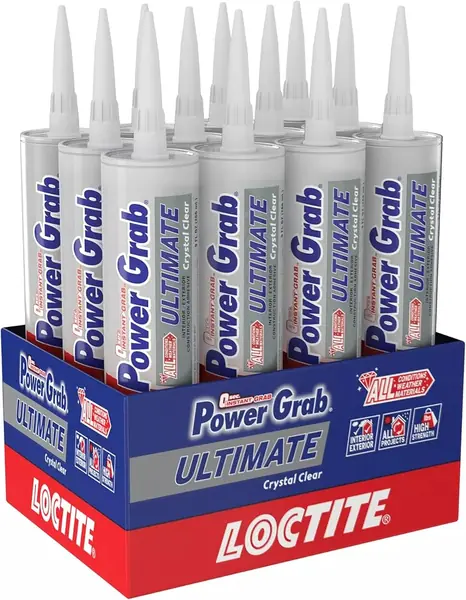
Loctite Power Grab Ultimate clear construction adhesive, case of twelve 9-ounce cartridges

Visible interior joints

Shop Score 88/100
Cartridge Volume
9 fluid ounces
Pack Size
12 cartridges
Tensile Strength
1500 psi
Set Time
10 minutes
View on Amazon

Twelve cartridges is a working quantity rather than a weekend one, and that is the right frame for Power Grab Ultimate: it is the clear adhesive a shop buys when a job has a long run of visible wood-to-masonry seams to close.

Two things earn it a place. The stated tensile is 1500 psi, the highest figure any cartridge adhesive here publishes, and it sets in ten minutes and cures in a day. The other is the clear cure: a rail on a concrete wall, a panel on a brick face or a trim return can be bonded without a gray or tan line advertising the repair. It also bonds two non-porous surfaces and will go on in wet conditions, which most construction adhesives will not claim.

We like it where appearance is part of the job — an interior wall, a stringer face, anything a client will look at. It is also a shop's purchase: a dozen visible joints justify a case and a single loose rail does not, so we treat it as the tube that comes out when a project has a run of clear seams rather than a one-off repair.

Worth Noting

  • Rated water resistant rather than waterproof
Our Verdict

We specify it for visible joints: clear, 1500 psi stated tensile and a ten-minute set, as long as a case of twelve suits the job.

Check Latest Price
6.

Bostik Grip n Grab Best for Overhead and Vertical

Bostik Grip n Grab white hybrid polymer adhesive cartridge, 9.5 ounces

Overhead and vertical

Shop Score 87/100
Cartridge Volume
9.5 fluid ounces
Water Resistance
Waterproof
VOC Content
Under 15 g/L
Application Temperature
0°F to 105°F
View on Amazon

Holding a heavy board against a block wall with one hand while the other hunts for a screw is the moment Grip n Grab is built for. The hybrid polymer grabs on contact, so the piece stays where you put it and your hands are free to check plumb before anything sets.

It cures into a durable elastic rubber under humidity, takes weather from 0°F to 105°F, and is fully waterproof, so an exterior bracket or a thin brick detail is inside its range. The solvent-free, low-VOC formula is the part that matters indoors: this is a bead you can run in a basement without propping the door open all afternoon.

We treat it as a specialist rather than an everyday tube. Holding heavy material on a vertical face long enough to fasten it is exactly where clamps and props fail, and that is the job we keep it for; for a flat, load-bearing wood-to-concrete joint we go to the cartridges with an explicit concrete listing.

Worth Noting

  • Small 9.5-ounce cartridge runs out fast
Our Verdict

Instant grab is what we are buying here, and it is enough to hold a heavy board while you line it up and fasten it.

Check Latest Price
7.

Gorilla Original Glue Best for Clamped Exterior Repairs

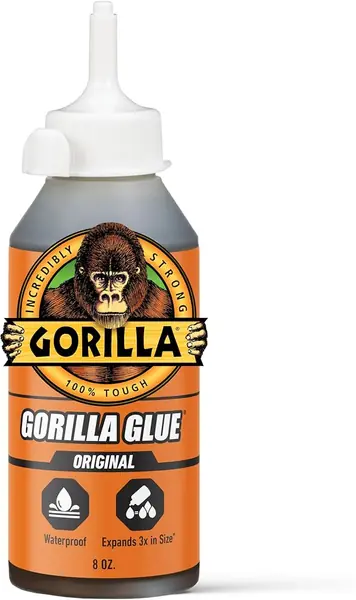
Gorilla Original polyurethane glue, brown, 8-ounce bottle

Clamped exterior repairs

Shop Score 86/100
Water Resistance
Waterproof
Full Cure Time
24 hours
Expansion
3 times into materials
Bottle Volume
8 fluid ounces
View on Amazon

The foam is the detail that decides whether Gorilla Original suits a wood-to-concrete joint. The polyurethane expands about three times its bead volume as it cures, working into the pores of a rough block or weathered end grain. That is useful where the two faces do not meet perfectly, and unwelcome anywhere a ridge of foam squeezing out would be visible.

We reach for the bottle on exterior repairs where the wood is small and the masonry is rough, because the foam works into the surface instead of sitting on it. It is fully waterproof, it lists concrete and stone among the materials it bonds, and it holds through heat and cold. It is the one we choose when the repair is exterior and the faces are rough enough that a straight bead would starve.

Worth Noting

  • Needs clamping and a dampened surface to cure
Our Verdict

Our pick for small exterior repairs on rough masonry, provided you can clamp the joint overnight and trim the foam the next day.

Check Latest Price

How We Tested Wood-to-Concrete Adhesives

We started with labels, not marketing copy. Anything that didn't name concrete, brick, or masonry in its documentation was set aside, along with formulas whose stated application temperature range ruled out an unheated garage. From there we pulled together 16 products spanning rigid and flexible chemistries, cartridge and squeeze-bottle formats, and a spread of prices, and we kept using them for four months.

Joints went up on a poured basement wall, a garage wall, an exterior stoop, and one visible interior patch where a clear bead mattered. We scrubbed and damp-wiped some concrete and deliberately left other patches dusty to see which formulas could bridge a rough, gritty surface. Every joint on anything overhead or load-bearing got screws or bolts in addition to adhesive, and we wore gloves any time a polyurethane bottle came out.

For each product we counted the seconds until a vertical board held on its own, timed how long it could still be nudged into place, and wrote down how much tape or clamping the joint demanded. We laid a quarter-inch bead on sample blocks to measure coverage per cartridge and cost per linear foot, cranked manual guns until our forearms ached, and noted which tubes strung, dripped, or skinned over mid-run.

Then we waited. Joints sat through cure times that ran from a day to a week before we pried and hammered them apart to see whether the bead snapped clean or stretched. Exterior samples went through rain and standing water; interior ones were checked for solvent smell in a closed basement, then trimmed, sanded, and painted so we knew how the squeeze-out cleaned up. We also recorded shelf-life dates, since a single block repair can leave most of a tube behind.

How to Choose a Glue for Wood to Concrete

Pick the adhesive family first

Three families cover this job. Cartridge construction adhesives — polyurethane, hybrid polymer and the better solvent-based formulas — are the workhorses for flat wood-to-masonry contact, and they bridge the small gaps a sawn board never quite closes against a wall. Polyurethane bottle glue such as Gorilla Original is for smaller exterior repairs where the faces are rough and you can clamp the piece. Two-part epoxy belongs to tight, rigid, small-area repairs where you want the joint to behave like one solid piece.

We start every wood-to-concrete question with a cartridge and move off it only when the job is small or the surfaces meet perfectly. Epoxy is strong but unforgiving of a gap, and a bottle glue needs clamping pressure in a way a cartridge does not.

Check that concrete is on the label

Multi-surface and all-purpose sound universal and are not. Before you buy, find concrete, brick or masonry in the manufacturer's own materials list — a glue built for wood and drywall can hold for a season and let go at the first freeze-thaw. Read the conditions line as carefully as the materials line: an interior-only formula has no business on a porch, and the temperature range tells you when a cartridge will refuse to cure. A bead applied at 35°F to a product rated from 40°F is a bead you will be scraping off in spring.

Choose rigid or flexible on purpose

Rigid adhesives hold a joint that must not creep. Flexible polyurethanes and hybrid polymers absorb the movement between a board and a wall that expands and contracts, which is why we take flexibility almost every time on anything outdoors. Indoors, on a flat sill or a bearing surface, rigidity is an advantage rather than a risk. Match the choice to what the joint will live through, not to the largest number printed on the tube.

Plan for grab, bracing and working time

Every adhesive here needs some form of support while it sets; what differs is how long you have to adjust the piece and how much help it gives you. A ten- or twenty-minute working time lets you fit a rail and check it against a level. A thirty-second grab means the piece stays where you put it, which is a gift on a ladder and a nuisance if you fitted it crooked. Dry-fit anything that will go overhead, and have more clamps on hand than you think you need.

Do the math on coverage and shelf life

A ten-ounce cartridge lays about 30 linear feet of quarter-inch bead, which is more than most repairs need and less than a deck run will consume. Buy for the project in front of you: one mid-range tube for a single repair beats a case of premium cartridges for a job that will take two. Then store what is left cool and tip-down, and check the date before you cut a tip — a stiff, half-cured tube is a bad first impression of a good adhesive.

Frequently Asked Questions

Final Verdict

Start with Loctite PL Premium Max. Its material list reads like the job itself — wood, concrete, brick, masonry, stone — and the waterproof, wet-surface cure covers what a real exterior repair meets. It is the one we recommend without a caveat beyond buying it in project quantities.

For a small, dry repair, Liquid Nails does the same work for far less, and SikaBond is the better answer on an exterior joint that has to move. Buy the six-pack when a project justifies it and a single cartridge when it does not; the right tube is the one sized to the job.