↑↓ navigate ↵ open Esc close All results →

Best High-Gloss Wood Finishes of 2026

High-gloss finish is the most unforgiving coat a woodworker can apply: sand a tabletop to 220 grit, brush on gloss, and every faint swirl reflects straight back from the surface. Because sheen relies on dead-flat leveling, the right topcoat bridges sanding lines, stays water-clear over pale maple without ambering, and cures hard enough to shrug off keys and a wet glass.

Over nine months of evaluating 12 gloss finishes—water-based, oil-based, lacquer, and friction polish—across maple, walnut, and oak offcuts alongside a cabinet door, a floor patch, and lathe spindles, recoat timing and ventilation needs quickly split the field. Low-odor water-based half-pints work comfortably indoors, while solvent lacquers and oil urethanes belong in a ventilated garage.

Spanning brush-on cans, wipe-on formulas, aerosols, and rag-applied lathe polish from small project tins to gallon containers for built-ins, these seven topcoats leveled smoothly and dried clear across both light and dark species.

Our Top Picks

The Best High-Gloss Wood Finishes

1.

Minwax Polycrylic Gloss Best Overall
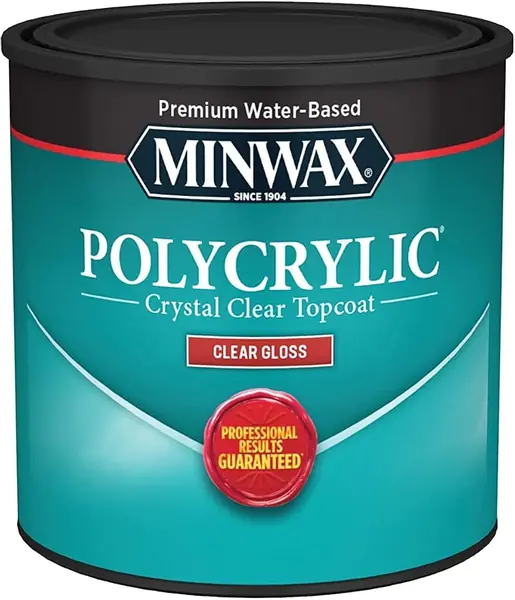
Minwax Polycrylic clear gloss water-based wood finish in a half-pint can

Pale wood furniture

Shop Score 96/100
Finish
Gloss
Size
8 fl oz (1/2 pint)
Base
Water-based
Recoat Time
2 hours
View on Amazon

Pale woods are where most gloss topcoats give themselves away. An oil-based film turns maple and ash honey-colored within a season, and the mirror you paid for ends up reflecting a color the wood never had. Polycrylic goes on milky and dries water-clear — we brushed it over a maple panel beside an oil-based coat and the difference was the entire argument. It also works over both oil-based and water-based stain, so it serves as the last step on a project that is already colored.

Brushing it is about as forgiving as a gloss film gets. Two hours between coats means a weekend project actually finishes in a weekend, where an oil-based poly stretches the same three coats across two days. Cleanup is soap and water at the sink instead of a solvent soak, and there is no strong smell driving you out of the shop — which counts for more in a basement or a spare room than any spec sheet admits.

What the gloss demands is prep. Every sanding scratch and dust nib shows in a mirror film, so sand to a uniform grit, raise the grain if you are going water-based over bare wood, and tack off before the first coat. Do that and this is the brightest, cleanest finish in this group on light-colored wood. Skip it and the finish will tell on you.

Worth Noting

  • Half-pint can is small for furniture-size projects
Our Verdict

Our default gloss for interior furniture: it stays water-clear over maple and ash, brushes out easily, and takes a second coat in two hours.

Check Latest Price
2.

General Finishes Arm-R-Seal Gloss Best for Hard-Wear Furniture

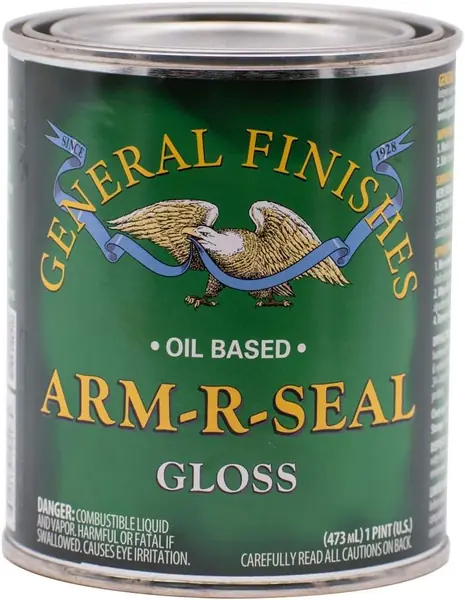
General Finishes Arm-R-Seal gloss oil-based topcoat in a one-pint can

Hard-wear tabletops

Shop Score 95/100
Finish
Gloss
Size
1 pint (16 fl oz)
Base
Oil-based urethane
Application
Wipe-on cloth or foam brush
View on Amazon

Nothing else here applies like Arm-R-Seal. There is no wet film to load and chase level with a brush: it goes on with a soft cloth or a foam brush in thin passes, closer to oiling a gunstock than varnishing a door. That sounds fussier than it is, and it turns out to be the reason the finish comes out so flat.

We have come to trust it on anything that gets handled: dining tables, desk tops, bar rails, a coffee table that takes feet. The urethane film is hard and water-resistant, and it builds a warm depth the water-based clears cannot touch. The slower set is a gift rather than a fault — it stays open long enough to level itself, so thin coats flatten out with almost nothing to sand back.

The amber is the trade, and it is one we are happy to make: on walnut, oak, and cherry it reads as richness, while on maple or ash it is a color change you may not want. Work thin, keep the cloth moving in one direction, and stop once the surface starts to tack; that is where streaks come from. On a white-painted piece, skip it and use the water-based clear instead.

Worth Noting

  • Premium price for a single pint
Our Verdict

For a tabletop that takes daily abuse, we pick this oil-based urethane: it wipes on thin, levels flat, and builds a hard, deep gloss.

Check Latest Price
3.

Varathane Triple Thick Gloss Best One-Coat Coverage

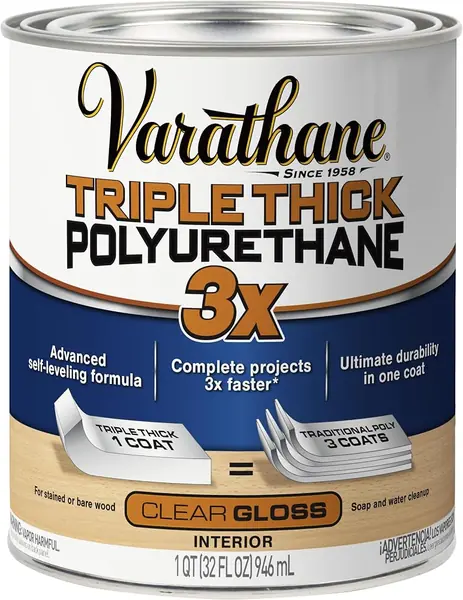
Varathane Triple Thick gloss polyurethane in a one-quart can

Large flat panels

Shop Score 94/100
Finish
Gloss
Size
1 quart (32 fl oz)
Coverage
50 square feet
Dry To Touch
2 hours
View on Amazon

A quart that covers about fifty square feet, a film three times thicker than the company's standard water-based poly, and a two-hour touch-dry: this is the finish for a project bigger than your patience. The liquid comes out noticeably heavier than a normal water-based poly — closer to thin syrup — and it flows out over the surface instead of soaking straight in.

It brushes on with a synthetic-bristle brush and cleans up with water, and the low odor makes it easy to live with in a closed shop. Give it 48 hours before you set anything on the surface and a full week to cure; that week is the least forgiving part of the schedule. Two hours to the touch is what makes a second pass practical the same day.

Where we like it most is a run of cabinet doors or a long shelf, where one heavy self-leveling pass beats three thin ones. It is not the hardest film in this group — a tabletop that takes daily abuse is better served by the oil-based pick above. Keep the brush moving in one direction and do not go back over a pass that has started to set; the thickness that saves you a coat is also what traps bubbles.

Worth Noting

  • Label keeps it off floors and outdoor projects
  • Adds a soft amber cast to bare wood
Our Verdict

When a big flat panel needs a gloss film in a hurry, this one-coat water-based poly does the work of three passes with soap-and-water cleanup.

Check Latest Price
4.

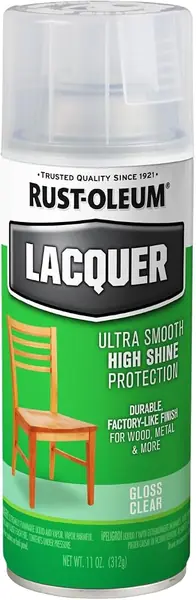
Rust-Oleum Lacquer Clear Spray Best Spray Finish

Rust-Oleum clear gloss lacquer in an 11-ounce aerosol spray can

Small parts

Shop Score 93/100
Finish
Gloss
Dry To Touch
20 minutes
Form
11 oz aerosol
Surfaces
Wood, metal, masonry, ceramic
View on Amazon

Twenty minutes to the touch is the number that earns this can a place in our shop. Lacquer does not cure so much as flash off, so you can lay a pass, come back after a coffee, sand it, and lay another — and that sand-and-recoat cycle is how a spray finish gets a flat, deep, factory gloss instead of a plasticky film with orange-peel texture.

Being an aerosol, it reaches what a brush cannot: turnings, routed edges, the inside of a small box, a repaired corner that needs to blend. Build several thin passes rather than one wet one, and sand lightly between them if you want the highest sheen the can will give. What you give up is film thickness. A lacquer coat is thin and does not shrug off a wet glass the way a urethane does, so keep it for decorative and light-duty surfaces.

Worth Noting

  • Solvent fumes need real cross-ventilation
  • A can covers only a small project
Our Verdict

The fastest route to a factory-smooth gloss on small parts: twenty minutes to the touch and sandable between passes, no gun or compressor needed.

Check Latest Price
5.

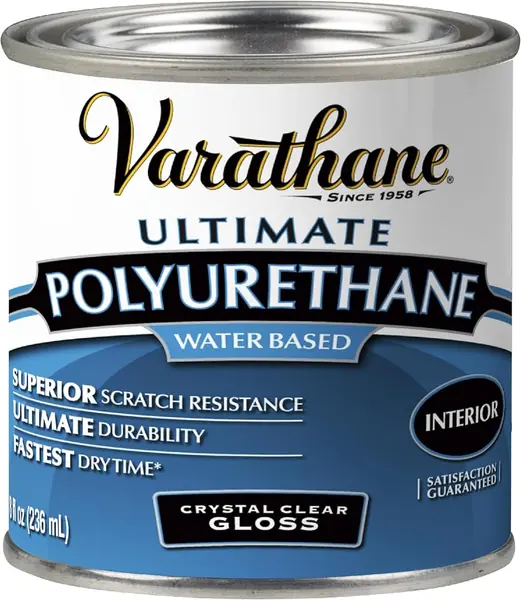
Varathane Ultimate Gloss Polyurethane Best Low-Odor Option

Varathane Ultimate gloss water-based polyurethane in a half-pint can

Indoor furniture

Shop Score 92/100
Finish
Gloss
Size
8 fl oz (1/2 pint)
Base
Water-based
Coverage
Up to 62 sq ft
View on Amazon

If your shop is half a garage or a corner of the basement, the smell decides as much as the sheen does. This one goes on milky and settles clear with barely anything in the air, which is the difference between finishing a bookcase tonight and waiting for a warm day with the door open.

Clarity is the other reason we keep it on the shelf. Over bare maple the gloss comes up glassy and colorless, so the sheen is the only thing you notice, and the half pint claims coverage up to 62 square feet — a chair, a small table, or a run of trim. It brushes out smoothly, cleans up with soap and water, and does not push you out of the room while it sets.

Sanding between coats is where the gloss comes from with any water-based clear, and this one knits its layers well: two or three thin passes with a light scuff of 320 between them, and the last coat lays out flat. Build it slow and it reads like glass over a pale wood; rush a heavy coat and it will show every pass of the brush.

Worth Noting

  • Can chip and scratch under hard use
Our Verdict

The gloss we reach for when the work has to happen indoors: a colorless water-based clear with almost no smell while it is wet.

Check Latest Price
6.

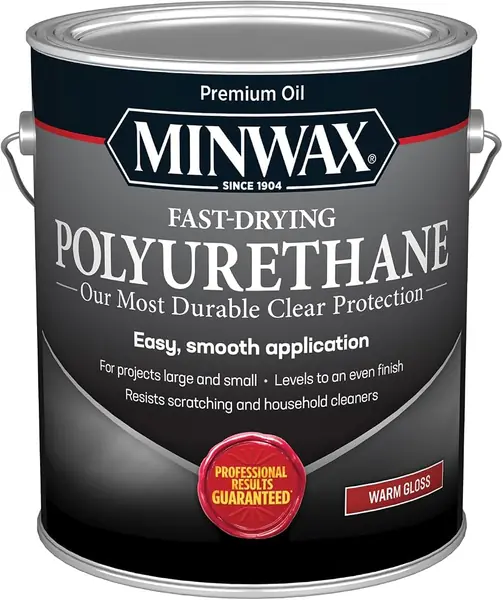
Minwax Fast Drying Polyurethane Gloss Best for Floors and Built-Ins

Minwax Fast Drying Polyurethane gloss finish in a one-gallon can

Floors and built-ins

Shop Score 91/100
Finish
Gloss
Size
1 gallon (128 fl oz)
Coverage
600 sq ft
Recoat Time
4 to 6 hours
View on Amazon

Six hundred square feet from one can is the number that matters here. A gallon of gloss oil-based poly is what a floor, a stair run, or a wall of built-ins actually takes, and buying that job by the half pint is how a weekend turns into three trips to the store.

It is an oil-based film, so it goes on amber and stays warm — it deepens oak and pine instead of sitting on top of them like a sheet of plastic — and it sands to a powder between coats rather than gumming up the paper. Plan a full day for three coats, and stay off the surface until the label's cure time has passed.

The gloss is genuinely mirror-like on a well-prepped surface, and it hides nothing. Work up through the grits, vacuum, tack off, and the film will read as a mirror; skip a step and it will read as a map of your shortcuts. On a bench top or stair treads, that hardness is the point.

This is the can we buy when the job is a whole room and the wood is oak, pine, or walnut. On maple and ash the amber reads as a stain you did not choose, so reach for the water-based clear instead. For everything else — floors, built-ins, shop furniture that gets dragged across a concrete floor — the gallon is the practical answer.

Worth Noting

  • Four-to-six-hour recoat window slows the build
Our Verdict

For floors and big flatwork, a gallon of oil-based gloss that covers 600 square feet is the practical buy — tough, warm, and slow enough to level.

Check Latest Price
7.

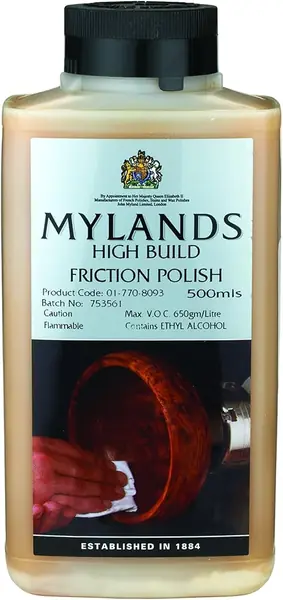
Mylands High Build Friction Polish Best for Lathe Turnings

Mylands High Build Friction Polish in a 500-milliliter bottle

Lathe turnings

Shop Score 90/100
Finish
High gloss over cellulose sealer
Size
500 ml
Application
Cloth on a spinning lathe
Dry Time
Almost instant
View on Amazon

Friction polish is the one finish here you apply with the lathe running. A cloth loaded with it goes against the spinning work, the friction warms the surface, and the film sets almost as it touches. It is a different craft from brushing a panel, and it rewards a light hand and a fast cloth.

It builds quickly — several coats in a couple of minutes rather than a couple of hours — and it dries almost instantly, so there is no dust settling into a wet film while you wait. On its own it leaves a smooth sheen. Lay a cellulose sealer first and the same routine finishes brilliant, which is how a pen barrel or a bowl rim ends up looking wet.

For small turned work, nothing else here gets to a gloss this fast, and a bottle goes a long way on pen blanks. It is not a panel finish: on flat work there is no friction to generate the heat the product depends on, so keep it at the lathe. And do not expect it to protect like a urethane — a pen or a bowl rim, yes; a tabletop, no.

Worth Noting

  • Wide bottle mouth makes over-pouring easy
Our Verdict

For pens, bowls, and handles, nothing here builds a gloss faster: apply it on the spinning lathe and it is dry before you stop the motor.

Check Latest Price

How We Tested High-Gloss Wood Finishes

We built the shortlist from the label first, because the label decides whether a finish can go on your project at all — interior furniture only or floors, brush or spray or wipe, and the recoat window you have to plan an afternoon around. From there we gathered 12 gloss finishes in water-based, oil-based, lacquer, aerosol, and friction formulas, favoring containers sized to a real project rather than a warehouse shelf, and tested them over nine months.

Each one went onto maple, walnut, and oak panels sanded to 220 and wiped with a tack cloth, plus a cabinet door, a patched strip of floor, and a few spindles on the lathe.

We applied them the way their labels intend — synthetic brush, wipe-on cloth, aerosol pass, or a rag held against spinning wood — counting coats until the film leveled, then reading each panel at a low angle under a shop light for streaks, dust nibs, raised grain that needed a light sanding, and how hard the gloss magnified scratches underneath. Panels were judged side by side, so a water-clear film that left pale maple nearly unchanged sat next to an amber one that warmed it two shades.

We timed the recoat at the maker's stated window, noted when the film stopped feeling tacky and when it could be stacked without blocking, then went at the cured surface with keys, a wet glass, and a spill left sitting before the wipe. Solvent-heavy products went on with the garage door up and respiratory protection per the label, and we tracked how long the smell lingered with a fan running and whether the brush cleaned up in soap and water or needed solvent. Coverage was measured against marked panel area to see what a container actually finishes, and oil-soaked rags and cloths were laid flat outdoors to dry before disposal.

How to Choose a High-Gloss Wood Finish

Water-Based, Oil-Based, or Lacquer

Brush-on polyurethane, water-based clear, and spray lacquer all get called varnish at the checkout counter, and they behave nothing alike. Water-based clears dry colorless and stay that way, clean up with soap and water, and recoat in a couple of hours; oil-based urethanes amber as they age, build a harder film, and take most of a day between coats. Lacquer flashes off in minutes and is the spray-can route to a factory finish.

Choose by the wood first. Maple, ash, birch, and anything painted or whitewashed want a water-based clear, because a gloss film magnifies whatever color sits under it. Oak, pine, walnut, and cherry can carry the warmth of an oil-based film and their color hides the amber. Then weigh durability: for a tabletop or a floor, the harder film earns its slower schedule.

The Gloss Comes From Flat, Not From the Can

A reflective film only reflects what is under it. Sand to a uniform 220, vacuum, and tack off before the first coat, and the finish will look like glass; leave 120-grit scratches or a dust nib and a high-gloss coat will magnify both. Gloss is the least forgiving sheen in any product line for exactly this reason.

Between coats, a light scuff with 320 or 400 grit knocks down nibs and gives the next coat something to bite. Skip it and the layers stack without ever flattening into each other, which is the dull, slightly textured look people blame on the product.

Read the Recoat Window, Not the Dry Time

Dry to the touch is a handling number, not a schedule. Minwax Polycrylic takes a second coat after two hours, the oil-based Minwax wants four to six, and Varathane's Triple Thick is touch-dry in two hours but wants 48 before light use and a full week to cure. Build your coats inside the recoat window the can gives you.

This is where impatience shows up. A finish that felt dry on Saturday can still print a coaster on Sunday, and the mark does not come out.

Match the Container to the Job

Coverage figures assume a smooth, sealed surface, and a first coat on bare, porous wood eats far more than the second. A quart of Triple Thick lists about 50 square feet, a half pint of Varathane's water-based gloss claims up to 62, and a gallon of Minwax oil-based covers roughly 600 — the difference between a chair and a floor.

Measure the surface, multiply by the number of coats, then buy one size up from your arithmetic. Running out mid-panel is how a gloss job ends up with a lap mark in the middle of the tabletop.

Frequently Asked Questions

Final Verdict

For most projects we reach for Minwax Polycrylic in gloss. It keeps a high-gloss film colorless over maple and ash, brushes out without drama, and takes a second coat in two hours — for furniture, cabinets, and trim, that is the whole job.

When the piece has to survive daily abuse, the better buy is General Finishes Arm-R-Seal: a harder oil-based film that wipes on thin and levels flat, at the cost of an amber cast that changes pale wood. Pick it for the dining table and keep the Polycrylic for everything that just has to look good.