↑↓ navigate ↵ open Esc close All results →

Best Natural Wood Finishes of 2026

Unlike a plastic film that seals wood beneath a rigid shell, an oil or hardwax finish penetrates the fibers so oak or walnut still feels like real grain under your hand. That behavior makes surface scratches easy to spot-repair with a shop rag rather than stripping a whole tabletop, allowing well-oiled furniture to look richer in year three than in week one.

Fourteen oils, hardwax blends, and waxes lived on scrap oak, a butcher-block counter, an outdoor teak bench, and a hard-used kitchen table over six months of curing and wear. Food-contact safety proved to be a curing question rather than a label promise — safe once fully cross-linked, not while still wet — and thin coats applied under good raking light consistently beat heavy floods that cure into a gummy film.

What separated these eight options, from pure tung oil to single-coat hardwax, was how cleanly they built and held up on the third coat.

Our Top Picks

The Best Natural Wood Finishes

1.

Odie's Universal Oil Best Overall
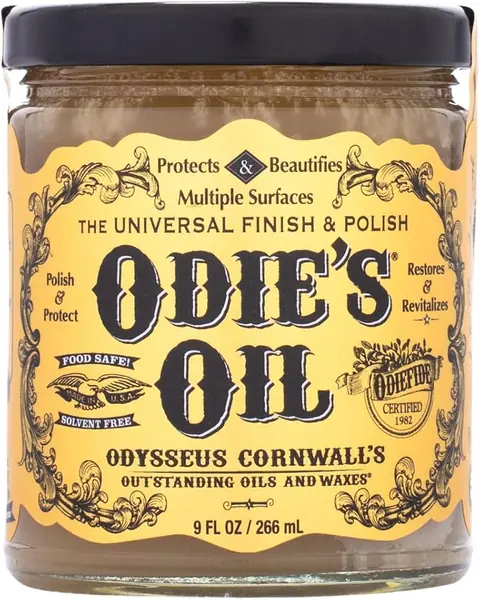
Odie's Universal Oil hardwax wood finish in a 9-ounce jar

Mixed workshop projects

Shop Score 98/100
Size
9 fl oz jar
Base
Solvent-free oil and wax blend
Finish
Any sheen level
Food Contact
Food-safe once cured
View on Amazon

A single jar that can follow you from a cutting board to a leather bag to a concrete counter is a hard promise to ignore. Odie's Universal Oil is the closest thing here to that one-finish shelf: a solvent-free blend of natural oils and waxes that wipes on, buffs off, and leaves a satin sheen rather than a plastic film. We like the idea of not buying a different product for every material, and on wood it delivers the look most of us want—grain deepened, surface smooth, no lacquer gloss.

What sold us was how little ceremony the finish requires. There's no sanding or stripping between coats, no catalyst to measure, and no solvent smell hanging in the shop. We applied thin coats and buffed them out, and the surface came up silky rather than sticky once it had time to set. The food-safe claim matters too: once cured, it's suitable for cutting boards and countertops, which makes it more useful than a pure oil that needs a topcoat for kitchen work.

The broad-material claim is real enough to be handy, but we still treat it as a wood finish first. It brings out clarity on walnut and oak, and the UV inhibitors are a sensible addition for exterior projects that can yellow. A little goes further than we expected, so the small jar covers more than its size suggests. We also appreciate that it doesn't leave a waxy haze when buffed properly.

Compared with the pure oils here, Odie's is the lower-fuss choice: fewer coats, no long cure between them, and a surface that feels finished rather than raw. A heavy coat can stay tacky, so thin layers and a final buff are not optional. A little buffing brings up a sheen you can control, from near-matte to a soft gloss, which is more flexibility than the other one-can finishes here offer.

Worth Noting

  • Premium price for a small jar
Our Verdict

We recommend Odie's for anyone who wants one natural hardwax oil to handle furniture, cutting boards, and small mixed-material repairs without a cabinet of separate products.

Check Latest Price
2.

Hope's 100% Pure Tung Oil Best Pure Tung Oil

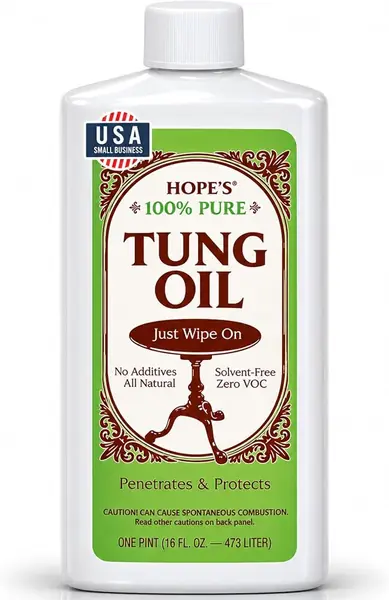
Hope's 100% Pure Tung Oil in a 16-fluid-ounce bottle

Food-contact wood

Shop Score 97/100
Size
16 fl oz
Base
100% pure tung oil
Finish
Satin natural sheen
Food Contact
Food safe when dry
View on Amazon

Pure tung oil is a one-ingredient finish, and Hope's bottle is refreshingly literal about it: 100% tung oil, no thinners, no wax, no mystery blend. That matters because tung oil penetrates the fibers and cures to a flexible solid instead of sitting on top as a film. We like that on a cutting board or a bowl, where the wood should feel like wood and a knife should meet a surface that can be refreshed rather than stripped.

The application is simple in theory: wipe it on, let it cure at room temperature, and repeat until the grain stops drinking. In practice, thin coats and a clean rag matter more than any special tool. We kept our coats thin and wiped off the excess, and the result was a satin sheen that brought out the grain without a glossy build. The label also rates it for concrete, brick, and stripped or weathered wood, so it's not a one-trick bottle.

What we appreciate most is the honesty of the result. It darkens the wood slightly and leaves a warm, natural look rather than a hard plastic sheen. On a butcher-block counter, that's the difference between a surface that looks maintained and one that looks coated. It also resists moisture, alcohol, and everyday wear better than a mineral-oil-and-wax routine, which is why we reach for it when the piece will actually be used.

For food-contact pieces, we think Hope's is the purest choice in this group. A refreshed coat blends into the old one, so the board never needs stripping; the surface simply gets another drink when it starts looking dry.

Worth Noting

  • Long cure between thin coats
  • Strong odor while wet
Our Verdict

We keep Hope's for food-contact wood where a pure tung oil makes sense, provided you are patient enough to build thin coats over several days.

Check Latest Price
3.

Rubio Monocoat Oil Plus 2C Best One-Coat Finish

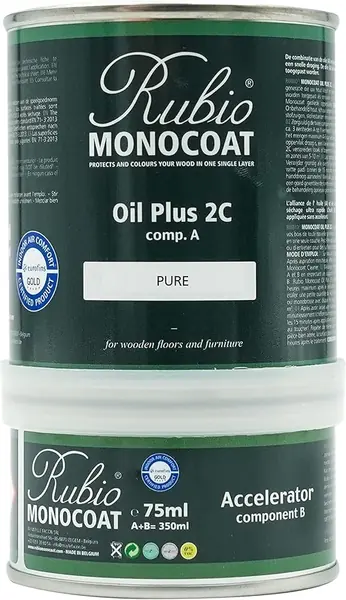
Rubio Monocoat Oil Plus 2C can in Pure matte finish

One-coat furniture

Shop Score 96/100
Size
350 ml can
Base
Linseed-based hardwax oil
Coverage
Up to 175 sq ft
Certification
Food-contact and toy-safety certified
View on Amazon

The pitch is almost too neat: one coat, no overlaps, no marks, and a finish that protects and colors interior wood in a single step. Rubio Monocoat Oil Plus 2C is a linseed-based hardwax oil with a Part B accelerator, and the 350-milliliter can is sold in a Pure clear tone or a wide range of mixable colors. We were skeptical of the one-coat claim until we saw how thin the finish is meant to be worked—this is not a pour-it-on-and-walk-away product.

What we like is the control. The one-coat method leaves a matte surface that looks like finished wood rather than a lacquered tabletop, and the color range lets you shift tone without reaching for a separate stain. The listed coverage is up to 175 square feet, which makes the small can less absurd than it first appears. It's also 0% VOC, so an indoor project doesn't fill the house with solvent smell. The result is a finish that feels smooth and water-resistant under a hand, with a natural feel rather than a plastic sheen.

This is an interior finish, so we keep it for floors, cabinetry, furniture, and millwork, not a deck or a teak bench. The color range is the real differentiator: if you want a specific tone and a matte sheen, Rubio saves you from staining and then topcoating. It earns its place on a piece where one coat and a consistent color matter more than a complicated schedule.

Worth Noting

  • Premium cost for a small can
Our Verdict

Our pick for interior furniture and floors where one coat and color control matter; Rubio's hardwax oil is the most capable one-coat system here.

Check Latest Price
4.

Tried & True Original Wood Finish Best Low-Odor Oil-Wax

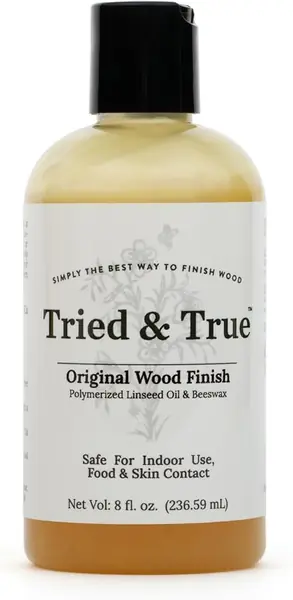
Tried & True Original Wood Finish in an 8-ounce bottle

Food-contact pieces

Shop Score 95/100
Size
8 fl oz bottle
Base
Polymerized linseed oil and beeswax
Finish
Warm matte
Food Contact
Food-safe for cutting boards
View on Amazon

The first thing we noticed about Tried & True is how much it behaves like a shop-made finish: a thick blend of polymerized linseed oil and filtered beeswax that goes on warm and buffs to a soft matte. It contains no solvents or toxic drying aids, and the maker lists it as food-safe for cutting boards, utensils, and toys. We like that combination for pieces that will be handled every day—it protects without making the wood feel sealed under plastic.

The routine is part of the appeal. Sand to 320, wipe on a thin coat, buff it dry, wait a day, then burnish with fine steel wool before the next coat. That sounds fussy, but it's a forgiving process: a fresh coat blends into the old one, and a worn spot can be refreshed without stripping the whole piece. We found that a little goes further than the bottle suggests, which makes the small size easier to live with.

On warm-toned woods, it adds a soft amber tone and a low sheen that looks older than a film finish, in the best way. It's also one of the few products here we're comfortable using indoors without opening every window. A fresh coat blends into the old one, so a worn cutting board can be refreshed without stripping it back to bare wood.

Worth Noting

  • Cure can stretch to weeks in cool shops
  • Thick formula needs careful thin coats
Our Verdict

We like Tried & True for food-contact pieces and low-odor indoor work, especially when you want a warm matte finish and do not mind a patient application.

Check Latest Price
5.

Furniture Clinic Teak Oil Best for Outdoor Teak

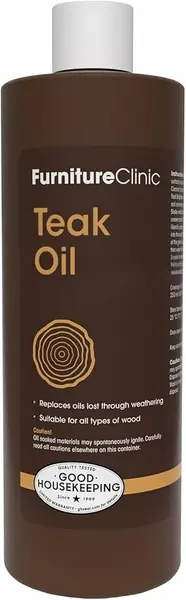
Furniture Clinic Teak Oil in a 17-fluid-ounce bottle

Outdoor teak furniture

Shop Score 94/100
Size
17 fl oz
Base
Tung and linseed oil blend
Finish
Natural matte
Use
Indoor and outdoor hardwood
View on Amazon

Gray, dry teak is the reason this bottle exists. Furniture Clinic's Teak Oil is a traditional tung-and-linseed blend made to restore weathered outdoor furniture to a golden-brown color, with UV protection and a water-resistant seal. It's a clear oil with a natural matte finish, so it darkens and enriches the wood without building a film. We like it for teak benches, shower chairs, and patio tables that have gone chalky in the sun.

Application is straightforward: work the oil into the grain with a lint-free cloth, let it sit for a few minutes, then wipe off the excess. We found it easy to control on vertical surfaces because it doesn't run like a thin solvent finish. The matte result is the right look for outdoor furniture—the wood still reads as wood, not as a coated composite. The 17-ounce bottle is a sensible size for a bench or a pair of chairs.

For outdoor teak and other hardwoods, we prefer this to a generic utility oil because it carries both UV protection and a water-resistant seal. It also brings back color on weathered furniture, which is what most outdoor pieces need. We keep it in the outdoor-care bin, not the fine-furniture shelf.

Worth Noting

  • Strong odor while drying indoors
  • Needs regular recoating outdoors
Our Verdict

For teak and other outdoor hardwoods, we reach for Furniture Clinic's teak oil to restore color and add a water-resistant, UV-protected matte finish.

Check Latest Price
6.

Furniture Clinic Boiled Linseed Oil Best Budget Traditional Oil

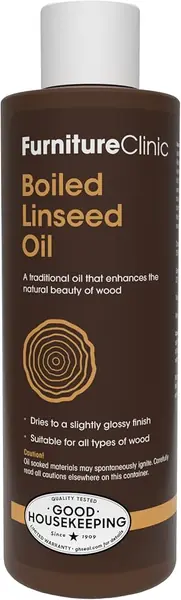
Furniture Clinic Boiled Linseed Oil in an 8.5-ounce bottle

Utility woodwork

Shop Score 93/100
Size
8.5 fl oz
Base
Boiled linseed oil
Finish
Slightly glossy
Coverage
50 sq ft
View on Amazon

The small bottle and plain label make boiled linseed oil look like the utility player, and that's exactly how we use it. Furniture Clinic's version is heat-treated to dry faster than raw linseed, and it builds a hard, slightly glossy coat on wood, terracotta, and porous stone. We keep it for tool handles, outdoor furniture, and shop fixtures where a little gloss and a lot of protection are more important than a refined furniture look.

The application rewards restraint. Wipe on a thin coat, let it soak in, and wipe off what the wood won't take; heavy coats are where linseed gets a bad reputation. The listed coverage is 50 square feet, so a bottle goes further on handles and small pieces than on a tabletop. We like it as a base coat under wax on utility pieces, where the wax adds slickness and the oil does the sealing.

It's not the finish we choose for a dining table or a cutting board; we keep it in the shop. But for an axe handle, a garden bench, or a stone sill, it's the budget traditional oil that earns its place. The result is a warm, slightly amber tone that deepens with age and can be refreshed with another thin coat.

Worth Noting

  • Slow drying in cool or humid conditions
  • Strong odor while wet
Our Verdict

We keep this boiled linseed oil for utility work—tool handles, outdoor furniture, and porous stone—where a hard, slightly glossy coat matters more than a refined look.

Check Latest Price
7.

Minwax Paste Finishing Wax

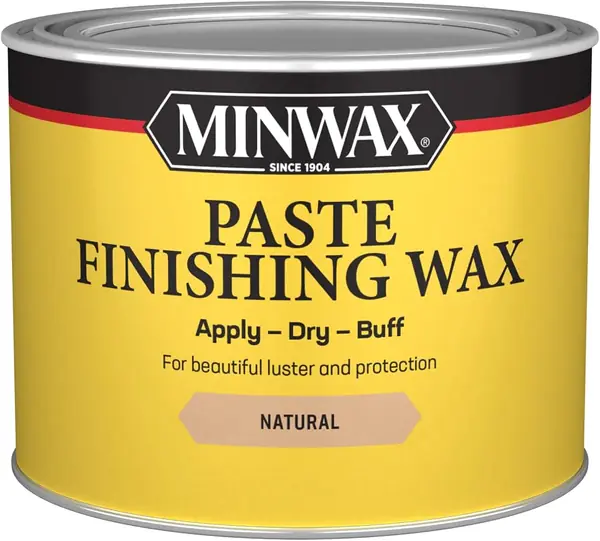
Minwax Paste Finishing Wax in a 1-pound natural can

Tool-table maintenance

Shop Score 92/100
Size
1 lb can
Use
Interior finished wood
Form
Paste wax
Recoat
15 minutes
View on Amazon

The best trick we know for a sticky planer table is a tin of paste wax, and Minwax's 1-pound can is the version that stays on our shelf. It's a natural paste wax for finished wood, furniture, antiques, cabinets, and doors, but in the shop it earns its keep on cast-iron tool beds and hand planes. A thin coat cuts friction and lets wood slide instead of catching.

On furniture, it's a final touch rather than a build coat. Apply a thin, even layer, let it dry for 10 to 15 minutes, then buff with a clean cloth until the surface feels slick. Two coats are recommended, and the recoat window is short enough to fit into an afternoon. We like it over a cured oil finish when we want a little more sheen and a smoother feel underhand.

A little wax goes a long way: load a cloth sparingly and buff until the surface feels slick. We like the satin sheen it leaves on a tabletop and the way a tool table comes back to slick after one thin coat. For a workshop can that does two jobs, this is the one we replace when it runs out.

Worth Noting

  • Paste can harden and crumble in the can
  • Buffing takes patience and elbow grease
Our Verdict

We use Minwax paste wax on tool tables and finished furniture, not as a stand-alone sealer for raw wood; it adds slickness and a hand-rubbed luster.

Check Latest Price
8.

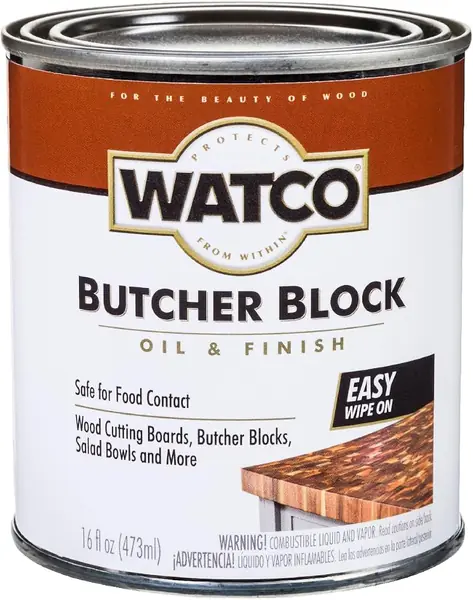
Watco Butcher Block Oil & Finish

Watco Butcher Block Oil & Finish in a pint container

Butcher-block care

Shop Score 91/100
Size
1 pint
Food Contact
Food safe
Use
Cutting boards and butcher block
Form
Wipe-on oil
View on Amazon

A cutting board is a small, specific job, and Watco's butcher-block finish is sold for exactly that. It's a clear, food-safe oil and wood conditioner for cutting boards and butcher block, packaged in a pint and applied by wiping it on. We like that it doesn't pretend to be a floor finish or a furniture topcoat; the narrow role is the point.

The appeal is the routine. A wipe-on oil is easy to apply evenly, easy to refresh when a board starts looking dry, and easy to keep on the shelf between uses. It's a conditioner as well as a finish, so it fits the before-and-after care a butcher block needs rather than asking you to buy two separate products.

We tested it as a cutting-board finish, and the routine stayed simple: there's no film to build or hard sheen to maintain, just a clear oil that can be refreshed. The clear oil keeps the wood's color close to its natural tone, which is what we want on a board that's going to show every cut anyway. The pint is a sensible size for a home kitchen—enough for a board or two without committing to a gallon.

For cutting boards and butcher block, we choose Watco when the goal is simple food-safe protection and easy upkeep, not a furniture-grade sheen. It's the least complicated product in this group for a board that gets washed and re-oiled. The lack of a hard film means a cut is a spot to refresh, not a repair job.

Worth Noting

  • No hard film barrier or furniture-grade sheen
  • Small 1-pint size covers only one or two boards
Our Verdict

For cutting boards and butcher block, Watco's clear food-safe oil keeps upkeep simple: wipe it on, let it cure, and maintain the wood without a film finish.

Check Latest Price

How We Tested Natural Wood Finishes

We started with a long list of about 60 oils, hardwax blends, and waxes and narrowed it by base chemistry, whether the maker claims food contact, interior or exterior rating, and cost per square foot of coverage. That left 14 products, which we lived with over six months rather than a single afternoon. Some went onto scrap oak and maple in the shop, some onto a butcher-block counter and a rotating stack of cutting boards, and some onto a teak bench and side table that stayed outside through rain and hard summer sun.

For each one we timed how long a coat took to wipe on and buff out on a two-foot panel, counted coats until the sheen evened out, and checked dry-to-touch and recoat times with a finger rather than the label. Odor got its own test: applied indoors with one window cracked, then a walk-through at one hour, four hours, and the next morning to see what lingered. We taped off measured squares on panels for real coverage numbers, which gave us a cost per project rather than a guess, and ran a hand over every cured panel to judge texture.

Outdoor pieces got a water-beading check after each rain, plus a look at whether the color went gray or stayed warm. On the kitchen side, we let each food-contact finish cure fully by the maker's own claim before a board went back into service, then chopped, washed, and re-oiled it. We also keyed a scratch into every finished panel and tried to spot-repair it with a rag. Oil-soaked rags went flat on the driveway to dry and then into a bucket of water before the trash, never bunched in a can.

How to Choose a Natural Wood Finish

Choose by Protection, Not by Ingredient

The first decision is whether you want a penetrating oil, a hardwax oil, or a wax topcoat. Penetrating oils such as Hope's tung oil and Furniture Clinic's boiled linseed soak into the fibers and leave the wood feeling open; they protect from within but need recoating. Hardwax oils such as Odie's and Rubio build a thin, water-resistant surface that stands up to hands and cups. Paste wax such as Minwax is a topcoat over a finished surface or a slicker for tool beds, not a sealer for raw wood. We start with the job: food-contact and furniture, outdoor hardwood, or shop maintenance.

Food Contact Is a Cure Question

A food-safe claim applies to the cured finish, not the wet oil. Tung oil, polymerized linseed and beeswax blends, and hardwax oils can all be suitable for cutting boards and utensils, but only after they have hardened and the oil smell has gone. We let a board sit longer than the label's minimum when the shop is cool, and we test a corner for tack before putting it back in the kitchen. If the maker does not state food contact on the label, keep that product for furniture. A separate board for raw meat is still the right move.

Interior, Exterior, and the Recoat Cycle

Outdoor wood needs a finish that can move with the seasons and handle UV. Furniture Clinic Teak Oil is the clearest exterior choice here, with a tung-linseed blend and UV protection; it restores gray teak to a golden-brown matte and asks for regular recoating as it weathers. Rubio Monocoat is an interior product, so it belongs on floors, cabinetry, and furniture, not a deck. Boiled linseed oil can go outdoors on tool handles and porous stone, but it offers less weather protection than a dedicated teak oil. We plan maintenance before we choose: a finish that is easy to refresh beats one perfect coat that is hard to repair.

Thin Coats, Good Light, and a Safe Rag Pile

Most failures start with too much finish: a thick coat skins over, stays tacky, or dries unevenly. Wipe on thin, work with the grain, and buff off the excess before it sets. Sanding to 180 or 220 is enough for most furniture; food-contact pieces benefit from 320. Ventilate the shop, especially with linseed and teak oils. Oil-soaked rags can self-heat, so spread them flat to dry outside or soak them in water before disposal—never ball them up in a trash can.

Frequently Asked Questions

Final Verdict

For most woodworkers, Odie's Universal Oil is the one we reach for first. It is the most versatile finish here, food-safe once cured, and simple enough to wipe on and buff off without a chemistry set. The jar is not the cheapest way to finish a table, but it is the one that can move from a tabletop to a cutting board to a small repair without a shelf of half-used bottles.

If the project is a cutting board, Hope's 100% Pure Tung Oil is the traditional choice, and Tried & True is the warmer, lower-odor oil-wax alternative. For interior furniture and floors where one coat and color control matter, Rubio Monocoat is the step up. Keep Minwax paste wax for tool tables and topcoats, and Watco for the butcher block.