↑↓ navigate ↵ open Esc close All results →

Best Plunge Router Bits of 2026

Drop the wrong bit into a hardwood board and it chars the bottom of a mortise, splinters the top veneer on plywood, or bottoms out short of your layout line. True plunge geometry solves those snags with an end-cutting tip built for vertical entry, flutes shaped to direct chips cleanly, and enough cutting length for deep pockets.

Running 14 bits with 1/4-inch shanks through six months of shop cuts showed that flute direction dictates results far more than shank size. Up-cut spirals evacuate shavings from deep mortises, down-cut spirals shear cleanly along fragile top plies, and straight flutes leave flat-bottomed dados without tear-out.

Factory edge sharpness varied unexpectedly regardless of price tag, leaving the seven bits ahead as the ones that enter on the mark and leave walls smooth enough to skip heavy sanding.

Our Top Picks

The Best Plunge Router Bits

1.

Whiteside RU2100 Spiral Upcut Bit Best Overall

Whiteside RU2100 solid carbide up-cut spiral router bit with 1/4-inch shank

General plunge work

Shop Score 95/100
Shank
1/4 inch
Cutting Diameter
1/4 inch
Cutting Length
1 inch
Cut Style
Up-cut spiral, 2 flutes
View on Amazon

Chips have to go somewhere, and the up-cut spiral on the RU2100 sends them up and out of the groove rather than packing them under the bit. In a deep mortise that is the difference between a second pass that cuts and one that burns. The dimensions are plain — 1/4-inch cutting diameter, 1-inch cutting length, 2-1/2 inches overall, two flutes in solid carbide — but the geometry is why it took the top spot.

This is the bit we treat as the default for plunge work. An inch of cutting length gets through most furniture mortises and stopped dados without a changeover, and the spiral leaves a side wall smooth enough that a light block-sanding is all it takes before glue-up. We paid close attention to how it starts a cut: the tip bites the moment it touches down instead of skating, which is the whole point of a plunge bit and the thing cheap spirals get wrong.

The trade sits at the top edge. An up-cut lifts fibers as it enters, so the show face of veneered plywood can come off fuzzy — rout with the good face down, or hand that cut to the Amana 46202-K below. Otherwise there is very little to work around: any router with a 1/4-inch collet takes the shank, and a midrange outlay for a solid carbide spiral is easy to justify against replacing a bargain bit twice a season.

Worth Noting

  • Solid carbide is brittle and can snap
Our Verdict

We recommend it as the default plunge bit here: the up-cut spiral clears chips from deep mortises and leaves walls clean enough to glue.

Check Latest Price


2.

Amana 46202-K Spektra Spiral Plunge Bit Best for Clean Show Faces

Amana 46202-K Spektra coated down-cut spiral plunge router bit with 1/4-inch shank

Clean show faces

Shop Score 93/100
Shank
1/4 inch
Cutting Diameter
1/4 inch
Overall Length
2-1/2 inches
Coating
nACo Spektra nanocomposite
View on Amazon

A nanocomposite coating and a price at the top of this group make the 46202-K the one you talk yourself into. We think it is worth it, because of what the down-cut spiral does to the top edge of a groove in melamine: it comes off clean enough to skip the sanding.

Down-cut flutes shear the wood downward, pressing surface fibers against the core instead of lifting them, which is why the face you see stays crisp where an up-cut leaves it fuzzy. The bit is compact — 1/4-inch cutting diameter on a 1/4-inch shank, 2-1/2 inches overall — and the nACo coating is there to keep the edge alive in abrasive sheet goods. It is made in the USA, and it is the line Amana sells on tool life rather than on price.

Chips are the thing to manage. A down-cut pushes them into the groove instead of flinging them clear, so run a vacuum alongside or lift the bit between passes and blow the cut out. Do that and this is the bit we want on anything wearing a veneer or a melamine face; for a run of shelf dados in prefinished plywood, it is the one that stays in the router all afternoon.

Worth Noting

  • Down-cut flutes pack chips into the groove without dust extraction
  • Priced near the top of this router bit group
Our Verdict

We think it is worth the premium whenever the visible face is veneered plywood or melamine and you want to skip the sanding.

Check Latest Price
3.

Freud 04-140 Double Flute Straight Bit Best for Wide Dadoes

Freud 04-140 double flute straight router bit with 3/4-inch cutter and 1/4-inch shank

Wide dadoes

Shop Score 92/100
Shank
1/4 inch
Cutting Diameter
3/4 inch
Overall Length
2-1/8 inches
Carbide
TiCo hi-density carbide
View on Amazon

Three-quarters of an inch is a lot of cutter to hang off a 1/4-inch shank, and the 04-140 carries it better than most straight bits this size. Freud grinds relief at the end of the bit so it can be dropped into the work, and the two cutters are TiCo hi-density carbide rather than the generic tips that show up on cheap sets.

The width is the whole argument. A 3/4-inch bit cuts a shelf dado or a 3/4-inch groove in one pass instead of three, and the shear and hook angles leave a flatter, smoother bottom than the bargain straight bits here. We keep it on the shelf beside a spiral because they do different jobs: the spiral for a narrow, deep mortise, this one for hogging out a wide, shallow recess.

What the width costs you is leverage, and the answer is technique rather than a different bit — slow the feed, take lighter passes, and let the cutter work instead of forcing it through. Get that right and it is a workhorse in plywood, pine shelving, and MDF, and it turns a stack of shelf dadoes into an afternoon's work rather than a weekend's.

Worth Noting

  • Entry and exit edges can chip in hard oak
Our Verdict

We point to it for wide, flat-bottomed grooves in plywood and softwood, where the 3/4-inch cutter saves passes.

Check Latest Price
4.

SICWOOD 6-Piece Straight Bit Set Best Budget Set

SICWOOD six-piece straight router bit set with 1/4-inch shanks in individual cases

First set

Shop Score 91/100
Shank
1/4 inch
Cutting Height
13/16 inch
Cutting Diameters
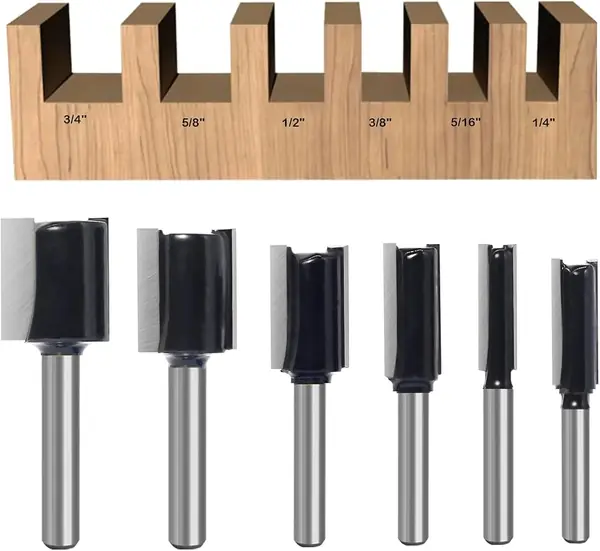
3/4, 5/8, 1/2, 3/8, 5/16, 1/4 inch
Cutters
2 flutes, C3 micro-grain carbide
View on Amazon

Six diameters is the pitch, and it holds up: 3/4, 5/8, 1/2, 3/8, 5/16, and 1/4 inch, all on a 1/4-inch shank with a pair of C3 micro-grain carbide tips behind each cutter. That is a groove width for nearly every joint a small shop builds, and the whole set comes in below the cost of one premium spiral.

As a first set, we like it more than we expected to. Each bit sits in its own tube, which matters more than it sounds when the alternative is a drawer of bare cutters knocking tips together, and the edges arrive sharp enough to leave a planed-looking bottom in pine and plywood at a moderate feed. For a bench being set up from scratch, that combination is hard to argue with.

Feed it steady, keep the router toward the slower end in sheet goods, and the set does what a small shop asks of it. For weekend work in pine, MDF, and plywood it covers the widths you actually reach for; a shop running oak through a router every day should start with a solid carbide spiral instead.

Worth Noting

  • 13/16-inch cutting height caps mortise depth
  • Brazed tips rather than solid carbide
Our Verdict

We like it as a first set: six diameters let you match a groove to the stock instead of buying bits one at a time.

Check Latest Price
5.

Amana 45982 Bowl and Tray Bit Best for Trays and Pockets

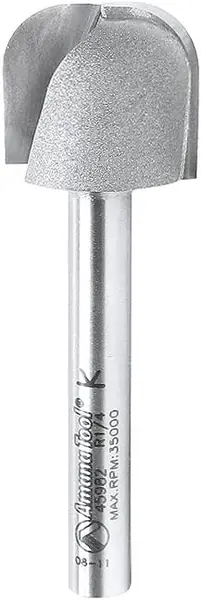
Amana 45982 carbide-tipped bowl and tray plunge router bit with 1/4-inch radius

Trays and pockets

Shop Score 90/100
Shank
1/4 inch
Cutting Diameter
3/4 inch
Cutting Height
5/8 inch
Corner Radius
1/4 inch
View on Amazon

A recess for a serving tray asks for something different than a groove does: a flat bottom, a wall that stands square, and an inside corner you can sand out in seconds instead of chiseling. That is the job the 45982 was shaped for, and it is the bit we hand someone who is tired of cleaning up tray corners by hand.

The numbers explain the shape. A 3/4-inch cutting diameter with a 1/4-inch corner radius and 5/8 inch of cut height on a 1/4-inch shank means one bit hogs out the pocket and leaves the soft inside corner that keeps a tray from feeling sharp in the hand. It is carbide tipped with a limited lifetime guarantee, and the flat cutters leave a bottom that takes finish without a planing session first.

Depth is the honest limit: 5/8 inch of cut height is a shallow tray or a dish, not a deep hollow, and anything deeper means a second setup from the other face. That suits the work it is built for — serving boards, catch-alls, a recessed handle — and no straight bit here leaves a pocket floor as even or as ready for oil.

Worth Noting

  • 1/4-inch radius leaves round inside corners
Our Verdict

We suggest it when the job is a tray, a dish, or a shallow pocket rather than a straight-sided groove.

Check Latest Price
6.

SpeTool Down-Cut Spiral Bit

SpeTool down-cut spiral router bit with 1/4-inch cutting diameter and shank

Value down-cut

Shop Score 89/100
Shank
1/4 inch
Cutting Diameter
1/4 inch
Overall Length
2-1/2 inches
Cutting Length
1 inch
View on Amazon

The cheaper of the two down-cut spirals here does the same basic job: the flutes shear downward and hold surface fibers against the core, so the top face of a groove in plywood or laminate comes off crisp instead of fuzzy.

The working dimensions match the price rather than undercut it — 1/4-inch cutting diameter, 1 inch of cutting length, 2-1/2 inches overall, two flutes in solid carbide. SpeTool rates it for handheld routers and CNC work alike, and it behaves the same in both: steady feed, clear groove, no drama.

In stopped grooves and shallow mortises it does what we ask of it, and the two flutes clear chips well enough that the cut stays cool through a run of plywood drawer bottoms. The plastic case it arrives in is worth keeping, since a bit this small tends to disappear into a drawer otherwise.

That is the honest trade: we treat these as bits to replace rather than restore, which is easy to live with at this price. You get clean top edges for meaningfully less than the coated premium bit, as long as you are not counting on one to survive a season of production work.

Worth Noting

  • Snapping can occur in deep hardwood cuts
Our Verdict

We keep this down-cut around for clean top edges at a lower outlay, and we feed it gently in hardwood.

Check Latest Price
7.

Wolfride 4-Piece Straight Bit Set

Wolfride four-piece straight router bit set with 1/4-inch shank and coated bodies

Learning on pine

Shop Score 88/100
Shank
1/4 inch
Cutting Diameters
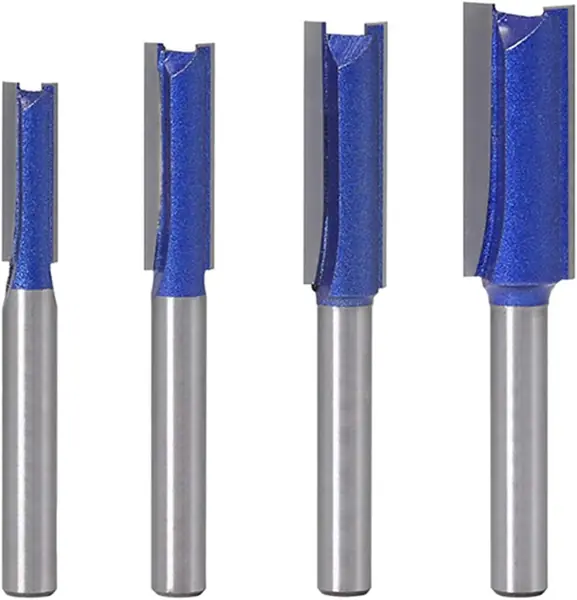
1/4, 5/16, 3/8, 1/2 inch
Blade Material
YG6 carbide
Cutting Heights
13/16 to 1-3/16 inch
View on Amazon

Tall cutters are the surprise in a set priced this low: the 3/8-inch and 1/2-inch bits carry 1-3/16 inches of cutting height, and even the 1/4-inch bit gets 13/16 inch. That is more reach than the SICWOOD set offers at any size, and it makes the bigger bits useful for template work and for grooves in thicker stock.

The bits themselves are YG6 carbide blades brazed to 45# carbon steel bodies with a heat-resistant Teflon coating, which does keep resin from building on the cutter in pine. Sizes run 1/4, 5/16, 3/8, and 1/2 inch on a 1/4-inch shank, and the coating also makes them easier to wipe clean between jobs.

Our read is that this is a learner set, and that framing does most of the work: for pine, MDF, and a burned sign or two, the tall cutters and the low outlay make sense together. Buy it to find out which two widths you actually reach for, then replace those two with solid carbide spirals once you know.

Worth Noting

  • Quality varies from bit to bit
  • 1/4-inch bit is the weakest of the four
Our Verdict

Four widths for pine, MDF, and sign work at the lowest price here — we think of it as a learner set.

Check Latest Price

How We Tested Plunge Router Bits

We built the shortlist by pulling every 1/4-inch-shank bit that could enter wood vertically, then filtering by cutting diameter and cutting length against the groove widths and mortise depths most projects actually call for. From there we sorted by construction — solid carbide versus brazed tips, coated versus uncoated — and by whether a bit came alone or as part of a set. Fourteen bits covered that range without repeating themselves.

Testing ran six months in a garage shop, with each bit chucked into the same 1/4-inch collet. We plunged straight down into white oak table legs for mortises, ran dadoes in birch plywood and melamine for a bookcase, chopped hinge pockets in door jambs, and routed shallow tray recesses in walnut. Every cut was a shallow pass at a speed matched to the material, with eye and hearing protection on and hands well clear of the bit, and each shank was seated and checked for tightness before the router started. With the sets, we worked through every width and noted how often we reached for the small ones.

At each cut we watched where the chips went — cleared out of the groove or packed in behind the bit — and checked the top edge for fuzz and the sidewall for burn marks. We counted linear feet until a bit stopped slicing and started needing feed pressure, and looked for chipped tips or any creep in the collet on heavier passes. After each project we tallied the sanding the cut face needed, since a bit that leaves a clean wall saves more time than one that cuts fast. For the sets, we also weighed the cost of a full range of widths against buying two or three singles.

How to Choose a Plunge Router Bit

Cut Geometry: Up-Cut, Down-Cut, or Straight

Flute direction decides two things at once: where the chips travel and which face of the work stays clean. An up-cut spiral lifts chips out of the cut, which is what you want in a mortise or any groove deeper than the bit's own diameter, at the cost of a top edge that can fuzz on veneered stock. A down-cut spiral reverses both — crisp show face, chips left in the groove. Straight bits sit in the middle, cutting a flat bottom and a predictable width.

We rout mortises with an up-cut spiral and keep a down-cut for the face that gets finished. One warning: a straight bit needs relief at the tip to plunge at all, and plenty of inexpensive ones have none, whatever the packaging claims.

Match Diameter and Cutting Length to the Cut

Diameter sets the groove width and cutting length sets the maximum depth, and neither is negotiable once the bit is in the collet. A 1/4-inch bit cuts a 1/4-inch mortise; a 3/4-inch straight bit clears a shelf dado in one pass instead of three.

Cutting length is the harder limit. The Whiteside's 1 inch reaches deeper than the SICWOOD set's 13/16 inch, and no number of passes closes that gap. Decide the finished depth first, then buy a bit that clears it; if you already own a short one, rout from both faces and register off the same edge.

Solid Carbide, Brazed Tips, and Coatings

Solid carbide spirals are ground from a single piece, which makes them stiff, slow to dull, and brittle — this is where the money goes in a premium bit. The cheaper route is a carbide tip brazed to a steel body: serviceable in pine, plywood, and MDF, less so in oak and particleboard, where the tip takes the whole load.

Coatings such as Amana's nACo matter most in abrasive sheet goods, where they cut friction and heat. In melamine and MDF a coated edge holds up better, and that is the difference we will pay for.

One Good Bit or a Set of Six

A set looks like value and often is, provided you are buying widths you will actually rout. Six straight bits cover shelf dadoes, hinge pockets, and panel grooves for less than one premium spiral, which is exactly what the SICWOOD set does. What a set does not buy is edge life or a clean top face in veneered stock.

Our order of buying: a 1/4-inch up-cut spiral first, a 3/4-inch straight bit second for wide shallow recesses, then a set once the work keeps calling for a width you do not own.

Frequently Asked Questions

Final Verdict

Start with the Whiteside RU2100. It makes the least fuss of a plunge cut: chips clear, the wall comes off clean, and 1 inch of cutting length covers the mortises most furniture actually needs. Add the Amana 46202-K when the face you see is veneered plywood or melamine and you want to skip the sanding, and the Amana 45982 when the work is trays and shallow pockets rather than grooves.

Wide, shallow dados are the one job where we reach past both for the Freud 04-140, whose 3/4-inch cutter turns a stack of shelf grooves into an afternoon.