↑↓ navigate ↵ open Esc close All results →

Best Sanders for Furniture Refinishing of 2026

Refinishing furniture puts a sander in your hand longer than any other tool in the shop, and no single pad geometry handles every surface cleanly. A five-inch random-orbit pad levels a flat cabinet door efficiently, yet that same wide disc will round over crisp edges on a chair spindle. Matching the pad to the profile comes first, while variable speed, dust extraction, and balanced weight keep that control steady over hours of work.

We put 12 sanders through seven months of refinishing cabinet doors, chair spindles, painted trim, a workbench top, and overhead passes — after seeing firsthand how quickly a single-speed unit can burn through veneer before you can lift off. Ease of handling, removal speed, and ongoing abrasive costs all factored into the rankings, since a sander tied to proprietary paper quickly outspends one built for standard five-inch eight-hole discs.

Corded models run continuously for heavy stripping, while cordless platforms trade runtime for freedom around awkward frames, with every option keeping the pad flat where you set it.

Our Top Picks

The Best Sanders for Furniture Refinishing

1.

Bosch ROS20VSC Random Orbit Sander Best Overall
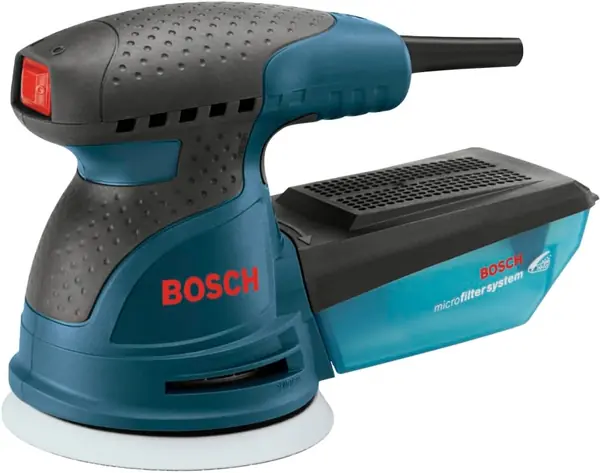
Bosch ROS20VSC five-inch random orbit sander with microfilter dust canister and carrying bag

Flat panels, cabinets

Shop Score 97/100
Pad Size
5-inch hook-and-loop
Speed Range
7,500-12,000 OPM variable
Power Source
Corded, 2.5 amp
Dust Collection
Microfilter canister and vacuum adapter
View on Amazon

When someone asks which sander to buy before starting a first dresser, this is the one we point to. The Bosch is a corded 2.5-amp, five-inch random orbital, and its speed dial runs from 7,500 to 12,000 OPM. That dial is most of the reason it wins the top spot: you can drop it low over a veneered drawer front and open it up when there are three coats of polyurethane to cut through.

What we did not expect to care about as much as we do is the dampening ring under the pad. It lets the pad float slightly instead of hammering the surface, and the practical result is an even finish without the pigtail swirls that mean another pass by hand. On a curved apron or a table edge we keep the speed low and let the tool do the work rather than bearing down, which is how veneer gets burned through.

Dust is where this sander separates from the cheaper corded tools here. The canister uses a micro-filter rated down to half a micron, and it seals well enough that we are comfortable sanding in a basement. The kit includes an adapter for a shop vac as well, which is what we switch to on a whole-room job, because the canister fills quickly once you are stripping real finish.

Against the cordless picks, the Bosch gives up the freedom to carry a piece out to the driveway and gains a motor that does not care how long the job runs. The carrying bag, the dampening ring, and the vacuum adapter round out a package that feels considered rather than assembled from whatever was on the shelf.

Worth Noting

  • Corded, so an outlet has to stay within reach
Our Verdict

We recommend it as the default refinishing sander: a variable dial down to 7,500 OPM, a pad that damps out swirl marks, and a microfilter canister that seals in fine dust.

Check Latest Price
2.

DEWALT 20V MAX XR DCW210B Best Cordless

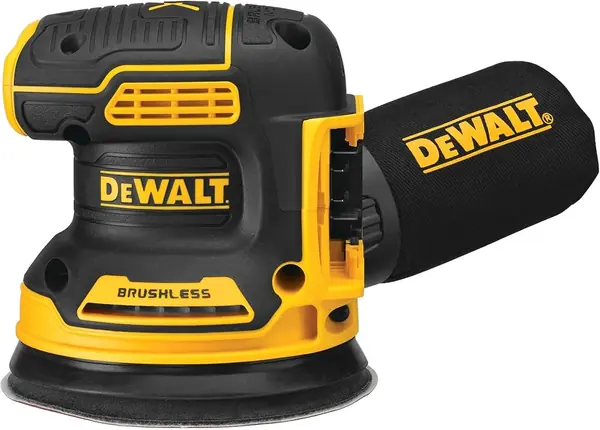
DEWALT DCW210B brushless five-inch cordless random orbit sander with dust bag attached

Cord-free finish sanding

Shop Score 96/100
Weight
2.5 lb
Pad Size
5-inch, 8-hole hook-and-loop
Speed Range
8,000-12,000 OPM variable
Power Source
20V MAX battery, tool only
View on Amazon

The box is small because there is not much in it: the sander, a dust bag, and nothing to make it run. DEWALT sells this as a bare tool for its 20V MAX line, which is either the best value in this group or an irrelevant one depending on what is already in your shop. The tool itself is a brushless five-inch random orbital with a dial from 8,000 to 12,000 OPM and a 2.5-pound body.

Low profile is the phrase DEWALT uses and it is the right one: the housing sits close to the pad, so your hand ends up near the surface and one-handed work on a vertical face stops feeling like a juggle. We also appreciate the dust-sealed switch and the replaceable 8-hole pad, since those are the parts that quit first on a sander that lives in a dusty shop. The bag lock is genuinely one-handed, which matters when the other hand is holding a drawer front.

The trade is the battery, and it runs the other way depending on your shop. If you already own 20V MAX packs, this is the most pleasant sander here to use away from an outlet. If you do not, the tool is only half a purchase: add a charger and at least one pack before you compare it with the corded options.

Worth Noting

  • Bare tool; battery and charger sold separately
  • Battery life drops off on small packs
Our Verdict

For anyone already on DEWALT's 20V MAX batteries, this is the sander we take to pieces that cannot come to an outlet — light, low, and steady at low speed.

Check Latest Price
3.

DEWALT DWE6411 1/4 Sheet Sander Best for Edges and Rails

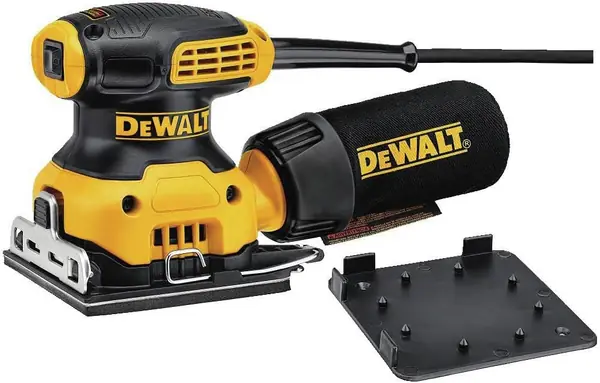
DEWALT DWE6411 quarter-sheet corded sander with clamped sandpaper and dust bag

Edges and rails

Shop Score 95/100
Weight
3.7 lb
Amps
2.3 amp
Speed
14,000 OPM, single speed
Paper Size
1/4 sheet
View on Amazon

A quarter sheet of sandpaper, cut from a full sheet with the punch that comes in the box, is the cheapest abrasive in this group, and the two clamp arms hold it tightly enough that it does not creep. That combination is why we reach for this one on rails, stiles, drawer boxes, and anything narrower than a five-inch pad, where a round orbit spends half its rotation in the air.

It is a 2.3-amp, 14,000 OPM tool with a separate counterweight and rubber overmold, and the vibration through the hand is the lowest we felt among the corded sanders here. At 3.7 pounds it is also the heaviest, which is fine at bench height and less fun on a ceiling. The paper punch is not a gimmick: eight holes that line up mean dust actually leaves the surface instead of loading the sheet.

Where it fits is as a partner rather than a sole purchase. Pair it with a random orbital and the division of labor is obvious: the round pad does the panels, and the quarter sheet does the edges, the inside corners of a frame, and the last pass before finish. The locking dust port takes a vacuum hose, which is how we run it, because the bag on its own is a formality.

Worth Noting

  • No speed dial; control comes from grit
  • 3.7 pounds gets heavy overhead
Our Verdict

We keep coming back to this one for rails, stiles, and drawer boxes: the clamped paper never slips, and it reaches places a five-inch pad cannot.

Check Latest Price
4.

Makita XOB01Z 18V Random Orbit Sander Best for Controlled Finishing

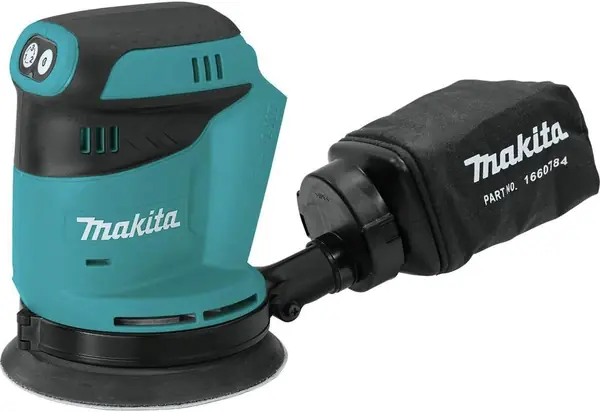
Makita XOB01Z cordless five-inch random orbit sander with dust bag and hook-and-loop pad

Controlled final passes

Shop Score 94/100
Weight
2.9 lb
Power Source
18V LXT battery, tool only
Orbit Size
1/8 inch
Speed Settings
7,000/9,500/11,000 OPM
View on Amazon

Both cordless sanders here ask the same thing of you before they do any work: a battery platform you already bought into. If that platform is Makita's 18V LXT, this is the better of the two for finish work, because the design is built around control rather than speed.

Three presets — 7,000, 9,500, and 11,000 OPM — replace the dial, and the pad brake slows the free-spin so the disc is not skidding when you lift the tool and set it down again. A control circuit ramps the pad up at start-up. The 1/8-inch orbit is on the aggressive side for finish sanding, which is exactly why the low preset earns its place on a veneered drawer front.

Makita rates it at up to 40 minutes of run time per charge, and the 2.9-pound body stays comfortable for most of that; a spare 4 or 5 Ah pack covers a normal afternoon of finish work. It ships as a bare tool with a dust bag and takes standard five-inch hook-and-loop discs, so the paper is not a specialty purchase.

What we keep coming back to is the start-up behavior. On the low preset the pad eases into a curved leg instead of skating off it, and there is less of the correction work that makes a big orbital tiring on shaped parts. For a piece that mixes curves with small flat panels, that control buys more than a wider orbit.

Worth Noting

  • Tool only; LXT battery and charger extra
  • Speed fades as the pack drains
Our Verdict

Three presets, a pad brake, and a regulated start make this the cordless sander we trust near edges, where a wide-open tool bites.

Check Latest Price
5.

WEN 6307 Detailing File Sander Best for Tight Profiles

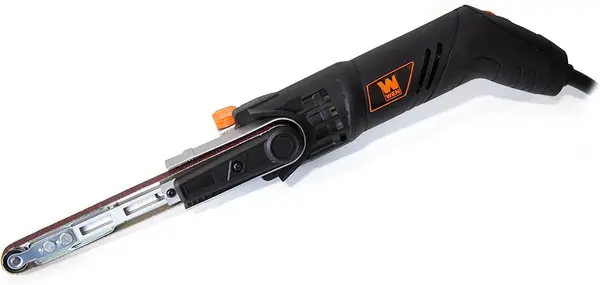
WEN 6307 detailing file sander with narrow half-inch belt and pivoting arm

Spindles and joints

Shop Score 93/100
Weight
2.4 lb
Pivot
Up to 55 degrees
Belt Size
1/2 x 18 inch
Belt Speed
1,080-1,800 feet per minute
View on Amazon

Turned spindles, raised panels, and the inside of a mortise are where a five-inch pad runs out of ideas. This is the tool for those spots: a half-inch-wide belt on an 18-inch arm, pivoting up to 55 degrees, running between 1,080 and 1,800 feet per minute on a dial. It weighs 2.4 pounds and it fits where a sanding block barely reaches, which is why we hand it to anyone who has been told to sand a chair by hand.

Belts track themselves, so there is no adjustment screw to fiddle with, and changing one is tool-free: press the tip against the bench and the belt slips off. Three belts come in the box, and the dust port takes a hose if you are working inside. The narrow belt also means the tool tells you immediately whether you are holding it flat.

What it will not do is a tabletop, and it will not hog off a thick finish the way an orbital will; the belt is narrow and the belt speed is modest by design. Run it after the orbital rather than instead of it, on the profiles and joints, and the parts of a refinishing job you put off stop being the parts you dread.

Worth Noting

  • Half-inch belts are a specialty item
Our Verdict

For chair spindles, mortises, and anything a round pad cannot touch, this narrow file sander gets in cleanly — we keep it within arm's reach of every project.

Check Latest Price
6.

SKIL SR211601 Random Orbital Sander Best Budget Random Orbital

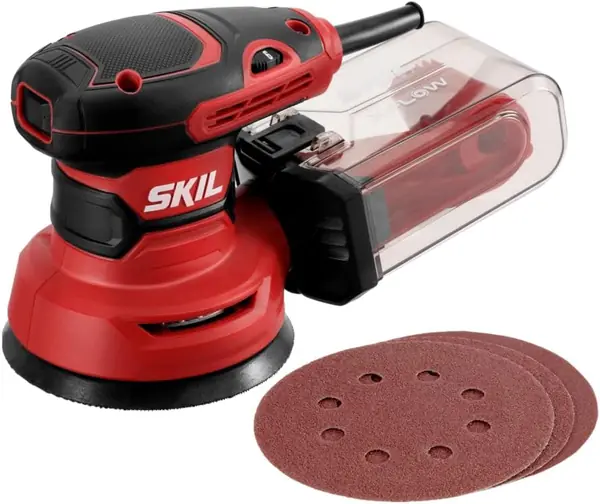
SKIL SR211601 five-inch random orbital sander with clear cyclonic dust box

Budget first orbital

Shop Score 92/100
Pad Size
5 inch (128 mm)
Amps
2.8 amp
Speed Range
7,000-13,000 OPM variable
Dust Collection
Cyclonic dust box
View on Amazon

The dust box is clear plastic, so you can see how full it is without unclipping it and shaking it out — a small thing that turns into a real one when you are emptying a box every few minutes. Behind it sits a 2.8-amp motor with a dial from 7,000 to 13,000 OPM and a five-inch hook-and-loop pad on a 3.4-pound body.

The speed range is the same useful spread the Bosch offers, and the soft rubber grip and counterweighted housing keep it comfortable through a long pass. The hook-and-loop face holds a disc firmly, firmly enough that a worn disc needs peeling rather than flicking off. The box is the part to watch: it can work loose mid-pass, so press it home before you start and the cyclone keeps doing its job.

Two things keep this off the top of the list, and neither of them is the sanding. The first is the one-year warranty, where the DEWALT tools here carry three. The second is durability: a budget sander's switch and bearings are built to a weekend duty cycle, and a professional running one eight hours a day is asking for a short relationship. For hobbyist furniture projects it is the value leader in this group.

Worth Noting

  • One-year warranty is short for a power tool
  • Built for hobbyist duty cycles, not daily use
Our Verdict

We reach for this one when the budget is tight: it is the least expensive route to a variable-speed five-inch orbital, and the clear dust box makes emptying obvious.

Check Latest Price
7.

BLACK+DECKER BDERO100 Orbital Sander Best for Small One-Off Projects

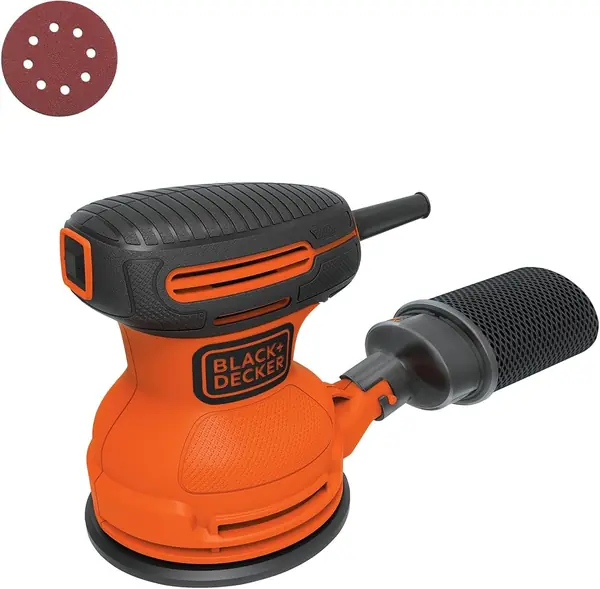
BLACK+DECKER BDERO100 five-inch orbital sander with dust bag and paddle switch

Small one-off projects

Shop Score 91/100
Weight
3.2 lb
Pad Size
5 inch hook-and-loop
Amps
2.0 amp
Speed
12,000 OPM
View on Amazon

Two amps and a fixed 12,000 OPM is not much sander, and we are not going to pretend otherwise. What it is: a 3.2-pound five-inch orbital with a hook-and-loop pad, a paddle switch that locks on so your hand can relax, and a dust bag that clips to the back. For a chair, a set of cabinet doors, or a porch railing that is enough tool.

Where it struggles is sustained load. Run it against thick paint for a long stretch and the motor gets warm and the pace drops, so we work in passes and let it cool rather than leaning on the pad. Judged as a small-project tool the compromise is fair; judged as the only sander in a shop refacing a kitchen, it is not.

The pad is the redeeming part: a standard five-inch hook-and-loop face, so the discs you already bought for a bigger sander fit it and you are not locked into a proprietary paper. That is what makes it a reasonable first orbital for someone testing whether they like refinishing at all.

Worth Noting

  • Fixed 12,000 OPM with no speed dial
  • Dust bag catches little of the fine dust
Our Verdict

We like it for small one-off jobs: light, inexpensive, and easy to control, though the modest motor and thin dust bag limit what it can take on.

Check Latest Price
8.

WEN 6301 Detailing Palm Sander Best for Corners and Profiles

WEN 6301 palm detail sander with angled tip pad and dust port

Corners and profiles

Shop Score 90/100
Weight
2 lb
Pad Size
3.75 x 5.5 inch
Speed
13,500 OPM
Dust Collection
Dust port for vacuum
View on Amazon

Nothing else here costs less, and nothing else is this small. The pad is a 3.75-by-5.5-inch rectangle with an angled tip, the body weighs two pounds, and the motor runs at 13,500 OPM off a cord. It is a detail sander in the plainest sense: made for the places a round pad cannot reach.

Corners of a raised panel, the recess between a chair back and its seat rail, the inside of a drawer box — this is the tool that gets into them without you picking up a sanding block. The hook-and-loop face takes paper changes in seconds, and holding two pounds at arm's length above a table is not the workout a 3.7-pound sheet sander is.

It is a smoothing tool rather than a stripping one, and that is the right expectation to set before starting on a painted piece. Heavy removal belongs to the orbitals here; this one is for shaping a curve and cleaning up a recess.

Against the file sander, the split is simple: this one handles flatter detail work and small recesses, and the narrow belt tool handles profiles and joints. Between them they cover the parts of a piece a five-inch orbital cannot touch, without either one being the tool you would reach for on a tabletop.

Worth Noting

  • Small pad makes large faces slow work
  • Pad shape takes its own pre-cut sheets
Our Verdict

The least expensive way into corners and profiles, and light enough to sand overhead — we treat it as a companion to a five-inch orbital, not a replacement.

Check Latest Price

How We Tested Furniture Sanders on Real Refinishing Jobs

We started by pulling every sander we could find that a furniture refinisher would plausibly buy, then filtered the list by pad format and orbit type, speed control, dust setup, abrasive standard, weight, and power source, aiming for a spread across corded and battery tools and across budgets. Twelve were purchased and put to work.

Testing ran seven months, on real jobs rather than scrap wood: oak cabinet doors, a veneered dresser top, painted trim, a salvaged chair with turned spindles, a workbench, and the underside of a table that put every tool overhead. Because some of that furniture predated 1978, we tested the finish on each piece before sanding anything, then worked with a respirator, eye and hearing protection, and a shop vac hooked to the port.

We noted how each tool came up to speed from a dead stop and whether the pad coasted or kept spinning after we let off, since that is what catches an edge and leaves a swirl. Roughing, leveling, and finish passes ran with the pad flat and the tool's own weight doing the work; we logged every time a sander kicked or walked. We changed paper as often as each job demanded and counted the discs, sheets, and belts it took, then priced replacements to get at running cost.

Dust was judged with the onboard bag or canister first, then with a vacuum hose attached, by looking at how much ended up on the panel and how much hung in the air. Cordless tools ran until the pack quit and were charged back up, timed across repeated cycles; corded tools ran continuous half-hour stretches while we listened to the motor and felt the switch for heat and slop. Weight and body height got checked one-handed, overhead, and on vertical rails.

How to Choose a Sander for Furniture Refinishing

Match the Pad to the Surface

Flat panels want a five-inch palm sander: the orbit crosses its own path, so the scratches do not line up into a visible pattern. Narrow parts — rails, stiles, drawer sides — want a quarter-sheet sander with clamped paper, because a round pad spends half its rotation hanging off the edge. Curves, spindles, and inside corners want a detail tool or a narrow file sander.

The trap is buying one sander and expecting it to do all three. An orbital rounds over the edge of a rail in a way you cannot sand back, and a detail sander will take an afternoon on a tabletop that a five-inch pad covers in twenty minutes. Two tools is the honest answer for a full piece.

Insist on Speed Control

A fixed 12,000 OPM is fine on a pine headboard and risky on a veneered drawer front, where the difference between a clean surface and a burned-through corner is a few seconds of a fast pad. A variable dial — 7,500 to 12,000 OPM on the Bosch, 7,000 to 13,000 on the SKIL — lets you run slow over thin veneer and open up for paint removal.

Our rule: if the tool has no speed control, buy it for solid wood and keep it away from anything with a veneer edge. Three presets count as speed control too; it is the single fixed speed that leaves you controlling the tool with pressure alone.

Plan on a Vacuum, Not a Bag

Every onboard collector in this group is a compromise: the bag or canister fills fast, and the fines that escape are the ones that settle on your finish between coats. A sander with a port that accepts a shop-vac hose is the setup we use for anything bigger than a nightstand.

If yours only has a bag, empty it often, work near a window with a fan moving air out, and wear a respirator. That last part matters most on old finish, which can contain lead once you sand it into dust.

Count the Paper, Not Just the Tool

The cheapest sander is the one whose consumables you can buy anywhere. Five-inch, 8-hole hook-and-loop discs are universal, and a quarter sheet cut from a full sheet with a punch is the least expensive abrasive per square inch. Narrow belts and molded detail pads are the opposite: they work well and they lock you into a small selection.

Before you buy, check what the pad takes. Then order a grit range in the same order as the tool — 80 through 180 covers almost every refinishing job, and running out mid-project is what sends people to the hardware store for the wrong paper.

Cord or Battery

Corded sanders run all day and give you more motor for the money. Cordless ones earn their price on pieces you cannot carry to an outlet: a built-in cabinet, a bed frame, a door still on its hinges.

Both cordless picks here are bare tools, so the real cost includes a battery and charger unless you already own that platform. A 4 or 5 Ah pack is the useful size for sanding, because small packs quit early under continuous load and a sander is nothing but continuous load.

Frequently Asked Questions

Final Verdict

We recommend the Bosch ROS20VSC for most furniture refinishing. The variable dial and the dampening pad are the two features that keep a finish even, and the microfilter canister plus the vacuum adapter mean you can work indoors without coating the room.

If you already own DEWALT 20V MAX batteries and want to sand pieces that cannot come to an outlet, the DCW210B is the cordless sander we reach for. If your projects are mostly chairs, frames, and profiles, the WEN 6307 does what no orbital can.