↑↓ navigate ↵ open Esc close All results →

Best Sanding Discs for Orbital Sanders of 2026

Bulk sanding discs look interchangeable online until a box of 100 lands on the bench and exposes every corner cut in manufacturing. Weak backing separates from the sander pad halfway through a tabletop, hole patterns miss the dust ports, or an imbalanced assortment leaves drawers full of 400-grit paper with nothing coarse enough to strip old finish.

Working through 16 packs of five-inch hook-and-loop discs over five months on pine, oak, painted trim, and automotive panels showed that disc failure usually starts at the attachment layer or misaligned dust holes rather than the mineral grain. Running every sander hooked to a shop vac with a respirator on for fine grits made hole alignment and mesh airflow immediately obvious.

Clear grit printing on the back also prevents grabbing 80-grit when you meant 120, saving finish coats from accidental re-sands across stripping, between-coat scuffing, wet sanding, and net-disc dust extraction.

Our Top Picks

The Best Sanding Discs for Orbital Sanders

1.

WORKPRO 150-Pack Sanding Discs Best Overall
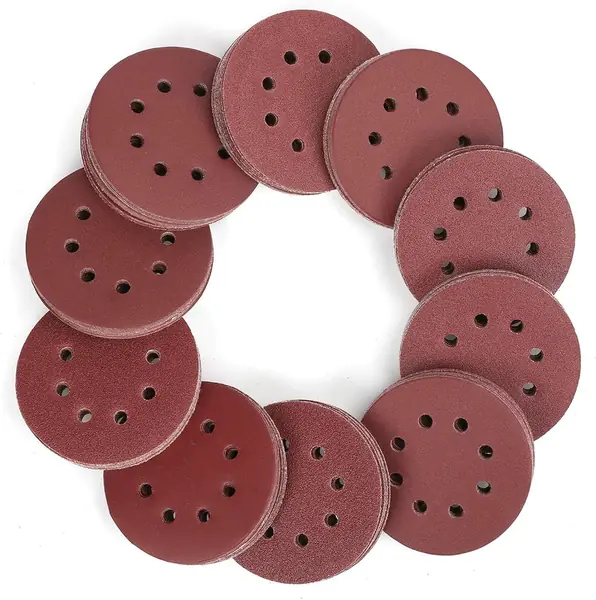
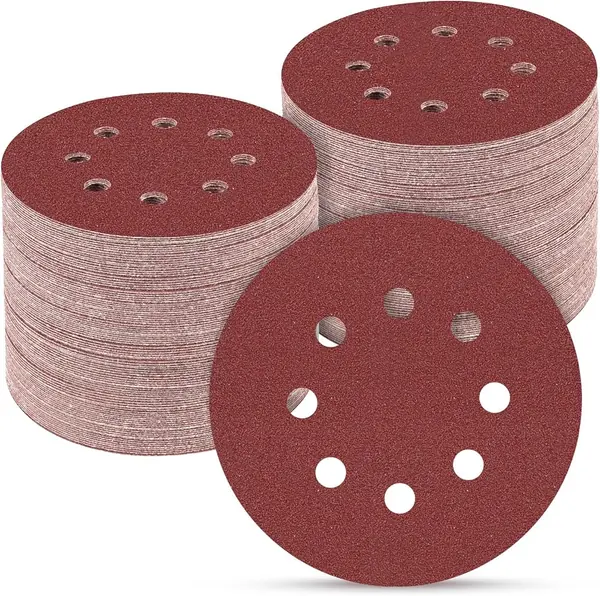
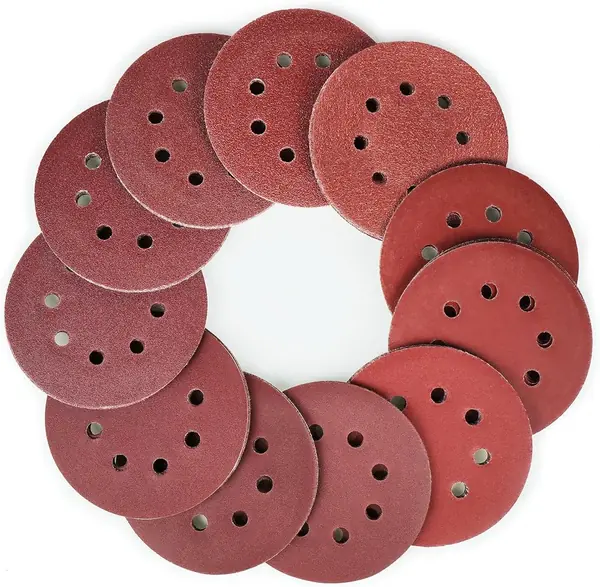
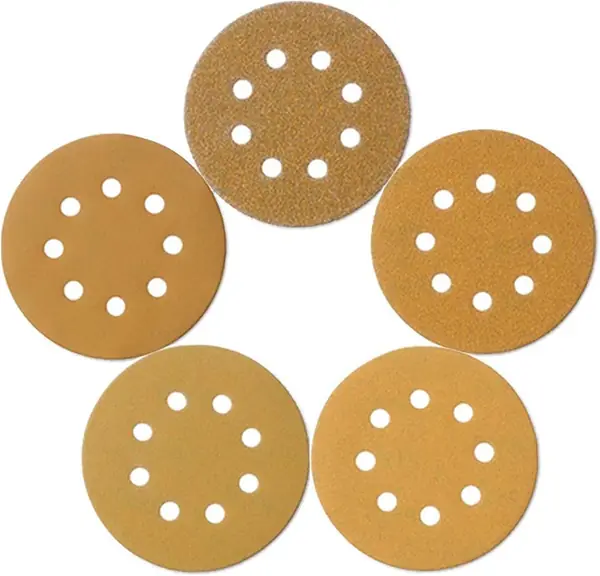
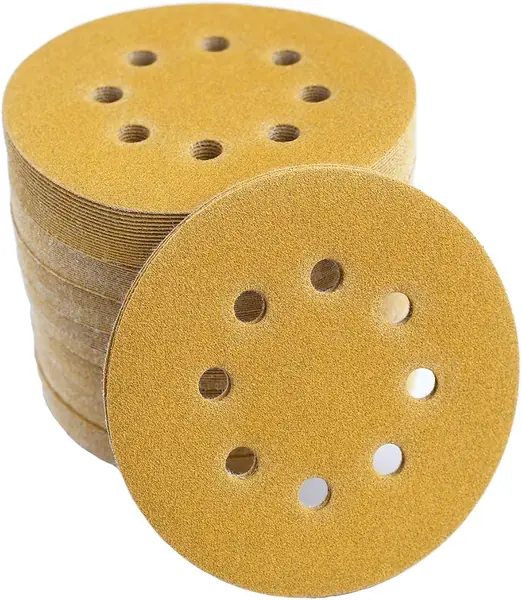
WORKPRO 150-pack 5-inch hook-and-loop sanding discs with 8-hole dust pattern

General woodworking

Shop Score 97/100
Quantity
150 discs
Disc Diameter
5 inches
Grits Included
60/80/100/120/150/180/240/320/400/600
Dust Holes
8
View on Amazon

Ten grits in one box is what settles this for us. Most assortments here stop at 220 and leave you shopping again the moment a project reaches topcoat prep; this one runs 60/80/100/120/150/180/240/320/400/600, so the same box strips, levels, and finishes. We like the coarse end most: a fresh 60 takes a glued-up panel down quickly, and the count is generous enough that you reach for another disc instead of nursing a tired one.

Aluminum oxide on a napped hook-and-loop backing, with eight holes punched to the ring a standard 5-inch pad uses. At 150 discs it works out to the lowest cost per disc of anything here, and that is not a small thing in practice. Cheap discs mean you change one the moment it dulls. Fresh abrasive is what gives you an even scratch pattern across a panel, and this box makes fresh abrasive the easy choice.

The gap is at the bottom: there is no 40 grit. For paint removal or knocking down a thick glue line you'll want a separate coarse pack, and that's the only place this set leaves you short. Between 60 and 600 the sequence has no awkward jump, no point where you're forced from 120 straight into 220 and left hoping the scratch closes up.

Wear is the other thing we noticed. These cut fast and then fade, so treat them as consumables rather than investment abrasives. On a clean pad they hold; on a pad packed with dust, no disc of any brand will. If you want fewer discs that keep their edge longer, Mestool's five-grit set is the tougher box; if 120 is your workhorse, Aiyard's hundred-pack is the smarter refill.

Worth Noting

  • Discs wear out faster than premium abrasives
Our Verdict

The box we hand most woodworkers first: ten grits from 60 to 600, the lowest cost per disc here, and enough of them to swap instead of nurse.

Check Latest Price
2.

Mestool 100-Piece Sanding Discs Best for Furniture Refinishing

Mestool 100-piece 5-inch 8-hole hook-and-loop sanding discs in mixed grits

Furniture refinishing

Shop Score 96/100
Quantity
100 discs
Disc Diameter
5 inches
Grits Included
60, 80, 120, 150, 220
Dust Holes
8
View on Amazon

Twenty discs at each of five grits, evenly split, is a different proposition from a box that front-loads the coarse grades. Mestool gives you 60, 80, 120, 150, and 220 in equal stacks, and that matches how refinishing actually eats paper: a couple of coarse discs to strip a top, then a long run of 120 and 150 that vanishes before the project does.

The discs are aluminum oxide with a resin-over-resin bond and an anti-clog coating, and the maker names the pads they're cut for: DeWalt's DW421 and DW423, Bosch's 3107 and 3725, Makita's B05010, and 5-inch Ryobi sanders. The eight holes sit on the standard ring, so dust keeps moving through the pad instead of loading the surface you're trying to flatten.

What earned this box a place for us is behavior under load. A disc that glazes over keeps sliding without cutting, and that's the failure that makes cheap paper expensive, because you keep sanding and produce nothing. These keep biting, and the grit stays consistent from disc to disc, so the scratch you establish at 120 is still there to refine at 150. The ceiling is 220, which is why we call it a refinishing box rather than an everything box.

Worth Noting

  • Finest grit is 220, so topcoat work needs another box
Our Verdict

Our pick for refinishing: even 20-disc stacks from 60 to 220, and grit that keeps biting under a heavy pass instead of glazing over.

Check Latest Price
3.

Aiyard 120-Grit Sanding Discs Best Single-Grit Refill

Aiyard 100-pack 5-inch gold hook-and-loop sanding discs in 120 grit

Restocking one grit

Shop Score 95/100
Quantity
100 discs
Disc Diameter
5 inches
Dust Holes
8
Grit
120
View on Amazon

One grit, one hundred discs. That reads as a limitation until you've watched a 120-grit disc give out halfway across a tabletop and realized the mixed boxes never give you enough of the grade you actually live on. Aiyard sells the refill instead of the sampler, and for anyone past a first project that's the more useful shape.

Fused alumina grain on a high-density flocking backing, bonded with a resin the maker builds for wear resistance and flexibility. In the hand these feel like cloth-backed discs rather than stiff paper, which matters at a contoured edge: a brittle disc cracks and lifts, a flexible one follows the curve and keeps cutting. The eight holes line up cleanly on a 5-inch pad, which is what keeps dust moving instead of packing the surface.

Where the box earned its recommendation is consistency. Grit to grit and disc to disc the cut stays the same, so a scratch pattern you establish early is one you can still refine later instead of chasing stray deep marks with the next grade up. We kept a stack of these on the bench for finish passes and stopped digging through the mixed boxes for a 120 that hadn't already been used twice.

Worth Noting

  • Only one grit in the box
  • Costs more per disc than the mixed boxes here
Our Verdict

The one we restock without thinking: a hundred 120-grit discs with the steadiest cut here, sold as a refill rather than a sampler.

Check Latest Price
4.

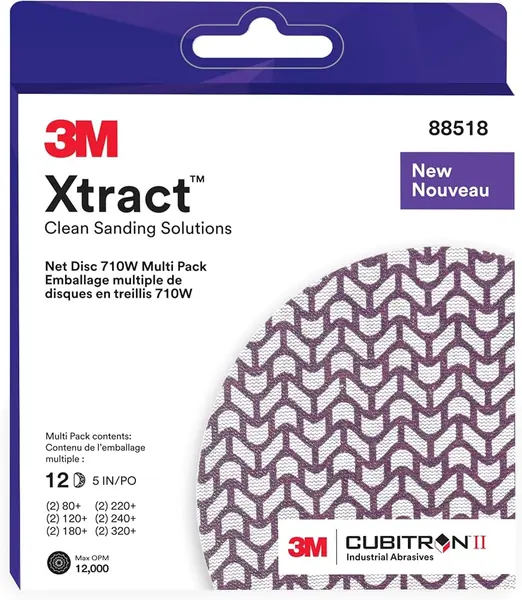
3M Xtract Cubitron II Net Disc 710W Best for Dust Extraction

3M Xtract Cubitron II net sanding discs in assorted grades with mesh backing

Dust-free sanding

Shop Score 94/100
Quantity
12 discs
Disc Diameter
5 inches
Grits Included
80+, 120+, 180+, 220+, 240+, 320+
Backing
Net, hook and loop
View on Amazon

Punch eight holes in a disc and dust gets one narrow path out. These skip the holes entirely: the whole disc is a mesh, so the sander's extraction pulls dust through the abrasive rather than around its edge. Sand a panel with one and the surface stays visible while you work instead of disappearing under a film of dust.

Cut rate is the other half of it, and it's the part that surprised us. 3M's precision-shaped grain fractures into fresh edges as it dulls, and these cut with noticeably less pressure than the coated discs here. We found ourselves letting the sander's weight do the work rather than leaning on it, which is easier on the pad and on the finish underneath.

Twelve discs across six grades, 80+ through 320+, is a finishing sequence more than a stripping box. They also come back to life: knock the dust out with a vacuum and the mesh opens up again, so a disc that looks spent often has another panel in it.

What you pay for is dust control and speed, and abrasive life doesn't keep pace with the price; the cut fades well before the mesh wears through. That's an easy trade indoors or in a client's house, and a harder one for a shop running a cyclone and buying paper by the case.

Worth Noting

  • Highest cost per disc in this guide
Our Verdict

The one we reach for indoors: the mesh lets extraction pull dust through the disc, and it cuts with less pressure than anything else here.

Check Latest Price
5.

POTUINOM 165-Piece Sanding Discs Best Starter Set

POTUINOM 165-piece 5-inch 8-hole hook-and-loop sanding discs in mixed grits

First-time buyers

Shop Score 93/100
Quantity
165 discs
Disc Diameter
5 inches
Grits Included
40, 60, 80, 120, 150, 240, 320, 400, 600
Dust Holes
8
View on Amazon

Forty grit is the disc that takes a cupped board back to flat, and it's the grade most mixed boxes quietly skip. This set starts there and climbs to 600 in nine steps, 40, 60, 80, 120, 150, 240, 320, 400, and 600, which is one of the widest coarse-to-fine spans among the budget boxes here.

Aluminum oxide, heat-treated for abrasion resistance, on a thick fleece backing, with eight holes punched for a standard 5-inch pad; the maker lists Bosch, DeWalt, Makita, and Ryobi sanders as fits. The coarse end is what we reached for. A 40 does work no 60-grit disc will do, and having 150 in the box means you can bridge the gap between 120 and 240 without improvising.

Treat it as a working box rather than a long-term one. There are 165 discs here, so you get plenty of chances at whatever grade is cutting, and the fleece backing grips a clean pad firmly. It's the box we hand a beginner who doesn't yet own a single disc, because it answers the question of which grits a real project actually consumes before you spend anything on a hundred of one thing.

Worth Noting

  • Discs wear out faster than premium abrasives
  • Backing can let go on a worn pad
Our Verdict

We point beginners here: nine grades starting at 40, 165 of them, at a per-disc cost that doesn't sting.

Check Latest Price
6.

S&F Stead & Fast Wet/Dry Sanding Discs Best for Wet Sanding

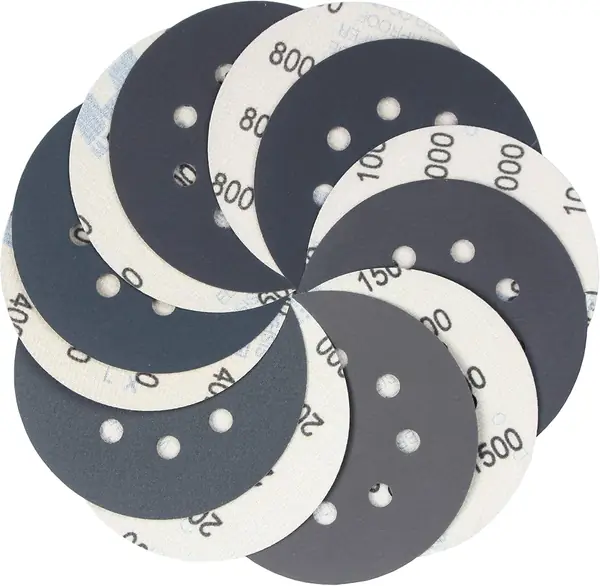
S&F Stead & Fast 5-inch silicon carbide wet and dry sanding discs in fine grits

Wet sanding

Shop Score 92/100
Quantity
60 discs
Disc Diameter
5 inches
Grits Included
400, 600, 800, 1000, 1500, 2000
Abrasive
Silicon carbide
View on Amazon

Water and sandpaper usually end badly. Silicon carbide doesn't care about water, which is why everything in this box runs from 400 to 2000 and gets used wet: leveling a film finish, knocking down orange peel, working gelcoat smooth without the abrasive loading solid halfway through the pass.

Ten discs at each of 400, 600, 800, 1000, 1500, and 2000, on waterproof backing paper with eight punched holes for a standard 5-inch pad. There's a tack cloth in the box too, which reads as a throw-in until you've tried wiping sanding slurry off a topcoat with a rag that leaves lint behind.

Where it earns its place is the last stretch of a finish. A 600 or 800 disc scuffs a coat of poly without cutting through it, and 1500 and 2000 take out the last scratches before the final wipe. Six grades in one box means you stop improvising with whatever's loose in the drawer and start working a sequence instead.

Worth Noting

  • Nothing coarser than 400 grit
Our Verdict

Our finish-work box: silicon carbide through 2000 grit, waterproof backing for wet sanding, and a tack cloth for wiping between passes.

Check Latest Price
7.

Dura-Gold 5-Inch Gold Sanding Discs

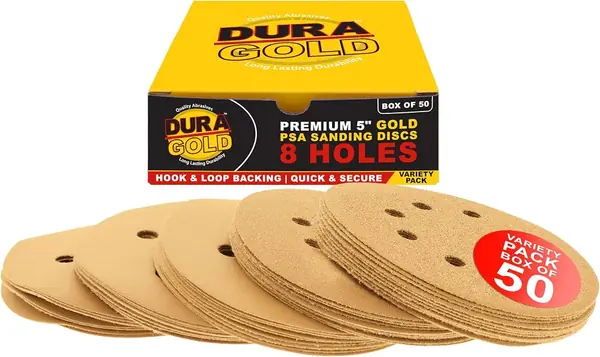
Dura-Gold gold 5-inch 8-hole hook-and-loop sanding discs in five grits

Paint prep

Shop Score 91/100
Quantity
50 discs
Grits Included
60, 80, 120, 220, 320
Dust Holes
8
Abrasive
Aluminum oxide, zirconia alumina
View on Amazon

Aluminum oxide blended with zirconia alumina is the difference here, and it shows up as an edge that keeps cutting after a plain aluminum oxide disc has gone smooth. That's what the extra money buys.

You get fifty discs, ten each of 60, 80, 120, 220, and 320, on an 8-hole pattern cut for a standard 5-inch pad. It's a working sequence for repair and paint prep rather than a full progression, with no 150, no 180, and nothing finer than 320, but for leveling a patch, feathering an edge, and prepping for primer it covers the steps.

The discs also behave well in the hand. They resist tearing when you fold one over an edge to soften a corner, and the backing sits flat when you press it down firmly rather than riding up at the rim.

Where this box loses ground is volume. Fifty discs is the smallest count here after the 3M pack, and the cost per disc is the second highest in this guide, so it suits someone doing finish work on a handful of pieces rather than a shop burning through paper on framing stock. We liked it as the box that stays on the shelf for the good jobs.

Worth Noting

  • Second-highest cost per disc here
Our Verdict

We keep this one for repair and paint prep, where the zirconia blend keeps cutting and the five-grit spread covers the steps.

Check Latest Price
8.

LotFancy 110-Pack Sanding Discs

LotFancy 110-pack 5-inch 8-hole hook-and-loop sanding discs, 40 to 1000 grit

Wide grit range

Shop Score 90/100
Quantity
110 discs
Disc Diameter
5 inches
Grits Included
40, 60, 80, 100, 120, 180, 240, 320, 400, 800, 1000
Dust Holes
8
View on Amazon

Eleven grades from 40 to 1000 is the widest span in this guide, and it's the whole argument for the LotFancy box: 40, 60, 80, 100, 120, 180, 240, 320, 400, 800, and 1000 in one 110-disc pack.

The value is the other half. Per disc this is among the cheapest ways here to get a full progression, and the eight holes line up cleanly on a standard 5-inch pad. In practice that means you can start at 40 on rough stock, work up to 220 before finish, and still have 400 through 1000 for between coats without buying a second box.

The catch is the backing. On a pad that has seen a lot of sanding these come loose well before the grit is spent, and a disc that lets go mid-pass leaves a scuff you have to chase out. A fresh pad and a light hand with pressure keep them planted; if your backing pad is years old, order a new one alongside.

Worth Noting

  • Disc life is shorter than premium paper
Our Verdict

We recommend it as the one box here spanning 40 to 1000 grit, at a per-disc cost that makes trying a new grade painless.

Check Latest Price
9.

FRIMOONY 60-Piece Fine Grit Discs Best for Between-Coat Sanding

FRIMOONY 60-piece 5-inch 8-hole hook-and-loop sanding discs in fine grits

Between-coat sanding

Shop Score 89/100
Quantity
60 discs
Disc Diameter
5 inches
Grits Included
240, 320, 400, 600, 800, 1000
Dust Holes
8
View on Amazon

Everything in this box is finer than 240, which is either exactly what you need or useless, depending on where you are in a project. Ten discs each of 240, 320, 400, 600, 800, and 1000.

The grit is printed on the back of every disc, which sounds trivial until you're sorting five near-identical gray discs on a bench. And 240 through 1000 is the range a random orbital does well: fine enough to polish a film, coarse enough at the low end to still cut rather than skate.

Buy it for between coats and final rubbing, not for prep. The fine grades load quickly on soft finishes, so keep the sander's speed down and the dust moving; a slow pass with a 400 does more for a topcoat than a fast one with a 240.

Worth Noting

  • Nothing coarser than 240 grit
Our Verdict

Our fine-grit box: everything here is 240 or finer, which makes it the set for between coats and final rubbing rather than prep.

Check Latest Price
10.

YNZDRWA 70-Piece Sanding Discs

YNZDRWA 70-piece 5-inch 8-hole sanding discs in nine mixed grits

Budget starter box

Shop Score 88/100
Quantity
70 discs
Disc Diameter
5 inches
Grits Included
40, 80, 120, 180, 240, 320, 400, 600, 800
Dust Holes
8
View on Amazon

Nine grits from 40 to 800 for the smallest outlay in this guide. If you're equipping a first sander and don't yet know which grades you'll burn through, that's the cheapest way to find out: 70 discs, five at 40 and eight or nine at each grade above it.

The discs fit a standard 5-inch pad on the usual 8-hole pattern, and the holes line up, which shouldn't need saying but does with inexpensive paper. The range covers more than most beginners need in one box: 40 through 800 gets you from stripping paint to a surface ready for finish.

Where it makes sense is rough work: deck boards, framing, a fence, anything where you want a coarse disc and don't want to think about what it costs. It also does the job a starter box should do, which is show you which two or three grades you actually wear out before you buy a hundred of anything.

Worth Noting

  • Short disc life
  • Backing can slip on a hot pad
Our Verdict

The cheapest way we know to find out which grits you burn through, with nine grades and enough discs for a first project.

Check Latest Price

How We Tested Orbital Sander Discs

We started with a couple dozen listings and narrowed to 5-inch discs with hook-and-loop backing, since a disc that doesn't match your pad's diameter and attachment style is a return waiting to happen. That left 16 packs, which we used over five months on a painted dresser, an oak tabletop, pine trim, cabinet doors, a car fender headed for paint, and a clear coat that needed wet sanding. Every sander ran to a shop vac, and we wore respirators for the fine grits.

Adhesion got the first test: we stuck each disc to a pad, ran it along a board edge where a disc catches, then peeled it off and re-stuck it to see if it still held. For abrasive life, we counted how many passes a disc made before it stopped cutting and started polishing, and how quickly it loaded up on paint and resinous wood. We also worked grit progressions the way a project goes, 60 or 80 to strip and then 120, 150, 220, because a set that skips a step sends you back to the store for the missing grit.

For dust, we held each disc against the pad to see whether the punched holes lined up with the sander's, then compared what landed on the bench with what went up the port; net-backed discs got the same passes with no holes to line up at all. We flipped discs over mid-change to see whether the grit was readable under shop light, and figured cost per disc from what a dresser and a set of cabinet doors actually consumed.

How to Choose Sanding Discs for an Orbital Sander

Match the Disc to the Pad First

Start with diameter and hole pattern. Five inches is the common size and every disc here is cut for it, but eight holes is not one universal standard: the ring the holes sit on varies between makers, and one listing here spells out its geometry in fractions of an inch precisely because it isn't obvious. Hold a disc up to your pad before you commit to a hundred of them.

If the holes fall between your pad's ports, extraction drops to almost nothing and the surface loads up instead of clearing. A disc that is flat on the pad and lined up will out-sand a better abrasive that is misaligned.

Build a Grit Progression, Not a Grit Pile

The useful bands are 40 to 60 for stripping and shaping, 80 to 120 for leveling, 150 to 180 before finish, and 220 and up for between coats. What matters is the size of each step. Going from 80 to 120 is fine; going from 80 to 220 leaves the coarse scratches sitting under your finish, and they show the moment light rakes across the surface.

Check the sequence against your job rather than the count on the box. One set here starts at 60 with no 40, another stops at 220 with nothing finer, and both are complete for some projects and short for others.

Punched Holes or Net Backing

Punched-hole discs move dust only where the holes line up with your pad's ports. Net discs skip the alignment problem entirely, because the abrasive itself is a mesh, so extraction works across the whole face and you can see the surface while you sand.

Net costs more per disc and its edges are more delicate. Indoors, in a garage, or in someone else's house, that trade is usually worth it. Outside with a breeze at your back, punched holes do the job and cost a lot less.

Hook and Loop Fails at the Pad, Not the Disc

Nearly every box here has a few buyers unhappy about adhesion, and the pad is usually the reason: dust packed into the hook surface, a backing pad gone smooth, or too much pressure heating the loop until it releases. Clean the hook with a stiff brush, keep a spare pad on the shelf, and let the tool's weight do the cutting.

If a disc won't stay on a pad that grips other brands, replace the pad before you blame good sandpaper.

Buy the Volume You'll Actually Finish

A mixed box is the right first purchase because it tells you which grades you burn through. After that, buy the two or three grits you actually wear out in bulk and stop paying for the grades that sit in the drawer.

Compare cost per disc, not the price on the box. A big box of the same abrasive is almost always the better deal, and a cheap disc that dies early costs more in the end than a good one that keeps cutting.

Frequently Asked Questions

Final Verdict

For most woodworkers the WORKPRO 150-pack is the box to buy: ten grits from 60 to 600, the lowest cost per disc here, and enough discs that you swap one instead of nursing it. Add a small 40-grit pack for stripping and you have the whole progression covered.

If dust is the thing that keeps you out of the shop, the 3M Xtract net discs change what sanding indoors feels like. And if your work lives on one or two grades, Aiyard's hundred-pack of 120 is the refill that makes more sense than another sampler.