↑↓ navigate ↵ open Esc close All results →

Best 5-Inch Random Orbital Sanders of 2026

Finish quality usually comes down to prep work, and a 5-inch random orbital sander strips a dresser or porch door in an afternoon without leaving the circular swirl marks of a plain rotary disc. Budget sanders give themselves away quickly once work begins: hands go numb from high vibration, dust bags pop loose the moment the tool tilts, and nonstandard exhaust ports refuse to mate with a shop vacuum.

Running 12 corded and cordless sanders across paint removal, flat panels, and edge work for eight months shifted focus to what shows up past the first hour. Real-world usability hinged on vibration damping, dust port sizing, bag retention, and how slow the variable-speed dial actually turns at its lowest setting.

Balancing corded endurance against cordless reach comes down to shop layout, though every viable model keeps its pad flat on the stock and holds its dust collection in place.

Our Top Picks

The Best 5-Inch Random Orbital Sanders

1.

DEWALT DWE6423K 5-Inch Random Orbit Sander Best Overall
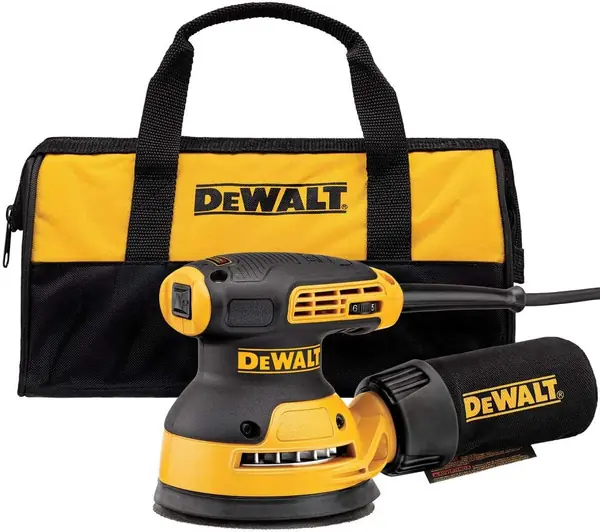
DEWALT DWE6423K 5-inch corded random orbit sander with dust bag and carrying bag

General woodworking

Shop Score 97/100
Pad Size
5 inches
Motor
3 amp
Speed Range
8,000-12,000 OPM
Included
Dust bag and carrying bag
View on Amazon

Speed control is the whole argument for this sander, and it isn't a marketing line. Backing the dial from 12,000 down to 8,000 orbits per minute lets you feather a veneer edge or cross a coat of paint without cutting through it, and there's enough usable range between those numbers to matter on real projects. Of the corded sanders in this group, it's the one we kept reaching for.

The separate counterweight is the other reason it stays in our hands. Vibration is what ends a sanding session early, and this DEWALT keeps it low enough that a few hours over a glued-up panel doesn't leave your fingers buzzing. The rubber overmold runs through both the grip and the body, and the low profile puts your hand close to the work, which is where it has to be to keep a pad flat.

Dust handling is simple and it works: an 8-hole hook-and-loop pad, a bag that locks on with one hand, or a direct connection to DEWALT's DWV010 and DWV012 extractors. Paper changes take seconds, the pad is replaceable, and the dust-sealed switch is the unglamorous detail that keeps a sander alive in a shop where it runs every week.

Ownership has been uneventful, which is the highest compliment we can pay a power tool. The kit arrives with a dust bag and a soft carrying bag rather than a hard case, so it lives on a shelf instead of in a box. If a hard case matters to you, the Makita BO5030K below is the one to look at.

Worth Noting

  • Cord is short for full-sheet work
Our Verdict

This is the corded sander we recommend to most woodworkers: variable speed, low vibration, and the steadiest build in this group.

Check Latest Price
2.

Bosch ROS20VSC 5-Inch Random Orbit Sander Best for Dust Collection

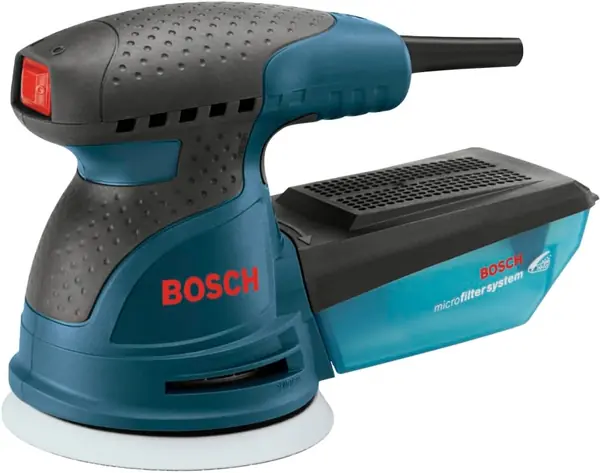
BOSCH ROS20VSC 5-inch palm random orbit sander with microfilter canister and soft carrying bag

Dust-sensitive shops

Shop Score 96/100
Pad Size
5 inches
Motor
2.5 amp
Speed Range
7,500-12,000 OPM
Dust Filtration
Down to 1/2 micron
View on Amazon

The canister is the reason to look at this Bosch. It's a microfilter unit rated to trap particles down to a half micron, and the effect in a closed shop is a real drop in the fine haze that hangs in the air after a session. Bosch includes a vacuum hose adapter as well, so you can run the canister on small work and switch to a shop vac for a whole room. Bosch calls it a palm sander, and it sits in the hand like one.

What we didn't expect was how quiet it runs. Against the other corded models here, this is the calmest by a clear margin, and the soft top grip passes very little vibration into your hand. The variable-speed dial covers 7,500 to 12,000 OPM — a narrower window than the Makita offers, but more than enough for finish work and for easing into a pass on a delicate surface.

The 2.5 amp motor sets the boundary: this is a sander for refining a surface, not for stripping a house full of painted trim. Point it at heavy removal and you'll wait, and you'll work the tool harder than it wants. Long-term durability is the open question, since these either run for years of careful use or give up early — but as a finish sander for furniture and cabinets, it's the most pleasant tool in this group to run for an afternoon.

Worth Noting

  • Canister is awkward to open and empty
Our Verdict

If dust is what drives you out of the shop, we point to this Bosch for its microfilter canister and its remarkably quiet motor.

Check Latest Price
3.

Makita BO5041 5-Inch Random Orbit Sander Best for Edges and Detail Work

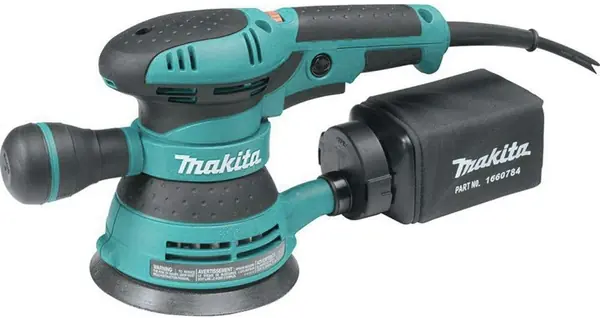
Makita BO5041 5-inch corded random orbit sander with adjustable front handle and rubberized grip

Edges and contours

Shop Score 95/100
Pad Size
5 inches
Motor
3 amp
Speed Range
4,000-12,000 OPM
Front Handle
Adjustable and removable
View on Amazon

The front handle unscrews and repositions at any angle, and that single detail is why this sander handles edges and contours better than anything else in the group. Run it along a rounded table edge or a curved rail and you can put your second hand exactly where it steadies the pad, rather than where the housing happens to leave room for it.

The speed dial also reaches lower than the others, down to 4,000 orbits per minute. That's slow enough to work a delicate veneer or a coat of finish without burning it, and it's the setting we came back to on furniture parts. The two-finger trigger with a lock-on button is a small mercy over a long session; you aren't holding a paddle down with your thumb for an hour.

Four thousand orbits per minute is the number that sells it, and the handle is what makes it usable on shapes instead of flat stock. It's also the largest-bodied corded sander here, and smaller hands may find the grip a stretch. Everyone else gets a tool with rubberized palm surfaces and ball-bearing construction that feels planted, and stays that way through a long afternoon of shaping.

Worth Noting

  • Dust bag can work loose mid-session
  • Premium price for a corded model
Our Verdict

Our pick for edges and contours, where the repositionable front handle and a 4,000 OPM floor give you control the others can't match.

Check Latest Price
4.

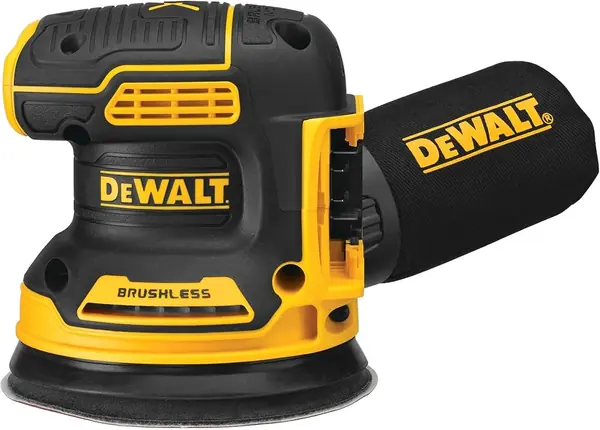
DEWALT DCW210B 20V MAX Random Orbital Sander Best Cordless

DEWALT DCW210B 20V MAX cordless 5-inch random orbital sander with dust bag, tool only

Cord-free finishing

Shop Score 94/100
Pad Size
5 inches
Speed Range
8,000-12,000 OPM
Battery
20V MAX, sold separately
Weight
2.5 lb
View on Amazon

A cordless sander only makes sense if the batteries are already paid for, and this DEWALT assumes exactly that. The real cost depends on what's on your shelf, because a sander is one of the hungrier tools on any battery platform — hungrier than a drill and closer to a circular saw. For a shop already running 20V MAX packs, the math works out neatly. For anyone else, it doesn't.

What you get in return is a genuinely cord-free sander. The brushless motor runs 8,000 to 12,000 OPM and holds its speed under load the way a plug-in tool does, and at 2.5 lb the body is the lightest in this group — obvious the moment you work overhead or lean across a bench for the fourth hour. The low, flat housing keeps your hand near the workpiece instead of perched on top of it.

Runtime is the variable you manage rather than a fixed number. Run it on a 4.0 or 5.0 Ah pack and it keeps up with a corded sander through a session; run it on a compact pack and you'll be walking back to the charger mid-panel. That's the trade for the cord, and it's a fair one if your packs are big.

Dust runs through an 8-hole hook-and-loop pad to a small bag, or straight into DEWALT's DWV010 and DWV012 extractors if you own one. The dust-sealed switch and the replaceable pad tell you DEWALT expects this thing to live on a job site rather than a hobby bench. If you aren't already on the platform, the corded DWE6423K above is the cheaper way into the same sanding performance.

Worth Noting

  • Bare tool; battery and charger sold separately
Our Verdict

For anyone already on the 20V MAX platform, this is the cordless sander we recommend, as long as you own packs big enough to feed it.

Check Latest Price
5.

SKIL SR211601 5-Inch Random Orbital Sander Best Budget

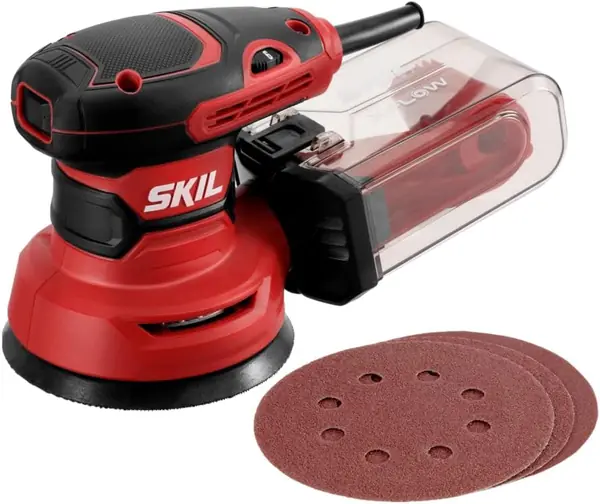
SKIL SR211601 5-inch corded random orbital sander with transparent cyclonic dust box

Small jobs

Shop Score 93/100
Pad Size
5 inches
Motor
2.8 amp
Speed Range
7,000-13,000 OPM
Included
3 sanding sheets
View on Amazon

Thirteen thousand orbits per minute is the top of this sander's range, and that's higher than several sanders here that cost more. The 2.8 amp motor won't out-muscle a 3 amp DEWALT, but the dial spans 7,000 to 13,000 OPM, which is the widest spread in this group — useful when you want slow and controlled for a finish pass and fast for a rough one.

The cyclonic dust box is the interesting part of the design. It's transparent, so you can see when it needs emptying, and it works without bags to buy or canisters to wrestle open. Cyclone collection is a genuinely good idea at this price, and it's the feature that makes the sander feel less like a compromise than it is.

In the hand it's compact and reasonably light at 3.4 lb, with a soft rubber grip and a counterweight that keeps the buzz tolerable through a couple of hours. The narrower body fits where a bigger sander won't, which is why it earned its place here: trim, a cabinet door, a patched section of decking, all the small jobs that don't justify a bigger tool.

We recommend it as a budget sander for small jobs, not as the only sander in a working shop. It's the lowest-priced tool in this group, and a sander this inexpensive trades away long-term durability for that price. If you sand a few times a month and you want variable speed without spending much, none of that will trouble you.

Worth Noting

  • Dust box can pop off mid-session
Our Verdict

We recommend this SKIL when the budget is small and the projects are too, provided you can live with a dust box that wanders.

Check Latest Price
6.

Makita BO5030K 5-Inch Random Orbit Sander Best for Simple Flat-Panel Sanding

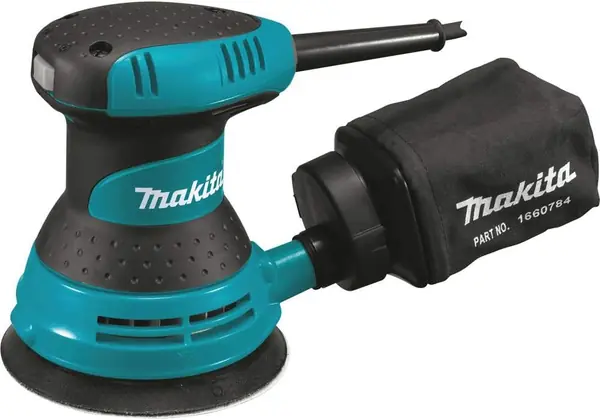
Makita BO5030K 5-inch corded random orbit sander with dust bag and plastic tool case

Simple flat-panel sanding

Shop Score 92/100
Pad Size
5 inches
Motor
3 amp
Included
Plastic tool case
Speed
12,000 OPM
View on Amazon

One speed, all ball bearings, and a hard plastic case: this is the plainest sander Makita makes, and it's the version a lot of shops keep on the shelf. The 3 amp motor runs a fixed 12,000 OPM, with no dial to think about and nothing to bump out of position mid-pass.

We like it for exactly that reason. The pad control system eases the disc up to speed instead of slamming it down on the panel, the through-the-pad dust collection with the wide-mouth bag keeps the bench reasonably clear, and at 2.87 lb it's light enough to run one-handed on a vertical surface. It balances well and it feels like a tool that was built to be used hard.

Where it differs from our top pick is adjustment. There's no way to slow the pad for a delicate pass, so edging and veneer work take a lighter hand and a finer disc. If you never touch the speed dial on the sander you already own, this one gives you the same sanding with a case to carry it in.

Worth Noting

  • Hook-and-loop pad loses grip as it wears
Our Verdict

A straightforward recommendation for anyone who wants one speed and a case: this Makita sands smoothly and shrugs off hard use.

Check Latest Price
7.

CRAFTSMAN CMEW231 5-Inch Random Orbital Sander Best for Stripping and Smoothing

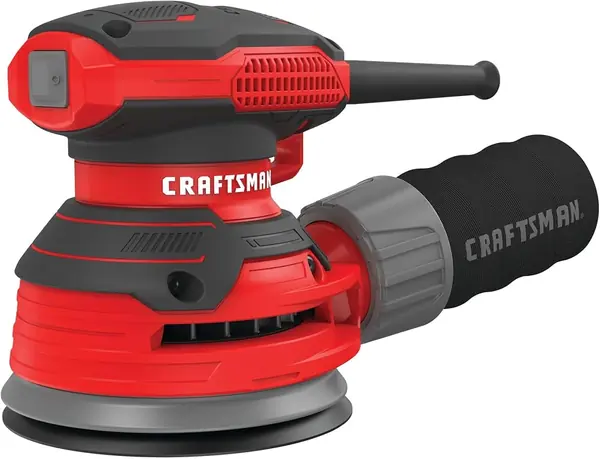
CRAFTSMAN CMEW231 5-inch corded random orbital sander with onboard dust bag and sample sandpaper

Stripping and smoothing

Shop Score 91/100
Pad Size
5 inches
Motor
3 amp
Speed
12,000 OPM
Vacuum Port
Fits 1-3/4-inch hose
View on Amazon

The 1-3/4-inch dust port is the part of this Craftsman we care about most. It takes a shop vac hose directly, which turns an inexpensive sander into a nearly dust-free one — and that matters more than any feature on the box, because a sander you avoid using is a sander you wasted money on.

The rest is plain and functional: a 3 amp motor turning 12,000 OPM, a dust-sealed switch, 3.4 lb in the hand, and a grip that stayed comfortable through an evening of taking paint off trim. It removes material at a rate that surprised us for the money, which is exactly what you want from a tool pointed at prep work rather than final finishing.

Where it lands for us is as a stripping and smoothing tool: enough power for paint and varnish, an honest vacuum port, and a three-year limited warranty behind it, all for less than most of this group. It is not the sander for someone chasing a flawless tabletop, and we'd—

Worth Noting

  • No variable speed; full 12,000 OPM at start
  • Onboard bag passes a lot of fine dust
Our Verdict

We like this Craftsman for stripping and rough smoothing on a budget, especially once you hook a shop vac to its dust port.

Check Latest Price
8.

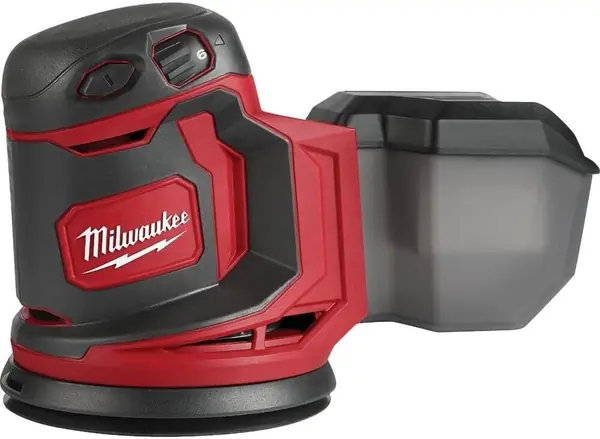
Milwaukee 2648-20 M18 Random Orbit Sander Best for M18 Platform Users

Milwaukee 2648-20 M18 cordless 5-inch random orbit sander, bare tool only

M18 platform users

Shop Score 90/100
Pad Size
5 inches
Speed Range
7,000-12,000 OPM
Battery
M18, sold separately
Runtime
Up to 35 minutes on 3.0 Ah
View on Amazon

Thirty-five minutes is the number to plan around: that's what Milwaukee rates this sander for on a 3.0 Ah M18 pack. On a bigger pack you get longer, but a cordless sander is one of those tools where the battery count matters as much as the tool itself, and a job that fills an afternoon needs more than one pack on the bench.

The performance side holds up. The dial spans 7,000 to 12,000 OPM, it carries corded-like torque into the panel, and the vacuum adapter fits both a small nozzle and a shop vac hose — a small thing we were glad to see, because adapters are where most sanders cheap out.

Dust collection is the compromise: the bag catches a fair amount, but this tool is at its best hooked to a vac, and the adapter makes that a two-second job. The 4 lb body is the heaviest of the cordless sanders here, which you notice by the end of a job working over your head.

For anyone already running M18 packs, this is the cordless sander to buy: it behaves like a corded tool and it takes the same batteries as everything else on the truck. If you aren't on the platform, the DEWALT above is the cheaper way into cordless sanding, and the corded DEWALT cheaper still.

Worth Noting

  • M18 battery and charger not included
  • Heaviest cordless sander here at 4 lb
Our Verdict

We recommend the Milwaukee sander to anyone already running M18 packs who wants cordless sanding without giving up corded power.

Check Latest Price

How We Tested the Best 5-Inch Random Orbital Sanders

We started with the spec sheets, sorting corded models from cordless ones, checking which dust ports were sized for a standard shop vac hose, and comparing how low each speed dial goes. That narrowed the field to 12 sanders across a spread of prices, all with a 5-inch pad and some form of dust collection. From there, the tools went into a garage shop for eight months of real work.

Each sander stripped paint from a porch door, flattened glue-up panels, and eased edges on pine shelves. We timed how long each one took to cut through two coats of paint on a flat board with fresh 80-grit, then turned the dial to its lowest setting on a scrap of veneer to see whether it stalled or gouged — a sander that idles fast is one you can't trust near a corner.

Dust got judged over a dark cloth: we ran every sander with a mask on and counted what landed on the cloth, checked whether the port accepted a standard hose, and noted whether the bag or canister stayed put when we set the tool down or tipped it sideways. Discs were changed with the cord unplugged and the battery out, and we kept count of how many swaps the hook-and-loop held up to before it let go.

Comfort was a matter of the clock — 20 minutes of continuous sanding, then a note on whether our hands were still steady, plus weight and grip in the palm. Overhead work on the door frame was done with eye protection. After months of shop use, we looked for switches that had gone gritty with dust and, on the cordless models, counted minutes of sanding per charge.

How to Choose a 5-Inch Random Orbital Sander

Corded or Cordless Comes First

Settle this before anything else, because it changes what you're shopping for. A corded sander like the DEWALT DWE6423K runs all day at full power, weighs less than most battery tools, and costs less for the same capability. A cordless model such as the DEWALT DCW210B gives you freedom from the cord and from hunting for an outlet, and in our testing it held speed much like a plug-in tool.

The trap is the bare-tool price. Cordless sanders are frequently sold without a battery or charger, so the number on the listing isn't what it costs to start sanding. Add up packs and a charger before you compare, and be honest about whether you already own the platform.

Variable Speed Is Worth Paying For

A speed dial lets you drop the pad from 12,000 orbits per minute to something gentler — 8,000 on the DEWALT, 7,500 on the Bosch, and as low as 4,000 on the Makita BO5041. Low speed matters at both ends of a project: easing the disc onto a surface without skipping, and working near an edge or a veneer where a fast orbit burns through in seconds.

What we don't put much weight on is the top number. Nearly every sander here claims 12,000 OPM or more, and a higher ceiling doesn't make one tool better than another. The useful question is how low the dial goes and whether the tool holds speed when you lean on it.

Bags, Canisters, and Shop Vacs

The bag on a sander is a convenience, not dust control. Cloth bags pass the finest dust back into the air, which is why a sander with real filtration — the Bosch's half-micron canister — feels different to work with in a closed room. If you own a shop vac, the port matters more than the bag: the Craftsman takes a 1-3/4-inch hose directly, and both DEWALT models connect to DEWALT's own extractors.

Check the adapter before you buy. Hose sizes vary, and a sander that won't take your vac's hose ends up running bag-only, which is the least pleasant way to spend an afternoon sanding cabinets.

Weight, Grip, and Pad Wear

Sand for an hour and you'll understand why we care about weight and vibration more than almost any other specification. Everything here runs between 2.5 and 4 lb, and that difference is real by the end of a session, especially overhead. A separate counterweight — the DEWALT corded model uses one, and SKIL balances its sander the same way — cuts the buzz that tires your hands.

The pad is the wear item. Hook-and-loop backing smooths out over time and discs start flying off mid-pass; a replacement pad fixes it in a couple of minutes. Match the disc's hole pattern to your pad — the DEWALT models here take 8-hole discs — and keep a spare pad on the shelf. A palm sander that stays flat, with a disc that's still sharp, will out-finish a more expensive tool every time.

Frequently Asked Questions

Final Verdict

Our first recommendation is the DEWALT DWE6423K, because it's the sander that gets out of the way: a speed dial with a usable range, low vibration, and dust collection that works whether you run the bag or a shop vac. If dust is the reason you're shopping, the Bosch ROS20VSC filters better and runs quieter. If the budget is the reason, the SKIL handles small jobs and asks little of you.

Anyone who sands overhead or works away from an outlet should look at the cordless DEWALT instead — the tool is affordable, but the batteries are the real decision.