↑↓ navigate ↵ open Esc close All results →

Best Sandpaper for Epoxy Resin

Dry-sand a cured epoxy pour like hardwood and the paper turns into a gray, gummy pad within sixty seconds while the resin smears dull underneath. Unlike timber, cured epoxy is a thermoset plastic that softens under frictional heat, loading ordinary paper and punishing anyone who skips grits on the way to a clear sheen.

Running 16 sandpaper sets across cast coasters, tabletop pours, and molded parts over six months — stepping from 80 grit up through 10,000 — separated assortments that stall at a hazy satin from kits capable of a true gloss polish. Upper grit ceiling and wet-use backing durability decide the finish, closely followed by having enough sheets per grit so one heavy stage does not exhaust the pack mid-pour.

Full hand sheets, five-inch orbital discs, and three-inch drill pads each fit different project shapes, letting you pair the right backing format with a continuous wet/dry grit ladder.

Our Top Picks

The Best Sandpaper for Epoxy Resin

1.

Atosun 45-Piece Wet Dry Sandpaper Best Overall
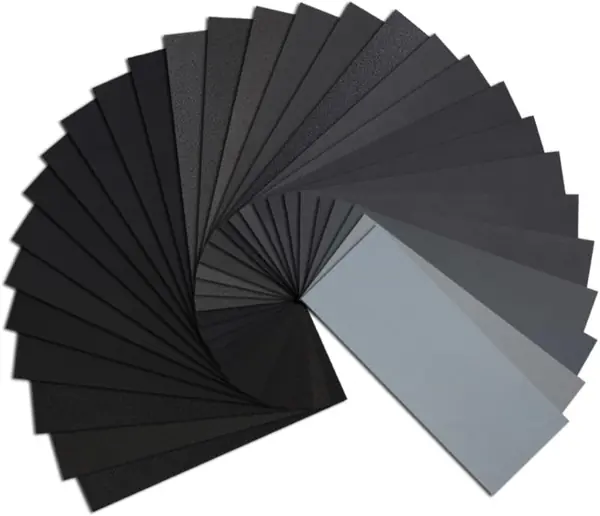
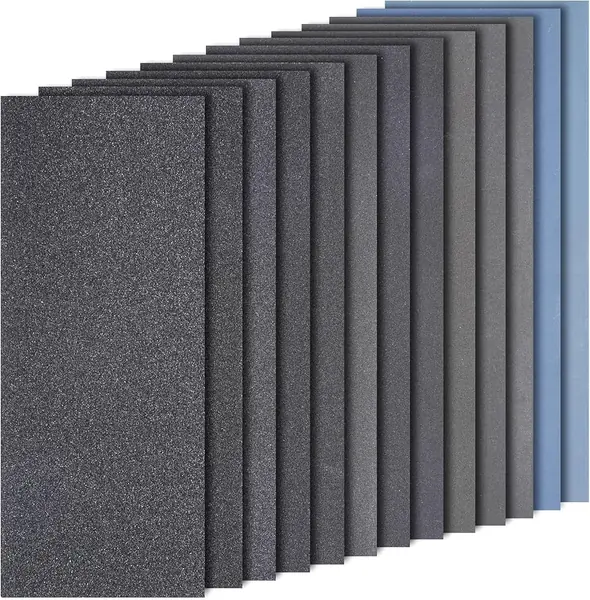
Atosun 45-piece wet dry sandpaper assortment in 9 by 3.6 inch sheets with assorted grits

All-around epoxy finishing

Shop Score 95/100
Grit Range
120 to 5000
Sheet Size
9 x 3.6 inches
Abrasive
Waterproof silicon carbide
Quantity
45 sheets, 15 grits
View on Amazon

The 5000-grit sheet at the top of this set is what earns it our top spot. Cured epoxy has to be scratched finer and finer before it goes glossy, and 45 sheets across 15 grits cover the whole climb — 120 and 180 for flattening a lumpy pour, 320 through 1000 for leveling, then the wet passes that end at 5000. We cut full sheets into thirds for small castings and used them whole on a block for flat panels, and the silicon carbide kept cutting through repeated wet passes.

Water is where cheap paper reveals itself, and these hold together in a tray. The 9 x 3.6-inch size is the standard sheet, so it fits a sanding block without trimming and cuts down with scissors when you need a strip for an edge. The backing is soft enough to hold by hand without slipping, which matters more than it sounds when you are working a small mold wet and do not want a block in the way.

Two things shape how we use it. On broad flat work the paper is thin enough that your fingers telegraph through, so a hard block does the leveling while hand-held sheets handle edges and curves. And if you are leveling a tabletop rather than a coaster, plan on a second pack — three sheets each of 120 and 180 is sized for small castings.

Worth Noting

  • Fine grits above 2500 dull quickly
Our Verdict

We recommend it as the default for cured epoxy: 120 through 5000 grit in waterproof silicon carbide, so one box takes you from flattening to a wet-sanded gloss.

Check Latest Price
2.

DOUSUDAN Ultra Fine Water Sandpaper, 17 Sheets Best for a Mirror Polish

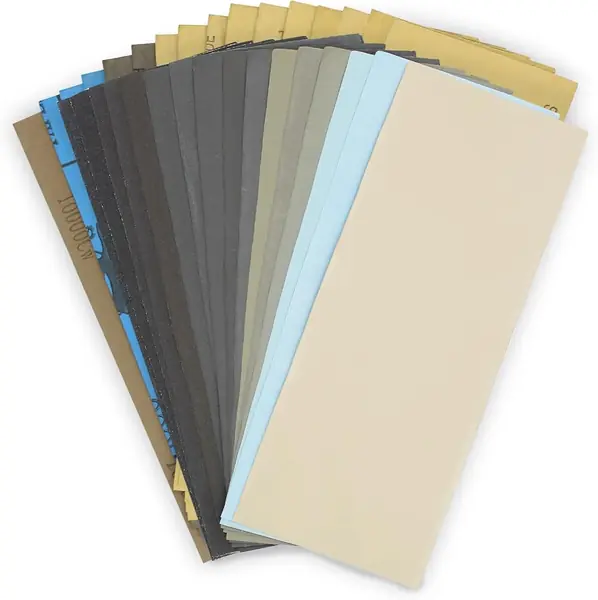
DOUSUDAN 17-sheet waterproof sandpaper set with grits from 120 to 10,000

Mirror-gloss polishing

Shop Score 94/100
Grit Range
120 to 10,000
Sheet Size
9 x 3.6 inches
Sheet Count
17 sheets, one per grit
Abrasive
Waterproof silicon carbide
View on Amazon

If you have been stopping at 2000 grit and reaching for a polishing compound to find the last of the shine, this set finishes the job with paper instead. Seventeen sheets run from 120 up through 3000 in the usual steps and then keep going — 5000, 7000, 8000 and 10,000 — which is the range where a wet-sanded epoxy surface stops looking satin and starts looking wet.

The sheets are silicon carbide on waterproof paper, and they handle a water bath without the grit letting go of the backing. At 9 x 3.6 inches they cut down cleanly into small squares for a pendant or a bottle stopper. We used the top three grits on a small casting and got a shine that did not need a buffing wheel afterward, though how mirror-like it gets still depends on the resin and on how flat you had the surface before you started.

Where this set earns its place next to our top pick is the last ten percent of the finish. It is the one we reach for when a piece is going to be handled or photographed, and it is the wrong tool for leveling a big pour — that work belongs to a coarser sheet with more sheets behind it. Think of it as the finishing half of a two-set shop.

Worth Noting

  • Just one sheet of each grit
Our Verdict

Our pick when the finish has to look glassy: 17 grits that climb to 10,000 take a small casting deeper into polish than any other sheet set here.

Check Latest Price
3.

BMOTL 42-Piece Wet Dry Sandpaper Best Value

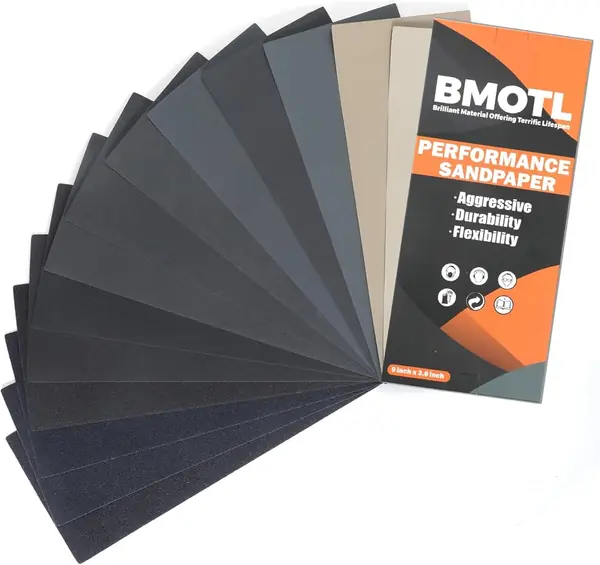
BMOTL 42-piece silicon carbide sandpaper sheets in 9 by 3.6 inch size

Budget full sequence

Shop Score 93/100
Grit Range
120 to 5000
Sheet Size
9 x 3.6 inches
Sheet Count
42 sheets, three per grit
Backing
Tear-resistant latex paper
View on Amazon

Forty-two sheets, three of each grit from 120 through 5000, on full 9 x 3.6-inch paper. The grit list is chosen well for resin: 220 and 320 sit exactly where most people scuff between coats, and the 400-to-1000 stretch — where epoxy eats paper fastest — gets three sheets at each step rather than one.

What we noticed first is the backing. It is a latex paper rather than a plain sheet, and after a long soak it stayed flat with no fraying at the cut edges and no grit washing off. That is the difference between finishing a wet pass and stopping halfway through a panel to hunt for a replacement, and it is why this set holds its place against more expensive paper.

Where it asks something of you is the format. Full sheets are more than you need for a small mold, and there is no block or storage in the box, so we cut ours into thirds and kept the offcuts in a zip bag sorted by grit. Budget ten minutes with a pair of scissors and a marker before your first pour.

Worth Noting

  • Includes no sanding block or storage organizer
  • Full 9 x 3.6 sheets need cutting for small molds
Our Verdict

The one we hand to anyone watching the budget: 42 sheets, three of every grit from 120 to 5000, on a latex paper that stays flat through a long soak.

Check Latest Price
4.

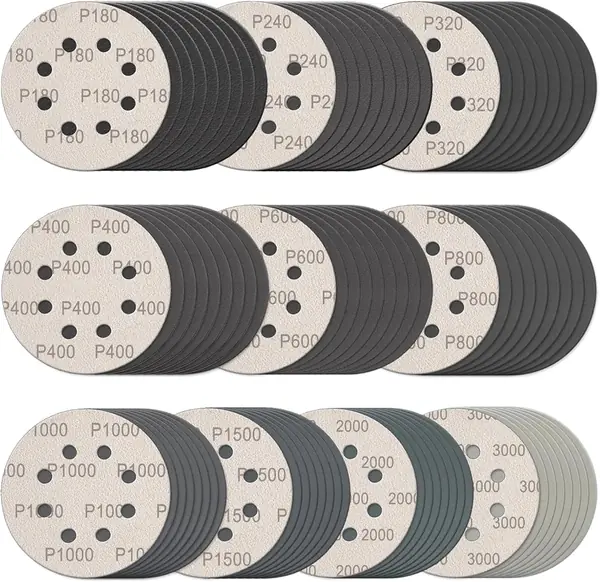
Rvetol 100-Piece 5-Inch Sanding Discs Best for Random Orbital Sanders

Rvetol 100-pack 5-inch hook and loop sanding discs with eight dust holes

Orbital sander work

Shop Score 92/100
Grit Range
180 to 3000
Quantity
100 discs, ten per grit
Disc Size
5 inches, 8-hole
Mounting
Hook and loop
View on Amazon

Five inches across, eight dust holes, hook-and-loop on the back — these discs are shaped for a random orbital sander and for nothing else, which is exactly right if that is the tool you finish epoxy with. Grit runs 180 to 3000, ten discs at each of ten steps, so a flood coat can go from leveling to polish without stopping to order something else.

We ran a set wet on a flat panel and came away impressed by how well they stayed put. The loop held through passes, the discs peeled off cleanly when we stepped up a grit, and the cut stayed consistent as long as we rinsed the load off rather than pressing harder.

The discs at the top of the range are the short-lived ones — you will go through a few 1500s to finish a panel — but with ten of each grit in the box that is a supply problem the set has already solved. Keep them clean with a brush or a quick dip and you get a steady scratch pattern instead of a polished-over gouge.

Worth Noting

  • Nothing coarser than 180 for heavy leveling
Our Verdict

We like these for anyone finishing epoxy under a 5-inch orbital: 100 discs across the grits, with a backing that holds through wet passes.

Check Latest Price
5.

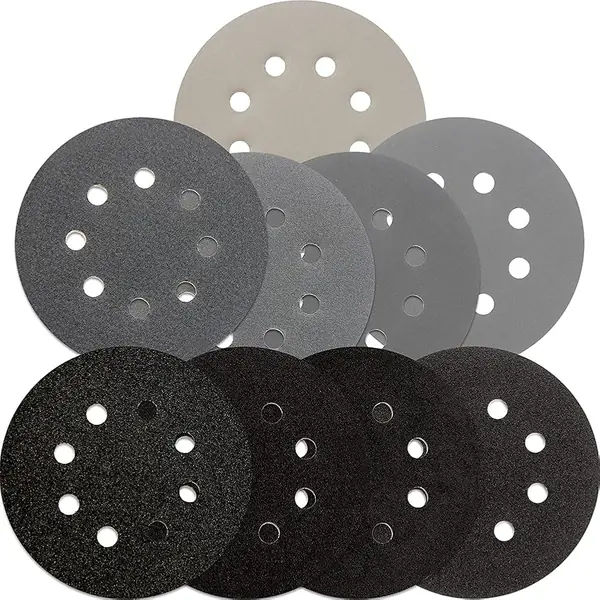
S&F STEAD & FAST 5-Inch Sanding Discs, 54 Pieces Best for Leveling Thick Pours

S&F Stead and Fast 54-piece 5-inch sanding disc assortment with tack cloth

Leveling thick pours

Shop Score 91/100
Grit Range
80 to 3000
Quantity
54 discs
Disc Size
5 inches, 8-hole
Includes
Tack cloth
View on Amazon

Eighty grit is an odd thing to find in a wet/dry assortment aimed at resin, and here it is the point. A thick flood coat often cures with a slight crown or a drip edge, and those first two grits take it down before you switch to anything finer. The rest of the box runs a full ladder to 3000, so the same set finishes what it starts.

Fifty-four discs, 5 inches across with eight dust holes, sized to fit the common random orbit sanders. The hole pattern is worth having: dry passes at the coarse end make a lot of dust, and extraction keeps the paper cutting instead of skating over the surface.

Wet work is where these earn their keep. The discs held together through 400 and 600 passes on a flat panel, and the tack cloth in the box turned out to be the detail we used most — a quick wipe between grits keeps slurry and dust from carrying scratches into the next step.

What decides it for us is the sequence. One box that starts at 80 and ends at 3000 removes a step from the shelf, and for anyone whose pours come out with high spots that is worth more than a bigger count of discs in the middle grits. If your panels already cure flat, the Rvetol set gives you more discs exactly where the work is.

Worth Noting

  • Coarse discs can break down under heavy pressure
Our Verdict

The set we reach for when a pour needs leveling: 80 and 120 grit to knock down high spots, then a full wet run to 3000.

Check Latest Price
6.

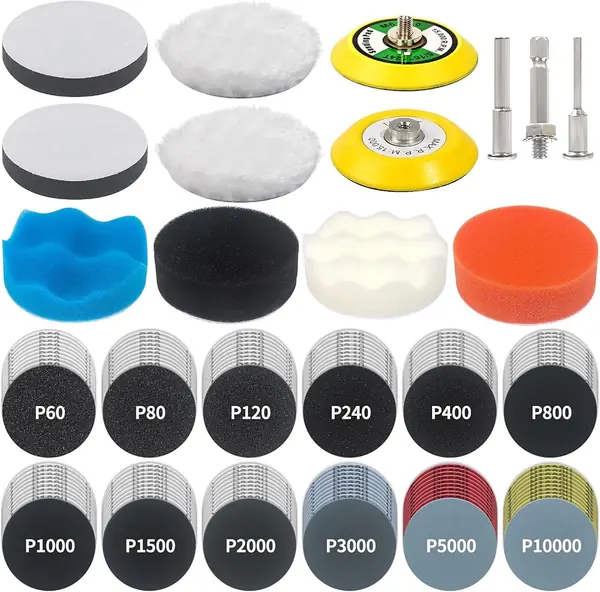
Pomsare 3-Inch Sanding Disc Drill Kit, 133 Pieces Best Drill-Mounted Kit

Pomsare 3-inch sanding disc drill kit with backing pad and polishing pads

Small castings

Shop Score 90/100
Grit Range
60 to 10,000
Disc Size
3 inches
Mounting
Hook and loop for drill
Pieces
133
View on Amazon

This is the only pick here that does not want your hands. A hook-and-loop backing pad chucked in a drill turns 3-inch discs into a small, controllable sander for pen blanks, pendants, and the inside curves of a casting, and we liked it best on exactly the awkward shapes where hand-sanding eats an afternoon. The grit spread — 60 all the way to 10,000 — means one pad takes a piece from rough to polished.

The discs are silicon carbide and rated for wet or dry use. The pad's hook face kept its grip through wet passes, which is what makes the high grits usable at all: a disc that creeps at 3000 leaves a swirl you have to sand out again. Four polishing pads in different hardnesses come with the kit for the final buff.

Two things to plan around. The tool spins, so edges round over fast — keep the speed low at the fine grits and let the paper cut. And a 3-inch disc is slow going on a big flat panel; this kit is for detail and small parts, not for leveling a tabletop.

Worth Noting

  • Small discs wear quickly at high speed
Our Verdict

We keep this drill-mounted kit for small castings and awkward shapes — 133 pieces, grits from 60 to 10,000, and a pad that grips through wet passes.

Check Latest Price
7.

Hyietta Sandpaper Assortment, 52 Sheets Best for First Epoxy Projects

Hyietta 52-sheet silicon carbide sandpaper assortment in 9 by 3.6 inch sheets

First epoxy projects

Shop Score 89/100
Grit Range
120 to 3000
Sheet Size
9 x 3.6 inches
Sheet Count
52 sheets, four per grit
Abrasive
Silicon carbide
View on Amazon

Nothing here is fancy: no block, no backing pad, no grit above 3000. What you get is 52 plain 9 x 3.6-inch silicon carbide sheets, four at each of 13 grits from 120 to 3000, packed in resealable bags that keep the unused ones flat and dry.

Four sheets of every grit is the useful part. You can make a mistake at 320 without rationing, and wet passes at 600 and 800 do not leave you short on the next project. The sheets stayed intact in water and the grit did not wash off, which is more than we expected at this price.

Where this set earns a place is the learning curve. Four sheets per grit means a beginner can practice the whole ladder — flatten, level, refine, polish — without treating each sheet as precious, and the resealable bags keep spare paper from curling in a humid shop. This is the set to buy before you know what you like.

Worth Noting

  • Tops out at 3000 so finishes read matte
Our Verdict

We point beginners here: 52 sheets, four of every grit to 3000, enough paper to practice the whole sequence without hoarding it.

Check Latest Price
8.

Xiweyla 72-Piece Micro Sandpaper Set Best for Small Parts

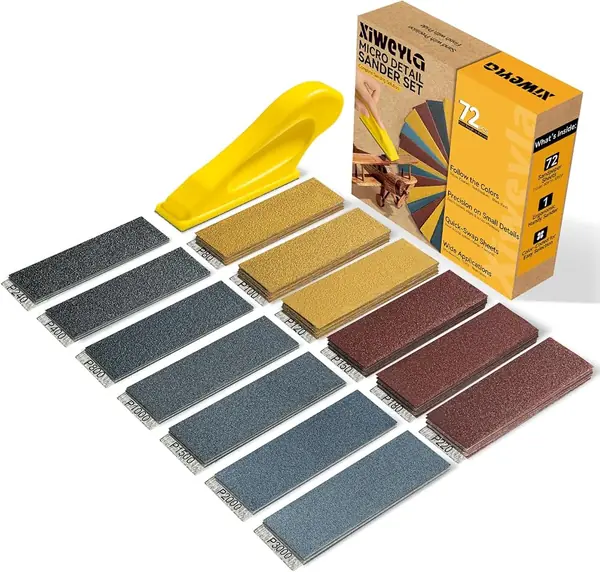
Xiweyla 72-sheet micro sandpaper set with small hand sander and color-coded grits

Small parts

Shop Score 88/100
Grit Range
80 to 3000
Sheet Size
1.18 x 3.54 inches
Sheet Count
72 sheets, 13 grits
Includes
Mini hand sander
View on Amazon

The sheets here measure 1.18 x 3.54 inches, small enough to sand a bottle-stopper blank without folding a full sheet around your finger. Seventy-two of them, 13 grit levels from 80 to 3000, sorted into three color-coded bands so you can grab the coarse yellow without reading a number.

The included mini sanding block is the part we keep coming back to. It is sized to the sheets, the hook-and-loop face holds them flat, and it reaches into recesses and inside edges where a 9 x 3.6-inch sheet is simply the wrong tool.

The abrasive is aluminum oxide on a cloth backing rather than the silicon carbide and waterproof paper of the wet-sanding picks here, so we keep this one dry and save the wet passes for a sheet set. In dry use on small castings and detail work it cut cleanly and the sheets held their grit.

What we like most is that it removes the excuse: one box with a handle, the paper, and every grit a small piece needs means you sand the detail instead of postponing it. It will not level a panel or replace a full sheet set, but between the coarse work and the polish it is the kit we reach for.

Worth Noting

  • Sheets are small for anything beyond detail
Our Verdict

Small sheets, 13 grits, and a hand sander that holds them flat — the kit we keep for pen blanks and tight detail.

Check Latest Price

How We Tested Sandpaper on Cured Epoxy

We built the shortlist from spec sheets and customer reviews, filtering for silicon carbide abrasive, a grit range that climbs past 1000, wet/dry construction, and formats that match how epoxy actually gets sanded: full 9-by-3.6-inch sheets, 5-inch hook-and-loop discs, 3-inch drill-mounted discs, and small hand-sander sheets. That left 16 sets, which we used over six months. Price was never a filter on its own — we judged it per sheet, after counting how many sheets or discs each set gave us at the coarse and middle grits, where most of the work happens.

Testing happened on real pours: cast coasters and small resin blanks on a garage bench, a bar top, and a thick pour that needed leveling with 80 grit on an orbital sander. Every pour cured for at least a week first, so the paper met hard plastic instead of gum. We wore eye protection and a dust mask for the dry passes, then wet sanded from a spray bottle — never a running hose — keeping the sander's cord clear of the water and plugged into a GFCI outlet.

We marked the back of every sheet so we knew which grit we were holding, then counted passes to flatten a ridge and noted whether the slurry loaded the paper or shed off it. To test the backing, we soaked sheets for twenty minutes and kept sanding to see whether edges frayed or the abrasive shed. Hook-and-loop discs got checked for slip and grip on wet passes. Finally, we cut sheets down with scissors for small castings and tracked how long each one kept cutting before it dulled.

How to Choose Sandpaper for Epoxy Resin

Start With the Grit Ladder, Not the Sheet Count

Epoxy cures hard and glossy and shows every scratch you leave behind, so the order of the grits matters more than how many sheets are in the box. Flatten with 120 to 180, level at 220 to 320, refine at 400 to 600, then wet sand from 800 up. Skip a step and you spend twice as long removing the previous grit's scratches with the next one.

What we look for first is how high a set climbs. A 3000-grit finish reads as a soft gloss; the 5000-to-10,000 range is where epoxy starts to look like glass. A set that stops at 400 is a prep tool, not a finishing one, and it will leave you shopping again before the project is done.

Wet or Dry Is Really a Question About the Backing

Silicon carbide on waterproof paper is what you want for epoxy. Aluminum oxide sheets sold for wood sanding are built for dry work, and plain paper softens and sheds grit once it sits in water. Wet sanding earns its trouble for two reasons: the water floats the slurry away so the paper keeps cutting, and it keeps dust out of the air.

We treat the word waterproof carefully. On most listings it describes the paper, not how long the abrasive stays sharp, so plan on the fine grits loading before anything else gives out. Rinse or brush a loaded sheet rather than pressing harder; pressure heats the resin and dulls the abrasive faster than the work does.

Match the Format to the Shape You Are Sanding

Flat panels and big pours belong under a 5-inch random orbital sander with hook-and-loop discs — the eight-hole pattern pulls dust out and the tool keeps the surface level. Hand work on edges, small molds, and anything you would rather feel is easier with a 9 x 3.6-inch sheet, which cuts into thirds with scissors.

For pen blanks, pendants, and inside curves, a 3-inch hook-and-loop pad on a drill reaches where a sheet cannot. Most of us end up with two of the three formats, and the order we buy them in is sheets first, orbital discs second, because sheets do every job adequately while you work out which shape you sand most.

Count Sheets per Grit, Not Grits in the Box

A sixteen-grit set with one sheet of each looks generous until you run out of 800 halfway through a panel. Epoxy work lives between 400 and 1500, and the coarse grits disappear fast when you are leveling a thick pour. Three or four sheets of each step is a working set; one of each is a sampler.

If you are finishing a single small casting, a sampler plus one high-grit polishing set will do everything. If you are working panels, buy the grits you actually burn through in quantity and skip the ones you will never open.

Frequently Asked Questions

Final Verdict

For most epoxy work, the Atosun 45-piece set is the one we point people to. Running 120 through 5000 grit in waterproof silicon carbide, it covers flattening, leveling, and the wet polish, all with sheets you can cut down to the job in front of you. It is not the last word in shine, but it is the set that finishes most projects.

Two requirements change the answer. If the finish has to look like glass, add the DOUSUDAN 17-sheet set and use it for the final three steps. If your epoxy lives on flat panels and you already own a 5-inch orbital sander, the Rvetol discs will finish faster and more evenly than any sheet.