↑↓ navigate ↵ open Esc close All results →

Best Sanding Sponges for Wood of 2026

Wrap stiff sandpaper around a hardwood block and press it onto a turned chair leg, and the paper promptly skids, creases, and gouges the profile. A foam sanding sponge yields under finger pressure so the grit tracks curves and moldings evenly, though overly soft cores and sparse grit progressions turn fast touch-ups into uneven dips.

Six months of sanding a maple side table, feathering hallway drywall, scuffing cabinet doors between coats, and shaping chair spindles with 16 sponge sets exposed the gaps quickly. Balanced grit coverage matters more than total block count — jumping straight from 120 to 220 leaves deep scratches that pigment stain highlights later — and pressing a thumbnail into the foam reveals whether a core stays firm enough to protect crisp edges.

Judged across grit progression, foam density, edge wear, clogging, block geometry, wet-or-dry versatility, and cost per usable sponge, the nine sets ranked below span compact starter packs to complete multi-grit finishing kits.

Our Top Picks

The Best Sanding Sponges for Wood

1.

Romeda 8-Pack Sanding Sponges Best Overall
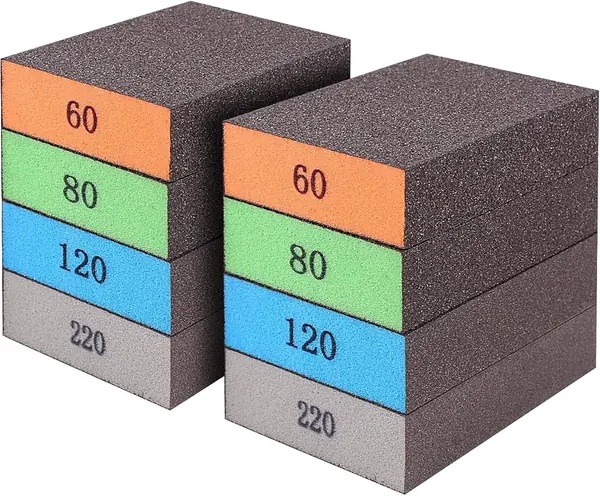
Romeda eight-pack sanding sponges in four grits with color-coded foam blocks

All-purpose wood prep

Shop Score 94/100
Grits
60/80/120/220
Blocks
8
Wet Or Dry
Yes
Foam
High-density sponge
View on Amazon

Two blocks of each grit is the detail that makes the Romeda set a practical default. The 60/80/120/220 spread matches the sequence most wood projects need: 60 for stripping and heavy shaping, 80 for removing tool marks, 120 for smoothing, and 220 for the final pass before stain or paint. Eight blocks means a spare coarse grade when one loads up, which is exactly where small samplers run out.

We keep coming back to this set because the blocks stay firm enough to keep a flat face on rails and panels, and the grit numbers are printed clearly enough to grab the next grade without squinting. The foam gives at the edges without collapsing, so it follows a gentle curve without rounding over a sharp corner. For a first sanding sponge purchase, it is the least fussy way to cover the work.

For most stained or painted furniture, 220 is the right place to stop, and having two fine blocks means you can finish a tabletop without rationing the last grade. The set is simple on purpose, and that simplicity is why it stays in the shop.

Worth Noting

  • No 320 or 400 grit for final polishing
Our Verdict

We recommend the Romeda set as the default for wood because two blocks of each grit let you shape, smooth, and finish without rationing the coarse grades.

Check Latest Price
2.

Pukamam 36-Piece Sanding Sponge Set Best Grit Range

Pukamam 36-piece sanding sponge set with six grits and flexible foam pads

Full grit progression

Shop Score 93/100
Grits
80/120/180/240/320/400
Blocks
36
Wet Or Dry
Yes
Block Size
3.94 x 2.76 x 0.2 inches
View on Amazon

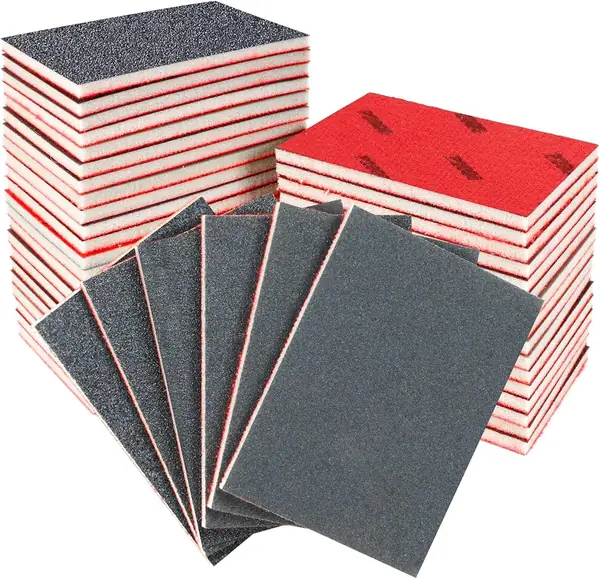
A 36-piece box is less about having a lot of sponges than about having the full grit sequence on hand. Pukamam runs 80/120/180/240/320/400 with six blocks of each, so you can work from stock removal through a 400-grit polish without stopping to order another grade.

The blocks are smaller than a full hand-sanding block, which makes them nimble around curves and profiles but slower on a broad tabletop. The flexible foam does a nice job on turned legs and edge profiles, where a stiff block bridges the curve. We also like the six-spare-per-grade layout for a finishing project that eats fine grits.

We keep this set for the finishing end of the shop, where the jump from 220 to 320 to 400 matters and a single coarse block is not enough. Test a scrap before you commit a finish, especially on a project where the final sheen matters. If you want a simpler four-grit set for general prep, the Romeda is the easier default; if you want the full range in one box, this is the one.

Worth Noting

  • Grit can run coarser than labeled
Our Verdict

Pick up the Pukamam box when you want one purchase to run from 80 through 400 grit, especially for finishing and larger projects.

Check Latest Price
3.

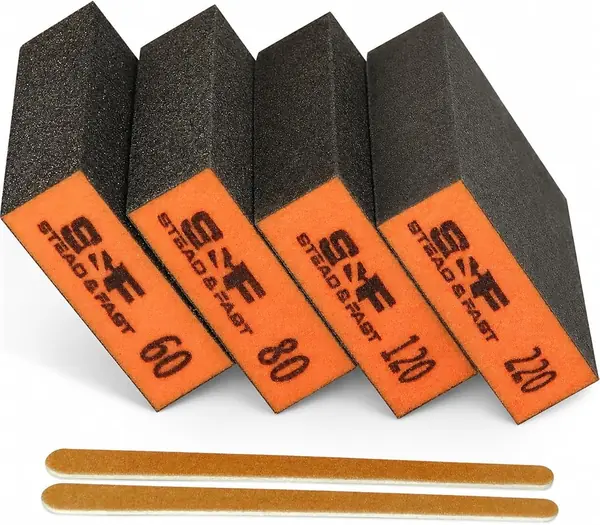
S&F Stead & Fast 4-Pack Sanding Sponges Best Thick Block

S&F Stead & Fast four orange sanding sponges with two emery boards

Comfortable hand sanding

Shop Score 92/100
Grits
60/80/120/220
Blocks
4
Thickness
1 inch
Includes
2 emery boards
View on Amazon

The one-inch foam is what sets this four-pack apart, and we like it for the same reason we reach for a thick-handled chisel: it gives you something to hold. The 60/80/120/220 grits cover the common wood-prep sequence, and the two emery boards are a useful extra for cleaning up inside corners and narrow trim.

On a door frame or a set of cabinet doors, the thicker block keeps your fingers off the surface and spreads pressure more evenly than a thin pad. The foam has enough give to follow a gentle profile without collapsing, but it is firm enough that it does not round over a crisp edge. We found the block comfortable during longer sessions, which is not something we can say for every sponge here.

The four-pack format is the trade-off: you get one block of each grit, so the 60 will be spent before the 220 on a stripping job. That is fine for trim and furniture touch-ups, but a bigger project will send you back for more coarse grit. Keep the emery boards for detail work and the blocks for the main surfaces.

Worth Noting

  • Foam can tear under heavy prolonged sanding
Our Verdict

We like the S&F blocks for long hand-sanding sessions because the thick foam cushions your hand and keeps pressure even.

Check Latest Price
4.

INBOF 12-Pack Sanding Blocks Best Bulk Starter Set

INBOF twelve multicolor sanding blocks with color-coded grit ends

Starter shop supply

Shop Score 91/100
Grits
60/80/120/220
Blocks
12
Wet Or Dry
Yes
Block Size
3.9 x 2.7 x 0.6 inches
View on Amazon

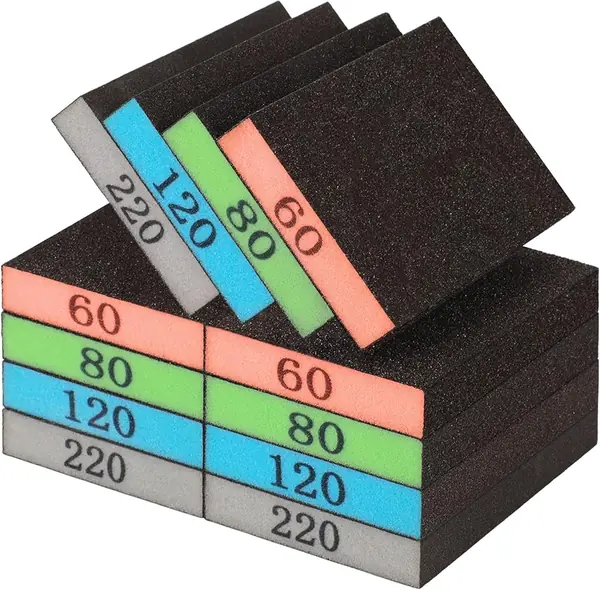
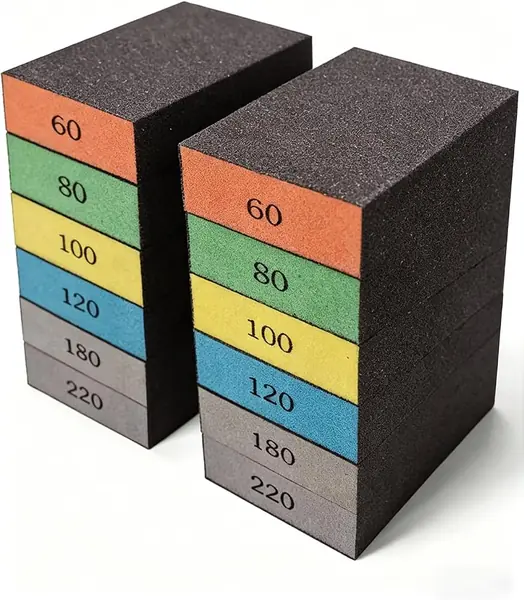
Color-coded ends and printed grit numbers are small conveniences until you are halfway through a project and need the next grade without hunting. INBOF puts three blocks each of 60, 80, 120, and 220 in one box, with orange, green, blue, and gray ends to match the printed numbers.

The 3.9 x 2.7 x 0.6-inch block is a middleweight: thick enough to hold comfortably, thin enough to flex a little on a curve. We like the three-per-grit layout because the coarse grades are the ones that load up first, and having two spares means you can keep working instead of switching to a worn block. The foam holds its shape on flat edges, and the abrasive stays put through a wash and dry.

We suggest this as a first shop supply for someone who wants a tidy set without paying for a full grit library. For cabinet prep, trim, and general furniture work, the organization is the feature that earns its place. The blocks are also easy to cut down for a narrow repair, which makes the set more useful than its four grits first suggest.

Worth Noting

  • No grits finer than 220
Our Verdict

We suggest the INBOF set for a first shop supply: it gives you three blocks of each common grit with clear color coding.

Check Latest Price
5.

SACKORANGE 12-Pack Sanding Sponge Set Best Six-Grit Spread

SACKORANGE twelve gray sanding sponges in six grits two per grit

Mid-range finishing

Shop Score 90/100
Grits
80/100/120/180/220/320
Blocks
12
Wet Or Dry
Yes
Foam
High-density sponge
View on Amazon

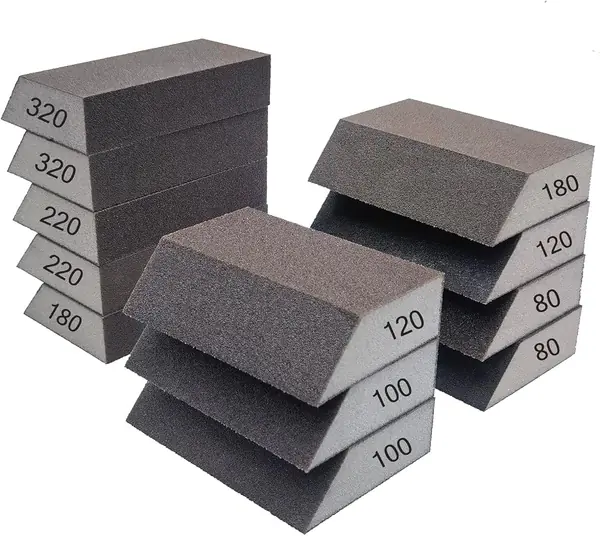
Six grits in one box—80, 100, 120, 180, 220, and 320—give this SACKORANGE set a wider spread than the four-grit packs that make up most of this group. There are two blocks of each, so the set is built for working through a project rather than sampling a single grade.

We reach for this one when a job needs a 320 step without jumping to a separate fine-grit purchase. The 100 and 180 grits fill gaps that a 60/80/120/220 set leaves, which is useful on a piece that is already close to flat. The blocks are firm enough for flat panels, and the printed numbers keep the sequence obvious.

Durability is the trade-off: the abrasive can wear at the edges before the center, so we treat these as a consumable set rather than a long-term block. That is not unusual for a sponge, but it matters if you are sanding a lot of flat stock. For a homeowner with a few pieces of furniture and a 320-grit finish to chase, the spread is worth it.

Worth Noting

  • No 60 grit for heavy stripping
Our Verdict

We reach for the SACKORANGE 12-pack when the job needs a 320-grit step, since its six-grit spread covers more finishing stages than most sets here.

Check Latest Price
6.

SACKORANGE 4-Pack Fine-Grit Sanding Sponges Best Fine-Grit Set

SACKORANGE four brown fine-grit sanding sponges for smoothing and polishing

Fine finishing

Shop Score 89/100
Grits
120/220/320/400
Blocks
4
Wet Or Dry
Yes
Block Size
4 x 2.6 x 0.7 inches
View on Amazon

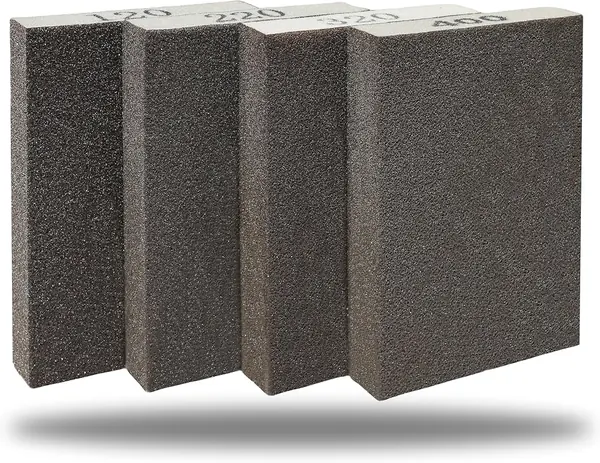
Starting at 120 grit and running to 400, this four-pack is built for the last stages of a finish rather than the first. We recommend it as a finishing companion: 120 and 220 for smoothing, 320 and 400 for between-coat scuffing and the polished feel that makes a topcoat look even.

The blocks are 4 x 2.6 x 0.7 inches, which is a comfortable hand size without being so thick that it hides the surface. The abrasive is planted on four sides, so you can rotate the block as one face loads up and keep working. On a tabletop or a cabinet door, that means fewer stops and a more even scratch pattern.

This is not the set for stripping paint or shaping a rough edge; for that, you need a 60 or 80. It is the set you keep after the shaping is done, when the work is about refinement and the grits need to be clean and consistent. If you finish a lot of small pieces, the four-pack earns its place beside a coarser set.

Worth Noting

  • No coarse grits for stripping paint or shaping edges
Our Verdict

Save the SACKORANGE fine-grit set for final passes and between-coat scuffing, not for stripping or shaping.

Check Latest Price
7.

Afruxy 4-Pack Sanding Sponges with Gloves Best for Small Projects

Afruxy four multicolor sanding sponges with a pair of protective gloves

Small projects

Shop Score 88/100
Grits
60/80/120/220
Blocks
4
Thickness
1 inch
Includes
Protective gloves
View on Amazon

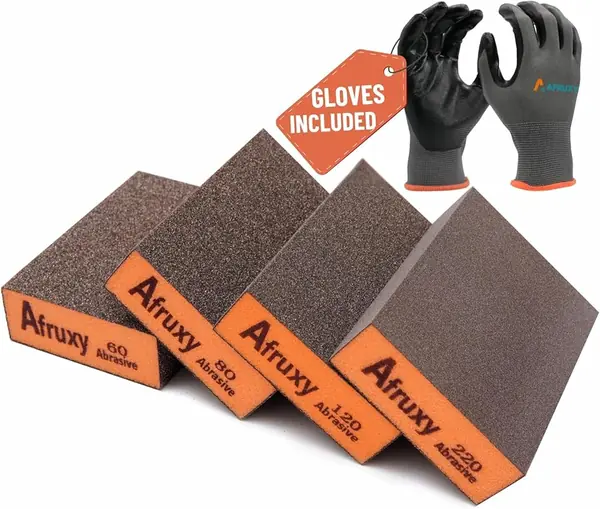
The gloves are the first thing you notice, but the four-grit assortment is what earns this set a place. Afruxy packs 60, 80, 120, and 220 grits in a compact four-block set, with one block of each and a pair of protective gloves.

The blocks measure 4.5 x 2.5 x 1 inch, which gives you a solid grip without a lot of bulk. The one-inch foam is comfortable on a long session, and the abrasive wraps the sides, so you can use the edge of the block on a reveal or inside corner. The gloves are worth having for the dust and the occasional sharp edge, and they make the set easy to hand to someone who does not sand often.

This is a small-project set: trim, a chair, a repair, or a single cabinet door. It is not the box for a whole deck or a room full of trim, because the blocks are sized for detail work rather than covering large flat areas quickly.

We like it as a starter set or a toolbox kit because the four grits are the ones most wood projects actually use, and the thick block is forgiving if your hand pressure wanders. The gloves are a small thing, but they are the kind of small thing that keeps the set in use.

Worth Noting

  • Only one block per grit
Our Verdict

We like the Afruxy set for small projects and occasional sanding, and the included gloves are a practical extra.

Check Latest Price
8.

Lunirve 12-Pack Sanding Blocks

Lunirve twelve colored sanding blocks in six grits one inch thick

Comfortable all-rounder

Shop Score 87/100
Grits
60/80/100/120/180/220
Blocks
12
Block Size
3.94 x 2.56 x 0.98 inches
Thickness
1 inch
View on Amazon

Lunirve's set is the one to pick when you want more grit choices than a four-pack but don't need Pukamam's 36-block box. It gives you 12 blocks in 60/80/100/120/180/220, with two of each grit and a one-inch foam body.

We think it's a comfortable all-rounder for furniture and cabinet work: the thick block is easy to hold, the pressure stays even on a flat rail, and the 100 and 180 grits fill in between the usual coarse and fine steps. The six grits cover the work before the first coat, and the two blocks per grit mean you can keep a fresh one for the final pass.

The block size is 3.94 x 2.56 x 0.98 inches, which is large enough for a drawer front and still manageable at an edge. The color coding and printed numbers are easy to read, and the foam has enough resilience to rinse and reuse without going limp. For a homeowner who sands furniture occasionally, this is a sensible middle ground.

Worth Noting

  • No 320 or 400 grits
Our Verdict

We think the Lunirve set is a comfortable all-rounder for buyers who want a thick block and a dozen sponges in common wood grits.

Check Latest Price
9.

MOWPOG 8-Pack Sanding Sponge Blocks

MOWPOG eight brown sanding sponge blocks in four grits

Budget wood prep

Shop Score 86/100
Grits
60/80/120/220
Blocks
8
Wet Or Dry
Yes
Block Size
4 x 2.75 x 0.65 inches
View on Amazon

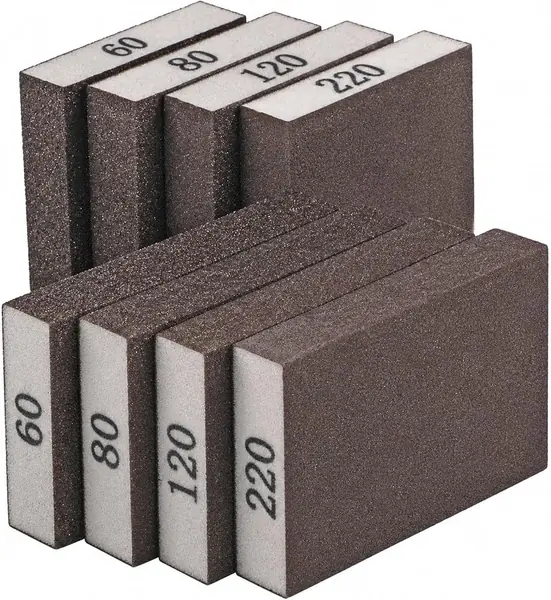
At the lowest price here for an eight-block set, MOWPOG is the budget route to four wood grits. You get two blocks each of 60, 80, 120, and 220, which is the same basic spread as the Romeda set for less money.

The blocks are 4 x 2.75 x 0.65 inches, a familiar hand size that works on flat panels and gentle curves. The foam is firm enough to keep a flat face on a rail, and the abrasive is planted on all four sides, so you can rotate the block as a face loads up.

This is not a finishing set; the range stops at 220, and the foam feel is a step below the thicker blocks here. That is the expected trade-off at this end of the group, and it does not stop the set from doing general prep.

We still see it as a useful budget pick for someone who needs a basic set for occasional furniture repair or trim work and does not want to spend much. The four grits are the right ones for general wood prep, and the eight-block count gives you a spare coarse grade. If you sand every week, step up; if you sand a few times a year, this set is enough.

Worth Noting

  • Shorter lifespan than pricier picks
Our Verdict

We see the MOWPOG set as the lowest-cost way here to get four wood grits, with the understanding that the blocks may not last like the pricier picks.

Check Latest Price

How We Tested Sanding Sponges

We started by pulling every sanding sponge set sold in a genuine grit assortment, 60 through 400, and set aside single-grit packs, blocks thinner than a quarter inch, and sets whose grits skipped a step between coarse removal and finishing. From that pool we bought 16 sets and put them to work over six months, in a garage shop and around the house.

The work was ordinary upkeep: sanding a stripped maple side table from 80 grit up through 220, feathering joint compound patches in a hallway, scuffing cabinet doors between paint coats, and wrapping blocks around dowels and routed edges where a flat block won't sit. We squeezed and pressed every sponge before the first stroke to rate firmness, measured thickness with calipers, and wrote down each set's grit progression so we could see whether reaching a finish took one extra step or three.

While sanding, we counted passes until a face loaded up and stopped biting, watched the corners for rounding and grit shedding, then rinsed the washable ones under the tap and ran them again to see whether they came back. Only blocks labeled for wet or dry use got water, and we did that at a bench with no power tools nearby, wearing safety glasses and a dust mask rated for fine wood dust the whole time with the garage door open.

Value was the last calculation: we divided each pack's cost by the number of blocks still flat and sharp after a second project, the number that actually matters when you're buying a consumable.

How to Choose Sanding Sponges for Wood

Match the Grit Spread to the Finish

For most wood projects, a 60/80/120/220 spread does the real work: 60 and 80 shape and strip, 120 smooths, and 220 prepares the surface for stain or paint. Sets that add 320 and 400 are useful for between-coat scuffing and glossy finishes, but they are not a substitute for a coarse grade when you need to remove material. We prefer two blocks of 60, 80, 120, and 220 over a single block of every number from 80 to 400. If you finish a lot of project pieces, the Pukamam box's 80-to-400 range earns its place; for general prep, the Romeda set's four-grit spread is enough. Skip no more than one grit between steps.

Prioritize Foam Firmness and Thickness

Thick foam is comfortable, but thickness alone does not make a block better. A one-inch block like the S&F or Lunirve gives you more to hold and keeps pressure even on flat panels; a thin pad can flex into curves but wears at the edges and can feel like a finger scraper. Check the block's dimensions, not just the count, because a small pad that disappears in your hand will slow you down on a door or tabletop. For curved work, a softer, thinner sponge is the better tool; for rails and panels, choose the firmest block you can hold comfortably.

Expect Edge Wear and Clean Often

Sanding sponges are consumables, and the edges usually go before the center on flat work. A block that stays firm and keeps its abrasive bonded is worth more than a larger pack of soft blocks that shed grit. Rinse clogged blocks and let them dry fully before the next session; a wet block can raise the grain on bare wood and soften the foam. Keep a spare coarse block on hand, because 60 and 80 grit do the most work and wear out first. The SACKORANGE 12-pack's 320 step is useful, but we treat its blocks as a replaceable set rather than a long-term tool.

Choose the Block Size and Pack Count for Your Work

A four-pack is a sampler: enough for trim, a small repair, or a single piece of furniture, but you get one block per grit. A 12-pack with three blocks of each common grit keeps you working when the coarse grade loads up, and a 36-piece box suits a shop that finishes often or wants the full grit sequence without reordering. The block face matters too: a sanding block with a 4-inch face covers a drawer front or rail quickly, while a narrower or angled block reaches inside corners. If you cut a block down, keep the cut edge away from the surface you care about, because a fresh cut can shed abrasive.

Frequently Asked Questions

Final Verdict

Start with the Romeda 8-Pack. Two blocks each of 60, 80, 120, and 220 cover the shaping, smoothing, and finishing steps most wood projects ask for, and the clear grit marking makes it easy to work in sequence. It is the set we recommend to someone who wants one sensible purchase rather than a shelf of options.

If your work is mostly finishing and you want the full 80-to-400 sequence in one box, choose the Pukamam 36-piece set. If you want a thicker block for long hand-sanding sessions, the S&F four-pack is the more comfortable tool.