↑↓ navigate ↵ open Esc close All results →

Best Sanding Blocks for Cabinets of 2026

Prepping kitchen cabinets for primer leaves almost no margin between flat faces and crisp profiles. A sanding block has to level a rail without dishing soft wood, track inside a raised-panel cove, and scuff a stile without rounding off its edge. Choose a pad that is too spongy, too short, or prone to slipping paper, and a single weekend repaint drags into three.

Running 16 blocks and multi-piece sets against a full kitchen's worth of painted doors and drawer fronts over four months highlighted a basic trade-off: a rigid block that flattens a broad face rarely reaches into a narrow cove, while the softest grip in the aisle often clogs and goes slick earliest.

Everything ranked here is stocked at standard retailers and handles trim or furniture work afterward, judged specifically on the 80-to-400 grit sequences and high door counts a full cabinet repaint demands.

Our Top Picks

The Best Sanding Blocks for Cabinets

1.

Romeda 8-Pack Sanding Sponges Best Overall
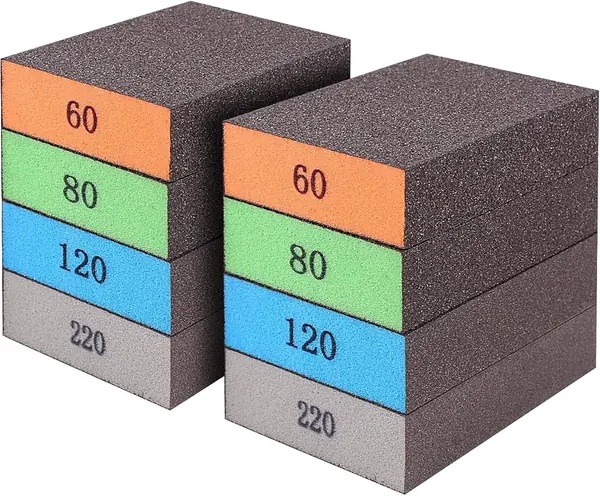
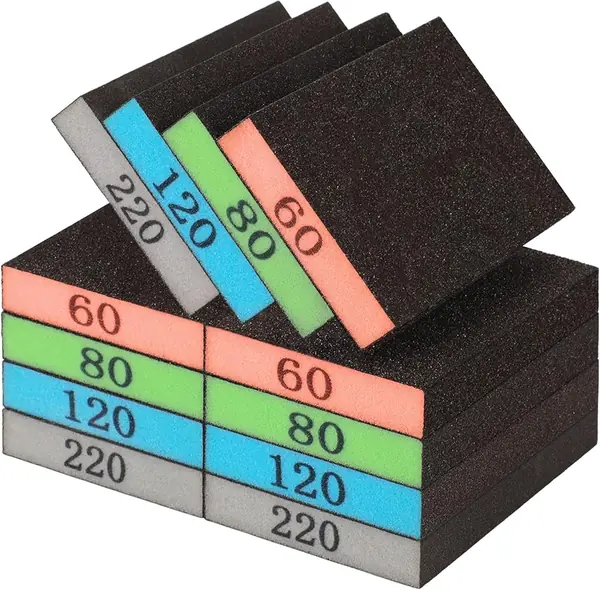
Romeda eight-pack of foam sanding sponges in four grits color-coded orange green blue and gray

Cabinet repaints

Shop Score 94/100
Grits Included
60, 80, 120, 220 (two of each)
Blocks Per Pack
8
Use
Wet or dry, washable
Block Material
High-density foam
View on Amazon

Four grits, two blocks of each, in one small box: that is the whole sanding sequence for a cabinet repaint. The 60 and 80 take down a chipped edge or a hardened paint drip, 120 dulls a factory finish enough to grab primer, and 220 smooths the nibs between coats. Having every grade in one place is why we hand this set to people first — no digging through a drawer for the next grit with a door sitting half sanded on the sawhorses.

Foam is the right body for the parts of a cabinet that aren't flat. Press one of these into the cove where a rail meets a stile, or work it along a beaded edge, and the abrasive follows the shape instead of bridging over it. The high-density foam bends without collapsing and comes back to its shape after a rinse rather than turning to mush in the bucket.

Wet or dry matters more than it sounds in a kitchen you still have to live in. Dampening a block knocks the dust down while you sand a hung door, and a rinse under the tap clears the loaded abrasive so the block keeps cutting. The color coding does the rest: orange 60, green 80, blue 120, gray 220, so the grade you want is the one you grab.

A knife takes a block down to a finger-sized piece for the inside corners of a face frame, which is where a full-size block won't fit and where a cabinet repaint usually shows its worst sanding. Buy the pack, cut one up, and keep the rest whole for the door faces.

Worth Noting

  • Grit range stops at 220
  • Soft foam can round a crisp door edge
Our Verdict

We think this is the box to start a cabinet repaint with: four grits, eight washable blocks, and enough of each grade to get through the doors without stopping.

Check Latest Price
2.

S SATC Hook and Loop Sanding Blocks Best for Flat Door Faces

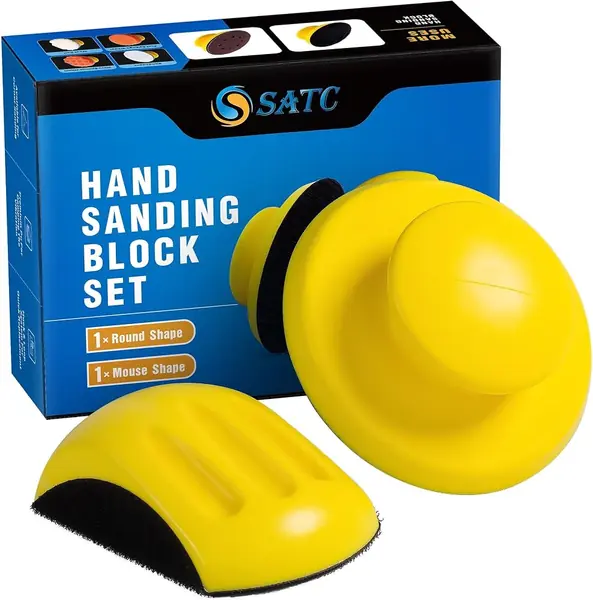
S SATC mouse-shaped and round hand sanding blocks with hook-and-loop faces

Flat door faces

Shop Score 93/100
Pieces Included
2 (mouse and round)
Weight
7.8 oz
Pad Size
5 inches
Attachment
Hook and loop
View on Amazon

The abrasives are the point. Both pads take standard 5-inch hook-and-loop discs, the same ones a random orbital sander eats, so a grit change is a peel and a press rather than a hunt for the right sheet. If you already keep 120 and 220 discs in the shop, this pair adds a hand-sanding option and nothing else to your supply list.

What we kept noticing is how stiff the polyurethane backing is. A sponge follows whatever it's pressed against, which is exactly wrong on a flat slab door where a dished patch shows under a coat of paint. These stay flat, so the door face stays flat, and the mouse shape lets you work a rail or stile without the paper curling off an edge.

The two shapes split the work cleanly: the round pad for open panels and wide faces, the mouse for rails, stiles, and the inside corners of a frame. Both are comfortable enough to hold for an evening, and at 7.8 ounces for the pair you can work overhead on upper cabinet frames without your arm giving out.

Worth Noting

  • Abrasives sold separately, so add discs
Our Verdict

A pair of stiff, comfortable blocks that turn your 5-inch discs into hand work — our pick when flat door faces matter more than contoured edges.

Check Latest Price
3.

Milescraft 1622 Sand-It Best for Moldings and Profiles

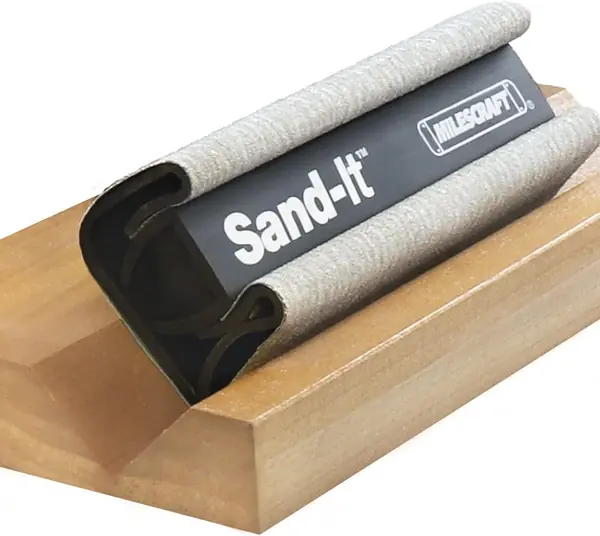
Milescraft Sand-It sanding block with flat concave convex and tight-edge profiles

Moldings and profiles

Shop Score 92/100
Profiles
Flat, convex, concave, tight edge
Warranty
3-year limited
Paper Size
Any quarter sheet
Included Abrasive
One 150-grit sheet
View on Amazon

Not every surface on a cabinet is flat. A raised-panel door has a cove and a bead, face frames get routed edges, and there's usually a run of cove molding sitting on top of the uppers. This small block puts a flat face, a convex curve, a concave cove, and a tight edge into one tool that closes inside your hand.

The paper lock is the clever part. A quarter sheet of any sandpaper snaps under the quick-snap lock, so the abrasive is whatever you already own and a refill costs sheet money rather than pad money. One 150-grit sheet comes fitted, which is enough to try it on a scrap of trim before committing.

We like it most for the tight edge and the small radius, which is where a cabinet repaint gets fussy: the inside corner of a frame, the step where a panel meets a stile, the shadow line under a bead. It isn't the block for a whole flat door — the body is small and you'd be there all afternoon — but that isn't the job we keep it for.

Worth Noting

  • Only one 150-grit sheet included
Our Verdict

For the curved and recessed parts of a cabinet — cove molding, beaded frames, routed edges — we reach for this one first.

Check Latest Price
4.

INBOF 12-Pack Sanding Blocks Best Bulk Buy

INBOF twelve-pack foam sanding blocks in four color-coded grits with printed numbers

Full kitchen repaints

Shop Score 91/100
Grits Included
60, 80, 120, 220 (three each)
Blocks Per Pack
12
Block Size
3.9 x 2.7 x 0.6 inches
Abrasive Sides
Four
View on Amazon

Twelve blocks, three of every grit. That sounds like more sponge than one kitchen needs until you're twenty minutes into a door and the 120 has loaded up solid — then the second block is already in your hand and you haven't broken rhythm. Three of each also means you can dedicate one block to a messy job and keep the rest clean for finish work.

The detail we appreciate most is that the grit number is printed on the sponge itself, not stamped on a wrapper that went in the trash. After a rinse and a dry, the 220 still says 220. The color-coded ends back it up: orange 60, green 80, blue 120, gray 220, so sorting a pile on the bench takes a glance.

At 3.9 by 2.7 by 0.6 inches they're sized for a hand and thin enough to press into a shallow cove, and each block carries abrasive on all four sides, so a loaded face is only a quarter of the block used up. A pair of scissors takes one down for the narrow gap between a door and its frame.

Worth Noting

  • Grits stop at 220 with nothing finer
Our Verdict

We recommend this one for a whole kitchen: three blocks of each grit means a clogged sponge never stops a door.

Check Latest Price
5.

POWERTEC 71441 Contour Sanding Grips Best for Curved Profiles

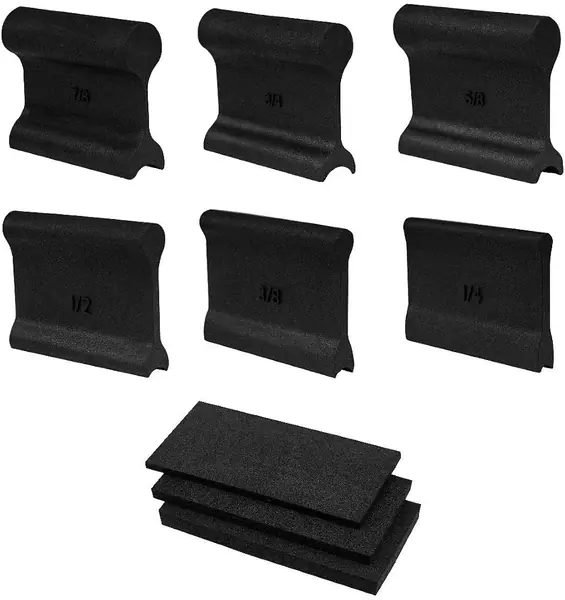
POWERTEC contour sanding grip set with six rubber profile grips and three foam pads

Curved moldings

Shop Score 90/100
Pieces Included
9 (six grips, three pads)
Material
Flexible rubber
Profile Sizes
1/4 inch to 7/8 inch
Foam Pad Thickness
13/64, 9/32, 29/64 inch
View on Amazon

Six rubber grips, each with its radius molded into the side: a quarter inch, three eighths, half, five eighths, three quarters, seven eighths. That numbering is the whole idea. You match the grip to the router bit that cut the profile instead of squinting at a curve and guessing which block will sit in it.

Using one is simple enough to explain in a sentence: cut a strip of paper, wrap it around the grip, and hold the ends with your fingers as you work the profile. Because no adhesive is involved, nothing leaves residue on bare wood, and as one section of the strip loads up you rotate to a fresh patch of the same piece.

The three foam pads take the flatter curves — the sweep of a raised panel, a cove that isn't a perfect radius — and they bend without creasing, which keeps the abrasive tight against a shallow arc instead of bridging it. The pads come in three thicknesses so you can pick the one that fits the gap you're working.

For raised-panel doors and the run of cove molding along the top of the uppers, these follow the shape instead of flattening it, and nothing else here matches a radius by number the way they do. If your cabinets are flat slabs with square edges, you don't need this set at all.

Worth Noting

  • Paper can shift on long straight edges
Our Verdict

When a door has a raised panel or the frame has a cove, these grips follow the curve instead of flattening it — we keep the set within reach.

Check Latest Price
6.

SACKORANGE 4-Pack Sanding Sponges Best for Finish Coats

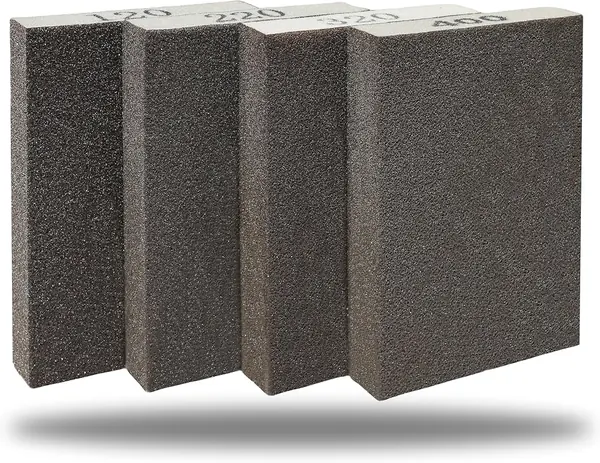
SACKORANGE four-pack sanding sponges in 120 220 320 and 400 grits

Between finish coats

Shop Score 89/100
Grits Included
120, 220, 320, 400
Blocks Per Pack
4
Use
Wet or dry
Block Size
4 x 2.6 x 0.7 inches
View on Amazon

Three-twenty and 400 are the grits that matter after the paint goes on. A light pass with either knocks the nibs and dust specks off a cured coat without cutting through to the primer below, and it's the step most sponge sets skip. This box starts at 120, then 220, 320, 400 — prep and finish in four blocks.

Each block measures 4 by 2.6 by 0.7 inches with abrasive on all four faces, so a loaded edge is a turn away from a fresh one. They can be used wet to keep dust out of a finished room or rinsed and reused between coats, and the grit is color-coded so you don't scuff a topcoat with the block you used for filler.

What we watch with these is the fine end. A 320 or 400 face is a thin coating of abrasive, and it dulls before the foam underneath shows any wear, so a block that looks new can stop cutting. Rotating to a fresh face buys time, and keeping a spare set for the last coat is worth the small outlay.

Worth Noting

  • One block per grit, so there's no spare
Our Verdict

For the sanding that happens between coats — when you need to dull the sheen, not cut through it — these are the blocks we keep out.

Check Latest Price
7.

SCOTTCHEN Hand Sanding Block Kit Best for Detail and Corners

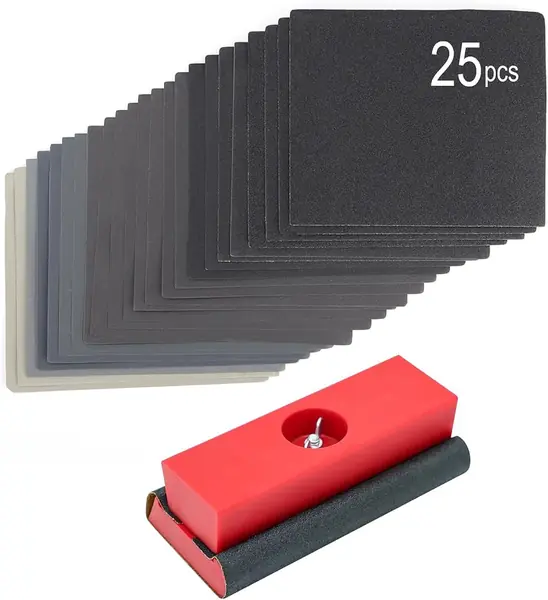
SCOTTCHEN plastic hand sanding block with wing-nut clamp and assorted sandpaper sheets

Detail and corners

Shop Score 88/100
Weight
6.2 oz
Edges
Rounded and beveled
Retention
Metal wing-nut clamp
Included Paper
25 sheets, 120 to 3000 grit
View on Amazon

A wing nut, a metal screw, and a sheet of paper folded over the block: that's the whole mechanism. No adhesive backing to wear out, no proprietary pad to reorder, nothing to peel off a roll. We like a block that will still take sandpaper when the hook-and-loop has given up, and this is the one in the group built that way.

The block has a rounded side and a beveled side, which covers the two awkward places on a cabinet frame: a routed edge on a stile and the inside corner where the rail meets it. The 25 sheets that come with it run from 120 to 3000 grit across 12 grades, so you can set up a finish schedule without buying paper separately.

Changing a sheet takes longer than peeling a disc. You loosen the nut, wrap the paper, and retighten, which is a real cost if you're switching grits every few minutes on a run of doors. For one door at a time and two or three grits, that trade is easy to live with.

Worth Noting

  • Half the included grits are finer than cabinet work needs
Our Verdict

We like that the wing nut takes any sheet you cut and that the beveled edge gets into the inside corners a cabinet frame hides.

Check Latest Price
8.

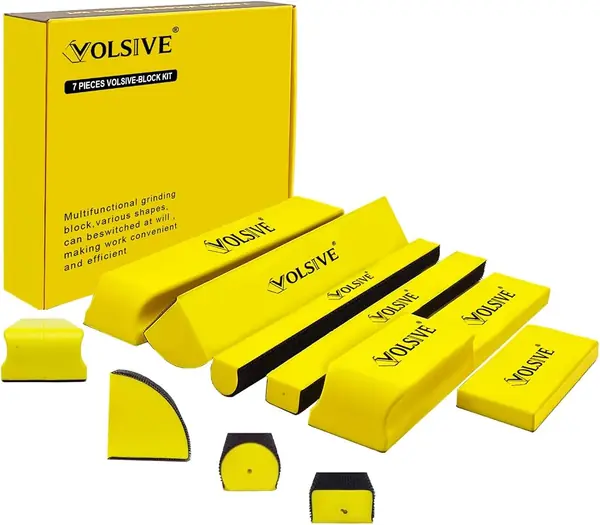
VOLSIVE 7-Piece Hand Sanding Block Set Best for Long Flat Panels

VOLSIVE seven-piece yellow hand sanding block set in long rectangle shapes

Long flat panels

Shop Score 87/100
Pieces Included
7
Material
Polyurethane foam
Backing
Hook and loop and PSA
Block Lengths
5, 5.5, 9 inches
View on Amazon

A nine-inch block spans a door stile in one pass. That length is the whole argument: a short block rocks over a long edge and leaves a slight wave you only see once the paint is on, while a block longer than the surface keeps the paper flat against it the entire stroke.

The set gives you seven blocks in three lengths — 5, 5.5, and 9 inches — in medium-density polyurethane foam, with hook-and-loop faces for discs and PSA backing for sticky-back rolls. Two ways to load the same block is more flexibility than the sponge sets here offer, and the short blocks still fit between a door and its frame.

The foam is firm enough that straight lines come out straight, which is the reason to buy these over a soft sponge, and the hook-and-loop holds a disc without creeping once it's pressed down.

We think the money is justified in a shop doing a lot of flat panel work: doors, drawer fronts, long face frames, all of it wanting a block that stays flat. Store them flat rather than leaning in a bucket, because foam this long can bow over time, and that bow is exactly what you bought the length to avoid.

Worth Noting

  • Blocks only, with no paper included
  • The priciest set here by a wide margin
Our Verdict

We think the long blocks pay off in a shop doing flat panel work — they keep a stile straight where a short block rocks.

Check Latest Price

How We Tested Sanding Blocks for Cabinets

We started with research, sorting the field by block shape — rigid flat pads, conformable foam, matched-radius profile grips — then by grit coverage, attachment method, and how many blocks a set delivers per grit. Anything that couldn't carry a cabinet sequence from 80 through 220, with a 320 or 400 around for between coats, dropped out early. That left 16 blocks and sanding sets, which we used for four months.

Testing happened in a working kitchen and the garage beside it. Doors and drawer fronts came off and went flat on sawhorses; face frames, stiles, and the inside corners of the boxes stayed hung. Before anything touched paint, we swabbed a hidden spot inside a cabinet, and we sanded with dust masks on and a fan pulling air out of the room. We timed how long each block took to load one-handed and noted whether the abrasive crept, tore, or glazed over.

Then the real work: a kitchen's worth of passes on flat faces, in the cove of raised panels, along the bevel of stiles, and into the corners where two rails meet. We noted where a block bottomed out, where a soft pad rounded an edge we wanted crisp, and where a thick block simply couldn't reach. After each session we washed the foam blocks and checked whether grit numbers and colors were still readable, and we counted blocks per grit against the doors a full repaint puts in front of you.

Durability got judged at the end: whether a block still held a flat face and a square edge after a whole kitchen, whether the foam had compressed under steady pressure, and whether a fresh sheet cost enough to matter across a repaint. The finer blocks also ran wet on finish coats, both for the smoother cut and to keep dust out of a room people still had to live in.

How to Choose Sanding Blocks for Cabinets

Match the Block to the Surface

Rigid blocks sand flat surfaces flat. A stiff backing keeps a door face or a long stile true, which is why the S SATC pair earns a place beside any orbital sander. Foam conforms: press a sponge into the cove where a rail meets a stile and it follows the shape instead of bridging over it. Profile grips go further and match a specific radius, which is what the POWERTEC set is built to do.

The trap here is the word compact. A block small enough to fit in an apron pocket is often too small to cover a door face, and you'll spend an afternoon chasing a wave across the panel. Buy small for corners and molding, full-size for the flats.

Build the Grit Sequence Before You Buy

Cabinet work has a short grit list: 80 or 120 to cut a chipped edge and dull a factory finish, 220 to smooth between coats, and 320 or 400 if you want a finer schedule. Anything running to 1000 or 3000 grit is aimed at auto finishing and pen turning, and you pay for grades you never open.

We care more about whether the grit is legible on the block than about how many grades a set contains. Once a sponge has been rinsed a few times the wrapper is long gone, and the number printed on the foam or its color-coded end is all you have to go on.

Decide How You'll Load the Paper

Three systems, three different costs. Hook-and-loop faces change in a second and let you reuse discs you already own for a random orbital sander, but the loop wears out before the block does. Clamps take any sheet you can cut, cost almost nothing to refill, and slow you down at every grit change. Bare sponge has no loading step at all — the abrasive is bonded to the foam, and the block retires when it dulls.

If you already keep 5-inch discs in the shop, buy a block that takes them and skip the paper aisle entirely. If you don't, a sponge set is the cheaper way to cover four grits at once.

Length and Thickness Matter More Than Count

A nine-inch block spans a stile in one pass and keeps a long edge from waving; a hand-sized block is what you want on a face frame and around hardware cutouts. Thickness is the spec nobody reads. Thin blocks slip into shallow coves and feel fine for ten minutes, but the abrasive at the edge wears through long before a thicker block is finished.

Count is the least useful number on the label unless the extras are in the grit you actually sand with. Two blocks of 120 and 220 will do more for a repaint than six grades you touch once.

Frequently Asked Questions

Final Verdict

The Romeda eight-pack is where we start: four grits, two blocks of each, washable, and inexpensive enough to keep a spare set in the drawer. Add the S SATC pair if your cabinets are flat slab doors and you already own 5-inch discs, because a stiff backing is what keeps those faces true.

If the doors have raised panels, or the uppers wear a run of cove molding, the Milescraft Sand-It and the POWERTEC grips reach profiles nothing else here touches. Buy one good block for the flats and one for the curves, and the sanding stops being the part of the job you dread.