↑↓ navigate ↵ open Esc close All results →

Best Sanding Blocks of 2026

Folding loose sandpaper around bare fingers dishes hollows into flat panels and cramps your hand long before a project is ready for finish, yet grabbing any random "sanding block" off the shelf creates its own mistakes. The category spans dense rubber bricks, closed-cell foam pads, soft sponges, and profiled grips, so a block built for curved molding ruins a crisp tabletop while an inflexible slab refuses to follow a rounded rail.

Four months of working through 16 blocks on flat panels, contoured trim, drywall patches, and tight corners showed that block firmness controls cut flatness far more than price. Just as important for long-term cost: the block itself is inexpensive, whereas proprietary refills add up quickly compared with models sized for standard quarter-sheets or five-inch hook-and-loop discs, provided the clamp or backing keeps paper from creeping mid-stroke.

Across rigid flat blocks, flexible contour pads, corner profiles, and disc-backed handles, reliable clamping and accessible abrasive formats separate everyday shop tools from drawer clutter.

Our Top Picks

The Best Sanding Blocks

1.

Milescraft Sand-It 1622 Sanding Block Best Overall
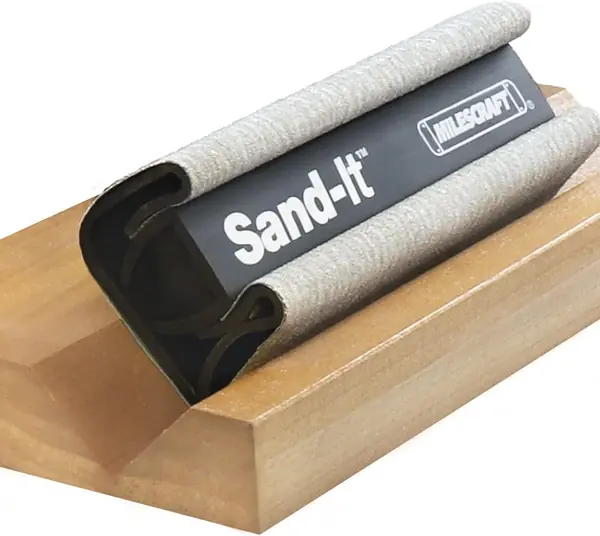
Milescraft Sand-It 1622 plastic sanding block with flat, convex, and concave working faces

Curves and trim

Shop Score 97/100
Weight
1.41 oz
Profiles
Flat, convex, concave, tight edge
Paper Size
Any quarter sheet
Included Abrasive
One 150-grit sheet
View on Amazon

Four working surfaces share one 1.4-ounce plastic body: a flat face, a convex curve, a concave cove, and a tight edge thin enough to reach into a routed groove. That is the whole case for the Sand-It. Where most blocks make you set the tool down and pick up a different one when a job moves from an edge to a spindle, this one just turns in your hand.

We reach for it on chair legs, small boxes, and anything with a radius, and what we appreciate most is the paper: any quarter sheet, any grit, held under a quick-snap lock that lets go without a tool. The abrasive already in your drawer works here, so there is no proprietary refill and no adhesive backing to peel, and you can move from 120 to 220 in the time it takes to fold and tear a fresh sheet.

Changing paper takes a few tries to learn. A fresh quarter sheet has to be squared up before the lock bites, and a rushed change bunches a corner. The mechanism itself has nothing to wear out, and the block carries a three-year limited warranty.

One sheet covers all four profiles, so the flat face and the cove cut at the same grit until you swap paper, which keeps a blend consistent when you are easing a curve into a straight edge. It is the block we carry to a job rather than leave on the bench, because there is almost nothing on a small piece it cannot be turned to.

Worth Noting

  • Compact body is short for large panels
Our Verdict

We recommend the Sand-It as the default block in a woodshop: four profiles in one small body, and any quarter sheet of paper locks in tight.

Check Latest Price
2.

Dura-Block 6-Piece Sanding Block Set Best Set for Curves and Panels

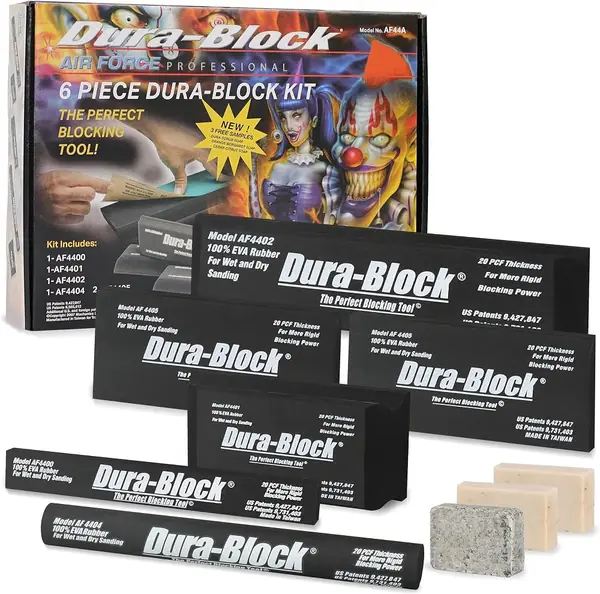
Dura-Block six-piece EVA foam sanding block set in assorted shapes and sizes

Large curved panels

Shop Score 96/100
Material
Closed-cell EVA foam
Abrasive
PSA tape, not included
Block Lengths
5.5 to 11 in
Blocks In Set
6
View on Amazon

Six blocks arrive in one box, in five shapes: an 11-inch standard block for panels, two-thirds and one-thirds blocks, and rounded blocks shaped to reach into recessed creases. It is a set rather than a single block, and it is the pick here for anyone sanding long curved surfaces instead of small parts.

The system is pressure-sensitive adhesive paper, which is not in the box. You press a strip of PSA roll onto the face and peel it off when it is spent, with no clips, pins, or springs to lose. Closed-cell EVA foam also refuses to drink water, so these blocks can be run wet, which is why body shops work them that way on primer and filler.

What we like is that the flexibility is calibrated. The blocks give enough to follow a curve but stay stiff enough that a long panel does not come out wavy, the usual failure of a block that is too soft. Six graduated shapes let you match the block to the panel rather than sand around the shape you happen to own. If your work is flat boards and square edges, a single quarter-sheet block will do more for less.

Worth Noting

  • PSA sandpaper sold separately
  • Costs several times a single block
Our Verdict

We think the six-block Dura-Block set is the right buy for large curved panels, where one block cannot follow every shape.

Check Latest Price
3.

3M Rubber Sanding Block 9292 Best Traditional Rubber Block

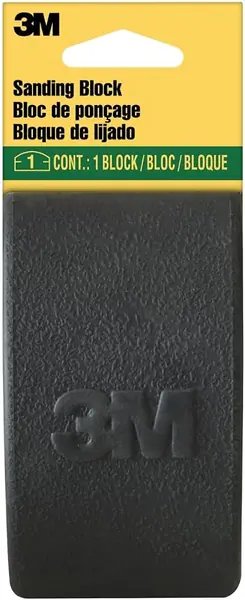
3M 9292 rubber sanding block with a contoured grip and side flaps for cut sheets

Flat edges

Shop Score 95/100
Material
Rubber
Block Size
4.75 x 2.63 in
Paper
Cut-to-fit sheets
View on Amazon

Dense, slightly tacky rubber with a contoured grip and enough substance that the paper does the cutting instead of your wrist: that is the appeal of this block, and it is why we like it for edges, rails, and any flat surface that has to stay flat.

Paper goes on under the side flaps, where steel pins spear it, and once a sheet is seated it does not slide, which is the thing that matters halfway along a long edge.

The body is the point. Rubber does not crack, soften, or delaminate, and the mechanism is two flaps and a few pins with no springs to fail, so this comes close to a one-time purchase. It also takes any paper you already own, cut to fit, which keeps the running cost as low as it gets. What it cannot do is follow a curve, which is why ours sits next to a profile block.

Worth Noting

  • Loading paper takes practice
Our Verdict

If you want one block that outlasts everything else in the shop, the 3M rubber block is the one we hand to a beginner.

Check Latest Price
4.

Tockrop 5-Inch Hand Sanding Blocks Best for 5-Inch Discs

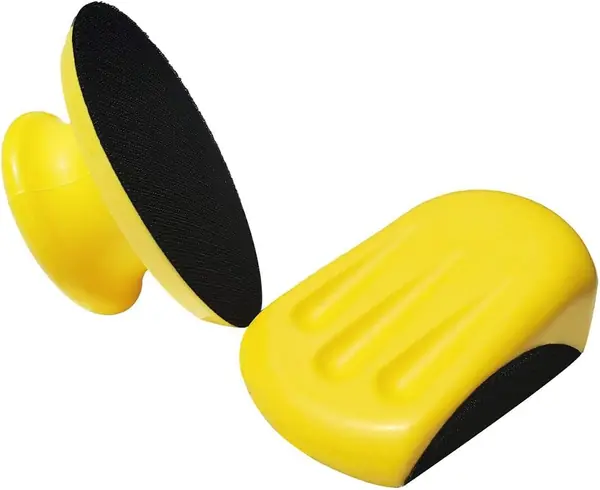
Tockrop two-piece hand sanding block set with round and mouse-shaped hook-and-loop pads

Disc touch-ups

Shop Score 94/100
Weight
5.6 oz
Blocks
Round and mouse-shaped
Attachment
Hook and loop
Disc Size
5 in
View on Amazon

Every shop with a random orbital sander has a drawer of half-used 5-inch discs. These two blocks put them back to work: the round one and the mouse-shaped one both take a standard 5-inch hook-and-loop disc, with any hole pattern or none at all.

What we like is what that does to a touch-up. A disc that is too fine for the orbital is often exactly right on a curved rail or a profiled edge, and pressing it onto one of these blocks takes a second. The polyurethane backing is soft enough to damp vibration without going mushy, so the disc sits flat on the work instead of rocking.

Both bodies are contoured for a palm grip, and the mouse shape reaches into corners where the round one cannot. The round block takes more pressure to cut at the same rate, simply because less of its face is in contact at any moment, so plan on the mouse for flat-ish spots and the round one for hollows and inside curves.

Neither shape replaces a long block on a wide panel. What the Tockrop pair replaces is tearing sheets to fit an old clamp-style block, which is the chore that keeps people from hand-sanding at all, and for blending and touch-up on finished pieces it covers ground the other picks here do not.

Worth Noting

  • Hook-and-loop can peel off the base
Our Verdict

Anyone with a drawer of 5-inch discs should own the Tockrop pair: two comfortable shapes that put spare orbital discs back to work.

Check Latest Price
5.

Romeda 8-Pack Sanding Sponges Best Budget Multipack

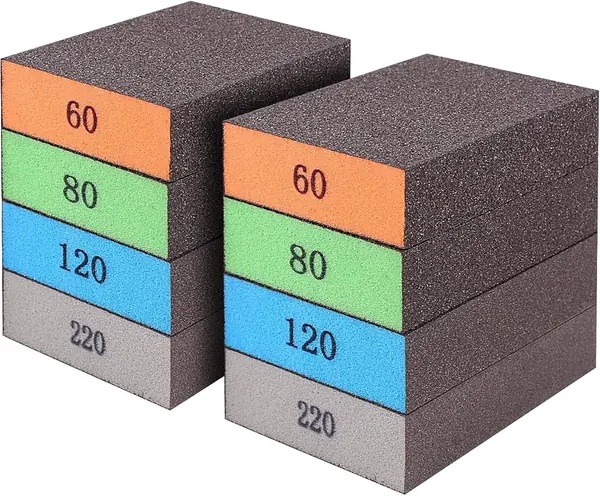
Romeda eight-pack sanding sponges in orange, green, blue, and gray color-coded grits

Paint prep

Shop Score 93/100
Use
Wet or dry
Grits
60/80/120/220
Material
High-density sponge
Blocks
8
View on Amazon

Stripping paint off a cabinet door eats abrasive, and stopping to cut and clamp a fresh sheet every ten minutes is the part nobody enjoys. A sponge block solves that by being the abrasive, and the Romeda eight-pack gives you four grits, two of each, so a worn-out block is an inconvenience rather than a trip to the store.

The grits are 60, 80, 120, and 220, each in its own color, with the number printed on the end as well. We found the colors genuinely useful on a project that bounced between roughing out filler and smoothing a topcoat, because you grab the right block without reading anything.

These are high-density sponge rather than soft foam, so they back the abrasive well enough to work a flat rail without rounding it over, and they can be rinsed and reused. Used damp, they keep dust down, which is the reason we keep a set aside for interior patching and painted surfaces.

This is the pack we keep stocked. Two of each grit means one can die mid-project without stopping you, the sizes are consistent, and the color system removes the small decision of which block to pick up next. For prep work, it is the most useful spread of grits in this guide.

Worth Noting

  • Finest grit is 220
Our Verdict

Our pick when you want a grit for every stage of prep: eight color-coded sponges that hold their shape through wet sanding.

Check Latest Price
6.

Tovpade 54-Piece Micro Sander Best for Detail Work

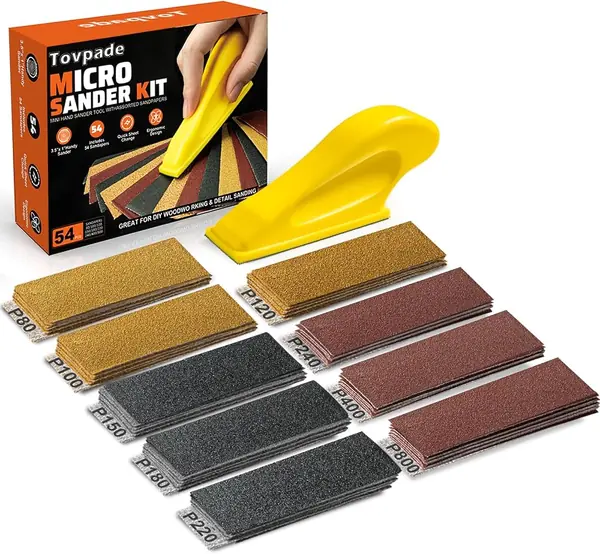
Tovpade micro sander block with a stack of color-coded hook-and-loop sandpaper strips

Tight detail work

Shop Score 92/100
Grits
80/100/120/150/180/220/240/400/800
Block Size
3.54 x 1.18 in
Attachment
Hook and loop
Strips Included
54
View on Amazon

At 3.54 by 1.18 inches, this block sits inside a routed letter or between the spindles of a chair back, which is the entire point and the reason we keep the Tovpade kit within reach on detail jobs. The hook-and-loop face takes any of the 54 included strips, and a three-color system sorts them into coarse, medium, and fine at a glance.

The strips hold hard and swap in a second, which matters when you are stepping 120 to 180 to 220 inside a small area. Nine grits, from 80 up to 800, run from shaping through to a surface that is ready for finish. Understand what you are buying, though: the block is the durable half of the kit, and the 54 strips are what you will use up.

Worth Noting

  • Too small to flatten a wide panel
Our Verdict

For fretwork, carvings, and any corner a bigger block cannot reach, the Tovpade kit is what we keep within arm's reach.

Check Latest Price
7.

3M Drywall Sanding Sponge 9095DC-NA Best for Drywall Patches

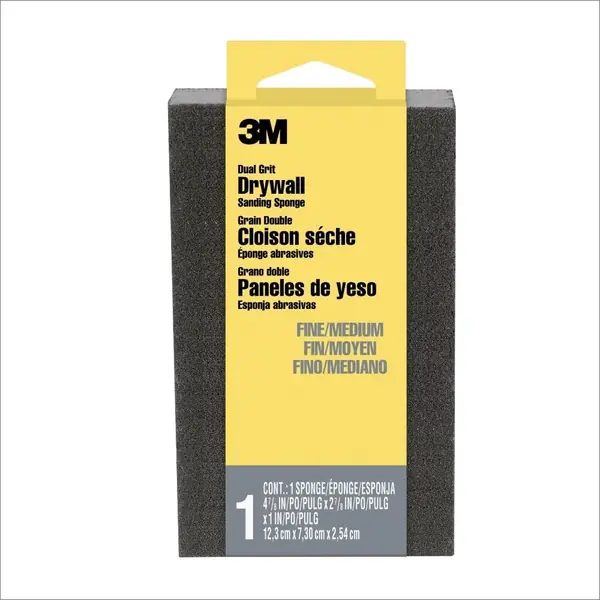
3M fine and medium grit drywall sanding sponge in a rectangular foam block shape

Drywall patches

Shop Score 91/100
Use
Wet or dry
Grits
Fine and medium
Size
4-7/8 x 2-7/8 in
Thickness
1 in
View on Amazon

Joint compound is where a sponge block earns its keep: the surface is soft, the shape is irregular, and a rigid block digs in. This one is flexible foam with medium grit on one face and fine on the other, so you knock down a ridge and then smooth it without setting the first tool down.

It rinses under running water and comes back for the next patch, and used damp it keeps the dust out of the air, which is the difference between sanding a ceiling repair and fogging the room. The 1-inch thickness gives your fingers something to press against without the foam collapsing under a knuckle.

We keep one in the drywall kit and another in the shop for painted trim and primer, where the flexible face follows a molding profile without cutting through the paint on the high spots. It is not the block for bare wood joinery, because the abrasive is bonded to soft foam and will round an edge instead of crisping it. For patching and touch-up on finished surfaces, nothing else here is as quick.

Worth Noting

  • Wears through on long sanding runs
Our Verdict

The sponge we keep for joint compound and painted trim: two grits on one flexible block, and it rinses clean for the next patch.

Check Latest Price
8.

Pukamam 24-Piece Sanding Sponges Best for Polishing Turned Work

Pukamam 24-piece sanding sponge assortment with grits running from 80 to 3000

Polishing turned work

Shop Score 90/100
Use
Wet or dry
Pieces
24
Backing
Soft foam
Grit Range
80 to 3000
View on Amazon

Twenty-four sponges, twelve grits, two of each: the range runs from 80 for shaping through 400 for smoothing and on to 3000 for polishing. That spread is the reason to look at this box, since most assortments here stop at 220 or 400, and the fine end is what you need on a surface that has to be leveled between coats.

The abrasive is aluminum oxide on a soft foam layer, so a block conforms to a curve instead of fighting it, and it works wet or dry. Durability lands where you would expect for the type: they do not tear easily, and the ones we have used held their shape through repeated rinsing.

Turners and pen makers are the natural buyers. A curved surface that a flat block cannot reach is exactly what a soft-backed sponge is for, and having 800 through 3000 on hand means you can polish a small turning without hunting for paper. Test a fine strip on scrap first, because some of the high grits cut coarser than the number suggests, and that is better discovered on an offcut than on a finished surface.

We treat it as a finishing box rather than a general-purpose one: the coarse end is ordinary, and the reason to buy it is everything from 400 up. If your sanding stops at a 220 finish, a four-grit prep pack covers you with less left over.

Worth Noting

  • Blocks are small in the hand
Our Verdict

We reach for this box when a piece has to go from shaping to polishing without leaving the bench: 24 sponges, twelve grits, one purchase.

Check Latest Price

How We Tested the Sanding Blocks

We started with the formats a shopper actually lands on — hard rubber, closed-cell foam, soft sponge, profiled blocks that reach into concave and convex edges, and blocks cut to take 5-inch hook-and-loop discs — then cut anything whose replacement abrasive was hard to find or priced out of proportion to the block. Sixteen made it into the test, and we used them for four months on a dresser refinish, patched drywall seams, painted trim, a set of turned chair legs, and assorted craft scrap.

Rigidity got checked the direct way: we laid a straightedge against each block face, then sanded a primed panel and looked at whether the block stayed flat on an edge or dug a groove. We sanded for 15 to 20 minutes straight and checked whether the paper had slipped under the pins, clips, or hook-and-loop, and we timed how long a fresh sheet took to mount. Each block went on a kitchen scale, because the heavier ones told on us in the wrist after a long session. Every grit was tracked for how clearly it stayed marked after the printing sanded off, and we logged what a replacement sheet or strip cost in the size each block takes.

How to Choose a Sanding Block

Start With Rigid, Semi-Rigid, or Soft

Three body types do three different jobs. A rigid rubber block keeps an edge crisp and a panel flat, which is what you want on rails, stiles, and glue-line cleanup. A semi-rigid foam or EVA block, like the Dura-Block set, follows a curve while still refusing to dish. A soft sanding sponge conforms to whatever it touches, including a molding profile and including the edge you were trying not to round over.

We keep one rigid block and one profile block on the bench and treat sponges as prep tools. If you buy only one, buy the profile block, because it covers the flat work too.

How the Paper Attaches

Four systems show up: steel pins under side flaps, pressure-sensitive adhesive, hook-and-loop, and grit bonded straight to foam. Pins are the cheapest to run and the fussiest to load. PSA gives a dead-flat face and no moving parts, but you buy paper on a roll. Hook-and-loop changes fastest and holds least securely when the backing plate is cheap, which is exactly the gap between the 3M block and the Tockrop pair.

Bonded grit is the simplest of all and the only system where a dull block is disposable. Decide which of those costs you more: money, or time at the bench with a sheet in your hand.

Match the Block to the Shape, Not the Label

Long blocks bridge a panel, short blocks get into a corner, and profiles get into a cove. The trap is the word compact. A block sold as compact is small in your hand and short across the work, which is a gift on a routed edge and a nuisance on a tabletop, so match the face length to the surface you are flattening rather than to the tool roll.

An 11-inch block belongs on panels and doors; something in the 3-to-5-inch range belongs on details. Assume two blocks, one long and one shaped, and the shopping gets simple.

Budget for the Abrasive, Not the Block

The block is usually the cheap part. Quarter-sheet blocks run on paper cut from a standard 9-by-11 sheet, which yields four quarter sheets and the lowest cost per pass in this guide. Blocks that take 5-inch discs turn abrasives you already own into hand-sanding stock. PSA and bonded-grit sponges push the cost into the refill, where a block that wears out mid-project is a consumable rather than a tool.

We pay for the block once and for the paper forever, so the block that takes cheap paper wins most ties.

Grits, and How They Are Marked

Prep work lives between 60 and 220; finishing runs finer. If your sanding stops at topcoat prep, a 60/80/120/220 pack covers the whole job. If you polish turnings, plastics, or film finishes, you want a set that reaches 800 and beyond. Grit printed on the block is worth more than a color code, which helps at a glance but is no substitute for a number when a block is covered in dust.

Frequently Asked Questions

Final Verdict

The Milescraft Sand-It is the block we buy first. It answers the most questions at once, with a flat face for edges, a cove and a convex curve for shaped work, and a lock that takes any quarter sheet you own, and it costs less than almost anything else in this guide.

Add the 3M rubber block if you want one rigid, permanent block for flat work, or the Dura-Block set if your projects are large and curved. One project with the Sand-It will tell you whether you need the others.