↑↓ navigate ↵ open Esc close All results →

Best Sanding Belts for Metal of 2026

A mismatched sanding belt announces itself within seconds: fit one to a platen it wasn't cut for and it tracks straight off the roller, or press a fine grit into a hot weld bead and it glazes over before cutting. That rhythmic tick from a bumpy lap joint is the early warning of a belt about to snap or chatter across your work. Getting the dimensions, abrasive grain, and splice construction right keeps the belt running cool and centered.

Testing 16 packs over four months across five common machine sizes — 4 x 36, 6 x 48, 3 x 21, 1 x 42, and 1/2 x 18 band files — made it clear that mineral type outweighs grit number alone. Zirconia alumina handles heavy steel removal without breaking down under heat, aluminum oxide covers everyday shop shaping, and silicon carbide takes over for finer finishing and polishing.

Buying a graduated grit ladder rather than a bulk box of one coarse number stretches every dollar further, especially once you divide pack cost by the belts that survive full runs without tearing at the seam.

Our Top Picks

The Best Sanding Belts for Metal

1.

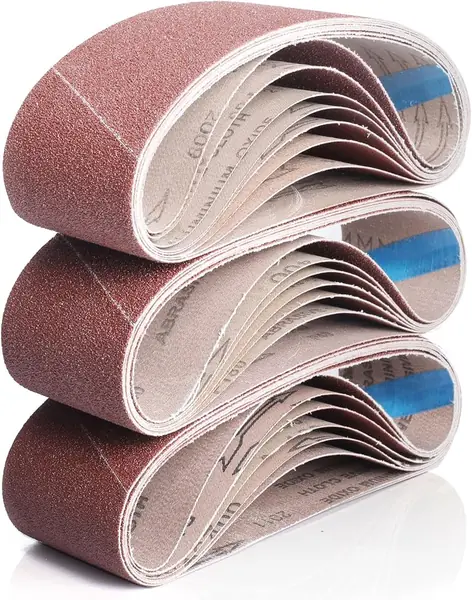
TPmax 4x36 Sanding Belts Best Overall
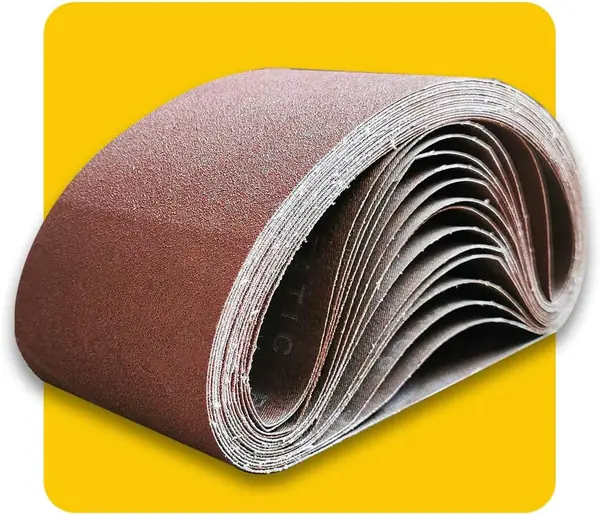
TPmax 4x36 inch aluminum oxide sanding belts, red, 12-belt assorted pack

General metal sanding

Shop Score 95/100
Abrasive
Aluminum oxide
Belt Size
4 x 36 in
Pack Quantity
12 belts
Grits Included
80, 120, 150 (4 each)
View on Amazon

Four inches wide by 36 inches around is the size most benchtop belt sanders take, and this is the pack that turns one of those machines into a metalworking tool. Twelve belts arrive in three grits — four each of 80, 120, and 150 — which covers deburring cut stock, dressing a weld, and smoothing out the scratches a coarser belt leaves behind.

Tracking is where a cheap belt gives itself away, and these ran true on our bench sander: no walking off the platen, no thump each time the lap joint came around. We paid close attention to that splice, because a joint sitting proud will telegraph a line into the work, and on metal that is a line you sand out twice.

The grain is aluminum oxide, the generalist of the three abrasives on this page: fine on aluminum and other non-ferrous metal, competent on mild steel, and just as happy on wood. What it will not do is finish. The range stops at 150 grit, so a bright edge or a polished guard needs a silicon carbide set — the SACKORANGE pack takes over exactly where this one quits.

Worth Noting

  • Aluminum oxide grain dulls faster on steel than zirconia
Our Verdict

The pack we tell most people to buy: a 4x36 sander, three working grits, and belts that track straight instead of wandering off the platen.

Check Latest Price
2.

SACKORANGE 4x36 Silicon Carbide Belts Best for Sharpening and Polishing Metal

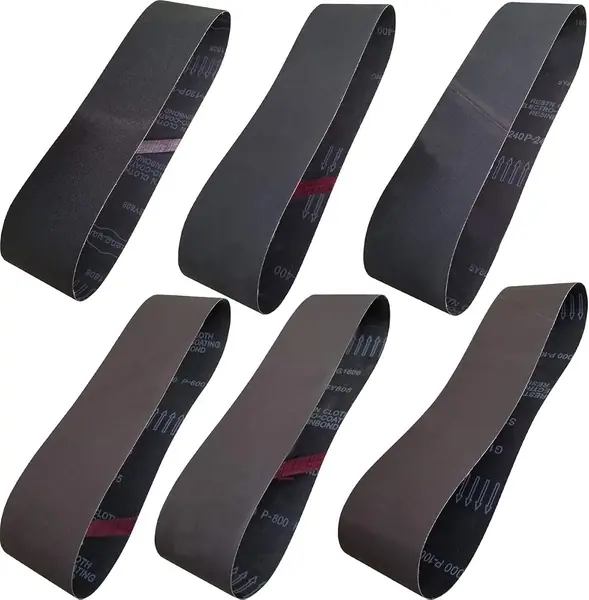
SACKORANGE 4x36 inch silicon carbide sanding belts in gray, six-grit pack

Sharpening and polishing

Shop Score 94/100
Abrasive
Silicon carbide
Belt Size
4 x 36 in
Grits Included
120, 240, 400, 600, 800, 1000
Backing
Y-weight cloth, waterproof
View on Amazon

Silicon carbide is the abrasive we want on hardened steel, and this pack pairs it with a heavy Y-weight backing that runs wet or dry. The grain is harder and sharper than aluminum oxide and fractures as it works, so it keeps cutting instead of glazing, and the scratch pattern it leaves is fine enough to polish out.

We appreciated the progression: 120 and 240 to true an edge, 400 and 600 to refine it, 800 and 1000 for the last passes. That is the sequence for a chipped mower blade or a kitchen knife somebody has been abusing. Wet is the real advantage on metal — a splash of water keeps the belt from loading and the workpiece from getting hot enough to spoil the temper at the edge you are forming.

Two practical notes. The grit is not printed on the cloth, so sort these into labeled sleeves the moment the box is open, or 600 and 800 become a coin flip. And this is a finishing set, not a stripping set: the coarsest belt is 120, so a weld or a piece of plate wants a 40 or 60 grit from somewhere else.

Worth Noting

  • Belts fit tight on some 4x36 sanders
Our Verdict

Six silicon carbide belts from 120 through 1000 grit: the set we reach for when the job is a sharp edge or a polished face rather than fast stock removal.

Check Latest Price
3.

POWERTEC 6x48 Zirconia Belts Best for Heavy Metal Removal

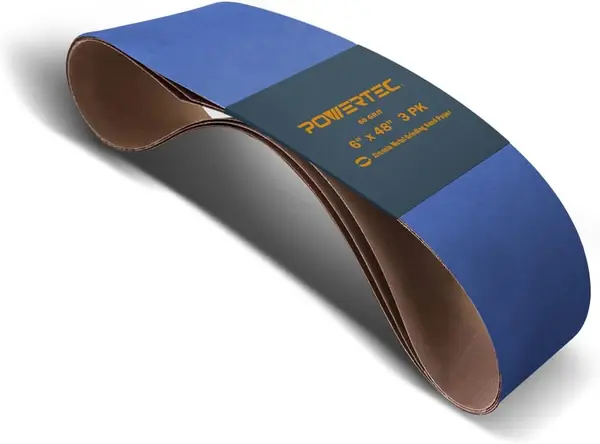
POWERTEC 6x48 inch zirconia alumina sanding belts, 60 grit, three-pack

Heavy weld grinding

Shop Score 93/100
Abrasive
Zirconia alumina
Belt Size
6 x 48 in
Pack Quantity
3 belts
Grit
60 (extra coarse)
View on Amazon

Zirconia alumina is the grain that behaves best when you lean on the machine. It is designed to fracture under pressure and expose fresh cutting edges, so pushing it into steel makes it work harder rather than glaze over.

The backing is heavy Y-weight cloth with a closed coat and a resin-over-resin bond, the combination that survives grinding a weld down to base metal. Closed coat means grain covers the whole surface, which is what you want on steel and exactly what you do not want on aluminum, where it loads in a hurry. The 6x48 size fits the big stationary sanders and belt-and-disc machines.

Three belts to a box is the part that gave us pause, and what settled it is how much grinding one belt covers before it needs changing — the zirconia keeps cutting after a general-purpose grit would have gone smooth, and the joint holds up under pressure instead of lifting at the seam.

Worth Noting

  • Only 60 grit in this listing
Our Verdict

The most aggressive belt here: zirconia alumina in a 60 grit that sharpens itself under pressure, built for weld removal and heavy grinding on a 6x48 machine.

Check Latest Price
4.

BOSHCRAFT 3x21 Sanding Belts, 21-Pack Best Grit Range

BOSHCRAFT 3x21 inch aluminum oxide sanding belts, 21-piece mixed-grit pack

Portable belt sanders

Shop Score 92/100
Abrasive
Aluminum oxide
Belt Size
3 x 21 in
Pack Quantity
21 belts
Grits Included
40/60/80/120/180/240/400 (3 each)
View on Amazon

Forty grit through 400 in a single box is the widest spread in this guide, and that is what makes it the practical first order for a portable sander that sees metal. Three belts per grit lets you strip rust at 40, clean up at 80 and 120, and take a part to a 400 finish without buying a second assortment.

The belts are aluminum oxide on a heat- and moisture-resistant backing, which suits a mixed shop — a little steel, a little aluminum, plenty of wood. They track well on the common 3x21 sanders, and the bidirectional tape splice means the belt runs either direction without the joint catching on the platen.

The grit is printed on the cloth backing of every belt, which sounds small until you own a drawer of unmarked belts and a part that needs one more pass. With three of each grit, you finish the job on the belt you started with instead of rationing your last 120.

Worth Noting

  • Seams can let go under sustained heat
Our Verdict

One box, seven grits, twenty-one belts: we hand this to anyone who wants to go from stripping rust to a 400-grit finish without ordering twice.

Check Latest Price
5.

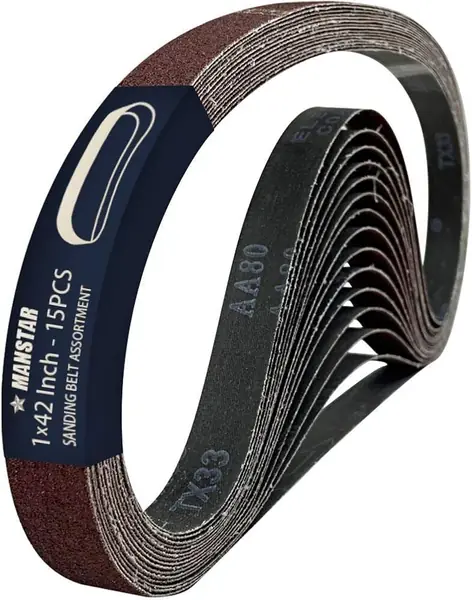
abrasticle 1x42 Sanding Belts, 15-Pack Best for 1-Inch Belt Sanders

abrasticle 1x42 inch aluminum oxide sanding belts, 15-piece assorted-grit pack

Knife grinding

Shop Score 91/100
Abrasive
Aluminum oxide
Belt Size
1 x 42 in
Pack Quantity
15 belts
Grits Included
80, 120, 150, 240, 400 (3 each)
View on Amazon

A 1x42 belt is what a lot of knife grinders and older 1-inch sanders run, and this pack covers the useful middle of that work: three belts each of 80, 120, 150, 240, and 400 grit, fifteen in all. Eighty grit does the shaping, 240 and 400 refine it, and the steps between are close enough that you are not chasing scratches from a grit you skipped.

We ran these on a 1-inch machine, and what stood out was how well they held their length — a 1x42 that stretches or has a lump at the joint will not track, and these ran flat from the first belt to the last. The 400 surprised us: fine enough to polish a bevel without loading the moment it touches steel.

The cloth backing washes clean and the resin resists loading, which matters more on metal than on wood, where swarf packs into the grain and stops the cut. Fifteen belts of five grits is a working supply for a hobbyist rather than a production shop.

Worth Noting

  • Nothing coarser than 80 grit for hogging stock
Our Verdict

For a 1-inch belt sander doing knife profiles and small deburring, this five-grit assortment is the one we keep reaching for.

Check Latest Price
6.

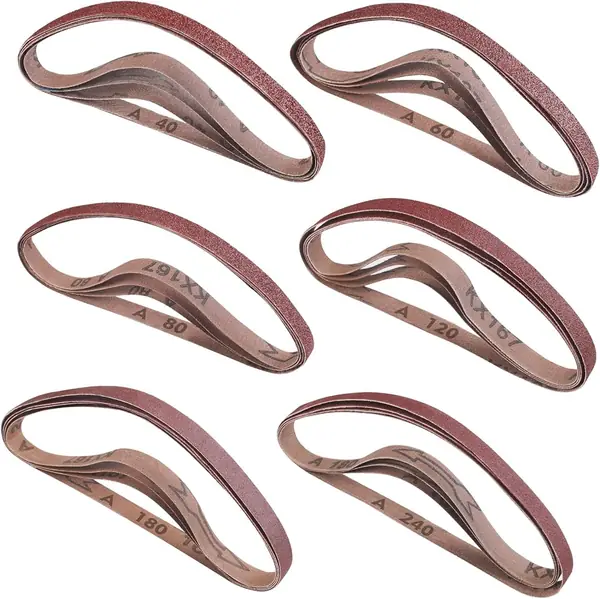
WORKPRO 1/2 x 18 Sanding Belts, 24-Pack Best Budget

WORKPRO 1/2 x 18 inch aluminum oxide sanding belts, 24-piece six-grit pack

Band files

Shop Score 90/100
Abrasive
Aluminum oxide
Belt Size
1/2 x 18 in
Pack Quantity
24 belts
Grits Included
40/60/80/120/180/240 (4 each)
View on Amazon

Half an inch wide and 18 inches around puts these on air belt sanders and band files rather than bench machines — the tool you reach for when a weld sits in a corner or a tube end needs a chamfer. Twenty-four belts, four each of 40, 60, 80, 120, 180, and 240 grit, cover that work from knocking down a spot weld to cleaning up before paint.

The grain is aluminum oxide on a firm cloth base, with a bidirectional lap joint that keeps the splice from thumping. In a band file the belt moves fast over a small contact wheel, so a joint sitting proud shows up immediately in the cut; we did not find that here.

Fabrication cleanup and weld prep are exactly what this size suits, and the 40 and 60 grits did most of our work. Loading is what kills small belts, so keep the pressure light and let the belt cut rather than smearing metal across the surface.

We treat these as consumables, which is the right model for a band file: a fresh belt costs very little and cuts like new, and twenty-four of them mean you never ration the last one.

Worth Noting

  • Fits band files and air sanders, not bench machines
  • Small belts load quickly under heavy pressure
Our Verdict

Twenty-four belts in six grits for the smallest outlay here: the pack we buy for a band file and the fiddly deburring nobody wants to do with a hand file.

Check Latest Price
7.

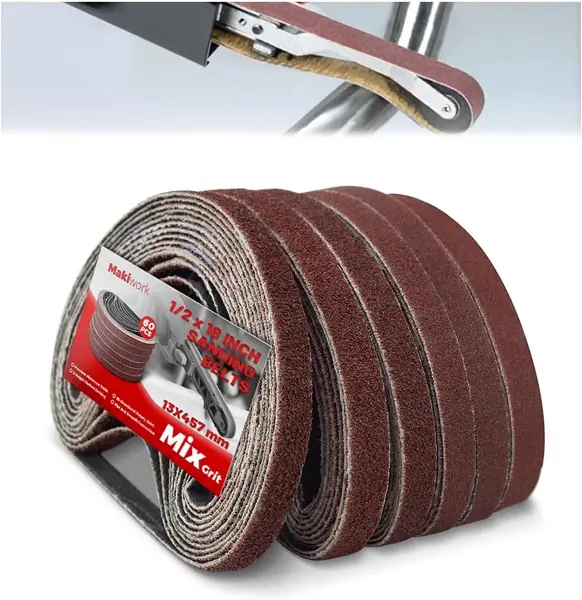
makiwork 1/2 x 18 Sanding Belts, 60-Pack Best for High-Volume Shops

makiwork 1/2 x 18 inch aluminum oxide sanding belts, 60-piece bulk pack in red

High-volume shops

Shop Score 89/100
Abrasive
Aluminum oxide
Belt Size
1/2 x 18 in (13 x 457 mm)
Pack Quantity
60 belts
Grits Included
40/60/80/120/150/240 (10 each)
View on Amazon

Sixty belts in one box is a lot of half-inch abrasive, and the way they are distributed is the interesting part: ten each of 40, 60, 80, 120, 150, and 240 grit. The coarse belts you burn through on weld cleanup are stocked as deeply as the fine ones you use sparingly, which is not how most assortments are built.

They fit 1/2 x 18 machines — the air belt sander or band file that lives on a fabrication bench — and the cloth backing is firm enough that the belt does not roll or wander on a small contact wheel. We ran them on steel, aluminum, and wood without a joint letting go.

What we noticed is that they keep cutting past the point where a thinner belt starts to glaze. That is the whole case for buying in bulk: the belt you change a little late still finishes the job, and ten more on the shelf mean you change it when you should.

Where these earn their place is repetition — the same grit and the same size, over and over, without the box running dry in the middle of a run of parts.

Worth Noting

  • Nothing finer than 240 grit for polishing
Our Verdict

We buy this 60-pack when half-inch belts disappear fast: ten belts of each grit from 40 to 240, and no reordering in the middle of a project.

Check Latest Price
8.

Shineboc 1/2 x 18 Zirconia Belts, 40-Pack

Shineboc 1/2 x 18 inch blue zirconia sanding belts, 40-piece mixed-grit pack

Small-belt steelwork

Shop Score 88/100
Abrasive
Zirconia
Belt Size
1/2 x 18 in (13 x 457 mm)
Pack Quantity
40 belts
Grits Included
40, 60, 80, 120, 180, 240
View on Amazon

Blue zirconia is the grain here rather than the aluminum oxide nearly every other half-inch pack uses, and that changes what the belt does on steel. Zirconia is tougher and self-sharpening under pressure, so it keeps biting instead of polishing itself smooth — the difference between a belt that deburrs and one that mostly makes heat.

Forty belts across six grits from 40 to 240 is a reasonable spread for a band file: coarse belts for weld cleanup, mid grits for blending, 240 for a finish before paint. The resin bond and the bidirectional seam are the details that decide whether a small belt survives a fast-running tool, and neither gave us trouble.

The backing is waterproof, which is worth knowing about even if you never run a band file wet. On stainless and on anything that work-hardens, a little coolant keeps the belt cutting and the part cool.

Set against the aluminum oxide packs that dominate this size, the zirconia is the reason to pay attention: on steel it holds its bite longer, and forty belts is enough to stop rationing them.

Worth Noting

  • Grit markings on the belts are hard to read
Our Verdict

Zirconia in a half-inch belt is unusual, and it is why we like this pack for steel: forty belts that keep cutting where aluminum oxide smooths over.

Check Latest Price

How We Tested Sanding Belts on Steel

We started from the belt sizes our sanders actually take — 4 x 36, 6 x 48, 3 x 21, 1 x 42, and the 1/2 x 18 that fits a band file — then filtered the field by grit ladder, abrasive grain, backing weight, and cost per belt. Sixteen packs came back to the shop for four months of testing.

Before anything was mounted, we measured each belt against its platen, flexed the lap joint, and ran a thumbnail along the seam to feel whether it sat flat. Safety glasses went on before the first belt touched steel, and we cleared wood dust out of the sander and dust bag before switching from wood to metal. On the machine we listened for the tick of a lap that wasn't flat and shut the sander down the moment a belt began to lift at the edge.

The work was ordinary shop work: knocking down weld beads on a steel frame, deburring cut tube, stripping rust, and grinding a knife bevel on the 1 x 42. We timed how long each coarse belt took to flatten a bead, checked how hot the steel got underneath it, and counted how many belts we burned through at each grit. Anything that glazed, shed grain, or smoked before the seam let go went to the bottom of the pile, and we ran the waterproof-backed belts wet as well as dry to see whether the cloth stiffened or softened.

At the end we divided each pack's price by the belts still doing useful work — cost per belt that survives a job counts for more than cost per belt in the bag.

How to Choose Sanding Belts for Metal

Start With the Belt Size, Not the Grit

Belt dimensions are written width by circumference, so 4x36 means a 4-inch-wide loop 36 inches around, and those numbers belong to your machine. A 1x42 belt will not fit a 3x21 sander no matter how good the abrasive is. Measure the worn belt laid flat, or read the plate on the sander, before you shop.

The sizes here run from half-inch belts for band files up to 6x48 for a big stationary machine, with 3x18, 3x21, 1x42, and 4x36 in between. Some listings sell the same loop as belt sander paper; match the numbers rather than the name.

Match the Grain to the Metal

Aluminum oxide is the generalist. It handles aluminum, brass, and other non-ferrous metal nicely, does respectable work on mild steel, and does not mind if you switch to wood. Zirconia alumina is the grinding grain — it fractures under pressure to expose fresh edges, which is why it suits weld removal and stock work on steel. Silicon carbide is harder and sharper again, and it is what we choose for sharpening and polishing hardened steel.

Think about the work rather than the label: heavy weld grinding wants zirconia and a closed coat, aluminum wants an open coat that resists loading, and edge work wants silicon carbide in fine grits.

Buy a Grit Ladder, Then Replenish What You Burn

Metal work eats coarse grits. A 40 or 60 grit removes a weld, 80 to 120 cleans up the scratches, and 180 and finer refines a surface or an edge. An assortment gets you started and shows you which grits you actually use; after that, buy those grits in bulk.

Count belts per grit, not the total in the box. A 21-pack spread over seven grits is three belts of each, which is not much once you are grinding steel all afternoon.

The Joint and the Backing Decide How Long It Lasts

A sanding belt fails at the seam. A diagonal lap splice that sits flat runs quietly and does not telegraph a line into the work; a lumpy one thumps, tracks badly, and lets go under heat. Look for a bidirectional joint and a belt described as flat at the splice.

Backing weight matters on metal: Y-weight cloth is the heavy option and takes pressure and heat. A waterproof backing lets you run the belt wet, which keeps both the belt and the workpiece cool while you sharpen, and a closed coat holds up better on steel than an open one.

Frequently Asked Questions

Final Verdict

The TPmax 4x36 pack is the one we point most people to: three grits, twelve belts, and a splice that runs flat on the size most bench sanders take. Add the SACKORANGE silicon carbide set if you sharpen or polish, because aluminum oxide stops at 150 and an edge wants finer.

If your machine takes 6x48 belts and you grind welds, the POWERTEC zirconia is the better belt and worth the smaller count. Working a band file instead, the WORKPRO 24-pack is the cheapest way into the size.