↑↓ navigate ↵ open Esc close All results →

Best Palm Sanders of 2026

Across a salvaged oak tabletop or a stack of cabinet doors, a palm sander turns an hour of hand-block work into ten minutes of passes—provided the pad sits flat, vibration stays manageable, and dust goes somewhere besides your lungs and the shop floor. Getting that right depends on matching the pad format and speed control to the stock in front of you.

In six months of work with 12 sanders across oak, painted trim, cabinet doors on sawhorses, and drywall patches, two limits showed up fast. A cloth dust bag is mostly a courtesy rather than real containment, and the low end of a variable-speed dial is what keeps an edge from burning through thin veneer.

No single format wins everywhere: a 1/4-sheet sander reaches tight corners a 5-inch disc misses, and cordless models make the most sense when you already own compatible batteries. The eight sanders ranked here hold a flat pad under light pressure and keep grip fatigue in check through long passes.

Our Top Picks

The Best Palm Sanders

1.

DeWalt DWE6423K Random Orbit Sander Best Overall
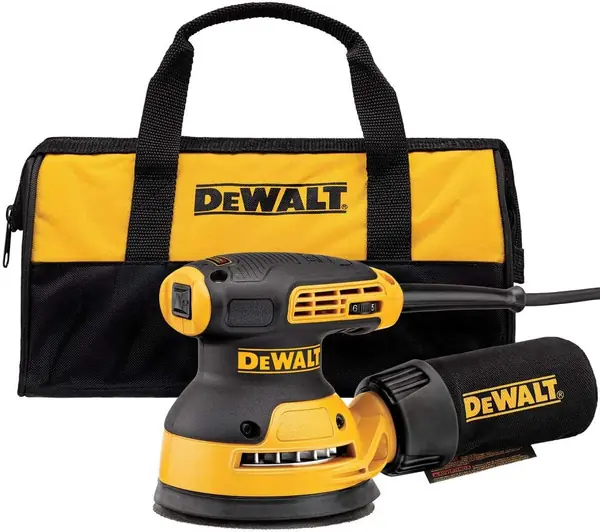
DeWalt DWE6423K 5-inch corded random orbit sander with rubber overmold grip and dust bag

All-around woodworking

Shop Score 97/100
Pad Size
5 in. hook-and-loop
Orbit Speed
8,000 to 12,000 OPM
Motor
3.0 amp
Dust Collection
Cloth bag and vacuum port
View on Amazon

Drop the dial to 8,000 orbits per minute and the DWE6423K stops behaving like a stock remover. The pad turns slowly enough to work a walnut edge or a shop-sawn veneer without burning through, and you can take a finish pass straight to stain. Open it to 12,000 and the same tool flattens a glued-up panel in a hurry. That range, more than the amp rating, is what makes it the sander we hand to someone buying their first serious one.

Nothing else in this group puts the unglamorous details together as well. The 3-amp motor holds its speed when you lean on it, the separate counterweight keeps vibration out of your wrists over a long session, and the dust-sealed switch is the kind of thing you only notice when a cheaper sander's switch starts sticking. DeWalt's three-year coverage is also a real advantage over the one-year warranties on the Bosch and corded Makita models.

Consumables are the cheapest part of woodworking: 5-inch hook-and-loop discs are sold everywhere, and the pad itself is replaceable once the hook field wears out. The cloth bag locks on with one hand. The wrinkle is the vacuum port, which is sized for DeWalt's own hose, so a 1-1/4-inch shop vac hose needs the DWV9000 quick connector to lock on. If you plan to sand indoors, add that to the order.

It sits mid-pack on price in this group and earns the difference. The sander it cannot replace is the 1/4-sheet one, because a round pad will not get into an inside corner no matter how well it is built.

Worth Noting

  • Corded only, so you need an outlet nearby
Our Verdict

This is the 5-inch sander we point most woodworkers toward: a usable speed range, dust collection that works, and a three-year warranty.

Check Latest Price
2.

Bosch ROS20VSC Random Orbit Sander Best for Indoor Work

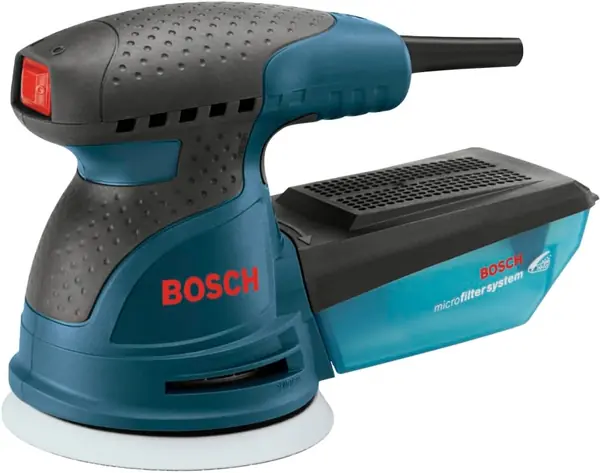
Bosch ROS20VSC 5-inch random orbit sander with soft grip and microfilter dust canister

Indoor finishing

Shop Score 96/100
Pad Size
5 in. hook-and-loop
Orbit Speed
7,500 to 12,000 OPM
Motor
2.5 amp
Dust Collection
Microfilter canister to 1/2 micron
View on Amazon

Quiet is the first thing that registers. The ROS20VSC runs at a low hum rather than a shop-tool shriek, and that changes where you are willing to use it: a finished bedroom, a rental, a Saturday morning with the family home.

The pad-dampening brake is the part we appreciate most. It stops the disc free-spinning when you lift the tool, so the sander does not gouge a softwood edge on the way in or out, and the pliable backing pad follows a curved apron or a table leg instead of sanding a flat spot into it. Speed runs 7,500 to 12,000 OPM, a narrower band than the DeWalt's but wide enough for paint removal at one end and a 220-grit polish at the other.

Our reservation is longevity. Coverage is one year, which is short for a tool at this price, and the failures that turn up tend to land after a year of weekend work, right when the warranty is gone. Buy it for the quiet and the sealed canister, and go in expecting to replace it eventually rather than hand it down.

Worth Noting

  • Canister lid is stiff to open
Our Verdict

Buy the Bosch if the sanding happens indoors: it's the quietest tool here and the sealed canister keeps fine dust out of the room.

Check Latest Price
3.

DeWalt DWE6411K 1/4-Sheet Palm Sander Best 1/4-Sheet

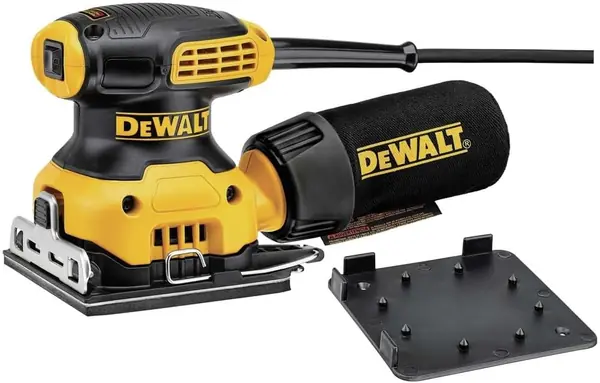
DeWalt DWE6411K quarter-sheet corded palm sander with paper clamp and cloth dust bag

Edges and corners

Shop Score 95/100
Pad Size
1/4 sheet
Orbit Speed
14,000 OPM
Motor
2.3 amp
Dust Collection
Cloth bag and vacuum port
View on Amazon

Quarter-sheet paper is the cheapest sanding you can buy. A standard 9-by-11 sheet cuts into four and covers an evening's work, and the DWE6411K is built around that economy. Its rectangular pad runs right up to an inside corner, along a rail, or into the step where a cabinet face meets a stile, places a 5-inch disc simply cannot reach.

The 2.3-amp motor runs at a fixed 14,000 OPM, fast enough to strip paint and mill glaze quickly and too fast for a delicate veneer. What keeps it in our kit is the clamp: the front and rear grippers bite the sheet hard enough that it stays flat and the edges do not shred, and there is no hook-and-loop backing to wear out and start shedding discs.

Finish carpentry is where we reach for it: casings, face frames, the inside of a bookcase, anywhere a round pad leaves a rounded edge. As a second sander for someone who already owns a 5-inch random orbit model, it earns its shelf space.

Worth Noting

  • Fixed 14,000 OPM with no speed dial
  • Cloth bag leaks fine dust
Our Verdict

When a round pad won't fit, this is the sander we want in hand: quarter sheets, a clamp that holds, and corners a 5-inch disc can't reach.

Check Latest Price
4.

Makita XOB01Z Cordless Random Orbit Sander Best Cordless

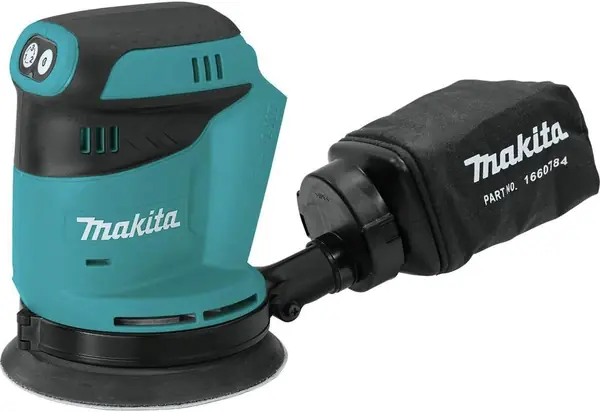
Makita XOB01Z 18V LXT cordless 5-inch random orbit sander with dust bag

Cordless work

Shop Score 94/100
Pad Size
5 in. hook-and-loop
Orbit Speed
7,000 / 9,500 / 11,000 OPM
Battery
18V LXT, tool only
Runtime
Up to 40 minutes per charge
View on Amazon

Makita rates this sander at up to 40 minutes of continuous run time on a charge, and that figure is what makes a cordless sander useful rather than a novelty. Fit a larger pack and you get closer to an hour, which is enough to work through a run of trim without walking back to an outlet.

Three detents, at 7,000, 9,500 and 11,000 OPM, cover removal through finishing in coarser steps than a dial. The pad brake and the start-up speed control keep the tool from skidding when you set it down on a panel, and at 2.9 pounds it is one of the lighter 5-inch sanders here, which tells on a ladder or working overhead.

Dust handling comes from a small bag, and the body has no cord to fight, so hanging a hose off it is a far less annoying proposition than dragging both a cord and a hose around a bench. The 1/8-inch orbit moves material at a decent rate for a battery tool.

For anyone already stocked with LXT packs, this is the cordless sander we recommend: it holds speed, sands flat, and does not feel like a compromise next to a corded tool. Just keep a second pack charged, because output tapers noticeably around half charge.

Worth Noting

  • Tool only; battery and charger sold separately
  • Slows noticeably around half charge
Our Verdict

Our pick for anyone already on Makita's 18V batteries: three speeds, a 5-inch pad, and enough runtime to finish a room.

Check Latest Price
5.

Makita BO5041 Random Orbit Sander Best for Control

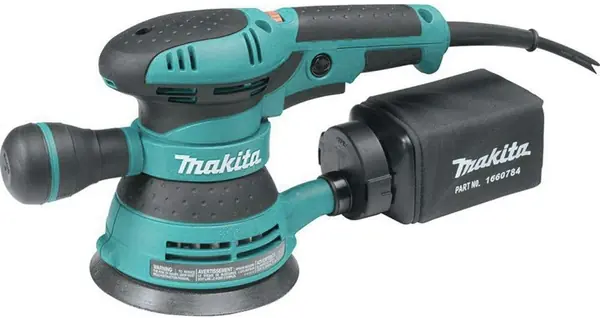
Makita BO5041 5-inch corded random orbit sander with adjustable front handle

Long sanding sessions

Shop Score 93/100
Pad Size
5 in. hook-and-loop
Orbit Speed
4,000 to 12,000 OPM
Motor
3.0 amp
Handle
Adjustable and removable
View on Amazon

The front handle is the reason to look at this one. It is a separate knob that mounts at any angle or comes off entirely, so you can plant your off hand on top for a wide panel or wrap it around the nose for an edge, and the sander stays flat instead of tipping off the workpiece.

Under that handle sits a two-finger trigger with a lock-on button, which we prefer to a paddle for long sessions: you can feather the speed with your trigger finger and lock it open when you are covering ground. The dial goes down to 4,000 OPM, the widest range in this group, and at the low end the pad is gentle enough for a finish pass on cherry or a curved rail.

This is the most controllable corded sander in the group, and that is what the extra money buys: a tool that behaves itself on contoured work and over a long session, where a fixed-speed sander starts to fight you.

Worth Noting

  • One-year warranty at a premium price
  • Dust bag can work loose
Our Verdict

Choose this if you want a trigger under your finger and a front handle you can move anywhere: the most controllable corded sander here.

Check Latest Price
6.

Milwaukee 2648-20 M18 Random Orbit Sander Best for M18 Owners

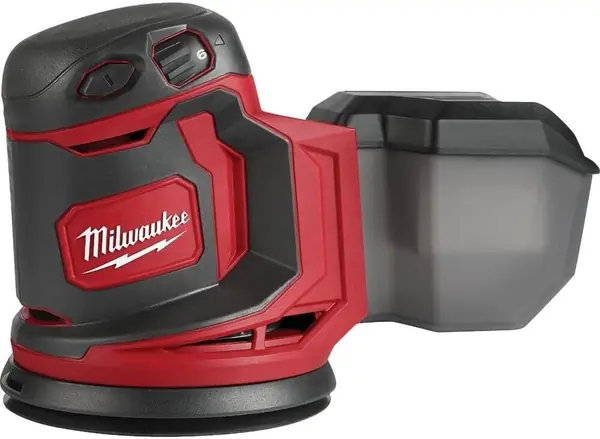
Milwaukee 2648-20 M18 cordless 5-inch random orbit sander with dust bag

M18 tool owners

Shop Score 92/100
Pad Size
5 in. hook-and-loop
Orbit Speed
7,000 to 12,000 OPM
Battery
M18, tool only
Runtime
Up to 35 minutes on 3.0 Ah
View on Amazon

If your shop is already full of M18 packs, the arithmetic here is different from every other sander on this page. The bare tool drops onto batteries and a charger you own, so you skip a whole power platform. Milwaukee rates it at 12,000 max OPM with a 7,000-to-12,000 dial, and it carries itself like a corded tool in the hand.

The dial is where you will spend your attention: 7,000 OPM keeps a finish pass from burning an edge, and the top end removes stock at a rate that justifies leaving the cord behind. At 4 pounds it is the heaviest sander here, and you feel that at the end of a long vertical run.

Runtime is the other number to plan around. Milwaukee rates up to 35 minutes on a 3.0 Ah pack, so larger projects mean two packs on the bench rather than one, and the tool is happiest when you keep them rotating.

Worth Noting

  • Tool only; battery and charger cost extra
  • Dust bag misses a lot of fine dust
Our Verdict

The cordless sander for a shop full of M18 packs: corded-class speed without adding another battery system.

Check Latest Price
7.

Skil SR211601 Random Orbital Sander Best for Tight Budgets

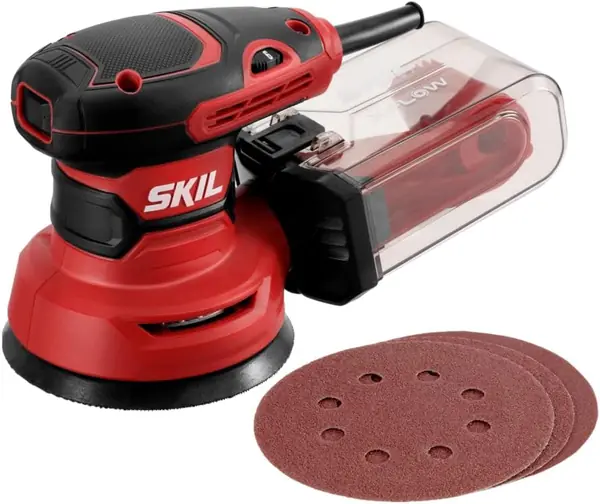
Skil SR211601 5-inch random orbital sander with transparent cyclonic dust box

Tight budgets

Shop Score 91/100
Pad Size
5 in. hook-and-loop
Orbit Speed
7,000 to 13,000 OPM
Motor
2.8 amp
Dust Collection
Cyclonic dust box
View on Amazon

The SR211601 buys a genuine 5-inch random orbit sander for the least money in this group: 2.8 amps, a dial from 7,000 to 13,000 OPM, and a hook-and-loop pad that takes the same discs as sanders costing several times as much. Nothing about the format is scaled down.

The cyclonic dust box is the interesting part, a transparent container that swirls dust out of the air stream and empties in one motion. It keeps the bench clearer than you would expect at this price, and the soft rubber grip over a counterweighted body stays comfortable through a long pass.

Where it earns a place is the occasional-use buyer: someone refinishing a deck, patching drywall seams, or cleaning up a single piece of furniture who cannot justify a premium tool. It sands flat, changes discs in seconds, and takes the same paper as everything else here.

Worth Noting

  • Dust box can work loose mid-sand
  • Some units fail within months of steady use
Our Verdict

A real 5-inch random orbit sander for very little money, provided you accept that steady use will wear it out sooner than the rest.

Check Latest Price
8.

Black+Decker BDEQS300 1/4-Sheet Sander Best for Quick Touch-Ups

Black+Decker BDEQS300 quarter-sheet sander with top paddle switch and dust bag

Quick touch-ups

Shop Score 90/100
Pad Size
1/4 sheet
Motor
2.0 amp
Dust Collection
Tri-layer filter bag
Switch
Top paddle with lock
View on Amazon

Two amps is the smallest motor in this group, well under half the DWE6423K's 3.0, and that sets the job description. This is a finishing and touch-up sander: trim, drywall patches, painted surfaces, an edge that needs one pass before paint. Nobody should buy it to flatten a glued-up panel.

What sets it apart is three-sided flush sanding. The pad is open across 270 degrees, so you can run it right up against a wall, into a corner, or along an inside edge, which is exactly where a 5-inch round sander leaves a scallop behind.

The paddle switch sits on top where your palm lands and it locks on, so you can work one-handed on a ladder or hold a workpiece steady with the other hand. The tri-layer bag is more filter than the cloth sacks on most sanders at this price.

We keep this one for the jobs that do not deserve a setup: a sticking door, a patch of filler, a shelf edge. If sanding is a recurring part of your week, spend more. For the twice-a-year user it is a sensible way to stop sanding by hand.

Worth Noting

  • Smallest motor in this group at 2.0 amps
Our Verdict

The budget 1/4-sheet sander we keep for quick fixes, thanks to three-sided flush sanding and a switch you can work one-handed.

Check Latest Price

How We Tested Palm Sanders

We started with every current 5-inch random orbit sander and 1/4-sheet sander from the major power tool makers, then narrowed the list by the things that change how a tool actually gets used: pad format, dust setup (cloth bag, sealed canister, or vacuum port), variable versus fixed speed, and for cordless models, whether a battery and charger came in the box. That left 12 sanders, which we ran for six months.

Most of that time was spent in a garage workshop with a salvaged oak tabletop, cabinet doors on sawhorses, painted trim, and drywall patches — the mix of flat, vertical, and overhead work a palm sander really sees. We seated every disc and sheet flat and fully engaged before start-up, wore eye and respiratory protection whenever we sanded a finish, and compared dust setups by sanding the same painted door with each tool, then checking what landed in the bag or canister, what landed on the bench, and how quickly the shop vacuum filter loaded up.

We ran each speed dial from the bottom of its range upward, watching for burn marks on veneer at the low end and swirl marks at the top. Every sander did 20-minute stretches on a vertical face and overhead, where we noted where the grip dug into a palm and when our hands started to tingle. We timed disc and sheet changes with a stopwatch.

Cordless models ran until the battery cut out — and two of them shipped without a battery or charger, so runtime only meant something once we priced those in. After six months we went back over switches, pad brakes, cords, and bag zippers to see what had loosened or clogged, and spun each pad to check it still ran flat.

How to Choose a Palm Sander

Pad Format Comes First

A 5-inch random orbit sander covers flat panels and doors quickly, and its orbiting pad blends scratches well enough that you can go from 120 grit to finish without visible swirls. A quarter-sheet sander has a rectangular pad that runs into inside corners, along rails, and up to a wall, the places a round disc physically cannot reach. The paper is cheaper too: one 9-by-11 sheet makes four pads.

Watch for the pointed detail sander sold alongside them. A pad with an angled tip is for profiles and slots, not panel work, and it will not flatten a glue seam. Match the pad shape to the shape of your work.

Dust Collection: Read Past the Bag

Every sander here ships with a bag, and most bags catch the chips while letting the fine dust through. If you sand indoors, that fraction is the one that matters, because it is what settles on the furniture and hangs in the air. A canister with a real filter, like the microfilter on the Bosch, or a shop vac connection is what actually changes the air in the room.

Check the port before you buy. Several of these are sized for the maker's own hose and need an adapter to fit a standard 1-1/4-inch shop vac hose, so price the adapter along with the sander if you plan to run extraction.

Pay for Variable Speed

A dial that reaches down to 4,000 or 7,500 OPM lets you slow the pad for veneer, paint edges, and curves, where a fast orbit burns through a finish in a heartbeat. A fixed-speed sander running at 12,000 to 14,000 OPM is a stripping tool: effective on paint and mill glaze, unforgiving on anything thin. If you finish as often as you strip, the dial is the feature worth paying for.

Cord or Battery, and the Tool-Only Trap

Corded sanders run at constant power all day and cost less for the same motor. Cordless ones go up a ladder, out to a deck, and around a room without a cord dragging across fresh work; the Makita and Milwaukee here both run roughly 35 to 40 minutes on a pack. The trap is tool-only pricing, which assumes you already own batteries and a charger. If you do not, price the whole kit before you commit.

Vibration, Weight, and Hand Comfort

An hour of sanding is a hand-and-wrist workout, and the details that matter are unglamorous: a counterweighted motor, an overmolded grip, a body short enough that your hand sits close to the work. Weight runs from about 2 to 4 pounds across this group. Lighter is easier overhead; heavier tends to stay flatter on a big panel. An adjustable front handle is worth having if you sand contoured parts.

Frequently Asked Questions

Final Verdict

We recommend the DeWalt DWE6423K as the default palm sander for a home woodworking shop. It is the one here that gets the speed range, the dust bag, and the vibration control right at the same time, and the three-year warranty backs it up.

Two situations change the answer. Sanding inside a finished house makes the Bosch's quiet motor and sealed canister worth the shorter coverage, and a shop already running Makita 18V batteries should go straight to the XOB01Z. For everything else, start with the DeWalt.