↑↓ navigate ↵ open Esc close All results →

Best Orbital Sanders of 2026

Finish sanding exposes every flaw in a random orbit sander just as the wood starts looking like furniture. Because the pad both spins and orbits to scramble scratch patterns, a well-balanced sander erases planer marks and glue lines without leaving linear pigtails, whereas a rough unit vibrates hands numb and fills the shop with fine dust.

Running 12 sanders for eight months across white oak, pine, and paint-heavy reclaimed lumber showed that next-day hand fatigue and low-speed control tell far more than top-RPM numbers on a carton. Finish passes happen in the bottom third of the dial, where models with weak speed regulation or aggressive startup spin can burn straight through thin veneer before a pass finishes.

Onboard dust bags never replace a respirator or a connected shop vacuum, so sanders with secure vac-hose ports quickly proved cleanest in daily use. Corded and cordless models, bare tools, and full kits all appear across these eight options for shops of different sizes.

Our Top Picks

The Best Orbital Sanders

1.

Bosch ROS20VSC Random Orbit Sander Best Overall
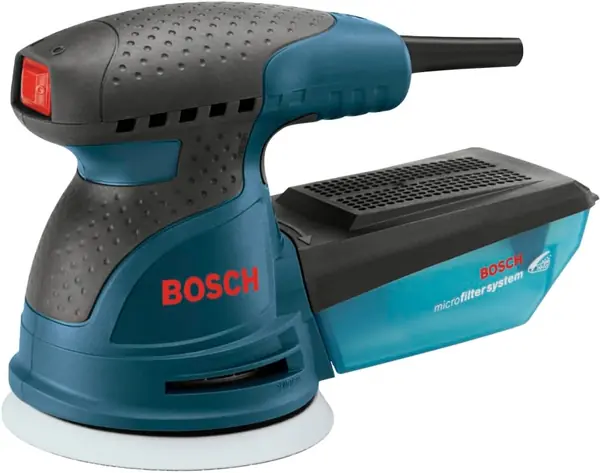
Bosch ROS20VSC 5-inch random orbit sander with microfilter dust canister and soft bag

All-around woodworking

Shop Score 97/100
Speed
7,500–12,000 OPM
Motor
2.5 amp
Pad Size
5 inches
Dust Collection
Microfilter canister
View on Amazon

Dust is what separates a finished panel from a do-over, and the ROS20VSC is the sander here that takes it seriously. Bosch's microfilter canister traps particles down to half a micron and the clear body shows the fill level without a teardown, so you know when to empty it instead of guessing. That is the difference between a tool you are willing to use in the shop and one you drag out to the driveway.

The rest of the package holds up. A 2.5-amp motor runs 7,500 to 12,000 OPM on a dial, the pad-dampening system is built to kill swirl marks on flat and contoured surfaces alike, and the microcellular backing pad flexes enough to follow a curve instead of fighting it. We are also glad Bosch includes the vacuum adapter and a soft bag rather than selling them separately; a shop vac on that port is how this machine does its cleanest work.

In hand it is composed: soft-grip top and body, low vibration, and a low profile that keeps your hand near the work for control on edges. Nothing about it feels built to a price, and it is the best balance of dust control, speed range and cost in this group, which is why it is our default recommendation.

One thing to plan around: the canister takes a couple of tries to seat squarely, which gets old if you empty it ten times in a session. Run a hose to a vac and you will barely open it.

Worth Noting

  • One-year warranty is short for the price
Our Verdict

We recommend the ROS20VSC as the one corded sander most woodworkers should own: it controls dust better than anything else here and gives you genuine speed control.

Check Latest Price
2.

Makita BO5041 Random Orbit Sander Best for Fine Finishing

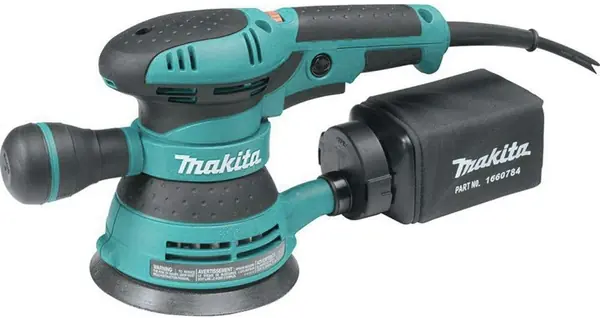
Makita BO5041 5-inch random orbit sander with adjustable front handle and variable speed dial

Fine finish work

Shop Score 96/100
Speed
4,000–12,000 OPM
Motor
3.0 amp
Pad Size
5 inches
Weight
3.09 lb
View on Amazon

Four thousand orbits per minute is as slow as this group gets. Most sanders here bottom out around 7,000, which is faster than you want when you are leveling a topcoat or working close to a veneer edge. On the Makita's lowest dial setting you can feather a repair without cutting through it, and that single ability justifies the tool for anyone who finishes what they build.

The rest is Makita doing what Makita does: a 3-amp motor, a 1/8-inch orbit, a rubberized palm grip, and a two-finger trigger with a lock-on button so you are not squeezing for twenty minutes straight. The adjustable front handle is another design detail we love. It swings to the angle the work calls for and comes off entirely when you want to choke up on the body instead.

It runs smoothly at every setting on the dial, discs change in seconds, and the whole tool feels built for years rather than a season. That is rare enough in this group to be worth paying for.

What the premium does not buy is more power. The motor is the same 3 amps as sanders that cost far less here, and it will not strip paint noticeably faster. What you are buying is the bottom of the dial and the handle, and for finish work that is the right trade to make.

Worth Noting

  • Dust bag trails the canister systems here
  • One-year warranty on a premium tool
Our Verdict

This is the sander we choose when a job is about finish rather than stock removal: its 4,000 OPM low end and adjustable handle have no equal in this group.

Check Latest Price
3.

DEWALT DWE6421K Random Orbit Sander Best Value Corded

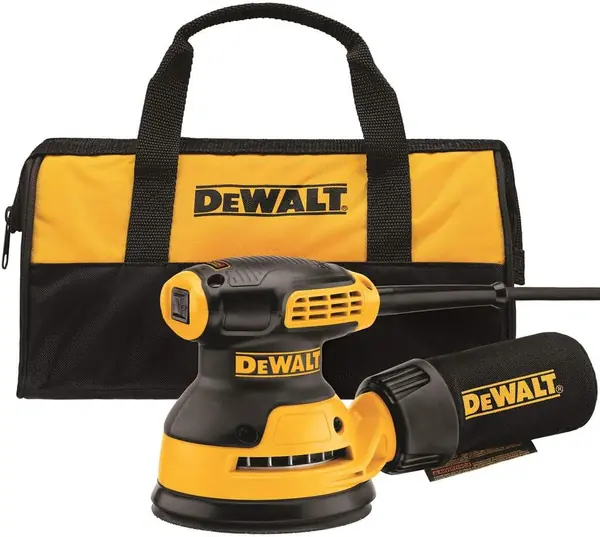
DEWALT DWE6421K 5-inch corded random orbit sander with dust bag and carrying case

Value corded sanding

Shop Score 95/100
Speed
12,000 OPM
Motor
3.0 amp
Pad Size
5 inches
Warranty
3-year limited
View on Amazon

Three amps, 12,000 orbits per minute, and one of the lowest prices in this group: the DWE6421K is what we point to when someone wants a corded workhorse and does not want to think about settings. It is the same basic motor as DEWALT's variable-speed kit, minus the dial.

What you get instead is simplicity. One switch, one speed, and a separate counterweight that keeps the vibration out of your hands rather than passing it through. The body is short, the rubber overmolding covers every place you grip, and the dust bag locks on one-handed and swaps for a hose without an adapter hunt.

The hook-and-loop pad grips hard, hard enough that peeling a worn disc off takes a deliberate tug. That is the better problem to have than discs launching across the shop mid-pass, and we would take a stubborn pad over a loose one every time on a machine with this much orbit speed.

DEWALT's three-year limited warranty is the longest coverage in this group, matched only by the Craftsman, and that counts on a tool whose pad and switch take the abuse. Set against the Bosch, you give up the canister and the dial; for paint removal and general prep, we do not miss either one.

Worth Noting

  • Fixed speed leaves no slow setting
Our Verdict

Our pick for anyone who wants a corded workhorse without paying for a speed dial: three amps, a three-year warranty, and no settings to think about.

Check Latest Price
4.

DEWALT DCW210B 20V MAX Orbital Sander Best Cordless for DEWALT 20V Owners

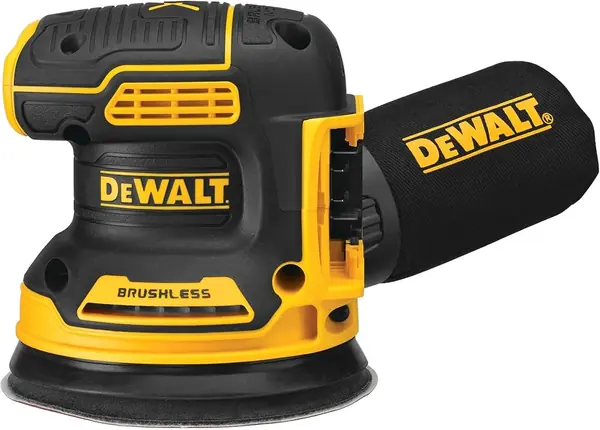
DEWALT DCW210B 20V MAX brushless random orbit sander sold as a bare tool

20V MAX owners

Shop Score 94/100
Speed
8,000–12,000 OPM
Motor
Brushless
Power Source
20V MAX battery, tool only
Pad
Replaceable 8-hole hook-and-loop
View on Amazon

This is a bare tool. No battery, no charger, and a price that only makes sense if 20V MAX packs are already on your shelf. Do that arithmetic before you order, because a cordless sander with nothing to plug into it is a paperweight with a very good grip.

For anyone already in the platform, it is an easy add. The brushless motor is there for runtime as much as for torque, the dial covers 8,000 to 12,000 OPM, and the body is deliberately low so your hand sits close to the panel instead of perched on top of it. The dust-sealed switch is a small thing that matters in a tool that lives in a cloud of wood flour.

The 8-hole hook-and-loop pad is replaceable, which we appreciate more than we expected to. The pad is the part that wears out on any sander, and being able to order a fresh one instead of retiring the tool is the difference between a machine you keep and one you replace.

Dust is the compromise. A cordless sander either collects into something you carry and empty, or trails the hose you bought a cordless machine to escape. Runtime tracks the pack you feed it, too: a compact battery is plenty for trim and punch-list work, while a deck is a two-pack job.

Worth Noting

  • Bare tool, batteries and charger sold separately
Our Verdict

If you already own 20V MAX batteries, this is the cordless sander we suggest adding first: brushless, variable speed, and one less cord to fight.

Check Latest Price
5.

Milwaukee 2648-20 M18 Random Orbit Sander Best Cordless for Stock Removal

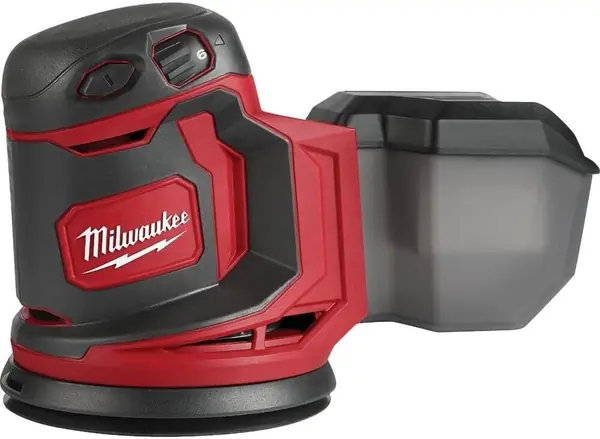
Milwaukee 2648-20 M18 cordless random orbit sander with dust port, bare tool

Cordless stock removal

Shop Score 93/100
Speed
7,000–12,000 OPM
Weight
4 lb
Power Source
M18 battery, tool only
Runtime
Up to 35 min on 3.0 Ah
View on Amazon

Thirty-five minutes is the number Milwaukee puts on this sander: the runtime you get from an M18 3.0 Ah pack. That is the honest measure of a battery sander. It is enough to finish a cabinet or a set of shelves, and not enough to resurface a floor without a stack of charged packs behind you.

Inside that window it behaves like a corded tool. The motor pulls hard enough that the 7,000-to-12,000 OPM dial feels like it is governing real power rather than trimming a weak one, and the 4-pound body stays flat on a wide panel instead of chattering across it. This is the cordless sander we reach for when a job is about removing material rather than finessing it.

Plan the batteries before you plan the project. Half an hour of sanding per pack sounds generous until you are working through a kitchen's worth of cabinet doors, and the packs are the real cost of going cordless. If you already run M18 tools, that math is done. If you do not, it is the reason to look at a corded sander instead.

Dust is the other half of the deal. The port takes a hose and the tool is far cleaner with one attached, but on its own collection is not this sander's strength. Between the two cordless picks here, the division of labor is genuine: Milwaukee for removal, DEWALT for trim and touch-up.

Worth Noting

  • Bare tool, battery and charger extra
  • Dust collection needs a vac attached
Our Verdict

We suggest it for M18 owners who want corded-class removal without a cord, as long as a few charged packs stay within reach.

Check Latest Price
6.

SKIL SR211601 Random Orbital Sander Best Budget

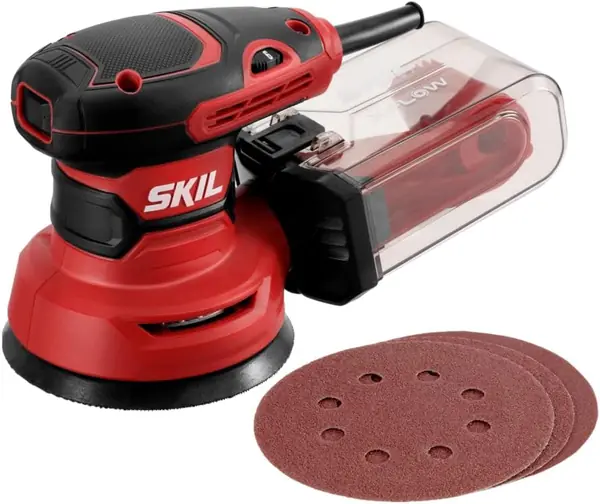
SKIL SR211601 5-inch random orbital sander in multicolor with cyclonic dust box

Budget first sander

Shop Score 92/100
Speed
7,000–13,000 OPM
Motor
2.8 amp
Pad Size
5 inches
Dust Collection
Cyclonic dust box
View on Amazon

A speed dial on the least expensive sander in this group is the small surprise of the roundup. The SR211601 runs 7,000 to 13,000 OPM, a top end higher than anything else here, and it does it with a 2.8-amp motor that is honest about its size.

The dust box is the other interesting piece. SKIL uses a cyclonic cup: dust spins to the outside of a transparent container instead of blowing into a bag, so emptying it is a one-handed job with nothing to unclip, and you can see when it needs doing. We like that arrangement a good deal more than a cloth bag at any price.

It is not a production tool, and that is the point. Two-point-eight amps in a compact body makes quick work of trim, cabinet doors, drywall patches and furniture, and slow going of stripping a deck. We rate it the best first sander here for exactly that reason: the jobs it is good at are the ones where a bigger tool is overkill and a sanding block is underkill.

Expect to fuss with the dust cup. It seats by friction, so it can work loose mid-job, and the outlet is not sized for a standard shop vac nozzle without an adapter. Check that the cup is fully seated every time you empty it and neither issue will cost you more than a second.

Worth Noting

  • Dust box can work loose mid-job
  • Dust port isn't sized for a shop vac
Our Verdict

We think it's the best first sander in this group: variable speed, a dust cup you can empty in seconds, and a light body that's easy to control.

Check Latest Price
7.

CRAFTSMAN CMEW231 Orbital Sander Best for Home Shop Sanding

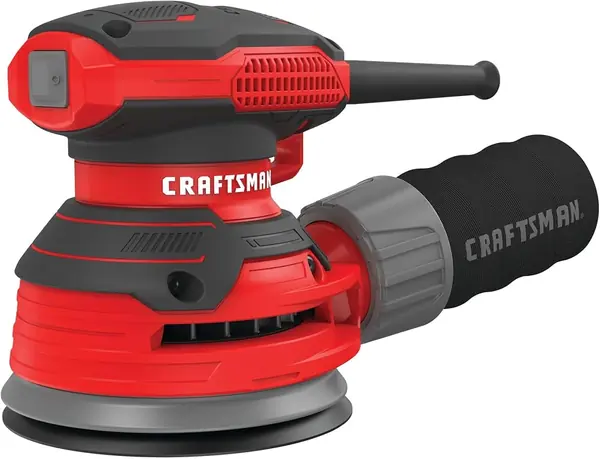
CRAFTSMAN CMEW231 5-inch corded random orbit sander with on-board dust bag

Home shop sanding

Shop Score 91/100
Speed
12,000 OPM
Motor
3.0 amp
Warranty
3-year limited
Vacuum Connection
1-3/4-inch hose
View on Amazon

Single-speed sanders have one behavior worth knowing before you buy: the pad is at full 12,000 OPM the instant the switch closes. Touch the CMEW231 down before it is moving on softwood and you can gouge a surface before you have made a pass. Start it in the air and lower it onto the work, and the problem never appears.

Otherwise it is a straightforward machine: 3 amps, a 5-inch hook-and-loop pad, a dust bag on board, and a port that accepts a 1-3/4-inch vacuum hose. At 3.4 pounds it sits in the middle of this group, comfortable for a long session without being a lightweight.

Power is adequate for paint and varnish removal and for smoothing rough stock, and the grip and switch placement make it easy to keep flat on a panel. The dust bag does what bags do, which is not much; the hose connection is the better half of the system, and unlike most sanders here it names a standard fitting instead of a proprietary one.

We rank it a step behind the DEWALT DWE6421K. Both are 3-amp, fixed-speed, 5-inch sanders with three-year warranties, and the DEWALT costs less here. Where the Craftsman earns its place is that 1-3/4-inch port: if your shop vac is already set up, this is a sander you can plumb in the day it arrives.

Worth Noting

  • Fixed 12,000 OPM speed can gouge softwood at startup
  • Onboard dust bag collects poorly without a shop vac
Our Verdict

We like it for a home shop that already runs a shop vac and wants three amps, a three-year warranty, and nothing to adjust.

Check Latest Price
8.

BLACK+DECKER BDERO100 Orbital Sander Best for Light Home Projects

BLACK+DECKER BDERO100 5-inch corded random orbit sander with dust bag and sheet

Light home projects

Shop Score 90/100
Speed
12,000 OPM
Motor
2.0 amp
Pad Size
5 inches
Weight
3.2 lb
View on Amazon

Two amps is the whole story with the BDERO100, and it is not a bad story. This is a sander for the shelf that holds a half-finished cabinet door and a can of polyurethane: a 5-inch pad at 12,000 OPM and enough output for paint, varnish and light stock removal.

The parts that make it livable are the ones that matter at this end of the market. A paddle switch with a lock-on lets your hand relax, the paper is hook-and-loop, and the grip does not fight you. At 3.2 pounds it moves around a project easily, and it suits the kind of work where a sander comes off the shelf a few times a year.

Push it and it tells you. Long, continuous sanding is where it heats up, and thick stock bogs a two-amp motor in a way a 3-amp machine shrugs off. Neither comes up on trim and touch-up work. Both come up fast on a porch floor.

Our honest read: buy it for small projects and do not ask it for a deck. If your sanding is furniture-sized and occasional, it is a low-cost way into a swirl-free random-orbit finish. If you are stripping paint off siding, skip the frustration and start with a 3-amp sander.

Worth Noting

  • Cloth dust bag clogs quickly
Our Verdict

For small paint and varnish jobs on furniture, this is the one we suggest to a beginner: light, simple, and priced to try.

Check Latest Price

How We Tested the Best Orbital Sanders

We started with roughly 30 sanders from brands with real service networks behind them, then filtered by pad size, dust setup, power source, warranty, and price so the shortlist covered corded and cordless, bare tool and kit, budget and pro-grade. Twelve of them came into the shop, and we kept using them for eight months.

Testing happened where sanding actually happens: a garage bench on weekends, working white oak for a tabletop, pine shelving, and reclaimed boards wearing three layers of old paint. Every sander ran the same sequence — flattening a glued-up panel, leveling a repaired edge, then a finish pass. To compare dust collection, we sanded a marked area of oak for two minutes and checked what landed in the canister, bag, or box against what ended up on the bench and on our forearms. A respirator was on for every session, and we noted which models sent us hunting for a shop vac hose instead of trusting the onboard bag.

For speed control, we feathered each sander at its lowest setting across veneer plywood and watched for burn-through. For vibration and hand comfort, we ran 20 unbroken minutes and paid attention to tingling and grip fatigue afterward. We timed paper changes with a stopwatch, listened for whether a long session called for hearing protection, and ran the cordless models until the battery cut out so we knew how much work fit in a charge. Over the months we also tracked the small things — pad wear, switch feel, whether the cord held at the strain relief — since that's usually what fails first.

How to Choose an Orbital Sander

Random Orbit, 1/4 Sheet, and What Each Reaches

A 5-inch random-orbit sander is the generalist of the category: the pad spins and orbits at once, so scratches cross instead of lining up and you get a swirl-free surface without much technique. A 1/4-sheet orbital palm sander clamps rectangular paper, covers less area per pass, and squeezes into tighter inside corners. For furniture, cabinets and paint removal, the round pad wins on speed and finish, which is why every pick in this guide is a 5-inch random-orbit machine.

Know the limit before you buy. Neither type reaches a true inside corner or a profiled edge; those still want a detail sander or a block and paper, and no amount of pressure changes that.

Dust Collection: Canister, Bag, or Hose

Dust leaves through the holes in the pad, and what it lands in ranges from a cloth bag to a filtered canister to a port for a shop vac. Bags are the weakest of the three: they catch the chips and pass the fine dust, which is the part that hangs in the air and settles into a wet finish. A canister with a real filter, or a hose to a vacuum, is what actually changes how clean the shop stays.

Look at the port as closely as the bag. A sander with a standard 1-3/4-inch fitting is a five-minute hookup; an odd-sized one means hunting for an adapter you will lose. We favor tools that either filter well on their own or connect easily to a vac you already own, and the Bosch canister and the Craftsman port are the two ends of that.

Speed Control and the Low End of the Dial

Variable speed is not a luxury. It is how you sand near a veneer edge, level a topcoat, or work softwood without gouging. Read the bottom of the range, not the top: most sanders here spin at 12,000 OPM, several drop to 7,000, and the Makita BO5041 goes to 4,000, which is the setting that makes delicate work possible.

The trap is paying for a broad range you never use. A dial parked at maximum is a switch with extra parts. If your work is paint removal and rough stock, a fixed-speed tool is the better deal; if you finish anything you care about, pay for the low end.

Corded or Cordless: Count the Batteries First

A corded sander runs all afternoon on shop power, and the cord is the only thing it costs you. A cordless one trades that for runtime: Milwaukee rates its M18 sander at up to 35 minutes on a 3.0 Ah pack, which is a cabinet's worth of sanding, not a deck's. Bare tools look like bargains until you price two packs and a charger.

Our rule is simple. If the batteries are already on your shelf, cordless sanding is genuinely handy for trim and punch-list work. If they are not, a corded tool buys more sander for the money every time.

Warranty Length Is a Fair Guess at Duty Cycle

Coverage across these sanders runs from one year to three. That is not a prediction of how long a tool lasts, but it is the maker's own statement of what it expects, and three years on a mid-priced sander is worth more than a spec-sheet advantage you will never notice. Register the tool the day it arrives and keep the receipt where you can find it.

Sanders live in dust, and switches and backing pads are what fail first. If you plan to run one hard, buy the longest coverage at a price you are comfortable with rather than the biggest motor on the shelf.

Frequently Asked Questions

Final Verdict

The Bosch ROS20VSC is the sander we point most woodworkers to, and the reason is dust. Its microfilter canister is the best collection in this group, and the 7,500-to-12,000 OPM dial means it handles a finish coat as comfortably as paint removal. Nothing else here balances those two things as well.

If your work is mostly finish sanding, meaning veneer, topcoats and repairs, the Makita BO5041's 4,000 OPM low end and adjustable handle justify the step up in price. And if you are already on the DEWALT 20V MAX platform and want to lose the cord, the DCW210B is the bare tool to add.