↑↓ navigate ↵ open Esc close All results →

Best Sanding Belts of 2026

The splice is what fails first. A sanding belt is a strip of abrasive joined into a loop, and that joint takes everything you throw at it: heat, tension, hardwood at full speed. When it lets go mid-pass, you're not out one belt — you're re-sanding a half-finished panel. I lost a seam on a painted cabinet door once and spent the afternoon chasing swirl marks.

We ran 18 packs of belts for four months across benchtop, portable, and file sanders, and the differences that showed up fastest weren't in the abrasive — they were in fit, seam quality, and how many belts you get in the grits you'll actually burn through. Coarse grits vanish; 240 and up sit in the drawer. A 60-pack sounds like value until you do that math.

Some picks here are assortments that carry a project from raw stock to finish; others are single-grit or metal-focused packs for restocking. All of them earn their spot on the same three counts: the size fits without a fight, the sanding stays consistent, and the splice holds.

Our Top Picks

The Best Sanding Belts

1.

BOSHCRAFT 3 x 21 Sanding Belts Best Overall
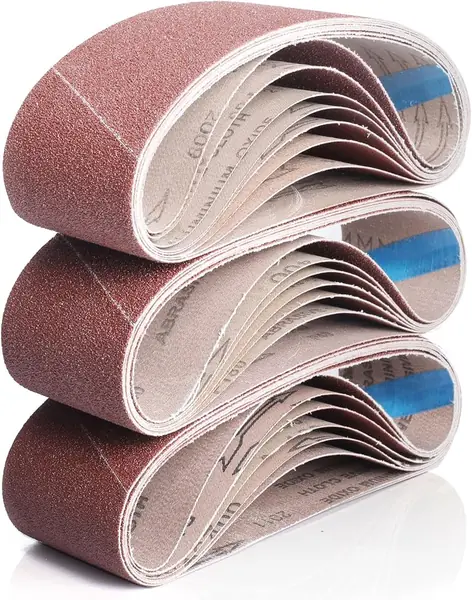
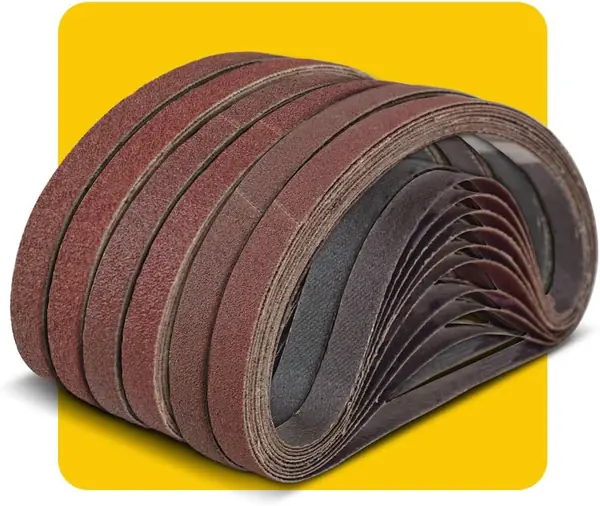
BOSHCRAFT 3 x 21 inch aluminum oxide sanding belts in assorted grits, 21-piece pack

Portable 3x21 sanders

Shop Score 95/100
Belt Size
3 x 21 inches
Belts Per Pack
21 (3 per grit)
Abrasive
Closed coat aluminum oxide
Grits Included
40/60/80/120/180/240/400
View on Amazon

Seven grits in one box is why the BOSHCRAFT 21-piece set leads this list. Three belts each at 40, 60, 80, 120, 180, 240 and 400 is enough range to strip a painted board, flatten a glue-up and take a tabletop to a finish without stopping to order a second box mid-project. The 3 x 21 size is one of the two or three that portable belt sanders are built around, which makes this the pack most shops can actually load.

What settled it for us is the shape of that grit ladder. Three belts at every grade means the middle grits — the ones a project genuinely burns through — get the same allocation as the coarse ones, so you don't end up with a stack of 400s and no 80. The closed coat aluminum oxide leaves an even scratch, and the heat- and moisture-resistant backing keeps a belt from stretching out of shape between sessions.

The range earns its keep mid-project, when you're stepping 80 to 120 to 180 across a panel and don't want to break your rhythm hunting for a belt. Three of each means the sequence survives one loading up, which is the point where a thinner assortment sends you to the store.

The 40s are the surprise in the box. On a belt sander, 40 grit takes material off fast enough that a light pass is all a glued-up panel needs before you step to 80 — treat the first belt of a project as a shaping tool and the rest of the ladder lasts longer.

Worth Noting

  • Splice can let go under sustained heat
Our Verdict

We recommend this box for most woodworkers: 3 x 21 fits a wide spread of portable sanders, and seven grits carry you from stripping to a finish.

Check Latest Price
2.

TPmax 1/2 x 18 Sanding Belts Best for Detail Sanders

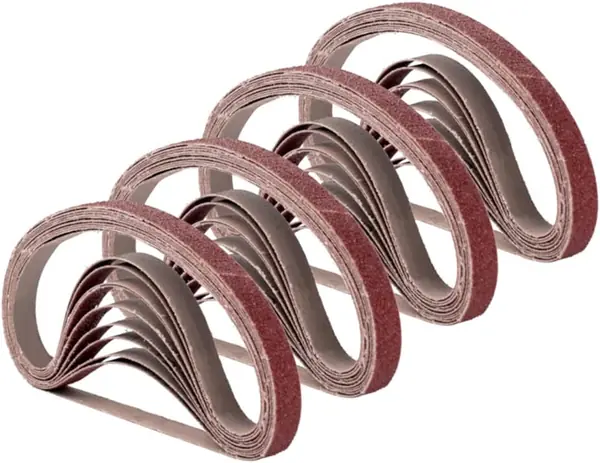
TPmax 1/2 x 18 inch aluminum oxide sanding belts, 60-piece multi-grit pack for file sanders

Detail sanders

Shop Score 94/100
Belt Size
1/2 x 18 inches
Belts Per Pack
60 (10 per grit)
Grits Included
40/60/80/120/150/240
Joint
Diagonal lap splice
View on Amazon

Half-inch belts are the forgotten corner of the abrasives aisle. The file sanders and air belt sanders that take them are bought for detail work, and the belts usually show up in small, expensive packs of four or five. This box goes the other way — 60 belts, ten at each of 40, 60, 80, 120, 150 and 240 grit — and it's the one we point any half-inch machine owner toward.

We like the TPmax pack for the coarse end. Ten 40-grit belts means you use a 40 the way it's meant to be used, hogging off material, instead of saving it for the one job that made you buy the pack. The resin carries an anti-loading additive, so the abrasive sheds dust rather than glazing over, which is how narrow belts usually die.

Narrow belts run hot, and heat is what kills a lap splice, so give the belt a few seconds between heavy passes and don't overtension it on a small sander. The diagonal splice sits flat enough that you won't feel a bump through the workpiece, which matters more on a half-inch belt than on a three-inch one.

Worth Noting

  • Grit range stops at 240
Our Verdict

For half-inch file and air sanders we recommend this one: 60 belts across six grits means you stop rationing the coarse ones.

Check Latest Price
3.

POWERTEC 3 x 21 80-Grit Belts Best Single-Grit Pack

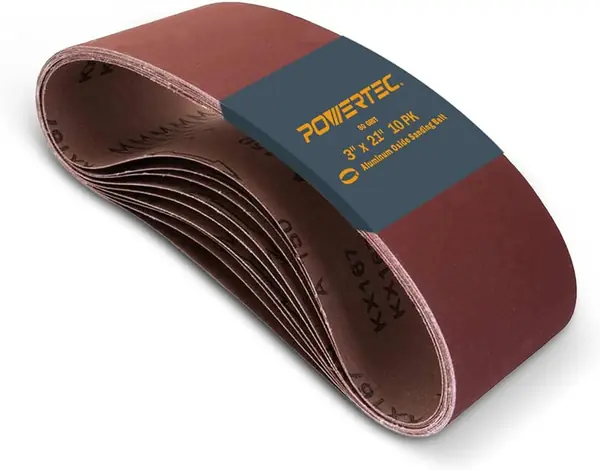
POWERTEC 3 x 21 inch 80-grit aluminum oxide sanding belt 10-pack for portable belt sanders

Restocking 80 grit

Shop Score 93/100
Belt Size
3 x 21 inches
Belts Per Pack
10
Abrasive
Open coat aluminum oxide, X-weight backing
Grit
80
View on Amazon

Most of the boxes here are shotguns: seven grits, three belts each, a stack of 400 grit nobody touches. This one is a rifle — ten belts, all 80 grit — and it's the one we buy when we already know which grade disappears from the shelf. Eighty is the grit a belt sander eats: coarse enough to erase a planed surface, fine enough to hand off to a random orbital.

Open coat aluminum oxide is the right grain for wood. It sheds dust instead of packing it into the abrasive, so an 80 keeps cutting rather than burnishing, and the X-weight cloth backing is the heavier of the two common backings; you feel that when a belt wraps an edge and the cloth is doing the flexing. POWERTEC sells the same belt in ten-packs from 40 through 400, so the format is worth knowing about if your work runs coarser or finer than an 80.

Worth Noting

  • Single 80-grit pack offers no finer or coarser steps
Our Verdict

Buy this ten-pack if you burn through 80 grit; the open coat and X-weight backing make it a workhorse on a 3 x 21 sander.

Check Latest Price
4.

SACKORANGE 1 x 30 Silicon Carbide Belts Best for Knife Sharpening

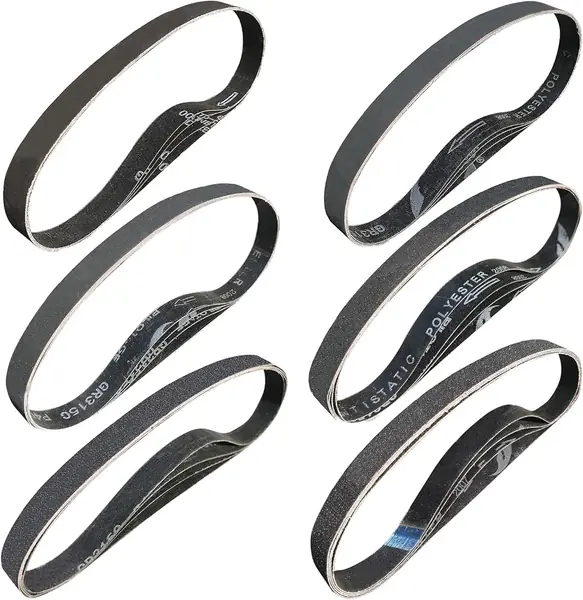
SACKORANGE 1 x 30 inch silicon carbide sanding belts in fine grits, 24-piece assortment

Knife sharpening

Shop Score 92/100
Belt Size
1 x 30 inches
Belts Per Pack
24 (4 per grit)
Abrasive
Silicon carbide, waterproof Y-weight backing
Grits Included
120/240/400/600/800/1000
View on Amazon

Silicon carbide is harder and sharper than the aluminum oxide most woodworking belts use, and it fractures to fresh edges as it dulls — which is why it's the abrasive for metal, glass and stone, and why this is the only silicon carbide set in the guide. The grits confirm the intent: 120, 240, 400, 600, 800 and 1000, four of each, with nothing coarser than 120 in the box.

That's a sharpening and finishing lineup, not a stock-removal one. On a 1 x 30 sander, which is what most knife makers and hobby machinists run, the 120 and 240 shape a bevel and the 400 through 1000 refine it to a polish. Having the 800 and 1000 at all is the useful part — plenty of sets stop at 400 and leave you hand-finishing an edge you could have finished on the machine.

The heavy Y-weight cloth backing is waterproof, so these run wet as well as dry. Wet is the better habit for edges: water carries the swarf away and keeps heat out of steel that has already been hardened. An anti-clogging stearate in the resin does a similar job dry, resisting the loading that makes a fine belt start polishing instead of cutting.

What we appreciate most is the honesty of the top end. The 800 and 1000 are genuinely fine abrasives rather than marketing grits, and they leave a bevel that reflects light evenly before it ever touches a strop. The cost of that refinement is speed, since nothing in this box removes material quickly, so pair it with a coarser belt when you're resetting an edge rather than polishing one.

Worth Noting

  • Several belts arrive with no grit marking
Our Verdict

If you sharpen knives or finish metal on a 1 x 30 sander, we think this set's 120-to-1000 range and waterproof backing make it the pick.

Check Latest Price
5.

3M Cubitron II File Belt 786F Best for Metal Detail

3M Cubitron II 786F 1/2 x 18 inch ceramic file belts, 36+ grade, 10-pack

Metal detail work

Shop Score 91/100
Belt Size
1/2 x 18 inches
Belts Per Pack
10
Abrasive
Cubitron II precision-shaped ceramic grain
Grade
36+
View on Amazon

36+ is a coarse grade even for metal, and the ceramic grain is why it doesn't behave like one. 3M shapes the abrasive into triangular structures that slice steel rather than plow through it, so a belt this aggressive still leaves a scratch you can blend out. On a file belt sander, that's the difference between taking a spot weld flush and burning a hollow into the panel.

We rate this as the metal belt of the group. The resin bond and heavy-duty backing are built for heat and pressure, and the 36+ grade keeps cutting hard steel after a budget aluminum oxide belt has glazed; you retire it when the grit is gone, not when the splice lets go. It is still a 36+, so it's a shaping tool — lean on thin sheet or soft aluminum and it will gouge. Feather the pressure and let the grain cut.

Worth Noting

  • One grade in one size only
Our Verdict

On a file belt sander, this belt handles spot welds and hard steel—it outlasts the aluminum oxide belts here and cuts cooler.

Check Latest Price
6.

abrasticle 3 x 24 Sanding Belts Best for 3x24 Sanders

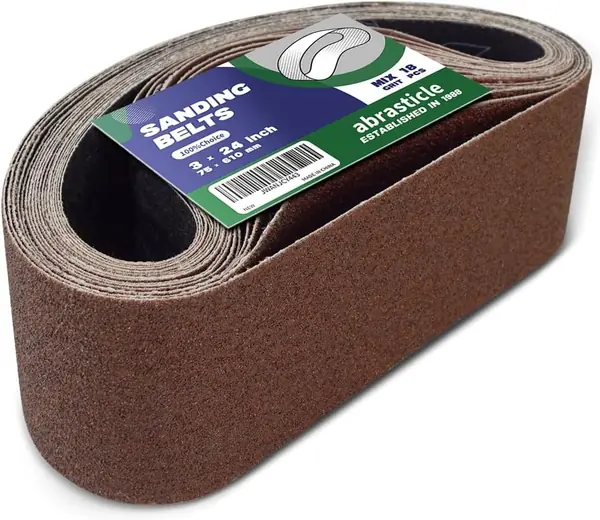
abrasticle 3 x 24 inch aluminum oxide sanding belts in six grits, 18-piece set

3x24 benchtop sanders

Shop Score 90/100
Belt Size
3 x 24 inches
Belts Per Pack
18 (3 per grit)
Abrasive
Open coat aluminum oxide
Grits Included
60/80/120/150/240/400
View on Amazon

Three-by-twenty-four is the odd size out. It's what plenty of benchtop and edge sanders take, including the oscillating edge sanders that have turned up in a lot of small shops, and it's the size least likely to be on a hardware store peg. That makes abrasticle's 18-belt set worth more than it looks: three at each of 60, 80, 120, 150, 240 and 400.

The spread is the point. Sixty through 400 in six steps covers stripping a finish, flushing a joint and finishing, and three of each means a job that eats an 80 doesn't strand you. Open coat matters most at the coarse end, where a 60 on hardwood loads up quickly if the grain can't clear the dust.

What we appreciate is how they hold up. The cloth backing stayed flat against the platen through long passes, and the belts kept cutting past the point where a cheap belt starts burnishing. That's the quality that counts when the sander is a benchtop machine used in bursts: the belts sit in the box without their edges curling, and they still track when you fit them months later.

Worth Noting

  • Fits only 3 x 24 benchtop and edge sanders
Our Verdict

For a 3 x 24 benchtop or edge sander, this is the assortment we reach for: six grits, three of each, and belts that keep cutting.

Check Latest Price
7.

Zivisk 1/2 x 18 Sanding Belts Best for Occasional Detail Work

Zivisk 1/2 x 18 inch aluminum oxide sanding belts in five grits, 20-piece pack

Occasional detail work

Shop Score 89/100
Belt Size
1/2 x 18 inches
Belts Per Pack
20 (4 per grit)
Abrasive
Aluminum oxide
Grits Included
60/80/120/180/240
View on Amazon

Zivisk's 20-belt pack is the cheapest way into half-inch belts here, and for a sander that comes off the shelf a few times a year, that's the whole argument: four belts at each of 60, 80, 120, 180 and 240 grit, in the size a file or air belt sander takes.

Four at each of five grits is a sensible split for small work. You'll use 80 and 120 hardest, 60 handles a stripped edge, and 180 and 240 finish. We found the aluminum oxide grain cuts pine and hardwood cleanly, and the belts sit flat on the platen without the wander that makes a narrow belt walk off mid-pass.

Worth Noting

  • Belts come unmarked by grit
  • Tape joints can separate under load
Our Verdict

Keep this set around as a low-cost way to stock half-inch belts, with five grits and four of each for occasional detail work.

Check Latest Price

How We Tested Sanding Belts

We started with the machines rather than the belts, noting the belt size each sander specifies — from 3-inch benchtop and portable sanders down to half-inch file sanders — and filtering the market to packs that matched on both width and circumference. From there we cut anything with a vague grit breakdown or a per-belt price that didn't hold up, then ordered 18 packs to test.

Testing ran four months across a benchtop sander, a portable belt sander, two file sanders, and a small rig set up for knives and chisels. We measured each belt flat with a tape before fitting it, tensioned it only as far as that sander's manual allows, and watched the first few passes for tracking — a belt that walks off the platen is a fit problem, not a grit problem. Every splice got checked when the pack was opened, and any with a lifting seam was set aside and never run.

Then came the actual work: oak and pine for the aluminum oxide belts, steel and dull chisels for the silicon carbide, and a paint-covered cabinet door to see how quickly an open coat loaded up. We noted how aggressively each belt cut on the first pass, then counted how many belts of each grit we used against how many came in the pack — on the assortments, the coarse grits ran out first while 240 and finer sat untouched.

Belt life got logged in board feet before the grain glazed over or the seam showed a line, and we checked whether the grit number on the backing was still legible after a session. Eye and respiratory protection stayed on for every run.

How to Choose Sanding Belts

Match the Size Before You Shop the Grit

A belt is identified by two numbers — width and circumference, written like 3 x 21 — and both have to match your machine. A 3 x 21 belt will not tension on a 3 x 18 sander, and one that's a fraction short won't stretch on no matter how you adjust tracking. The sizes here run from 1/2 x 18 for file and air sanders up to 3 x 24 for benchtop and edge sanders. Read the number off the cloth backing of your old belt before ordering, then write it on the machine so you never guess again.

Decide Between an Assortment and a Single Grit

Coarse grits remove stock, middle grits do the shaping, and fine grits finish, which means the belts you actually wear out sit between 80 and 150 rather than at the extremes. If the sander is new to you, buy an assortment; a seven-grit box carries a whole project, including the fine end you'll use once. If you already know that 80 grit is what vanishes from your shelf, a single-grit ten-pack wastes nothing and costs less per belt. The only wrong choice is guessing at your own habits.

Expect the Splice to Fail First

Every sander belt is a strip of abrasive joined into a loop, and that joint — a lap splice or a taped seam — is the part that dies. Heat softens the resin, tension pulls at the overlap, and a belt stored in a hot garage or overtensioned on the machine can let go mid-pass. Fit a new belt with its arrow pointing the right way, tension it until it tracks without slipping, and give it a few seconds between heavy passes on metal. If a seam looks lifted when the box arrives, don't run it.

Match the Abrasive to the Material

Aluminum oxide is the default for wood: tough, inexpensive and forgiving. Silicon carbide is harder and sharper, and it's what you want for metal, glass and stone — with a waterproof backing it also runs wet, which keeps heat out of a thin edge. Ceramic grain, the kind in 3M's Cubitron, is for hard metal under heavy pressure. Coat matters too: open coat resists loading on resinous woods, while closed coat gives a denser scratch and a longer-lived belt on hard materials.

Count Belts Against the Grits You'll Finish

A 60-belt box of narrow belts and a 10-belt box of wide ones can land in the same price range, so compare per belt and per grit you'll truly use up. Big packs make sense in the sizes you run weekly and less sense in a grade you touch once a year. Check, too, whether the grit is printed on the backing: unmarked belts are fine until you have three identical loops on the bench and no way to tell 120 from 240. Sort and label the box the day it arrives.

Frequently Asked Questions

Final Verdict

For most woodworkers, the BOSHCRAFT 3 x 21 assortment is the box to buy: seven grits, three belts at each, in one of the common portable sizes. Half-inch file and air sander users should take the TPmax 60-pack instead, and knife makers go straight to the SACKORANGE silicon carbide set for its 120-to-1000 range and waterproof backing.

Buy for the sander on your bench first, then for the grits your projects actually eat. Everything else on this page is a variation on that decision.