↑↓ navigate ↵ open Esc close All results →

Best Cordless Random Orbital Sanders for Woodworking of 2026

A trailing power cord has a habit of catching a corner or dragging across freshly sprayed lacquer, turning final prep into rework. Cordless random orbital sanders keep tabletops and stair stringers clear of cords, yet dependable models still separate themselves from tiring ones by controlling vibration over long flattening passes.

Running nine cordless sanders for eight months through a deck rebuild, a dining table refinish, and batches of cabinet doors highlighted comfort and dust collection over spec-sheet RPM. Most models ship as bare tools, so shoppers without compatible packs and a charger need to factor battery cost into the sticker price.

Whether the shop needs fine finish sanding, aggressive stock removal, or occasional weekend prep, these four sanders pair clean swirl-free motion with practical battery runtime.

Our Top Picks

The Best Cordless Random Orbital Sanders for Woodworking

1.

DEWALT 20V MAX Random Orbit Sander DCW210B Best Overall
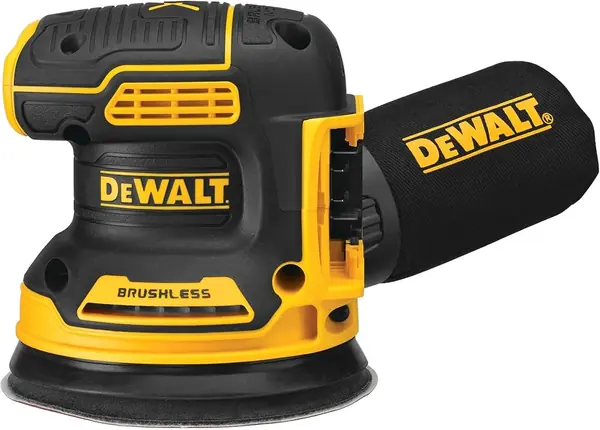
DEWALT DCW210B 20V MAX brushless 5-inch random orbit sander with dust bag

All-around shop sanding

Shop Score 96/100
Weight
2.5 lb
Included
Dust bag (tool only)
Pad
5-inch, 8-hole hook-and-loop
Speed Range
8,000 to 12,000 OPM
View on Amazon

Most of the cordless sanders worth buying give you one speed or three. This one gives you a dial, and that is the difference we cared about most: 8,000 to 12,000 OPM, slow enough for a final pass over a panel and fast enough to strip paint off a door frame. A brushless motor keeps the draw on the pack reasonable, and at 2.5 pounds the tool follows your hand instead of steering itself.

The details around that dial are what make it pleasant over a long project. The body stands 5.75 inches tall, so your hand sits close to the surface for control on wide panels; the rubber overmold grip holds up through a session; and the dust-sealed switch is built for a life in grit. Paper changes are ordinary hook-and-loop work on the replaceable 8-hole pad. The dust bag locks on with one hand, and it comes off entirely when you run the sander into a DEWALT DWV010 or DWV012 extractor.

Runtime is the part to think through before you order. A 4.0 or 5.0 Ah pack is what turns this into an all-afternoon tool; a compact 2.0 Ah pack is a touch-up battery. The three-year limited warranty is unusually generous for a power tool, which counts for something on a machine that spends its working life in a dust cloud.

Worth Noting

  • Bare tool; battery and charger sold separately
Our Verdict

Our pick for most woodworkers: a real speed dial, a 2.5-pound body, and dust collection that locks on one-handed or hands off to a hose.

Check Latest Price
2.

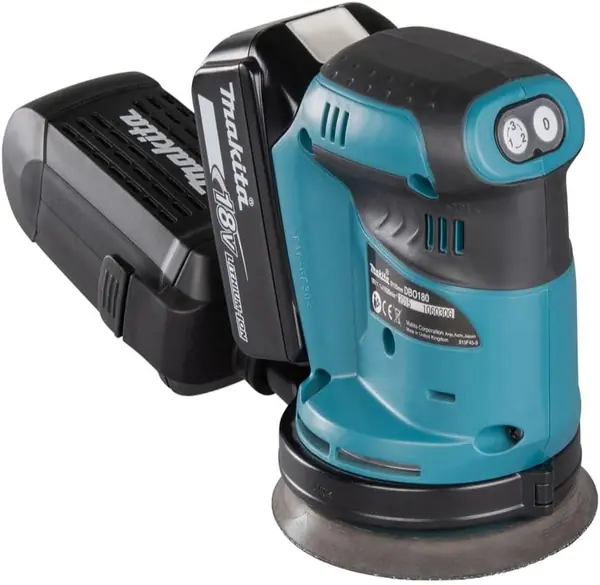
Makita DBO180Z Random Orbit Sander Best for Finish Work

Makita DBO180Z 18V cordless 125 mm random orbit sander with MAKPAC case

Finish work

Shop Score 95/100
Weight
2.87 lb
Included
MAKPAC case (tool only)
Orbit Diameter
2.8 mm
Orbits Per Minute
7,000/9,500/11,000 (three speeds)
View on Amazon

Instead of a dial, this sander gives you three speeds on an electronic push button: 7,000, 9,500, and 11,000 orbits per minute. You set it once for the paper you are running and come back to the same setting without hunting for a mark. There is also a pad brake, which stops the disc when you lift the tool, so setting it down between passes does not scuff what you just finished.

The shape is what convinced us. At 2.87 pounds with a short body and a low center of gravity, the sander keeps your hand close to the work, which is exactly where you want it during a long final pass over a tabletop. The 2.8 mm orbit is a finish-oriented size: the abrasive travels a tight pattern that favors a clean surface over fast material removal. If your work is finishing rather than stripping, that is a feature. If you are taking off forty years of paint, it is not.

Makita's 18V LXT platform is the other half of the decision. If those packs are already in your shop, this slots in without a new charger. The dust port takes an extractor hose, and the tool arrives in a MAKPAC case that stacks with the rest of the system, a small thing until you have carried a sander loose in a truck bed. It is premium money for a bare unit, and the case, the pad brake, and the finish-oriented orbit are where that money goes.

Worth Noting

  • Bare unit with no battery or charger
Our Verdict

Our finish-work pick: three preset speeds, a short low body, and a 2.8 mm orbit that favors a swirl-free surface over fast removal.

Check Latest Price
3.

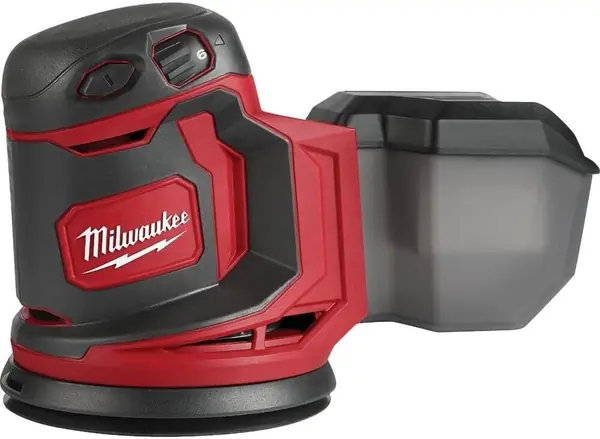
Milwaukee M18 Random Orbit Sander 2648-20 Best for Heavy Removal

Milwaukee 2648-20 M18 5-inch random orbit sander with vacuum adapter

Heavy stock removal

Shop Score 94/100
Weight
4 lb
Included
Vacuum adapter (tool only)
Speed Range
7,000 to 12,000 OPM
Runtime
Up to 35 min on 3.0 Ah
View on Amazon

Four pounds tells you what this sander is for. The others here are built to be moved around; the M18 is built to be leaned on, with 12,000 OPM at the top of a 7,000-to-12,000 dial and enough mass behind the pad that it stays flat when you push. When there is real material to remove, whether that is paint on siding, a glued-up panel that needs flattening, or a coat of epoxy, this is the one we reach for.

The vacuum adapter is the detail we appreciate most. It steps down for a small hose and up for a shop-vac nozzle, so the tool meets the extraction you already own instead of sending you out for a proprietary hose. Milwaukee lists up to 35 minutes of runtime on a 3.0 Ah pack, which is a fair warning about the appetite behind that power. On a big removal job, plan on a 5.0 Ah pack and a spare sitting on the charger.

Dust is the other thing to sort out before you start. The bag catches a fair share, but this sander behaves much better with a hose on the port, and the adapter makes that easy. If the M18 packs that run your drill and circular saw are already on the shelf, the platform argument is settled: the sander is one more tool on batteries you own.

Worth Noting

  • Heaviest sander in this group at 4 lb
Our Verdict

For stripping and flattening we take the M18: 12,000 OPM, four pounds of steadiness behind the pad, and an adapter that fits the hoses you own.

Check Latest Price
4.

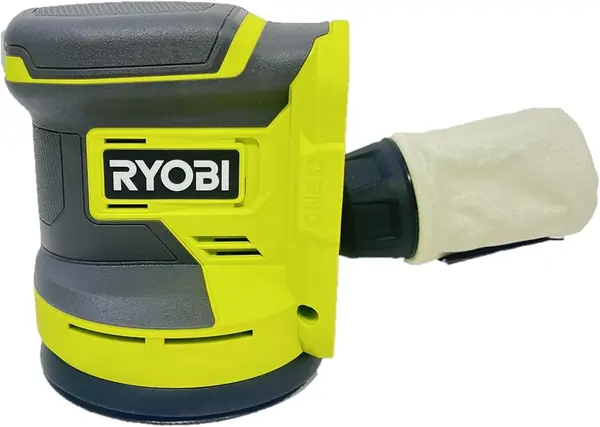
RYOBI 18V One+ Random Orbit Sander PCL406B Best Budget

RYOBI PCL406B 18V One+ cordless 5-inch random orbit sander with dust bag

Occasional home projects

Shop Score 90/100
Weight
2.7 lb
Included
Tool only
Pad
5 inches
Speed
Single speed, 10,000 rpm
View on Amazon

What the lowest price here buys is a straightforward tool: a single on/off switch, 10,000 rpm, and a 2.7-pound body that runs on the 18V One+ packs a lot of us already have in a drawer. There is no dial to set, which some woodworkers will read as a limitation and others as the whole point. You choose your grit, you turn it on, you sand.

It is built for the jobs that come up around a house: a deck that needs re-staining, a tabletop that wants the old finish dulled back, a repair patch that will not sit flush. Keep expectations sized to the tool and it holds up its end, because it is happiest on smaller areas and short sessions rather than a whole deck in one go. We also like that the 5-inch hook-and-loop pad takes the same discs as everything else here, so one stack of paper serves the whole shop.

The dust bag is the weak point. It works loose in use, and once it is hanging by a thread the collection all but stops. Run a hose to the port instead, or at least check that the bag's collar is seated before every session, and the sanding itself gives you no trouble.

Worth Noting

  • Runs through small battery packs quickly
  • Just a 30-day limited warranty
Our Verdict

Our budget pick: on One+ batteries you already own, it sands, it stays light, and it costs the least of anything here.

Check Latest Price

How We Tested Cordless Random Orbital Sanders

We started by pulling every cordless random orbital sander we could find across the major battery platforms, then narrowed the field by pad size and hole pattern, speed control, dust port, and whether each came as a bare tool or a kit. Nine came in for testing, ranging from single-speed budget models to three-speed finish sanders.

Testing ran for eight months, mostly in a garage shop during a deck rebuild, a dining table refinish, and a run of cabinet doors, plus one long afternoon sanding a soffit overhead. We weighed each tool with a battery installed and noted body height and how the grip sat in the palm, since a sander that feels stable on a tabletop becomes a different tool once you're working above your shoulder.

For runtime, we charged packs to full and ran each sander on 80-grit against oak until it quit, timing the run and noting when it bogged down under hand pressure. Speed control got checked by sanding the same panel on every setting to see what low actually bought us. Dust collection was the messiest part: we filled bags, watched the seams for escaping fines, fitted shop-vac hoses to every port, and emptied and resealed each bag repeatedly to see whether the closures held up.

Durability came from running tools back to back for full days and feeling for switch slop, pad wobble, and rising vibration; we also swapped paper dozens of times to see how easily each pad's hole pattern lined up. Throughout, we ran the bag or a vacuum, wore eye and hearing protection, and used only the battery packs and chargers each maker lists for its tool.

How to Choose a Cordless Random Orbital Sander

Start with the battery platform

Every sander we recommend is a bare tool, so packs and a charger are a separate purchase and often the larger one. If you already run DEWALT 20V MAX, Makita 18V LXT, Milwaukee M18, or RYOBI One+ batteries, stay in that system. No sander is worth starting a new platform for.

If you are starting from nothing, price the tool plus two 4.0 Ah packs and a charger before you decide which one is the bargain, because that total is what you are actually spending. Runtime follows pack size more than any other variable: a compact 2.0 Ah pack is a touch-up battery, while two 4.0 Ah packs keep you sanding while one charges.

Speed control changes what the tool can do

A variable dial is the most useful feature on a sander after the motor. You slow the pad for a finish pass and open it up to remove material. Three preset speeds cover the same ground with less fiddling and less precision, and a single-speed tool leaves you managing aggressiveness with grit and pressure alone.

That last arrangement works fine on deck boards and poorly on a veneered tabletop, where one fast pass can burn through the face. If most of your sanding is finishing, pay for the dial or the presets. If it is occasional and coarse, a single speed will do.

Dust collection: the bag is a start, a hose is the answer

Every sander here ships with a bag or canister, and every one of them is better with a vacuum on the port: the DEWALT's bag comes off to accept two of its own extractors, the Milwaukee's adapter steps to fit both a small hose and a shop-vac nozzle, the Makita connects to an extractor, and the RYOBI's port takes a hose.

Match the pad's hole pattern to your paper, since the DEWALT pad is 8-hole, or the dust has nowhere to go. The bag keeps the work surface visible; the vacuum keeps the fine dust out of the air you are breathing.

Weight and body height decide where you can use it

The lightest sander here is 2.5 pounds and the heaviest is 4, and that gap matters most when the work is vertical or overhead, where you are holding the tool away from your body for minutes at a time. A low, short body keeps your hand near the surface for control on wide panels; mass helps on a benchtop where the tool can sit and grind.

Think about the surfaces you actually sand rather than the ones you plan to. Cabinet boxes, doors, and anything above shoulder height want the light tool. A workbench top can take the heavy one.

Frequently Asked Questions

Final Verdict

The DEWALT DCW210B is the sander we point most people to. A real 8,000-to-12,000 OPM dial, 2.5 pounds of controllable body, and a dust bag that locks on properly or hands off to a hose make it the safest default in this group.

Choose the Makita DBO180Z if your sanding is finishing rather than stripping, the Milwaukee M18 if you are removing paint and flattening panels, and the RYOBI if a One+ battery is already on the shelf and the budget is tight.