↑↓ navigate ↵ open Esc close All results →

Best 6-Inch Random Orbital Sanders of 2026

Choosing a 6-inch random orbital sander without checking power supply and orbit stroke is how pigtails and swirl marks end up visible under the first coat of finish. Before comparing pads or weights, shop infrastructure sets the boundary: either an outlet for a corded motor or a compressor capable of sustaining continuous pneumatic CFM draw.

Eight months of testing 10 corded and air-powered sanders showed that orbit diameter separates machines faster than any other specification. A 1/8-inch stroke cuts slowly for a finish-ready surface, whereas a 3/16-inch stroke clears stock rapidly on panels like a walnut tabletop but leaves deeper scratches that take an extra grit progression—or tedious hand sanding—to erase.

Between dual-mode sanders for heavy stock removal, lightweight models that reduce overhead fatigue, and vacuum-ready air units for high-CFM production benches, the right match depends on the work and the air supply behind it.

Our Top Picks

The Best 6-Inch Random Orbital Sanders

1.

Bosch GET75-6N Best Overall
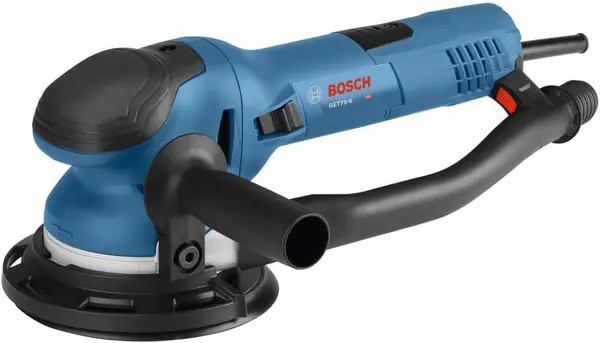
Bosch GET75-6N dual-mode random orbit sander with front handle and 6-inch pad

All-around shop sanding

Shop Score 92/100
Pad Diameter
6 inches
Weight
5.7 lb
Amperage
7.5 A
Sanding Modes
Dual: random orbit and turbo
View on Amazon

The switch on top is what sold us. Flick it one way and the GET75-6N orbits like any finishing sander; push it the other way and the pad is driven in an eccentric, gear-driven spin that takes off material fast enough to keep the belt sander in its box when you're flattening a glue-up. The front handle comes off when you want a lower profile, and the tapered top grip is shaped for the palm doing the pushing.

The 7.5-amp motor and the variable dial, 3,300 to 7,300 orbits per minute, are why it doesn't sag in hardwood. On maple and white oak the pad keeps cutting at low speed instead of stalling, and the multi-hole pad accepts a wide range of discs rather than one proprietary punching. Hook it to a vacuum through the included adapters and the work stays visible; the dust that usually ends up on every shelf in the shop goes into the canister instead.

Longevity is the open question, and it's the one thing that keeps this from being an unconditional recommendation for everyone. There's more machinery inside than a plain orbit sander carries, and while plenty of these run for years in daily shop use, some fail early. Buy from a seller with a generous return window and give it a hard first week, because flattening a rough panel tells you more than a few passes on pine. The range it buys, from 80 grit on a warped glue-up to 220 on a tabletop without swapping tools, is worth that bit of risk.

Worth Noting

  • Requires a shop vacuum and hose you supply
  • 5.7 pounds is heavy for overhead work
Our Verdict

Our pick for most woodworkers: turbo mode strips stock fast, random orbit finishes clean, and the 7.5-amp motor holds speed in hardwood.

Check Latest Price
2.

Makita BO6030 Best for Finish Sanding

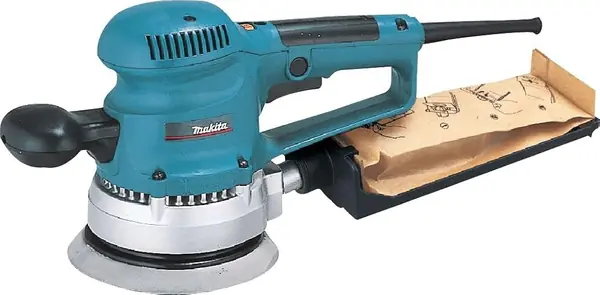
Makita BO6030 6-inch random orbit sander with two handles and dust bag

Finish work

Shop Score 91/100
Pad Diameter
6 inches
Weight
5.29 lb
Orbit Diameter
1/8 inch
Orbits Per Minute
4,000-10,000
View on Amazon

Finish quality is where this one earns its place. The BO6030 runs a 1/8-inch orbit, the smallest stroke in this group, and that tighter pattern leaves fewer swirls to chase out by hand before stain. It's the difference you notice on the last grit, when the work is already flat and the only question left is whether the surface is even enough to take a stain without blotching.

Two handles are what make that finish repeatable. The rear grip is rubberized, the front handle detaches when you're working into a corner, and the pair keeps a 6-inch pad flat instead of tipped up on an edge, which is why we trust it across a wide tabletop. It also runs quiet for an electric sander, a real advantage if you work in a garage with the door closed, and the speed dial spans 4,000 to 10,000 orbits per minute.

The through-the-pad dust system with its bag catches the worst of the residue, though a vacuum hose does more for the air in the room. What you're buying here is the last third of the job: a tool that turns a sanded panel into a finished one. Buy it as the sander you reach for after something else has done the flattening.

Worth Noting

  • Slow material removal on rough stock
Our Verdict

We reach for the BO6030 when the surface has to be perfect: the 1/8-inch orbit and two-handed grip leave boards ready for stain.

Check Latest Price
3.

Festool ETS EC 150/5 Best for Long Sessions

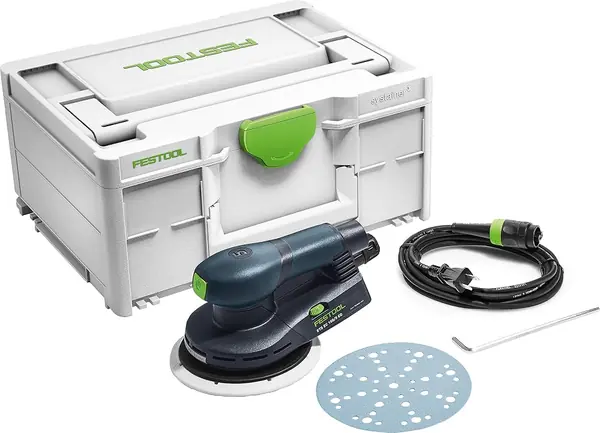
Festool ETS EC 150/5 6-inch random orbital sander in a Systainer case

Long sanding sessions

Shop Score 90/100
Pad Diameter
6 inches (150 mm)
Weight
2.5 lb
Amperage
4.5 A
Sanding Stroke
5 mm
View on Amazon

Two and a half pounds doesn't sound like much until you've held a 6-inch sander at chest height for an hour. The ETS EC 150/5 is the lightest corded tool in this guide by a wide margin, and paired with Festool's vibration control it's the one we hand to anyone who says sanding hurts their hands. Nearly all the dust goes up the hose, so the work stays visible and you're not breathing the room.

The brushless motor is the quieter half of the story. The speed dial is stepless and the tool holds its setting under load instead of sagging when you lean on it, so a heavy pass on a hardwood tabletop cuts the way the dial says it will. The pad brake stops the disc almost immediately when you lift off, which matters more than it sounds when you're working next to a surface you've already finished.

What you give up besides money is muscle. A 5 mm stroke and a 4.5-amp motor are built for control, not for stripping paint, so this complements a stock-removal tool rather than replacing one. The Systainer it ships in is genuinely useful if you already stack Festool boxes, and just more plastic if you don't. For a cabinet shop or anyone finishing furniture at volume, the trade is straightforward.

Worth Noting

  • Highest price in this group
Our Verdict

We think the ETS EC 150/5 earns its price for anyone who sands for hours: 2.5 pounds, near-zero vibration, and extraction that clears the air.

Check Latest Price
4.

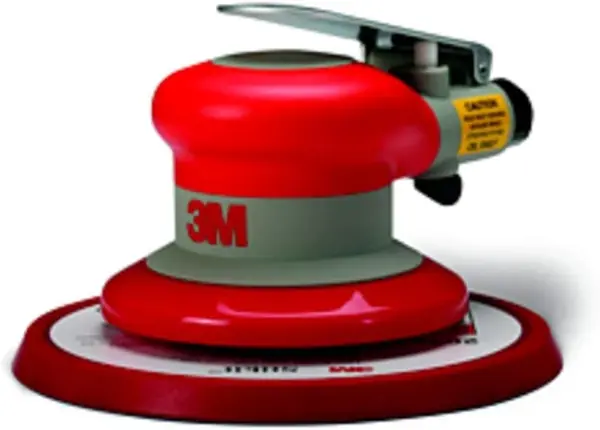
3M 20325 Best Air-Powered for Production

3M 20325 pneumatic random orbital sander with aluminum body and 6-inch pad

High-volume shops

Shop Score 89/100
Pad Diameter
6 inches
Weight
2.2 lb
Orbit Diameter
3/16 inch
Free Speed
12,000 rpm
View on Amazon

The word non-vacuum in the name is the first thing to understand. There is no dust port on this sander at all, because 3M built it for industrial floors where air handling is somebody else's job. In a home shop that means sanding in a cloud unless you park it over a downdraft table, so be honest with yourself about your setup before you fall for the rest of it.

What you get in exchange is a tool that behaves like a professional instrument. The 0.28-hp air motor is precision balanced, the aluminum body and composite cover shrug off the knocks that end cheaper sanders, and the internal muffler keeps it noticeably quieter than a typical air sander without the fragile add-on mufflers that snap off. We noticed the recessed lever platform too, which keeps the lever out from under your palm instead of digging in.

The Stikit pad takes adhesive-backed discs rather than hook-and-loop, and that single detail decides this one for a lot of buyers. Discs go on dead flat and stay there through a long pass, and you peel them off when they're spent. If you already run PSA paper and you sand in volume, this is the best-built air sander in this guide. If you change grits constantly, the pad is a commitment you should think about twice.

Worth Noting

  • No dust port at all
  • Stikit pad only takes adhesive-backed discs
Our Verdict

Our advice for a high-volume shop: the 3M 20325 runs cool and quiet all day, as long as you've got the compressor and the air handling.

Check Latest Price
5.

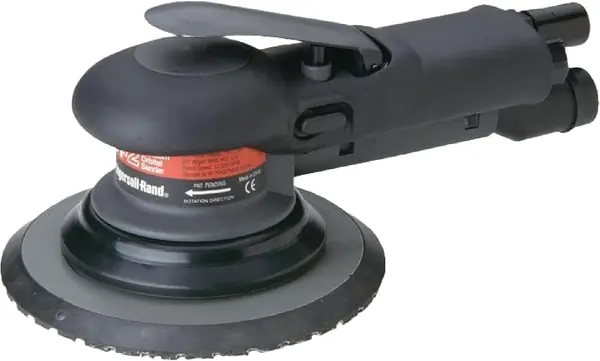
Ingersoll Rand 4151 Best Air Sander with Dust Extraction

Ingersoll Rand 4151 air random orbital sander with 6-inch vacuum-ready pad

Vacuum-ready air sanding

Shop Score 88/100
Pad Diameter
6 inches
Weight
1.9 lb
Orbit Diameter
3/16 inch
Free Speed
12,000 rpm
View on Amazon

A vacuum port on a 1.9-pound air sander is the combination that makes this one easy to recommend. The 4151 pulls dust through and around the pad into a central or portable vacuum, which keeps the air clear and, just as usefully, keeps abrasive dust out of the motor instead of grinding through it.

We like how little it asks of your hands. The palm shape is contoured, the exhaust diffuses out the back rather than into your face, and the vibration is low enough that a long blocking session doesn't leave your fingers buzzing. Interchangeable grip rings let you size the body to your hand, a small thing that most tools in this price band skip entirely.

The catch is air. It wants 8 CFM at 90 PSI, so a pancake compressor will spin it for a few seconds and then fall on its face; a 20-gallon unit with real CFM is the entry ticket. Feed it properly and the 3/16-inch orbit leaves a swirl-free finish across general woodwork, paint prep, and metal, which is exactly the range a single air sander should cover.

Worth Noting

  • Needs a compressor that supplies 8 CFM
Our Verdict

For a compressor-equipped shop that wants dust control, we send you to the 4151: vacuum-ready, 1.9 pounds, and smooth at 12,000 rpm.

Check Latest Price
6.

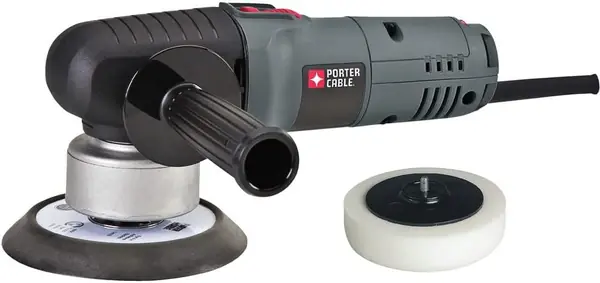
Porter-Cable 7346SP Best for Sanding and Polishing

Porter-Cable 7346SP corded 6-inch sander with side handle and polishing pad

Sanding and polishing

Shop Score 87/100
Pad Diameter
6 inches
Weight
6 lb
Amperage
4.5 A
Speed Range
2,500-6,800 OPM
View on Amazon

The second handle is the giveaway that this isn't a one-hand finish sander. Porter-Cable mounts a removable side handle on either side of the 7346SP, and with it in place the tool stays flat and controllable through the low-speed work it was designed for: compounding, polishing, and sanding large flat surfaces.

The 4.5-amp motor runs through a variable-speed dial from 2,500 to 6,800 orbits per minute, and the bottom of that range is the useful part. It's slow enough to polish a finish without burning through it and fast enough at the top to strip a panel. A proprietary counterbalance and roller bearings keep it smooth down low, where cheaper polishers chatter and leave marks.

There's no dust bag in the box, and the tool ships with a polishing pad and a sanding disc rather than a collection system, so woodwork with it means a respirator or a downdraft table. That's the honest limitation of an older design aimed at automotive and marine work. The variable speed and the handle are what make it worth owning anyway, especially if your work runs from sanding to buffing.

Six pounds is the rest of the cost, and it's why the handle matters: this is a two-hand tool, and a long session on a vertical panel will let you know it. What you get back is a design that's been around for decades with a one-year warranty behind it, and while plenty of these run for years, there are also units that break at the shaft and can't be repaired. For paint prep and flat panel work, we still think the trade is worth it.

Worth Noting

  • Six pounds needs two hands
Our Verdict

The 7346SP is our pick for paint prep and polishing as much as sanding: one corded tool with a speed dial and a side handle.

Check Latest Price
7.

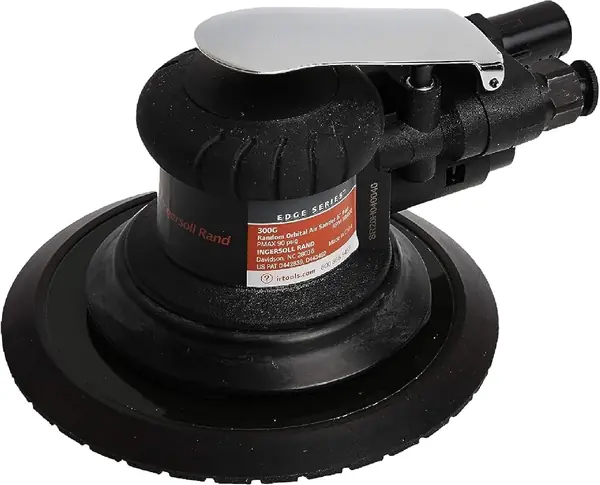
Ingersoll Rand 300G Best for Simple Finish Sanding

Ingersoll Rand 300G 6-inch air random orbital sander with contoured grip

Simple finish sanding

Shop Score 86/100
Pad Diameter
6 inches
Orbit Diameter
3/16 inch
Free Speed
10,000 rpm
Motor
0.20 hp
View on Amazon

There's no speed dial on the 300G, and that is the whole story of this tool. Air pressure at the regulator is your only control, so the sander runs at whatever your shop's line pressure gives it. That's fine if you plumb a regulator at the bench; it's frustrating if you don't, because the throttle becomes your speed adjustment.

The rest is honest air-tool engineering. A 0.20-hp motor turns a 3/16-inch orbit up to 10,000 rpm, the grip is contoured for a palm, and the exhaust diffuses out the back away from the work instead of blowing dust across your last pass. The body is light enough to hold one-handed on a vertical panel, which is where a heavier corded sander starts to wear on you.

We treat it as a second sander: keep a coarse disc on it and leave the finishing passes to a tool with a speed dial. It's the least expensive name-brand air sander in this guide, and a steady 3/16-inch orbit at 10,000 rpm leaves a surface you can take straight to finish. Set your regulator before you start and it does everything a hobbyist needs an air sander to do.

Worth Noting

  • No speed dial on the tool
Our Verdict

Think of the 300G as a no-frills air sander for finish work, and we rate it for a shop that already regulates pressure at the bench.

Check Latest Price
8.

Gedu 6-Inch Air Sander Best for Budget Air Sanding

Gedu 6-inch pneumatic random orbital sander with hook-and-loop pad

Budget air sanding

Shop Score 85/100
Pad Diameter
6 inches
Orbit Diameter
3/16 inch
Free Speed
12,000 rpm
Air Consumption
10.5 CFM
View on Amazon

The price is the headline, but the body is better than the price suggests: a composite housing, a light 2-pound frame, and a hook-and-loop pad that takes ordinary 6-inch discs instead of a proprietary paper. That last detail matters more than it sounds, because it keeps your consumable cost down instead of locking you into one brand.

It runs smooth. The 3/16-inch orbit and a balanced pad keep vibration low, and at 12,000 rpm free speed it removes material at a rate that surprised us given what it costs. The air inlet is a standard 1/4 inch fitting, so it drops onto a normal hose without an adapter hunt, and the composite body stays comfortable in a bare hand.

The limits are the usual ones for a budget air tool. The speed control sits under your palm where it's easy to knock, and the throttle lever is touchy enough that you'll learn to feather it rather than squeeze. Plan on a light hand and a steady regulator setting; that's the trade for the money you're saving.

For a shop that already owns a good finish sander, this is the one to keep loaded with coarse paper and let the dust fly, especially on body panels and rough stock where a cheap pad is exactly what you want. For cabinet-grade finishing, put the money into one of the picks above. For everything else, this earns its shelf space.

Worth Noting

  • Needs 10.5 CFM from your compressor
  • No dust port means dust everywhere
Our Verdict

Ours is the budget vote: a smooth 3/16-inch orbit and a standard hook-and-loop pad for very little money, if your compressor can feed it.

Check Latest Price

How We Tested the Best 6-Inch Random Orbital Sanders

We sorted the category the way a shop does, starting with power source, then orbit size, then dust setup, and narrowed from there by pad diameter (six inches only), pad attachment, weight, and whether the tool came with a vacuum port, a bag, or nothing at all. Price factored in too, since a sander that eats adhesive-backed discs gets expensive in a way the sticker never shows. From that research we bought 10 units and put them to work for eight months.

Most of the sanding happened on glued-up hardwood panels flat on the bench, but we also clamped cabinet sides vertical and worked overhead on table aprons, because a six-pound tool and a two-pound tool are different animals once gravity joins in. We weighed each sander on a kitchen scale and ran a one-handed vertical pass to see how long before the forearm complained. For dust, we hooked vacuum-ready bodies to a shop vac, ran the bagged and bare non-vacuum models as they came, and watched how much dust stayed hanging in the air; respirators and eye protection stayed on for those runs, and we checked every disc hole pattern against our paper supply before mounting anything.

Speed control got judged under load rather than on the spec sheet: we dialed each tool to its lowest setting, leaned into white oak, and listened for the motor to bog. Air sanders ran at 90 PSI through rated fittings with the hose secured, and we counted how many minutes of continuous sanding each one managed before the compressor fell behind. After each session we pulled the pad, checked for bearing play and a glazed or cracked backing, and looked over the cord, switch, and housing for the wear that separates a daily-shop tool from a weekend one.

How to Choose a 6-Inch Random Orbital Sander

Air or Electric: Start With What's in Your Shop

Half of the sanders here run on compressed air, and that is the decision to make first. A pneumatic sander needs a compressor that can deliver roughly 8 to 11 CFM at 90 PSI continuously; a pancake or hot-dog unit will spin one for a few seconds and then fall on its face. If you don't already own a compressor that size, a corded sander is the cheaper route to the same finish. If you do, air buys you a tool that weighs under 2.5 pounds and runs cool all afternoon.

The listings rarely spell out the compressor demand, so check the CFM figure before you commit. A sander advertised as a DA sander tells you what kind of motion it makes, not what it will cost you in air.

Orbit Size and Modes Decide How Fast It Cuts

The orbit, the size of the circle the pad traces, sets both how fast the tool removes material and how clean the surface ends up. A 1/8-inch orbit is a finishing stroke: slow going, but it leaves very little to chase out by hand. A 3/16-inch orbit is the all-round size and covers most of this group. Aggressive removal comes from a bigger stroke or from a second, gear-driven mode, which is what the Bosch's turbo switch adds.

The trap here is treating a turbo or rotary mode as a finish mode. Use it to flatten and rough out, then switch back before your last two grits, or you'll spend the finishing pass sanding out the marks the aggressive mode left behind.

Dust: Non-Vacuum, Vacuum-Ready, or a Bag

Three setups turn up in this group and they are not interchangeable. A non-vacuum sander has no dust port at all and is built for shops with downdraft tables or real air handling. A vacuum-ready tool has a port but needs a hose and extractor you supply. An onboard bag is the most convenient and the least effective at keeping fine dust out of the room.

One detail catches people: discs are punched in patterns. Six-hole paper is common, but multi-hole pads want matching paper, and a bargain box of the wrong punching will clog the port and leave dust on the work instead of in the canister.

Pad Attachment Sets Your Sandpaper Bill

Discs attach two ways, and the choice affects your paper bill more than the sander's price does. Hook-and-loop pads let you swap grits in seconds and reuse a disc until the grit dulls, which is the right call if you work through four or five grits on every panel. Adhesive-backed pads, like the Stikit pad on the 3M, hold a disc perfectly flat and never slip, which is why production shops favor them, but each disc is effectively single-use.

If you sand a lot of small parts in mixed grits, hook-and-loop pays for itself. If you run long, flat passes at one grit, adhesive wins.

Weight and Hand Position Over a Long Session

Fatigue decides the last hour of a sanding session. Air sanders and the Festool sit around 2 to 2.5 pounds, light enough to hold one-handed on a cabinet side or overhead rail. The corded Bosch and the Porter-Cable run closer to 6 pounds, and on a vertical surface you'll feel every one of them.

Two-hand designs with a front or side handle keep a 6-inch pad flat across a wide panel. A palm grip gives you reach into corners and up a wall. Match the grip to the work you do most, and don't plan on holding a 6-pound sander at eye level for long.

Frequently Asked Questions

Final Verdict

The Bosch GET75-6N is our recommendation for most woodworkers: enough power to flatten a glue-up, enough control to finish a tabletop, and dust collection that keeps a shop breathable once a vacuum is attached. Two modes in one housing is what makes it the default rather than a specialty tool.

If your work is all finish sanding, the Makita BO6030 leaves a cleaner surface with less fuss. If you already own a compressor that can feed 8 CFM, the Ingersoll Rand 4151 gives you vacuum-ready dust control in a 1.9-pound body for a lot less money.