↑↓ navigate ↵ open Esc close All results →

Best Benchtop Belt and Disc Sanders of 2026

It is easy to assume any benchtop belt-and-disc sander will square end grain and dress curves right out of the box, only to watch a lightweight housing walk across the benchtop and bog down halfway through a white oak leg. Shaping chamfers to a pencil line and truing mitered ends so glue joints close tight requires real mass and steady tracking, not just spinning abrasive.

Putting 12 combo sanders to work over nine months in a garage shop and a shared basement workspace exposed flaws that spec sheets skip: bevel tables that slip out of square under lock pressure, bases that creep when long boards overhang the bench, slow belt changes, and dust ports positioned right where stock needs to pass.

Motor power and price set the initial bracket, yet lasting shop value depends on a rigid table lock and a belt mechanism that tracks straight from one grit change to the next.

Our Top Picks

The Best Benchtop Belt and Disc Sanders

1.

WEN 6502T Belt and Disc Sander Best Overall
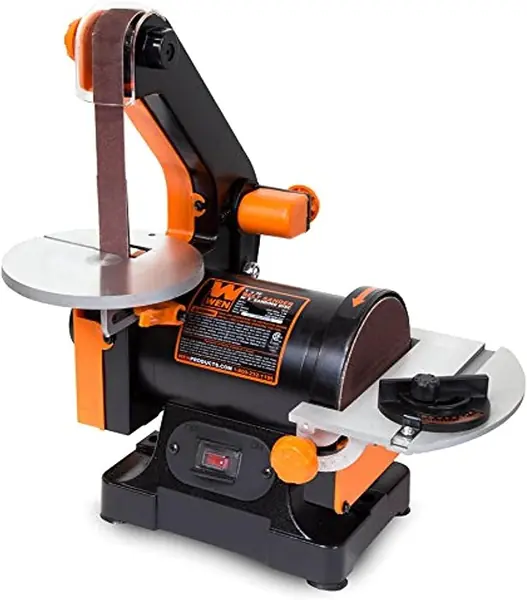
WEN 6502T benchtop belt and disc sander with cast iron base and 4-by-36 belt

General woodworking

Shop Score 93/100
Belt Size
4 x 36 in.
Disc Diameter
6 in.
Motor
4.3 amps
Belt Tilt
0 to 90 degrees
View on Amazon

A 4-by-36 belt is what separates a shop sander from a craft sander: wide enough to true the edge of a glued-up panel and long enough that a board doesn't slide off before it's flat. The WEN 6502T pairs that belt with a 6-inch disc, a cast-iron base, and a 4.3-amp motor, and it does it for less money than the heavier machines here. That combination is why it's our pick for most woodworking shops.

The details are right where they matter. A tension release lever means you swap grits without wrestling the belt off and on, the belt tilts from flat through 90 degrees so you can chamfer on the platen and then stand a part up for end grain, and the cast iron does real work — this is a sander that stays put on a bench without a clamp. We were pleasantly surprised by how solid the whole thing feels once it's out of the box.

The dust port is the one place the layout works against you. Route the hose straight out the back and it can foul a long board as it comes off the belt. Swing the fitting to the side, or pop the hose off for long stock, and the problem is gone — worth doing before a run of rails rather than halfway through it. The 6-inch disc is a squaring and end-grain station, not a flattening surface; save the wide work for the belt.

What gives us pause is longevity. The switch and the motor are the parts that fail when one does, and a hobby schedule of short sessions is easier on both than a production bench that runs all afternoon. That's the buyer we have in mind — the home woodworker who sands a set of parts, switches the machine off, and comes back to it next weekend.

Worth Noting

  • Modest power in full-width hardwood cuts
Our Verdict

We recommend the 6502T to most woodworkers: a 4-by-36 belt and 6-inch disc handle real furniture parts, and the cast-iron base keeps it steady without clamping.

Check Latest Price
2.

BUCKTOOL BD4801 Belt Disc Sander Best for Heavy Sanding

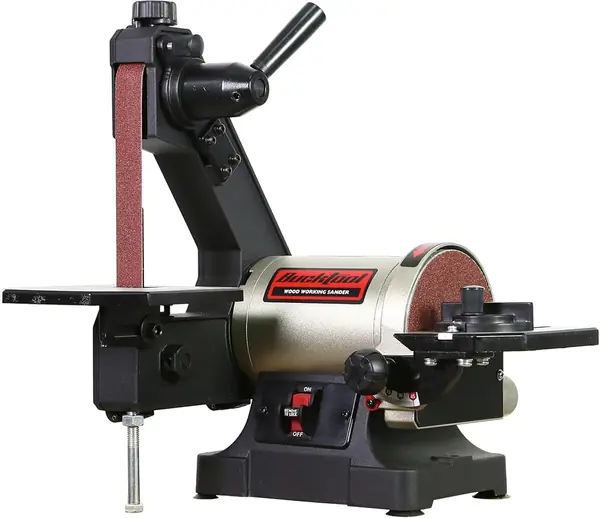
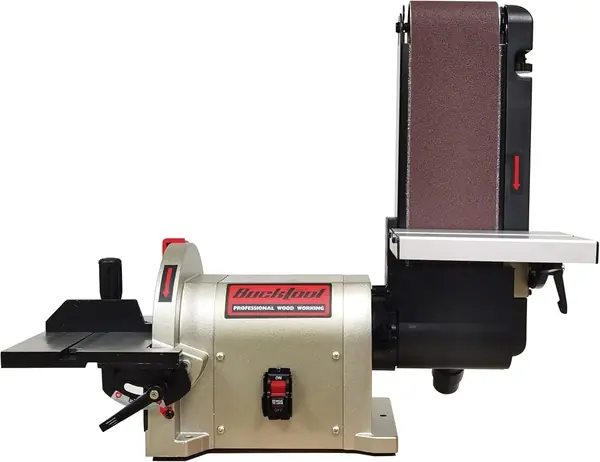
Bucktool BD4801 bench belt disc sander with 8-inch disc and two work tables

Heavy stock removal

Shop Score 91/100
Belt Size
4 x 36 in.
Disc Diameter
8 in.
Motor
3/4 hp direct drive
Belt Speed
2,161 FPM
View on Amazon

No drive belt sits between the motor and the sanding head on the Bucktool BD4801 — it's a direct-drive machine, rated at 3/4 hp, 5 amps, and 3,450 rpm at the disc. The disc is 8 inches across under a heavy steel cover, the largest here, and the belt is a 4-by-36 running at 2,161 feet per minute.

That extra power is what you're paying for. Three-quarter horsepower through a direct drive gives more reserve than the 4.3-amp machines here, and the 8-inch disc is the part we keep coming back to: it takes a wider pass when you're flattening end grain or squaring a leg. It's built like a small industrial tool — metal housings, two cast work tables, and enough mass that it doesn't walk across the bench.

The trade-offs are space and access. It has the biggest footprint of this group, so measure the bench before you commit, and the dust fitting sits where it can block the far end of the belt; plan the hose route to fall away from the work. What we appreciate is the two-table layout — one for the belt, one for the disc, both slotted for the included miter gauge — and a direct drive with no cog belt to tension, which is one less thing to adjust on a machine you'll own for years.

Worth Noting

  • Tables can shift slightly as you lock them
  • Belt changes involve more disassembly
Our Verdict

Buy this one if you sand hard and often — its direct-drive 3/4 hp motor and 8-inch disc are the most capacity here, and we think the extra spend pays back in stock removal.

Check Latest Price
3.

RIKON 50-161VS Variable Speed Sander Best Variable Speed

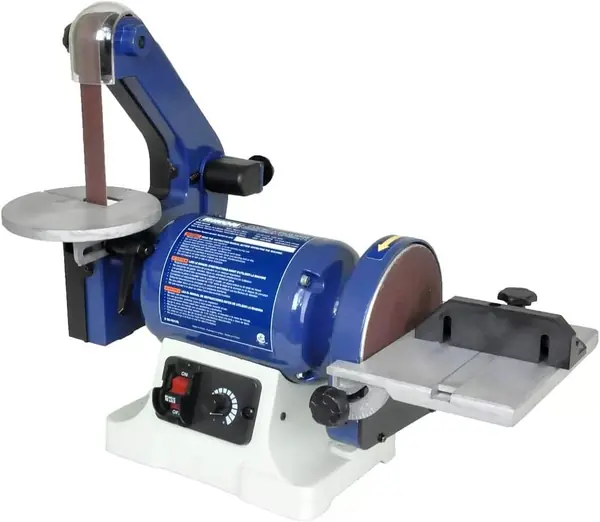
RIKON 50-161VS variable speed belt and disc sander with tilting work tables

Variable-speed detail work

Shop Score 90/100
Belt Size
1 x 30 in.
Disc Diameter
6 in. PSA
Warranty
5 years
Speed Range
2,000 to 3,400 rpm
View on Amazon

Variable speed is the whole argument for the RIKON 50-161VS, and it's the only machine here that offers it: 2,000 to 3,400 rpm at the disc, with belt speed tracking from 1,909 to 3,248 surface feet per minute. That range lets you slow the abrasive for thin stock, plastics, and sharpening, where a fixed-speed sander burns before it cuts. We think it's the pick for anyone whose work changes more often than their sandpaper does.

The rest of the machine is compact but serious. A 3/4-hp motor drives a 1-by-30 belt and a 6-inch PSA disc, both stations have tables that tilt from 0 to 45 degrees, and the disc table carries a miter slot for the included gauge. At 30.2 pounds it has real mass behind it — good news for steadiness at the bench, less so if you move between workstations — and there are mounting holes in the base if you want it bolted down. Separate dust ports and a five-year warranty round it out, and that warranty is the longest in this group.

Setup is where this sander earns or loses your patience. The belt has to be tracked to center, and both tables are worth checking for square before the first cut; a quick pass with a machinist's square now saves a lot of head scratching later. The miter slot and gauge are the detail we use most, because they turn the disc into a decent machine for squaring small parts. Guitar parts, knife bevels, and pen blanks are where this one makes sense.

Worth Noting

  • 1-inch belt is narrow for flat panels
Our Verdict

Our pick when the work needs control rather than volume: variable speed from 2,000 to 3,400 rpm lets you slow the belt for thin stock, plastics, and knife edges.

Check Latest Price
4.

WEN 6515T Compact Belt and Disc Sander Best for Small Shops

WEN 6515T compact benchtop belt and disc sander with 1-by-30 belt and miter gauge

Small shops

Shop Score 89/100
Belt Size
1 x 30 in.
Disc Diameter
5 in.
Belt Speed
3,160 FPM
Weight
16 lb
View on Amazon

On price alone the WEN 6515T sits at the bottom of this group, and it's the smallest machine here: a 1-by-30 belt, a 5-inch disc, a 2.3-amp motor, and 16 pounds of sander. Those are deliberate compromises rather than shortcuts. The narrow belt is the point — it reaches into curves, sharpens a chisel or a knife, and cleans up the inside of a cutout that no 4-inch belt can touch.

Two beveling tables, one for the belt and one for the disc, plus a miter gauge mean you can set an angle and leave it alone, and a belt change is a simple matter of releasing tension and slipping a new one on. Belt speed is 3,160 feet per minute, quick enough for a clean pass on small parts, and the two separate dust ports let you keep a vac on the disc without unhooking it every time you move to the belt.

Where it earns its place is the small shop and the first sander. Sixteen pounds is a machine you can lift onto a shelf when the bench has to become an assembly table, and the two-year warranty is real comfort at this end of the market. We hand it to anyone whose work is small parts, curves, and edges rather than panels.

Worth Noting

  • Belt tracking can drift during use
  • 5-inch disc limits flat sanding
Our Verdict

We point first-time buyers and anyone short on bench space here: the 1-by-30 belt and 5-inch disc cover curves and small parts at the lowest price in this group.

Check Latest Price
5.

BUCKTOOL MM493C Compact Belt Disc Sander Best for Knives and Crafts

Bucktool MM493C compact benchtop belt disc sander with 5-inch disc and belt cover

Knives and crafts

Shop Score 88/100
Belt Size
1 x 30 in.
Disc Diameter
5 in.
Motor
1/3 hp direct drive
Warranty
2 years
View on Amazon

The belt cover on the Bucktool MM493C opens with one push and no wrench, and the wrenches you do need for the tables live in a holder on the machine. That sounds like a small thing until you've changed grits four times in an afternoon. Belt changes take a few minutes, and the tracking holds once it's set.

The direct drive is smooth and quiet, the 1-by-30 belt and 5-inch disc handle knife blanks, pen blanks, and small furniture parts, and at just under 20 pounds it moves around the shop without a second thought. The disc table tilts to 45 degrees, and the two-year warranty matches the bigger Bucktool here. It is also the most solid-feeling machine of this size we handled, with a metal enclosure rather than a plastic shell.

Rated at 3,300 feet per minute, the belt moves fast for this size of motor, which is why light passes come out clean rather than smeared. What we like most is how much machine Bucktool packs into a footprint that fits on the end of a bench. It's the one we reach for when the job is a handle, a knob, or a knife bevel and a 4-inch sander would be more machine than the part needs.

Worth Noting

  • 1/3 hp keeps heavy stock removal slow
Our Verdict

A tidy little machine for knife blanks, pen blanks, and craft work; we like that the belt cover opens without a tool, so grit changes take minutes.

Check Latest Price
6.

Woodskil 4x36 Belt Disc Sander

Woodskil 4-by-36 belt and 6-inch disc sander with steel base and dual dust ports

First benchtop sander

Shop Score 87/100
Belt Size
4 x 36 in.
Disc Diameter
6 in.
Warranty
2 years
Belt Speed
1,732 FPM
View on Amazon

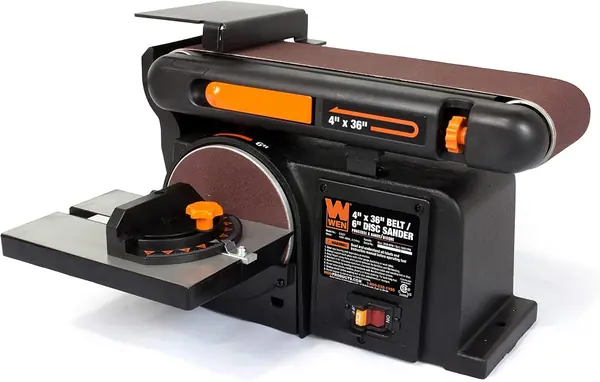
On paper the Woodskil is the closest thing here to our top pick: a 4-by-36 belt, a 6-inch disc, a 4.3-amp motor, a steel base, and a belt that tilts from flat to 90 degrees over a table that goes 0 to 45. It also carries a two-year warranty and a double safety switch that has to be engaged deliberately before the motor will start — a small feature we're glad to see on a machine this size.

Where it differs is refinement and pace. Belt speed is listed at 1,732 feet per minute, slower than the direct-drive machines here, which is a fair trade for a sander aimed at weekend work rather than production. The steel base is stable enough, though it doesn't have the cast-iron heft of the WEN. We rank it behind the top pick on how proven the machine is rather than on how it performs. If you want the 4-by-36 capacity with a warranty card in the drawer, this is a sensible buy.

Worth Noting

  • Slower 1,732 FPM belt speed trails direct-drive machines
  • Steel base lacks the heft of cast-iron sanders
Our Verdict

A sensible alternative if you want the 4-by-36 format backed by a two-year warranty, though it has less of a track record than our top pick.

Check Latest Price

How We Chose and Tested Benchtop Belt and Disc Sanders

We started with every combo sander we could find, meaning machines that carry both a belt and a disc on one base, and filtered the list by belt width and disc diameter, motor rating and drive type, table size, dust port count, footprint, weight, and warranty terms. Twelve machines made it onto the bench.

Testing happened in two working shops: a one-car garage with a single circuit, and a basement workshop where the bench doubles as an assembly table. Every machine got the same first hour. We checked the table against a machinist square out of the box, locked the angle, and checked it again once the machine had done real work. We ran a long board past the belt with the base unclamped to see whether the sander crept, then bolted it down through the mounting holes.

Belt swaps were timed with the sander unplugged and only the tools that live on our bench, and we watched whether a fresh belt tracked straight at full speed or walked toward the edge once it was under load. To judge power, we fed end grain into the belt and waited for a stall; after ten minutes of continuous work we felt the motor housing and the switch for heat and listened for a change in pitch. Value was tallied at the end, against what came in the box.

Dust collection was hooked up with a shop vac on each port, eye and hearing protection on, and a long board to show where the hose left the machine relative to the work. Nine months in, we re-checked tracking, table squareness, switch feel, and disc runout, and read each warranty the way an owner filing a claim would.

How to Choose a Benchtop Belt and Disc Sander

Match the Belt Width to the Work

The 4-by-36 belt is the woodworking standard: wide enough to true a panel edge or flatten a rail, long enough that a board doesn't slide off mid-pass. A 1-by-30 belt is a different tool — it reaches into curves, sharpens a chisel, and cleans up knife bevels, but it will not flatten a glued-up panel no matter how patient you are.

Buy the wide belt if you build furniture and the narrow one if your work is small parts, handles, and edges. Plenty of shops end up wanting both, and that's the argument for starting with the 4-inch machine and adding a 1-inch later rather than the other way around.

Direct Drive, Belt Drive, and How Much Motor

Amperage numbers are the worst way to compare these machines, because a 4.3-amp belt-driven sander and a 5-amp direct-drive unit are not putting the same share of their power into the abrasive. Direct drive removes a wear item — no cog belt to tension or replace — and delivers more of the motor's output to the sanding head.

For light work a 2.3-amp machine is perfectly adequate. If you routinely take heavy cuts in hardwood, the 3/4-hp direct-drive units here are the ones that keep the belt moving when you lean into a cut. We would rather have less motor and a wider belt than the reverse.

Tables, Tracking, and the Setup Nobody Checks

The spec sheet rarely tells you the two things that decide whether a sander is pleasant to own: whether the tables lock down square and stay there, and whether the belt tracks to center and keeps tracking. Almost every table on a machine this size is adjustable, and almost every one can be knocked out of square by a locking lever.

Plan to spend the first session with a machinist's square, setting each table against the platen or the disc and then rechecking it after you lock it down. Set the table, lock it, check it again — that last step is where square cuts come from.

Plan for Dust and for the Hose

Every machine here has at least one dust port, and the better ones have two so the belt and disc don't have to share a hose. Port placement matters as much as port count: a fitting that exits straight off the back can foul a long board as it leaves the belt, which is the complaint that shows up most often on the roomier 4-inch machines.

Port sizes vary between brands and even between models in the same lineup, so measure the outlet across before you order an adapter rather than assuming your shop vac hose will push on. Leave room behind the machine for the hose to loop.

Fixed Speed or Variable

Fixed speed is fine for wood, and it's what most of these sanders offer. Variable speed earns its premium on thin stock, plastics, sharpening, and any cut where heat is the enemy — slowing the abrasive is often the difference between a clean bevel and a burned one.

Only the RIKON here offers it, and its 2,000-to-3,400 rpm range is the reason to pay for that machine. If you sand wood and only wood, put the money into belt width instead.

Frequently Asked Questions

Final Verdict

We recommend the WEN 6502T for most woodworking shops. The 4-by-36 belt and 6-inch disc cover edge work, end grain, and small parts, the cast-iron base keeps it in place without clamps, and it costs less than the heavier machines that do the same jobs.

If you sand hard and often, the money for the Bucktool BD4801 buys real power and an 8-inch disc. And if your work is knife bevels and small curves rather than panels, start with a narrow-belt machine instead — the WEN 6515T handles that for less.