↑↓ navigate ↵ open Esc close All results →

Best Cordless Detail Sanders of 2026

Inside cabinet face frames, raised-panel grooves, and tight spots behind stair spindles stop a random orbit sander cold, forcing slow hand sanding with a folded scrap of paper. A cordless detail sander gets into those corners with a pointed pad or finger attachment, clearing profiles cleanly without a cord trailing over finished trim.

Eight months of paint prep and refinishing across 11 cordless detail sanders—including marathon dresser and trim touch-ups—also highlighted a practical consumable catch: abrasive sheets are cut to each pad's exact footprint, so local availability matters before you commit to a tool.

Meant for corners, profiles, and overhead trim rather than stripping decks, these four models pair effective dust collection with variable speed control, with select units offering interchangeable pads.

Our Top Picks

The Best Cordless Detail Sanders

1.

Milwaukee M12 FUEL Orbital Detail Sander (2531-20) Best Overall
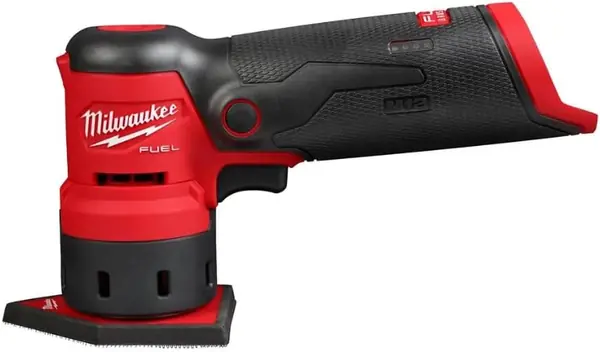
Milwaukee M12 FUEL orbital detail sander with compact red and black body

Corner finish sanding

Shop Score 92/100
Weight
16 oz
Power Source
12V lithium-ion (tool only)
Orbit Diameter
1.5 mm
Speed Settings
4, plus variable-speed trigger
View on Amazon

Sixteen ounces is the whole argument. A detail sander spends its life at bad angles — inside a cabinet carcass, along installed casing, upside down under a rail — and the tool you can hold there in one hand with a light grip is the one that actually gets used. The M12 FUEL's body is short, the four-speed selector sits under your thumb with a variable-speed trigger behind it, and the LED is close enough to the pad to light the corner you are working in.

We like the 1.5mm orbit for what this tool is. At a finer stroke than the WORX finger sander's 3/32 inch, it leaves a scratch pattern you can pull out with a light hand-sand or a scuff between coats. You pay for that in removal speed — this is not the sander for stripping a painted door — but on a pad this small, finish quality is the trade we want.

The platform is the real cost. This is a bare tool, so it is only cheap if M12 packs and a charger are already on your shelf; starting from nothing, price the batteries and charger before you compare it with the 20V options here.

What you get for that is a sander you can run one-handed through an afternoon of trim without your wrist filing a complaint, and a tool pleasant enough to leave on the bench between coats.

Worth Noting

  • Replacement paper costs more and is harder to find
Our Verdict

We recommend it to anyone already on Milwaukee's M12 platform: it is the lightest, most controllable detail sander here, and the fine orbit is made for finish work.

Check Latest Price
2.

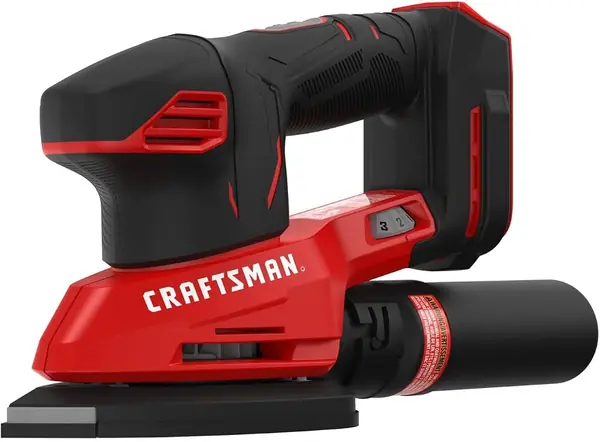
CRAFTSMAN V20 Cordless Detail Sander (CMCW221B) Best for Dust Control

CRAFTSMAN V20 cordless detail sander in red with D-handle grip and dust bag

Indoor sanding jobs

Shop Score 91/100
Weight
2.6 lb
Power Source
20V MAX lithium-ion (tool only)
Speed Range
9,000 to 12,000 OPM
Dust Collection
Dust bag or 1-1/4 in. vacuum connection
View on Amazon

The 1-1/4-inch vacuum port is what makes this one worth owning. Detail sanding puts your face near the work, and a shop vac on that port pulls the dust away before the paper loads up — you can see the line you are cutting, the sheet keeps cutting instead of skating, and the room stays breathable. There is a bag in the box for quick jobs, and a dust-sealed switch, which we are always glad to find on a tool that lives in a shop.

Variable speed from 9,000 to 12,000 opm gives you a low end the single-speed picks here do not have, and that is the useful part: back it down for paint prep over a repair, open it up when you are easing a curve. What we ended up appreciating most is the D-handle. It puts your palm over the pad for vertical work, so sanding a cabinet side or easing a door edge does not turn into a wrist exercise.

At 2.6 pounds with a tall body it is bulkier than the compact picks, and that is the price of the handle and the port. If most of your detail work happens at bench height you will never notice; if you sand overhead, you will.

Worth Noting

  • Bare tool; 20V battery and charger sold separately
Our Verdict

Our pick if you sand indoors: the vacuum port and variable speed make it the most shop-friendly tool in this group.

Check Latest Price
3.

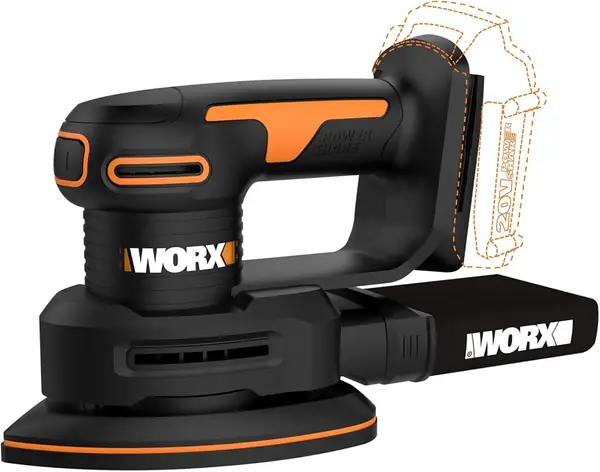
WORX 20V Detail Sander (WX822L.9) Best Budget

WORX 20V cordless detail sander with finger sanding attachment and dust bag

Budget corner sanding

Shop Score 90/100
Weight
2 lb
Included
Finger sanding attachment, 6 sanding sheets, dust bag
Orbit Diameter
3/32 in.
Speed
12,000 OPM
View on Amazon

If your garage already has a shelf of orange 20V packs, this is the detail sander to put on the bench. It is the cheapest way into corner sanding of the picks here, and it runs on the same PowerShare batteries as the trimmer and drill you already charge.

Credit the finger attachment for the useful part. A narrow strip of paper gets into a routed groove, a louver, or the inside corner of a frame where even a triangular pad bottoms out, and 2 pounds at 12,000 opm is light enough to steer with your fingertips while you do it. The 3/32-inch orbit is coarser than the Milwaukee's 1.5mm stroke, so it cuts faster and leaves more scratch to clean up.

Our take is that this is the right compromise for a general-purpose detail tool. Most of what a sander this size does is shaping and stripping, and speed matters more there than a mirror finish. It is the one we grab for odd jobs between bigger ones rather than the final pass before stain, and at this end of the price range it is hard to argue with as a second sander.

Worth Noting

  • Bare tool; WORX 20V battery and charger sold separately
Our Verdict

Buy this one if the batteries are already in your garage — nothing here costs less to get into corners, and the finger attachment earns its keep.

Check Latest Price
4.

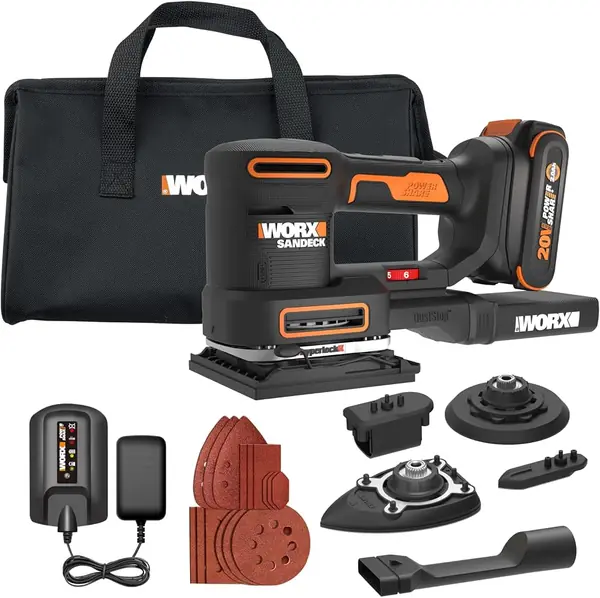
WORX 20V 5-in-1 Multi-Sander (WX820L) Most Versatile

WORX 20V 5-in-1 multi-sander with five interchangeable sanding bases and dust bag

One-tool workshops

Shop Score 89/100
Weight
4.4 lb
Included
20V 2.0Ah battery, 5-hour charger, sanding sheets, dust bag, hole punch
Speeds
6
Sanding Bases
Five: random orbit, finishing, detail, finger, contour
View on Amazon

Five sanding bases in one case is the pitch, and it mostly holds: a 5-inch random-orbit pad for panels, a quarter-sheet finishing pad, a detail pad for corners, a finger pad for grooves, and a contour pad for curves. Swapping them takes a button press and a twist of the lever, no tools and no hunting for an Allen key, which is the difference between actually using the detail pad and leaving it in the case.

The kit is what separates it from the bare tools here. A 20V 2.0Ah battery, a charger, sanding sheets, a dust bag, and the hole punch for the finishing pad all come in the box, so it runs on the first afternoon. Six speeds and a 10,000-opm motor give you enough range to work a veneered panel gently and then open up on a routed groove with the finger base.

We think it earns its shelf space as the only sander a small shop needs, and the honest way to buy it is as a 5-inch random-orbit sander that happens to get into corners. The base that earns its keep is the big round one, with the detail and finger pads as the bonus. Judged that way, the case, the charger, and the five bases are a lot of kit for one purchase.

Worth Noting

  • 4.4 pounds is heavy for overhead work
  • 2.0Ah pack gives short runtime under load
Our Verdict

For a shop that wants one sander instead of three, this is the box to open, since the battery and charger come with it.

Check Latest Price

How We Tested Cordless Detail Sanders

We built the shortlist by sorting through cordless detail sanders and keeping only the ones with a shaped detail base or a finger attachment plus some form of dust collection, then spread the rest across battery platforms, bare tools, and full kits. Eleven of them ran for eight months — in a garage workshop and a spare bedroom we were repainting, sanding paint off door frames and baseboards, stripping a dresser and a stack of cabinet doors, and cleaning up the curves on stair spindles. Eye protection and a dust mask went on for every session, and each tool only ever ran on the battery platform it was built for.

Pad swaps were timed with work gloves on, and we noted whether the paper seated square or wandered. In inside corners and raised-panel grooves we ran each sander at a middle speed and looked for swirl marks, gouges, and whether the pad's edge or the tool housing reached the corner first. On scrap plywood we ran packs flat out under steady hand pressure and logged runtime, how warm the grip got, and how the tool balanced overhead one-handed with the pack fitted.

Dust got its own pass: we sanded a painted door once with the bag in place and once with a vacuum hose connected where the tool accepted one, then checked the floor and the door trim afterward. We tracked what sheets cost and whether the local hardware store carried them in the pad's own shape, since an odd pad means ordering online forever. Switch feel and motor response were logged on day one and again at the end.

How to Choose a Cordless Detail Sander

Match the Pad to the Corner

Two shapes do most of the work: a triangular detail pad for open corners and edges, and a narrow finger attachment for routed grooves, louvers, and the inside corner of a frame where a triangle bottoms out before the paper does. A finger sander like the WORX WX822L.9 is built around that second shape, and it is the only way to get paper into a slot narrower than the pad.

Buy for the work you actually do. If you finish assembled furniture, insist on both a detail base and a finger attachment in the box. If your detail work is mostly installed trim and eased edges, a pad with a point is enough and the finger attachment will live in the case.

Orbit Size Sets the Finish

The stroke decides whether you are polishing a surface or removing material. The Milwaukee's 1.5mm orbit leaves a fine scratch pattern that comes out with a light hand-sand; the WORX finger sander's 3/32 inch cuts faster and leaves more behind. Neither is better in the abstract — they solve different halves of the job.

On a detail sander we favor the small orbit. You are usually working next to a finished surface, and a coarse stroke on a small pad digs a groove faster than you can react.

Bare Tool or Kit

Most cordless detail sanders ship without a battery, and the box says tool only in small print that is easy to miss when the product page says battery powered. If you already run the brand's packs, a bare tool is the cheapest way in. If you do not, price two batteries and a charger into the decision before you compare anything else — the WORX 5-in-1 is the one pick here that arrives ready to run.

Runtime, not voltage, is what limits a detail sander. A compact pack keeps the tool balanced in your hand; a big one doubles the time but tips the nose down, which you feel on a vertical edge.

Dust Control Is Half the Job

A loaded sheet stops cutting, and on a small pad that happens quickly. A vacuum port beats a bag: the CRAFTSMAN's 1-1/4-inch connection takes a shop vac hose, which keeps the paper working and the cut line visible while you work. Bags are fine for a few minutes of touch-up and not much more.

If you sand indoors, in a finished room, or anywhere near someone's furniture, make the port a requirement. Out in the garage with the door up, a bag is enough.

Weight and Grip for Overhead Work

Sixteen ounces and 4.4 pounds feel very different after ten minutes above shoulder height. A short barrel grip lets you choke up and steer with your fingertips; a D-handle like the CRAFTSMAN's puts your palm over the pad for vertical surfaces but adds bulk to the tool.

Compact in a description can mean it fits a drawer, not that it fits inside a cabinet. Sand overhead or inside carcasses and weight belongs at the top of your list; work at a bench and it barely registers.

Frequently Asked Questions

Final Verdict

Our pick is the Milwaukee M12 FUEL 2531-20 for anyone already running M12 packs: 16 ounces, a 1.5mm orbit, and four speeds make it the detail sander we reach for on trim, frames, and inside corners, and nothing else here is as easy to control with one hand.

If you do not own M12 batteries, the CRAFTSMAN is the better value — a 1-1/4-inch vacuum port, variable speed, and a D-handle on a bare tool that can go on a platform you may already have. Want one purchase that includes the battery? The WORX 5-in-1 covers flat work and corners together, as long as the work stays at bench height.