↑↓ navigate ↵ open Esc close All results →

Best Buffing Systems for Woodworking of 2026

Because a buffing wheel is the final tool to touch a finished project, a misstep can ruin an hour of careful prep in seconds — leaning into a soft edge with a loaded wheel burnishes a hollow, while spinning a dry wheel too fast hazes the surface with fine scratches. A well-built wheel stays balanced at speed, retains compound evenly, and removes only the targeted sheen.

Fourteen buffing wheels and kits ran for four months on a bench grinder, a drill, and a rotary tool across wide white oak panels and walnut chair spindles. Arbor and shank compatibility proved just as critical as cotton quality because any wobble ruins control, while ply count and stitching determine how a wheel holds wax or compound under pressure — and many bundled abrasive sticks are formulated for metal rather than wood.

Matched to both broad tabletop panels and tight spindle profiles, the four systems ranked ahead run smoothly at working RPM without fighting the workpiece.

Our Top Picks

The Best Buffing Systems for Woodworking

1.

SCOTTCHEN 6-Inch Cotton Buffing Wheels Best Overall
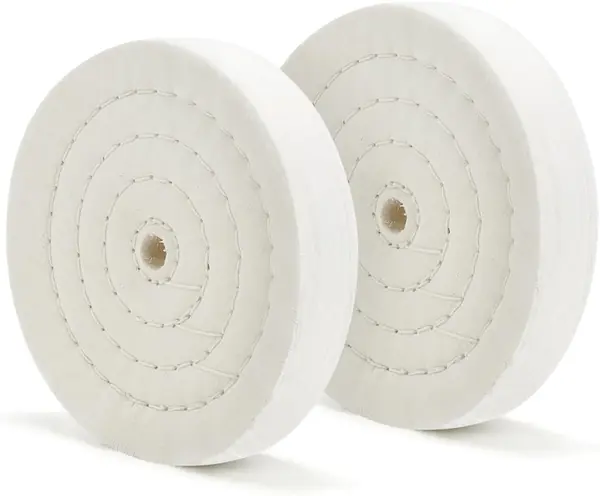
SCOTTCHEN 6-inch cotton buffing wheels with 1/2-inch arbor holes, two-pack

Wood finish buffing

Shop Score 92/100
Set Contents
2 buffing wheels
Arbor
1/2 inch
Diameter
6 inches
Construction
70-ply cotton
View on Amazon

Seventy plies is the number that matters on a bench-grinder wheel, and these have the body to back it up. The extra thickness gives the wheel a wider working face and more resistance to folding over when you press a profile into it. On a 6-inch grinder, that translates into a wheel that carries compound instead of immediately matting flat.

The 1/2-inch arbor slipped onto our grinder without an adapter, and the tight concentric stitching kept the cotton stacked together at speed. We used the pair on a chair arm and a turned knob; the wheel stayed firm enough to work a curve without digging a flat spot. That is the balance we want in a primary buffing wheel: stiff enough to cut, soft enough to leave a sheen rather than a scratch.

Load it with a fine white or tripoli stick for wood, and keep a separate wheel for each grit. The first run throws some loose cotton, so wear eye protection and expect a quick vacuum pass; the shedding settles down after that.

Worth Noting

  • No polishing compound included
Our Verdict

We recommend these as the foundation of a woodworking buffing setup: thick 70-ply cotton, a standard 1/2-inch arbor, and enough body to carry compound without collapsing.

Check Latest Price
2.

Ceeintee 6-Inch Buffing Wheel Kit Best Complete Kit

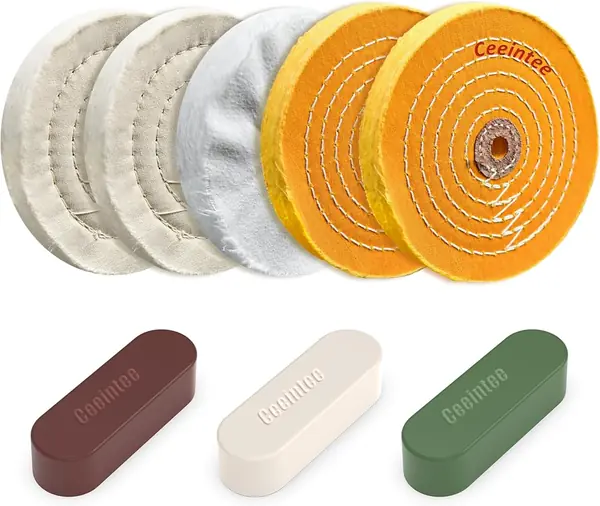
Ceeintee 6-inch bench grinder buffing kit with cotton wheels and three compounds

Mixed-shop polishing

Shop Score 91/100
Set Contents
5 wheels and 3 compounds
Arbor
1/2 inch
Diameter
6 inches
Wheel Plies
42, 50, and 30
View on Amazon

A buffing setup is easier to live with when the wheels and compounds arrive together, and the Ceeintee kit is the most complete box here: five 6-inch cotton wheels in three densities plus three polishing sticks.

We like that the kit gives you a sequence out of the box rather than one wheel and a shopping list. The two 42-ply yellow wheels are the firmer pair, the two 50-ply white wheels are a step softer, and the single 30-ply flannel wheel is the finishing wheel. On a bench grinder, that lets you start with more bite and work toward a softer face without changing machines. We used the firmer wheels first and moved to the flannel for the final pass, and the progression felt more controlled than jumping straight to a soft wheel.

The included sticks are labeled for aluminum, stainless, soft metals, and hard metals, so we treat them as a mixed-shop bonus and add a wood-friendly compound for furniture. The 1/2-inch arbor fit a standard grinder, and the set leaves you with a soft wheel for the final pass. For a shop that moves between wood and metal, that is a fair trade.

Worth Noting

  • Thinner wheels than a heavy-duty set
Our Verdict

The Ceeintee kit is the one we choose for a mixed wood-and-metal shop: five cotton wheels and three compounds give you a full bench sequence in one box.

Check Latest Price
3.

XUPYNAR 100-Piece Rotary Buffing Kit Best for Rotary Detail Work

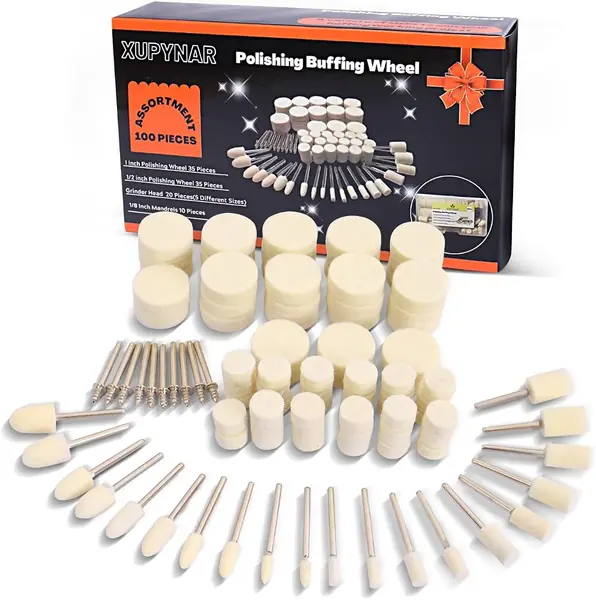
XUPYNAR 100-piece felt buffing kit with assorted wheels and 1/8-inch shanks

Rotary detail work

Shop Score 90/100
Set Contents
100 pieces
Shank
1/8 inch
Material
Wool felt
Wheel Diameter
1 inch
View on Amazon

Carved details and tight coves are where a full-size buffing wheel gives up, and that is the gap this 100-piece rotary kit fills. The set is built around 1-inch and 1/2-inch felt wheels, with conical and cylindrical points on 1/8-inch shanks, so you can match the shape to the recess instead of forcing a flat wheel into it.

We found the smaller points useful for getting into a groove without dragging the surrounding surface, and the shanks fit a standard rotary tool. The felt is firm, which gives it more bite than a soft cotton mop; that is helpful on a hard wood or a metal inlay. The felt is aimed at metal, glass, and jewelry rather than wood, so we test on scrap before committing a finished piece.

The variety is the real value: you get a shape for most small details without buying a dozen separate bobs. Felt does load up, so clean it between grits; that is the upkeep that comes with the reach. For carving cleanup and small profiles, it is a useful box to keep near the rotary tool.

Worth Noting

  • Firm felt can be aggressive on soft wood
Our Verdict

For rotary-tool detail work on carvings, we like this 100-piece kit for its small felt shapes; the felt is aimed at metal and jewelry, so test on scrap wood first.

Check Latest Price
4.

ZFE 44-Piece Drill Polishing Pad Kit Best for Tight Detail Polishing

ZFE 44-piece foam and wool drill polishing pad kit in three sizes

Tight detail polishing

Shop Score 89/100
Set Contents
44 pieces
Adapter
M14 thread
Pad Sizes
1, 2, and 3 inches
Backing Thread
5/8-11
View on Amazon

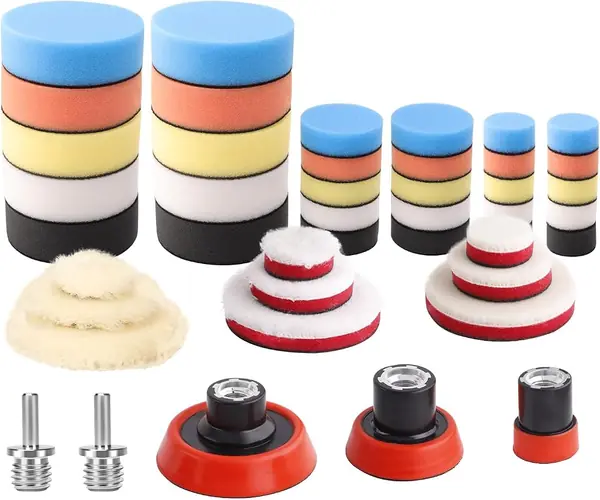
The 1-, 2-, and 3-inch pads in this 44-piece kit are small enough to follow a routed edge or a turned bead without flattening the surrounding surface. That is the kind of access a 6-inch bench wheel cannot give you, and it is why the kit earns a place in the detail drawer.

The foam pads are for applying and working a finish, while the wool pads have more bite; the hook-and-loop backing makes changes quick, and the 5/8-11 backing pad and M14 adapter cover common drill and polisher threads. We see it as a problem-solver for tight profiles.

For small turnings, routed edges, and waxing in tight spots, the variety is worth having. The small pads also let you work wax into a routed bead without loading up a full-size wheel. We keep it in the detail drawer, within reach of the drill.

Worth Noting

  • Not sized for large flat panels
Our Verdict

This is a detailing kit rather than a wood-finishing system, but we like its tiny foam and wool pads for waxing tight profiles and small turnings.

Check Latest Price

How We Tested Buffing Wheels, Pads, and Kits

We started with the mount, because a wheel that won't seat safely on your tool isn't worth testing. We measured arbor holes, shank diameters, and backing threads against the grinders, drills, and rotary tools in our shop, and weighed diameter, ply, whether compound came in the box, and whether the listing stated an RPM rating. That left 14 wheels, pads, and kits, which we ran for four months.

Testing happened where the work does: Saturday mornings at the bench grinder, working a white oak tabletop and cabinet doors, and weeknights at the rotary tool, cleaning up chair spindles and brass hardware. Each wheel went on the arbor, spun up, and watched for wobble before it touched wood.

Once a wheel ran true, we loaded compound in short bursts and counted how many passes it took to build a working layer and how long it kept cutting before it needed more — our read on adhesion, and where ply and stitching separated the good wheels from the rest. We noted whether the stick crumbled or loaded smoothly, and whether it was cut out for wood or only for metal.

Then we pressed scraps of soft pine and thin veneer against each wheel, measured what came off with calipers, and checked the surface under raking light for swirl marks and an even sheen. Every wheel stayed at or under its rated speed, we wore eye protection and respirators throughout, and every workpiece was clamped with hands clear of the spinning wheel.

At the end we weighed each wheel again and swept the bench to see how much fiber and compound dust it threw. We also tallied what each kit still needed bought separately, which is where a cheap set stops being a deal.

How to Choose a Buffing System for Woodworking

Match the Mount to Your Tool

A bench-grinder wheel needs the right arbor, usually 1/2 inch; a rotary-tool accessory needs a 1/8-inch shank; a drill pad needs the correct backing thread. Buying a beautiful wheel that will not mount is the most common mistake we see. The SCOTTCHEN and Ceeintee wheels both use a 1/2-inch arbor, the XUPYNAR kit uses 1/8-inch shanks, and the ZFE kit carries a 5/8-11 backing pad with an M14 adapter. Check your machine before you fall for the wheel.

Choose the Wheel Face for the Work

A 6-inch cotton wheel is the workhorse for broad surfaces: it covers ground quickly and carries enough compound to bring up a flat panel or a chair arm. For carvings, routed edges, and inside curves, a 1- to 3-inch pad or a small felt point reaches where the big wheel cannot. The trap is buying one size for everything. A 70-ply wheel like the SCOTTCHEN has more body under pressure; the Ceeintee kit's 42-, 50-, and 30-ply wheels give you a softer sequence; the small drill and rotary pads are for detail, not flattening a tabletop.

Match the Compound to the Finish

Compound is the abrasive, and the stick has to match the finish. A metal-focused brown or green stick can be too aggressive or leave a residue on wood; for wood, start with a fine white or tripoli compound and test on scrap. The Ceeintee kit's three sticks are labeled for aluminum, stainless, soft metals, and hard metals, so we treat them as a mixed-shop bonus and add a wood-friendly stick for furniture. Load the wheel lightly and keep it moving; more compound is not better.

Control the Mess and the Heat

Cotton and wool wheels shed, especially when new, and buffing generates heat fast. Wear eye protection and a respirator, keep the workpiece moving, and do not press so hard that the finish burns. A wheel that is badly unbalanced or mounted on the wrong arbor will wobble; stop and fix it rather than fighting it. The cotton wheels here throw some loose fiber on the first run, and a quick vacuum pass keeps the bench clean. A dedicated wheel for each compound saves more time than a bigger kit.

Decide Between a Kit and Components

A kit saves you from hunting down arbor sizes and compound grits, but only if the contents match your work. The Ceeintee kit is the most complete box here, while the SCOTTCHEN pair is the better foundation if you already have compounds and want thicker wheels. The XUPYNAR and ZFE kits are detail tools, not substitutes for a bench wheel. Buy for the work in front of you: broad panels and long runs point to a bench-grinder wheel, while carvings and tight profiles point to small pads.

Frequently Asked Questions

Final Verdict

Our default for most woodworkers is the SCOTTCHEN 6-inch pair: thick 70-ply cotton, a standard 1/2-inch arbor, and a wheel-only setup that lets you choose the compound. If you want compounds and a softer finishing wheel in the same box, the Ceeintee kit is the better choice for a mixed shop. For carvings, add the XUPYNAR rotary kit; for tight profiles, the ZFE pads.