↑↓ navigate ↵ open Esc close All results →

Best Sandpaper for Wood Turning of 2026

Spinning wood on a lathe punishes clogged sandpaper immediately. The moment dust packs into the abrasive, turning up hand pressure to force a cut generates friction heat that scorches dark rings into a bowl you just spent an hour shaping with a gouge.

Testing 16 cloth rolls, mesh strips, two-inch disc sets, and foam pen pads over four months on green bowl blanks, resinous timber, and CA-finished pens focused on how long each abrasive kept cutting cleanly rather than just the initial scratch pattern. Choosing the right delivery format comes before picking a grit number: a one-inch flexible cloth roll wraps safely around a spinning vessel and tears cleanly to length at the lathe.

Skipping steps in the sequence only guarantees those hidden scratches reappear under oil or lacquer, so these options cover coarse shaping through ultra-fine pen polishing across both hand strips and rotary bowl sanders.

Our Top Picks

The Best Sandpaper for Wood Turning

1.

Peachtree Woodturner Sanding Roll Set Best Overall
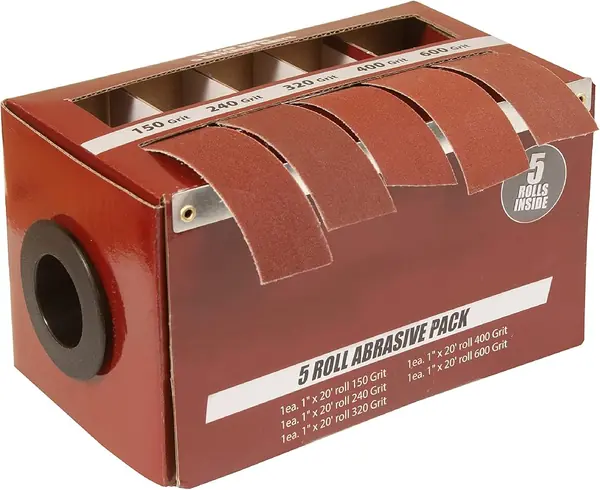
Peachtree five-roll cloth-backed sandpaper set in a dispenser box

Lathe finishing

Shop Score 93/100
Roll Width
1 inch
Roll Length
20 feet each
Grits Included
150/240/320/400/600
Backing
J-weight cloth
View on Amazon

Five 20-foot rolls in 150 through 600 grit make this the box we keep by the lathe. The 1-inch width tears into short strips for pen blanks and spindles, and the cloth backing follows a curve instead of cracking at the fold. Peachtree labels the set for lathe work and turned wood, and that is exactly where it earns its keep: after the gouge and scraper, one strip at a time, stepping through the grits without changing tools. For a turner who wants a dependable finishing sequence rather than a drawer full of loose sheets, this is the set we point to first.

The dispenser is more useful than it looks. Five rolls sit in separate slots, so you can pull the grit you need and tear off a length without unrolling the whole coil. The box also keeps the finer rolls from disappearing under shavings, which matters in a shop where the lathe is already throwing debris. We like that the grits stay visible and in order, so the next step is obvious even when the bench is crowded.

What the set does not include is a coarse shaping grit; it starts at 150. That is a sensible place to begin after your tools have left a fairly clean surface, but a rough blank with tear-out needs an 80- or 120-grit roll alongside it. The 240, 320, 400, and 600 rolls then do the work most turners feel in their wrists: they cut quickly enough to remove the previous scratch pattern without loading instantly. We especially like the 400 and 600 rolls for pens and small bowls, where a small strip is easier to control than a full sheet.

Worth Noting

  • Rolls can be slow to thread through slots
Our Verdict

Our default for lathe finishing: five long cloth rolls from 150 to 600 grit that stay organized and follow curved work.

Check Latest Price
2.

DCT Abrasive Paper 5-Piece Variety Pack Best for Pen Turning

DCT five-roll cloth-backed sandpaper pack with built-in cutter and dispenser

Pen turning

Shop Score 92/100
Roll Width
1 inch
Roll Length
20 feet each
Grits Included
150/240/320/400/600
Dispenser
Built-in cutting blade
View on Amazon

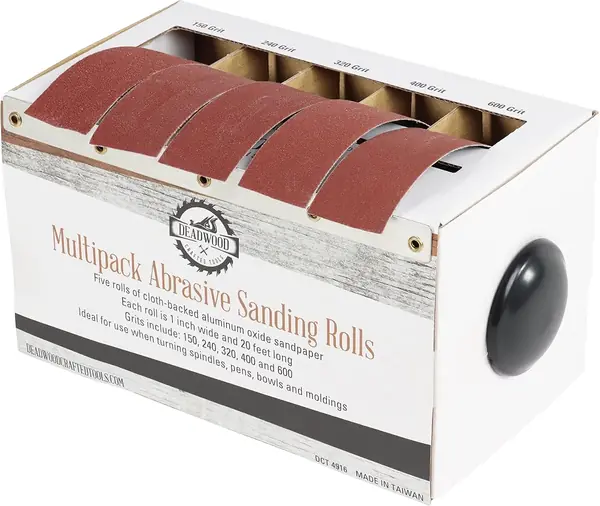
A small steel blade on the bottom edge of the box is the detail that makes this pack a pen-turner's friend. Pull a short length of 1-inch roll, tear it against the cutter, and you are back at the blank without hunting for scissors. Five 20-foot rolls give you 150, 240, 320, 400, and 600 grit, each in its own dispensing slot. We used short strips on pen blanks and narrow spindle work, where a full sheet is more material than the job needs.

DCT's dispenser is simple, but the five slots keep the rolls from tangling and the cutter is genuinely useful. The strips are narrow enough to wrap around a rounded blank and short enough that you can swap grits without stopping for long. We also like that the box stays small on the bench; it does not take over the space beside the lathe.

The cutter makes it practical to take only what you need, and the five slots keep the sequence visible. The 150-grit roll will clean up light tool marks, and the progression to 600 is easy to follow once the surface is ready. For turners who work small and change grits often, that is the whole appeal.

Worth Noting

  • No coarse grits for rough shaping
Our Verdict

We reach for this pack for pen blanks and small spindles; the built-in cutter keeps narrow strips coming.

Check Latest Price
3.

MAXMAN 2-Inch Flex Edge Sanding Discs Best for Bowl Sanders

MAXMAN purple 2-inch hook-and-loop sanding discs with flexible edges

Bowl interiors

Shop Score 91/100
Disc Count
80
Grit Range
80 to 800
Diameter
2 inches
Attachment
Hook and loop
View on Amazon

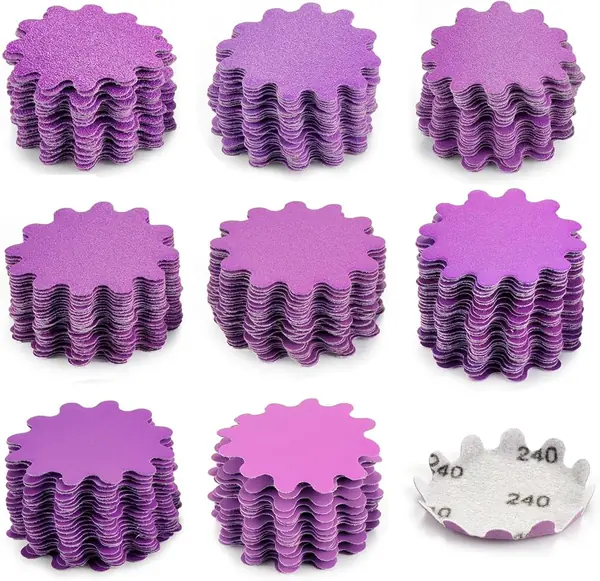
Bowl interiors are where a flat disc shows its limits: the edge catches, the center stalls, and the transition from wall to bottom stays rough. These 2-inch MAXMAN discs have a flexible rim that folds into that curve, and the hook-and-loop backing lets you swap grits on a bowl-sander pad without peeling and repositioning a sheet. The assortment runs from 80 through 800 grit, so it covers shaping through fine finishing.

We used the discs on the inside of a bowl and found the flex edge did the job it promises: it kept contact across the curve instead of digging in at one point. The 80- and 120-grit discs cut quickly, while the finer end lets you refine the surface before you reach for a finish. Eighty discs in one pack also means you are not rationing them on a big bowl.

What we like most is the pacing it allows. You can start at 80 on a rough interior, step through the middle grits, and finish at 800 without changing tools or cutting a new sheet. The 2-inch size also fits inside a bowl without overwhelming the curve, which makes the set easy to keep on the bench beside the lathe.

Worth Noting

  • Requires a matching 2-inch hook-and-loop pad
Our Verdict

We like these flexible 2-inch discs for bowl interiors, where the edge can fold into the wall-to-bottom transition.

Check Latest Price
4.

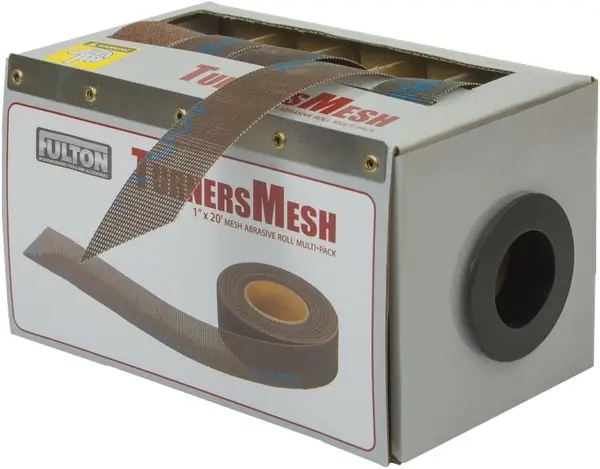
Fulton Turners Mesh Abrasive Roll Best Mesh Option

Fulton Turners Mesh five-roll abrasive set in a dispenser box

Dusty woods

Shop Score 90/100
Roll Width
1 inch
Roll Length
20 feet each
Grits Included
180/240/320/400/600
Material
Silicon carbide mesh
View on Amazon

Dust is the tell with mesh. Instead of sitting on the surface and dulling the cut, the open structure lets particles pass, so the abrasive keeps biting on resinous or dusty woods. Fulton's Turners Mesh comes as five 1-inch by 20-foot rolls in 180, 240, 320, 400, and 600 grit, all in a dispenser box with a steel cutter. That is a finish-sanding sequence rather than a shaping set, and it suits the turner who already has the surface close.

The mesh is flexible enough to wrap around spindles and the outside of a bowl, and the cutter keeps strips short and manageable. We found the open texture especially welcome when sanding a wood that usually loads a cloth strip after a few passes; the abrasive kept cutting instead of skating. The dispenser is compact and keeps the five rolls separated, which is more than you can say for a pile of loose sheets.

The range starts at 180, so this is not the roll for leveling tear-out; it is for the finish passes after your tools have done the shaping. If dust loading is the problem, that boundary is easy to live with. We keep this roll for the woods that fight ordinary paper, not for the first pass on a rough blank.

Worth Noting

  • Mesh can wear faster than cloth backing
Our Verdict

The mesh rolls we choose when dust loading is the problem, with a 180-to-600 grit range built for finish sanding.

Check Latest Price
5.

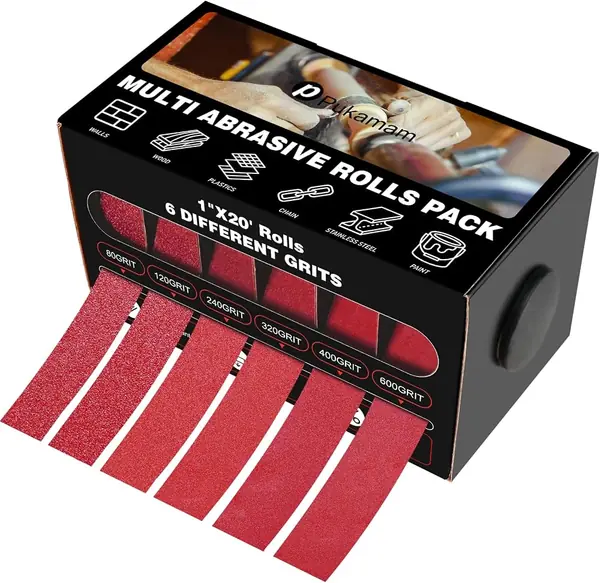
Pukamam 6-Piece Cloth Roll Set Best Full-Grit Range

Pukamam six-roll brown cloth-backed sandpaper set with dispenser box

Full grit range

Shop Score 89/100
Roll Width
1 inch
Roll Length
19.7 feet each
Grits Included
80/120/240/320/400/600
Backing
Tear-resistant nylon cloth
View on Amazon

Six rolls from 80 through 600 grit give you the whole sequence in one small box, including the coarse end many finishing packs leave out. The rolls are 1 inch wide and just under 20 feet long, with a tear-resistant nylon cloth backing that handles wet or dry sanding. For a turner working from a rough blank, that 80-grit roll is the difference between buying one set and buying two.

The cloth backing folds around a spindle without cracking at the crease, and the 80 and 120 grits take down tool marks while the middle grits do the usual cleanup. The 400 and 600 rolls bring the surface up for finish, and the dispenser box keeps all six separated and labeled so you can grab a strip and get back to the lathe.

The full grit range is what earns this set a place. We like that it starts coarse enough for a rough blank and still finishes without a second order. Six grits in one box is the appeal, but the 1-inch width also matters: it keeps the strip narrow enough to control on a spinning spindle. If you already own a 150-to-600 set, this overlaps most of it; if you want one box that starts at 80, it is an easy pick.

Worth Noting

  • Overlaps most grits in existing 150-to-600 sets
Our Verdict

We recommend this when you want the whole 80-to-600 grit climb in one compact cloth-roll set.

Check Latest Price
6.

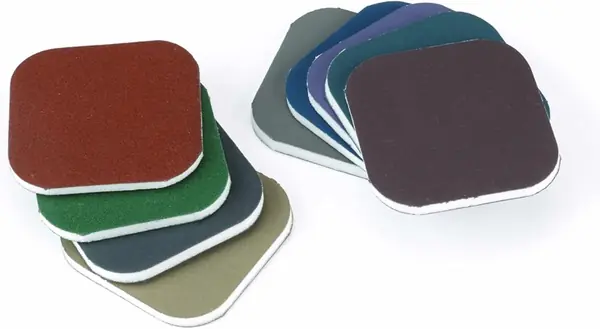
Micro-Mesh Pen Sanding Kit Best for Pen Finishing

Micro-Mesh pen sanding kit with small color-coded foam-backed pads

Pen finishing

Shop Score 88/100
Backing
Foam
Pad Size
2 x 2 inches
Starting Grit
1500
Intended Finishes
CA and acrylic
View on Amazon

This is the final step for a pen, the sequence that makes a CA finish look wet. The kit contains 2-inch-by-2-inch soft-touch pads with foam backing, starting at 1500 grit and climbing into the very fine ranges. Color-coded backs keep the order straight when your hands are already sticky with finish.

On a CA-finished pen blank, the pads leveled the finish without the gritty scratch pattern we associate with jumping straight to a polish. The foam gives just enough cushion to follow a slight curve, and the small size is an advantage around the ends and the clip area.

We also used a pad on an acrylic blank and found the same result: a clean, even shine with less hand pressure than a stiff sheet. The sequence rewards light passes; pressing hard only loads the pad and muddies the finish. Keep a scrap blank nearby to confirm the scratch pattern before you commit a final coat.

For us, this kit is a finishing station, not a general abrasive. It is the last thing we reach for on a pen or a bottle stopper, when the surface is already smooth and only the gloss is missing. Compared with the cloth rolls here, it does a different job and does it well.

Worth Noting

  • Small pads limit use to pens and stoppers
Our Verdict

We keep this kit for the last step on pens and stoppers, when the finish needs a gloss rather than shaping.

Check Latest Price
7.

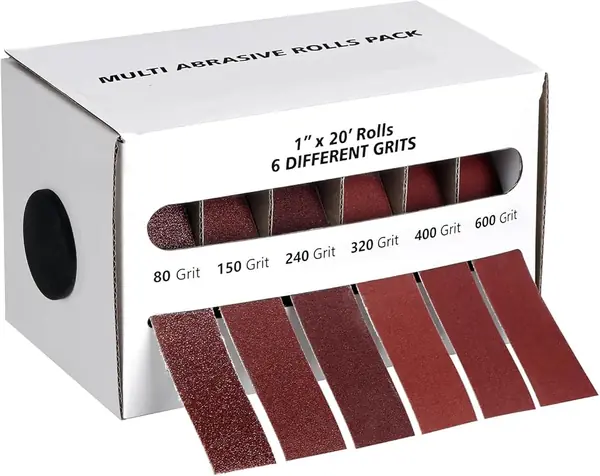
HL-YMXQ 6-Piece Cloth Roll Set Best for Full-Range Sanding

HL-YMXQ six-roll red cloth-backed sandpaper set with dispenser

Full-range sanding

Shop Score 87/100
Roll Width
1 inch
Roll Length
19.7 feet each
Grits Included
80/150/240/320/400/600
Backing
Nylon cloth
View on Amazon

When a project needs both a coarse start and a fine finish, one box with six rolls from 80 through 600 grit saves a second order. Each roll is 1 inch wide and just under 20 feet long, with a nylon cloth backing that is built for wet or dry sanding. The 80 and 150 rolls are the ones that earn their keep when a blank comes off the lathe uneven; the finer rolls take over once the surface is true. That full range is why we reach for this set on mixed grit jobs.

The cloth backing is the reason to pick this over a paper sheet. It flexes around a spindle and does not fall apart when a corner catches, and the wet-or-dry construction means you can use it with a little water on finishes that call for it. The dispenser box keeps all six grits labeled and together, which is more convenient than digging through a drawer for the next step.

The box is compact enough to sit on a shelf, and the labeled slots make the next grit easy to find. The range is the real draw: it starts coarse enough for shaping and still goes fine enough for a finish, without making you store two separate dispensers. For a turner who works from rough blanks, that saves both shelf space and a second order.

Worth Noting

  • Rolls take time to line up in dispenser
Our Verdict

We reach for this six-roll set when a project needs both a coarse start and a fine finish from one box.

Check Latest Price
8.

Dura-Gold Woodturning Bowl Sander Kit Best for Curved Bowl Work

Dura-Gold bowl sander kit with hardwood handle backing pads and discs

Curved bowl work

Shop Score 84/100
Disc Count
50
Grit Range
60 to 320
Handle
Dual-bearing hardwood
Disc Sizes
1 and 2 inches
View on Amazon

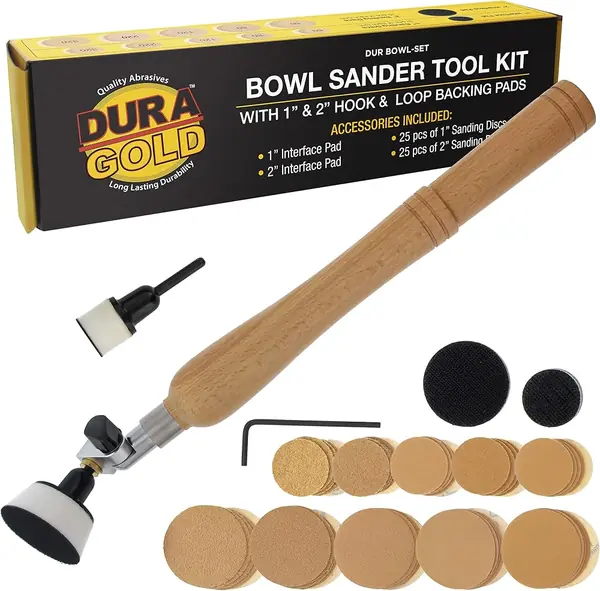
The sandpaper is only half the story here: the kit includes a dual-bearing sanding head, a hardwood handle, 1-inch and 2-inch hook-and-loop backing pads, soft interface pads, and 50 discs from 60 to 320 grit. That makes it a bowl-sanding tool rather than a roll of abrasives, and it is aimed at the convex and concave curves of bowls and platters on the lathe.

We found the angled head easier to control inside a bowl than a bare pad, and the two bearing surfaces let the mandrel spin freely without fighting the drill. The 1-inch pad gets into smaller curves while the 2-inch pad covers more area, which is a useful pair on a single bowl. The 60- through 320-grit discs handle shaping and smoothing, and the soft interface pad adds a little cushion on the surface.

Inside a bowl, the handle lets you keep both hands on the tool instead of chasing a loose pad, and the 1-inch pad reaches the bottom transition where the 2-inch disc cannot. The discs are sized for the backing pads in the kit, so there is no guessing about compatibility. For a turner who already owns a finishing roll, this fills the harder job: getting a consistent surface inside a bowl without burning through the walls.

Against the roll sets here, this is the only pick that brings a handle and backing pads, and that is why it stays in the roundup. It is not the first purchase for pen blanks or flat work; it is the tool for the inside curve that wears out your fingers. We think it earns its place for bowl work, where its handle and pads do what a loose sheet cannot.

Worth Noting

  • Discs stop at 320 grit
Our Verdict

We like this kit for the last hard-to-reach passes inside a bowl, where a bare pad struggles.

Check Latest Price

How We Tested Sandpaper at the Lathe

We started by mapping the forms abrasives actually come in — 1-inch cloth and mesh rolls, 2-inch hook-and-loop discs, and foam-backed pen pads — then filtered by backing material, roll length, grit range, whether the dispenser had a built-in cutter, and cost per foot. Anything that only existed in a form we couldn't use at the lathe or the pen bench didn't make the shortlist; 16 units did.

For four months we sanded three or four sessions a week: green bowl blanks and resinous exotics on the lathe, spindle work, and CA and acrylic pen finishes at the bench. Eye protection, a fitted respirator, and dust collection were on for every session, and we kept light pressure with hands and strips clear of the spinning work. We counted how many passes a strip made before it stopped cutting, whether dust fell away when we rapped it against the bed, and how warm the wood got under our fingers after a light pass.

Discs were pressed onto bowl-sander pads and run at speed to see whether the hook-and-loop held or crept, and we tracked how many discs a bowl interior ate from coarse grit up. Cloth edges were checked for fraying, dispenser cutters were used one-handed at the bench with the lathe stopped, and every grit's scratch pattern was read under raking light before we moved up. Pen pads were judged on whether they conformed to a round blank without the edges digging in.

Last, we worked out what a roll or kit really costs per foot and how often we'd have to restock, which is where value and durability separate from a good first impression.

How to Choose Sandpaper for Wood Turning

Pick the Form Before the Grit

The shape of the abrasive decides how much control you have. A 1-inch cloth or mesh roll is the traditional choice for hand sanding because you can tear a short strip, wrap it around a spindle, and throw it away when the grit dulls. A 2-inch hook-and-loop disc fits a bowl-sander pad and reaches inside a form where fingers cannot. Foam-backed pads are for the last, small-area polish on pens and stoppers.

Match the form to the tool you already own. The MAXMAN discs are useful only if you have a 2-inch backing pad and mandrel; a 1-inch bowl sander needs a different disc. For hand work, the Peachtree and Fulton rolls are ready to use with no pad at all. Buy the form you can hold comfortably before you chase a wider grit range.

Build a Grit Sequence That Reaches the Finish

Woodturning sanding usually starts where the tool left off, not at the same grit for every blank. A rough blank with tear-out needs an 80 or 120 grit to level the surface; a clean spindle can start at 150. From there, step through 240, 320, 400, and 600 without skipping so far that the previous scratch pattern survives.

A full-range set such as the Pukamam or HL-YMXQ takes you from 80 to 600 in one box, while the Peachtree and DCT packs begin at 150 and assume the shaping is done. Neither approach is wrong; they answer different starting points. If you turn rough blanks often, the coarse rolls are worth having on hand even if you do not use them on every project.

Choose Cloth or Mesh for Curves

Cloth backing is what lets a narrow strip follow a curved surface without cracking or tearing at the fold. Emery cloth, the traditional name for cloth-backed abrasive, is still a useful label to look for, but check the backing description rather than the name alone. Mesh does the same job with an open structure that lets dust pass through, which helps on resinous or dusty woods.

Paper-backed rolls can work for light touch-up, but they are less forgiving when a corner catches on a spinning blank. We prefer cloth for general lathe work and mesh when loading is the main frustration. The Fulton mesh set is the specialist here; the Peachtree and Pukamam cloth rolls are the all-around choice.

Watch How the Abrasive Loads

Loading happens when dust and resin fill the spaces between the grit particles, and the abrasive starts polishing instead of cutting. Open mesh resists this better than a closed cloth or paper surface, but technique matters too. Light pressure and constant movement keep the strip from heating the wood and packing the grit.

If a strip starts to skate, stop and clear it rather than pressing harder. A clean backing pad matters just as much with hook-and-loop discs; dust on the pad lets the disc creep and cuts unevenly. For a bowl interior that clogs ordinary paper, the Fulton mesh roll or the MAXMAN discs are the picks to try first.

Match the Dispenser to Your Sanding Rhythm

A dispenser box is not a gimmick when you are changing grits every few minutes. Five or six rolls in separate slots let you pull a short length and tear it off without unrolling a whole coil, and a built-in cutter saves a trip to the scissors. The DCT pack is the most convenient for pen work because the blade is right on the box.

Roll length matters more than box size. A 20-foot roll lasts through several projects, while a shorter roll may run out in the middle of a bowl. If you sand only occasionally, a small set is easier to store; if you turn every week, buy the longer rolls and keep the dispenser where you can reach it.

Frequently Asked Questions

Final Verdict

Peachtree's five-roll set is the one we recommend first for most lathe work: 20-foot cloth rolls, a sensible 150-to-600 progression, and a dispenser that keeps the sequence together. If your sanding happens inside bowls, add the MAXMAN 2-inch discs and a matching pad; for dust-heavy woods, the Fulton mesh roll is the better choice. Match the abrasive to the reach, and the finish gets easier.