↑↓ navigate ↵ open Esc close All results →

Best Wet/Dry Sandpaper of 2026

Dunking a sheet of wet/dry sandpaper into water changes how abrasion behaves: the backing holds together, sanding dust turns into a clean slurry instead of packing into the grit, and the surface flattens smoothly under hand pressure. Keeping the abrasive open lets a single sheet keep cutting long after dry paper would have glazed over.

Four months of wet and dry sanding across dressers, varnished bookshelves, a car hood, and a brass lamp with 15 packs showed that sheet dimensions matter nearly as much as grit quality. A 3-2/3 x 9-inch sheet drops straight onto a quarter-sheet sander with no trimming, while total pack counts often mislead—what counts is having enough sheets in the grits that actually wear out first.

Inconsistent grit grading can also derail a finish, since two sheets stamped 400 do not always leave the same scratch pattern. From coarse stock removal up through final polishing, these eight assortments stay legible when wet, resist tearing, and cut predictably across the full grit ladder.

Our Top Picks

The Best Wet/Dry Sandpaper

1.

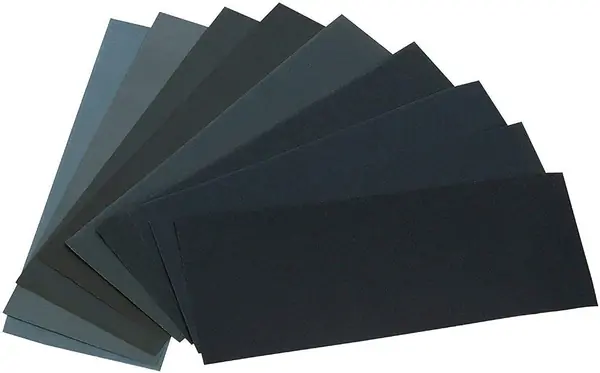
Dura-Gold 50-Sheet Wet/Dry Assortment Best Overall
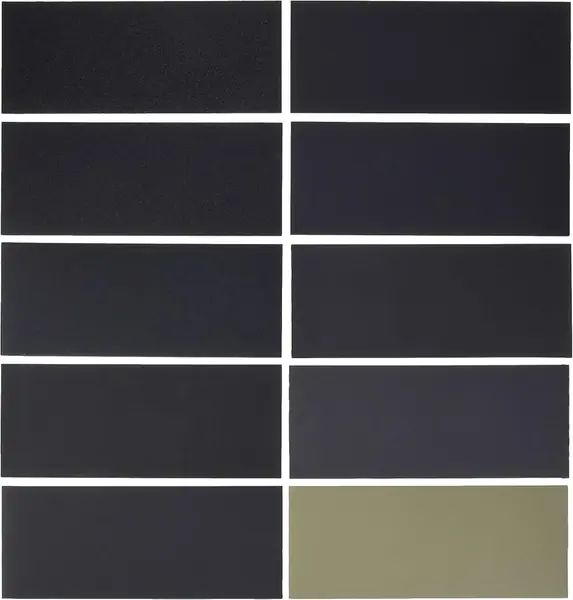
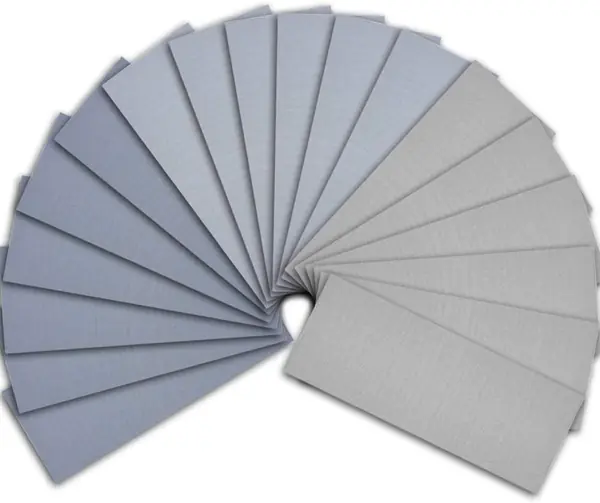
Dura-Gold assorted wet and dry sandpaper strips in ten grits, 50-sheet box

Mixed-shop refinishing

Shop Score 97/100
Sheet Size
3-2/3 x 9 in
Grit Range
150 to 3000 (10 grits)
Sheets Per Grit
5
Backing
Waterproof paper
View on Amazon

Ten grits, five sheets each, in one box: 150 and 220 for taking a finish down or flattening a repair, 320 and 400 for the last passes before stain or color, then 600 through 3000 for the polishing stages most of us end up buying separately. The sheets are the size that clamps into a hand block without trimming, so the whole ladder works by hand or under a pad sander.

We paid close attention to how the coarse end behaves, because 150 and 220 will crack if you fold them hard over a sharp edge. Wrapped around a block instead of creased, they hold together fine, and the grit stays put through a long wet pass. The fine grits are where we were pleasantly surprised: a 1500 sheet keeps cutting and shedding its slurry instead of glazing over, which is what lets one sheet finish a drawer front.

As a single purchase for a mixed shop, this is the pack we recommend first. Nothing else here spreads five sheets across ten grits from the leveling stages to the polish, and the backing survives water well enough that you aren't rationing the fine end. The paper is plain-backed rather than pressure-sensitive or hook-and-loop, so it clamps, wraps or clips, with no adhesive to peel.

If your work never goes below 600, the 3M Wetordry pack is the sharper tool. If you want the polish end on a shoestring, the Atosun assortment reaches 5000 for very little money. For everything in between — a table, a door, a fender, a set of shelves — this is the box we keep on the shelf.

Worth Noting

  • Nothing coarser than 150 grit for stripping
Our Verdict

Our pick for most shops: ten grits from 150 to 3000 with five sheets at every step, so one order covers leveling, prep and the final polish, and the waterproof backing lasts through wet work.

Check Latest Price
2.

3M Wetordry 03006 Assorted Grit Best for Auto Body Clear Coat

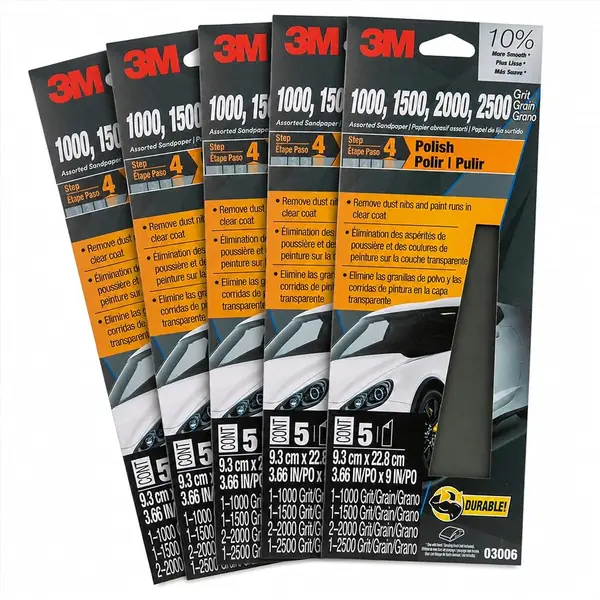
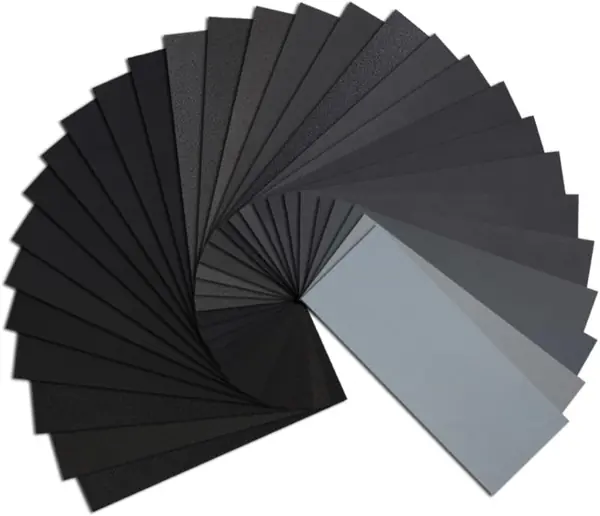
3M Wetordry sandpaper sheets in black silicon carbide, 25 sheets of 1000 to 2500 grit

Clear coat repair

Shop Score 96/100
Sheet Size
3 2/3 x 9 in
Grit Range
1000, 1500, 2000, 2500
Sheet Count
25
Backing
Waterproof A-weight paper
View on Amazon

A run in the clear, a dust nib on a fender, a patch of orange peel across a hood: the repair is always the same sequence, and it starts with 1000 grit. This pack is built around that sequence — five sheets each of 1000, 1500, 2000 and 2500, cut to 3-2/3 by 9 inches for a block or a hand pad.

The mineral is the difference we noticed. Silicon carbide that self-fractures keeps exposing fresh edges instead of glazing over, so the scratch pattern stays even across a panel you'll be examining in daylight, and stepping from 1500 to 2000 actually removes the previous scratches instead of polishing them in. The A-weight paper is thin enough to follow a character line, and we were also impressed by how little it loaded when worked wet.

Work the defect in one direction, then turn ninety degrees at the next grit so you can see when the old scratches are gone. That habit pays off on this paper, because the cut is consistent enough to read.

Worth Noting

  • Four fine grits only, nothing below 1000
Our Verdict

When the finish is visible, this is the paper we reach for — a tight 1000-to-2500 range whose even cut lets you see what the last grit actually did.

Check Latest Price
3.

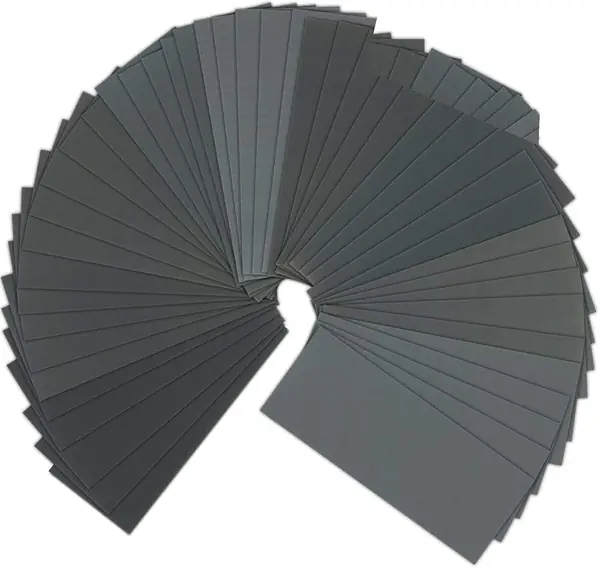
Atosun 45-Piece Wet/Dry Assortment Best Budget Assortment

Atosun wet dry sandpaper sheets, 45 assorted silicon carbide pieces from 120 to 5000 grit

Budget all-round sanding

Shop Score 95/100
Sheet Size
9 x 3.6 in
Grit Range
120 to 5000 (15 grits)
Sheet Count
45
Abrasive
Silicon carbide
View on Amazon

Fifteen grits from 120 to 5000, three sheets of each. Nothing else on this page covers as much of the ladder, and nothing else covers it for so little. That's why we send value-minded shoppers here: 120 and 150 strip a finish, the 240-to-400 middle does the leveling, and the 1000-to-5000 tail handles polishing.

The mix leans toward the top of the range. Three sheets each of 2000, 2500 and 3000 sit in the box for a long time, while the 240 and 320 you burn through on a tabletop or a car panel disappear first. If most of your work is stock removal and finish prep, a pack with more mid grits pays off; if you polish, this gets you the whole range at once.

The 9-by-3.6-inch sheets have a soft backing that grips a hand block well, and they cut cleanly with scissors, so quartering one for a small repair is easy. For a first assortment, or a spare kit that lives in the truck, it's a straightforward buy.

Worth Noting

  • Ultra-fine grits wear through quickly
Our Verdict

We point bargain hunters here first: fifteen grits from 120 to 5000 in one cheap pack, as long as you accept that the fine sheets wear out.

Check Latest Price
4.

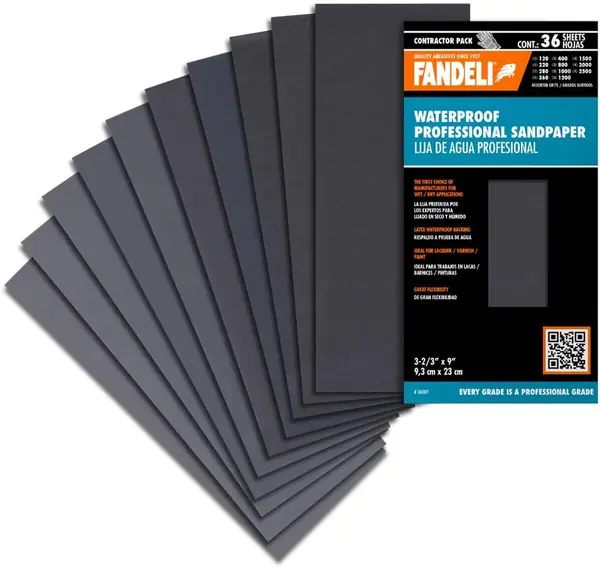
Fandeli Waterproof Sandpaper Assortment Best for Wood Finishing

Fandeli waterproof sandpaper sheets in assorted grits, 36-sheet pack for hand sanding

Furniture finishing

Shop Score 94/100
Sheet Size
23 x 9.1 cm
Grit Range
120 to 2500
Sheet Count
36
Abrasive
Silicon carbide
View on Amazon

Most assortments here jump from 220 or 240 straight to 320. This one goes 220, 280, 360, 400 — the in-between steps that decide whether a tabletop reads flat under a raking light, and the ones we end up buying separately when a pack skips them.

The sheets are 23 by 9.1 cm, a hand-sanding strip you wrap around a block or fold into thirds, and the backing is the sturdy part: it resists tearing through long passes and keeps its grit when wet, which is the first thing to fail on cheap paper.

What we like most is the restraint of the selection. Thirty-six sheets in a sequence you'll actually follow beats ninety sheets of a sequence you have to work around, and from 120 up to 2500 this one covers leveling a glue line through the last pass before finish. For furniture and cabinet work, that's the ladder.

Worth Noting

  • Three sheets per grit goes fast
Our Verdict

Furniture and cabinet work is where we get the most out of this pack, thanks to the 280 and 360 steps and a backing that won't tear mid-pass.

Check Latest Price
5.

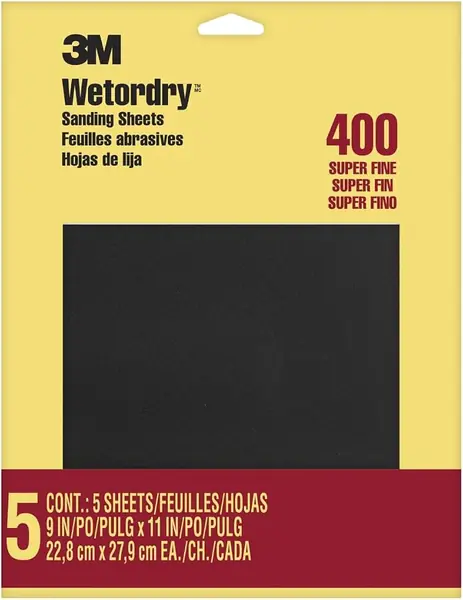
3M Wetordry 400-Grit Sheets Best Single-Grit Sheets

3M 400 grit wet or dry sandpaper sheets, five 9-by-11 inch waterproof sheets

Between-coat sanding

Shop Score 93/100
Sheet Size
9 x 11 in
Sheet Count
5
Backing
Waterproof paper
Grit
400, super fine
View on Amazon

Nine by eleven inches is the old full-sheet size, and it's why we keep a pack in the drawer: cut it for a quarter-sheet sander, fold it into thirds for a hand block, or tear off a strip for a curve. The 3-2/3-inch strips in the assortments are already sized for you; a full sheet lets you decide.

Four hundred grit is the step we reach for between coats of varnish and lacquer, and this paper takes that work without drama. Soak it, work it wet, and the sheet comes out in one piece with grit still cutting. That's the whole test for between-coat paper, and the cheap sheets here fail it at the corners first.

Worth Noting

  • Five sheets per pack run out fast
Our Verdict

Full 9-by-11 sheets in 400 grit cut to any block, and they come out of a soak still cutting — that's why we buy these for between-coat work.

Check Latest Price
6.

VERONES 90-Piece Sandpaper Set Best for Bulk Fine Finishing

VERONES sandpaper set, 90 silicon carbide sheets in nine grits from 400 to 3000

Bulk fine finishing

Shop Score 92/100
Sheet Size
8.85 x 3.54 in
Grit Range
400 to 3000 (9 grits)
Sheet Count
90
Sheets Per Grit
10
View on Amazon

Ninety sheets, ten of each grit from 400 to 3000. Anyone who has run out of 1500 three-quarters of the way through a rub-out will recognize the appeal: the top of the ladder is where sheets vanish, and this pack buys that end in bulk.

There's nothing below 400 in the box, which makes it a finishing kit rather than a sanding kit — pair it with a coarse assortment and you have the whole range while spending your money where sheets actually go. Expect the numbers to cut mildly, too: a 1000 here behaves closer to a 1200, which is right for polishing a curve and not what you want for leveling a ridge.

Two practical notes from the bench. The sheets carry no grit marking we could rely on, so keep them in order or label the backs yourself before the stack gets shuffled. What we liked is how well the grit stays bonded when wet — no shedding, no bare patches after a long pass.

For someone who finishes a lot of small pieces — pens, knife scales, castings, guitar parts — ninety sheets of the fine end beats five small assortments that keep running dry at 1200.

Worth Noting

  • Backing can soften during long wet passes
Our Verdict

We think this is the better buy for anyone who polishes more than they strip: ninety sheets of the 400-to-3000 end, not five small assortments.

Check Latest Price
7.

HSYMQ 24-Piece Sandpaper Variety Pack

HSYMQ assorted sandpaper sheets, 24 pieces in 12 grits from 120 to 3000

Starter kit

Shop Score 91/100
Sheet Size
9 x 3.6 in
Grit Range
120 to 3000 (12 grits)
Sheet Count
24
Sheets Per Grit
2
View on Amazon

Twenty-four sheets, twelve grits, two of each, from 120 through 3000 — the smallest and least expensive pack here. As a way to find out which grits you actually use, it makes sense: you aren't buying ten sheets of 2500 to discover you needed 320.

The sheets are 9 by 3.6 inches, which cuts down easily for a detail block or a curved form. If you're used to a full 9-by-11 sheet in the hand, this strip will feel short, and on a pad sander you'll be trimming and clamping rather than clipping.

Where this pack shows its price is wear on hard surfaces. On dried joint compound or cured epoxy a sheet is spent quickly — the abrasive loads and stops cutting rather than wearing down gradually. Keep a few for that work if it comes up, and don't count on one sheet carrying a whole tabletop.

For a first assortment, a second kit for the garage, or a set to hand someone learning to sand, the buy-in makes it easy to say yes. For a full refinish with a deadline, buy heavier paper and accept the higher price.

Worth Noting

  • Two sheets of each grit
Our Verdict

We suggest this as a first assortment: 12 grits and 24 sheets to learn what you use, at the lowest buy-in on this page.

Check Latest Price
8.

AUSTOR High Grit 3000/5000/7000 Best for Final Polishing

AUSTOR high grit wet and dry sandpaper sheets in 3000, 5000 and 7000 grit

Final polishing

Shop Score 90/100
Sheet Size
9 x 3.6 in
Grit Range
3000, 5000, 7000
Sheet Count
18
Sheets Per Grit
6
View on Amazon

3000, 5000 and 7000 grit are polishing numbers, not sanding numbers: you reach for them once the surface is already flat and you want it bright. Six sheets of each, 18 total, is a practical way to buy that last stage, and we like this pack for what it doesn't pretend to be — there's no coarse paper here to dilute the point.

The numbers are where the pack gets loose. Ultra-fine sheets at this price don't always cut like their label, and a 3000 that scratches like a 600 undoes the step before it. Test a corner of each sheet on scrap before you commit a finished surface to it.

Used with water on stone, resin, knife steel or lacquered wood, they do deliver a mirror, and one sheet goes a long way at this grit because so little material comes off. Not the pack to start a project with; the pack to end one.

Worth Noting

  • Grit ratings vary from sheet to sheet
Our Verdict

We reserve this one for the last stage: 3000, 5000 and 7000 grit for a mirror finish, with a test pass on scrap first.

Check Latest Price

How We Tested Wet/Dry Sandpaper

We started with every wet/dry assortment we could find that ran from coarse stock-removal grits up into the polishing range, then narrowed by sheet size, how many sheets of each grit came in the pack, and whether the grit number was printed on the back of the sheet. That left 15 packs, which we bought ourselves and worked through over four months of real projects.

We trimmed sheets to fit a quarter-sheet pad sander and a cork sanding block and set to work on dresser drawers, oak offcuts, a brass lamp base, and a car hood — dry first, dust mask on, then wet by hand at a bench with a GFCI-protected outlet and a spray bottle. At each step we noted how fast a sheet loaded and went slick, whether a wet sheet stayed put on the block or slid out from under our fingers, and what scratch pattern each grit left under a raking light.

For the backing, we soaked a sheet from every pack in a tray of water for twenty minutes, then rubbed it across scrap painted pine to see whether the edges furred, curled, or separated. We checked whether the number on the back survived the soak and a full sheet's worth of sanding, and put a labeled 400 from one pack against a labeled 400 from another on the same board to compare cuts and grit shedding. We also counted how many sheets each job actually burned through, so we could weigh cost per usable sheet against how quickly a given paper wore out.

The picks are the sheets that stayed flat and legible after soaking, held their cut with and without water, and had grit left when the job was done.

How to Choose Wet/Dry Sandpaper

Match the grit ladder to the job

Grits work as a sequence, not a menu. Jumping from 120 to 400 leaves scratches the next grit can't lift, so step roughly by halving the scratch depth — 120, 180, 240, 320, 400 — rather than doubling up at the top. Refinishing a table needs coarse and mid grits in quantity; polishing a resin casting needs almost none of the coarse and plenty above 1000.

Count the sheets per grit before you buy any assortment. A 90-sheet pack with ten sheets each of 1200 and 2000 and two of 240 is a polishing kit, not a sanding kit, and you'll be buying the middle separately.

Sheet size and what it fits

Most wet/dry paper comes as 9-by-3.6-inch strips, sized to clamp into a hand block or a pad sander without trimming. A full 9-by-11 sheet gives you the choice — cut it for a detail sander, fold it for hand work, wrap it around a dowel for a curve — at the cost of doing the cutting yourself.

Measure the pad before you order. A strip narrower than your sander's clamps will pull loose mid-pass, and a full sheet cut badly wastes more than it saves.

What water does to the paper

Wet sanding keeps the abrasive from loading with dust, cuts the airborne particles, and leaves a finer scratch pattern on finishes and metal. It also punishes cheap paper: the backing softens, the grit shell separates, and a sheet that felt fine dry falls apart in a bucket.

Look for silicon carbide on waterproof paper. A-weight paper is thin and conforms to curves; heavier C-weight backing holds up better on flat panels and machine work. Soak one test sheet for a few minutes before you commit a whole pack.

Grit accuracy and where to spend

The number printed on the back is a claim, not a measurement. Inexpensive sheets in the fine range sometimes cut coarser or finer than their label, and that matters most at the last step before finish, where a single stray scratch shows. Test a new sheet on scrap and work in one direction so you can read the scratch pattern you're making.

Spending more buys consistency and backing life rather than a better grit — worth it on a visible clear coat, rarely worth it on a deck rail. Assortments are cheaper per sheet; single-grit packs are how you restock.

Frequently Asked Questions

Final Verdict

Our pick for a shop that does a bit of everything is the Dura-Gold 50-sheet assortment: 150 through 3000 with five sheets at every step covers refinishing, paint prep and the final polish without a second order. Take the Atosun pack instead when range matters more than longevity and the budget is tight.

And when the job is a visible clear coat, the 3M Wetordry 1000-to-2500 pack is the one that keeps the scratch pattern honest enough to read.