↑↓ navigate ↵ open Esc close All results →

Best Wood Grain Fillers of 2026

Sanding an open-pored board like oak until it feels glassy does nothing to close the pores—the first wipe of stain still drinks unevenly and dries into a blotchy surface. Smooth finishing demands filling those pores flat, a job often confused with patching deep gouges, nail holes, and chipped corners.

Grain filling and gouge patching are distinct jobs, and six months of testing 14 water-based pastes, acrylic latex compounds, two-part epoxies, and kneaded putty sticks on oak, pine, door casing, and an exterior windowsill proved how rarely one formula excels at both. Spreadable grain fillers level open pores cleanly across broad tabletops yet lack the body to hold in deep structural gouges.

Spanning full-panel tubs through pocket-sized putty sticks for stray dings, these eight formulas sand flush without tearing and accept stain or clear topcoats without turning muddy.

Our Top Picks

The Best Wood Grain Fillers

1.

GoodFilla Wood and Grain Filler Best Overall
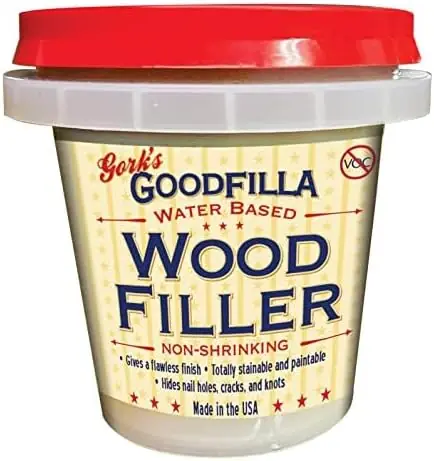
GoodFilla wood and grain filler in an eight-ounce can of white oak putty

Open-grain interior wood

Shop Score 95/100
Container Size
8 oz
Base
Water-based
Color
White Oak
Full Cure
24 hours
View on Amazon

Open-grain oak and ash are where most fillers fall down. You work a skim coat across the panel, sand it back, and half the pores are still open. GoodFilla is the one here built for that job first and for holes second. Spread thin with a knife and sanded flush, it left us a pore-free, table-flat surface that took a clear finish without a pale halo ringing the repair. It is the filler we hand to anyone finishing a tabletop, cabinet doors or a floor on their own.

The body is the reason it works on grain. It is water-based, so a splash of water takes it from a stiff paste for a knot hole down to a slurry you push into pores with a squeegee. Any stain, dye or pigment mixes straight into the tub, and this listing is the White Oak tone, sold alongside a range of other wood colors. Best of all, a tub that stiffens between projects comes back with water and a stir. That single property saves more half-used filler than anything else we have tried.

Know the boundaries. This is not a water-resistant filler, so keep it indoors or under a solid topcoat rather than on a wet exterior sill. Deep cavities also go better in two thin passes than one thick one, since a heavy blob skins over while the middle stays soft; sand between passes and the second coat flattens faster than fighting a lump.

Worth Noting

  • Eight-ounce tub runs out on large panels
Our Verdict

We recommend GoodFilla as the default grain filler for bare interior wood: it thins into pores, sands flush, tints to match, and revives with water.

Check Latest Price
2.

DAP Premium Wood Filler Best for Color Matching

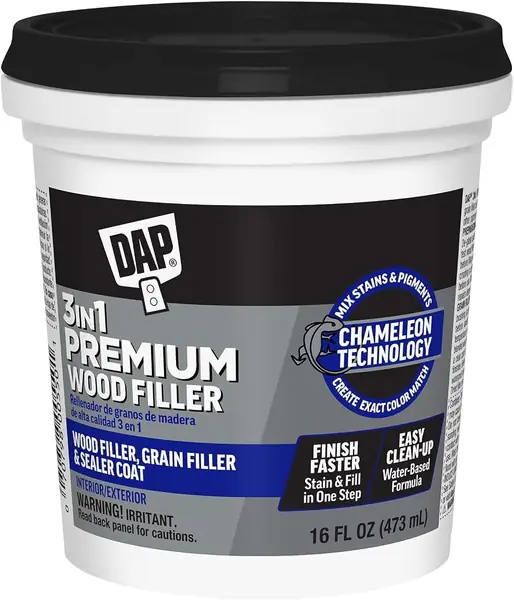
DAP Premium Wood Filler in a sixteen-ounce white tub for grain filling

Color-matched visible patches

Shop Score 94/100
Container Size
16 fl oz
Base
Acrylic latex
Color
White
Sandable In
2 to 4 hours
View on Amazon

Most fillers ask you to fill now and hope the stain matches later. DAP Premium reverses that order. Stain, dye or pigment gets mixed into the wet filler, so the color goes on with the patch instead of over it. It is a three-in-one product — filler, grain filler and sealer coat — built on a white acrylic base with a stiff, knife-grade body.

That color-blend trick is what earns it a place here. On a repair in the middle of a visible panel, matching the wood rather than tinting a pale spot afterward is the closest thing to a disappearing patch in this group, and the sixteen-ounce tub goes a lot further than the small putty tubes. It also holds its shape on a corner or a vertical face instead of sliding off, which is more than most tub fillers manage.

The cost is commitment. You have to choose the color before it dries, and a white base needs a serious amount of pigment to go dark, so mix a test smear on scrap from the same board first. The stiff body wants a wet knife to spread thin, and you are waiting two to four hours before sanding — slower than the fast-dry fillers, quicker than the epoxies.

Worth Noting

  • White base needs heavy tinting for dark woods
  • Two to four hours before it is sandable
Our Verdict

We reach for DAP Premium when the patch will sit in plain sight: blending stain into the wet filler gets closer to the surrounding wood than staining afterward.

Check Latest Price
3.

PC-Woody Wood Repair Epoxy Paste Best for Rotted and Exterior Wood

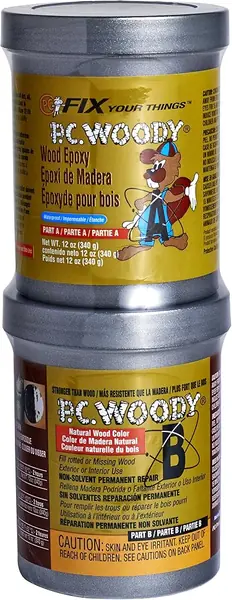
PC-Woody two-part epoxy paste in two tan twelve-ounce cans

Rotted exterior wood

Shop Score 93/100
Container Size
12 oz, two cans
Full Cure
24 hours
Mix Ratio
1:1 by volume
Service Temperature
-20 to 200 degrees F
View on Amazon

PC-Woody is not a grain filler and does not pretend to be. It is a two-part epoxy paste for wood that has gone soft, crumbly or missing — a sill end, a door bottom, a window frame a screwdriver sinks into. You mix equal volumes from the two cans on a flat scrap with a putty knife and pack it into the cavity.

The working time is the reason to choose it for a large repair rather than a small one. It stays shapeable long enough to fill, sculpt and clean the edges without racing the cup, and the high tack keeps it from sagging on a vertical sill or an overhead soffit. Once cured it drills, taps and holds a hinge screw, which is more than any of the water-based fillers here can claim.

It is also sticky, and that is the tax. It grabs gloves, tools and fingers, so keep a rag and a scraper within reach and work in short pushes instead of long drags. Light stains do not cover it well — the maker's own guidance is to go dark or heavily pigmented — so on painted exterior trim that costs you nothing, and on a stained piece it is a reason to pick a different filler.

Worth Noting

  • Sticky paste fights gloves and putty knives
  • Light-colored stains disappoint on exposed patches
Our Verdict

For soft, rotted or missing wood, PC-Woody is the epoxy we trust: it hangs on a vertical sill, cures hard enough to drill, and takes paint or a dark stain.

Check Latest Price
4.

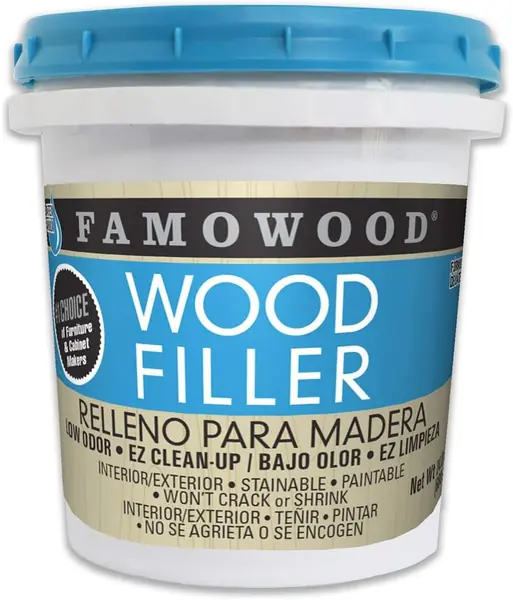
Famowood Water-Based Latex Wood Filler Best for Fast, Large-Area Work

Famowood water-based latex wood filler in a natural-color one-pint can

Large fast repairs

Shop Score 92/100
Container Size
1 pint
Base
Water-based latex
Use
Interior and exterior
Dry Time
15 minutes
View on Amazon

Fifteen minutes is the whole pitch. Where our top pick asks you to tint it and work it into pores at your own pace, Famowood's water-based filler skins up fast enough that you can fill, sand and recoat in one sitting. It comes in a pint, it is solvent-free, and it cleans up with water.

On a run of cabinet doors or a floor with a hundred small gaps, that speed is worth more than any subtlety. It spreads creamy, sands to a powder rather than gumming the paper, and it can be drilled and planed afterward. We kept coming back to it on anything with a long list of small defects, because a filler you can sand in the same hour changes the shape of the day.

Two things to watch before you commit. The natural shade has a pink cast straight out of the container, so buy a wood tone or tint it if the piece is going to be seen. And stain matching is the weak spot — the patch can dry darker or lighter than the surrounding wood, so test on scrap from the same board instead of trusting the stain to hide the repair. It is labeled for exterior use, but on a deck that stays wet, topcoat it and expect to revisit.

Worth Noting

  • Natural shade has a pink cast before finishing
  • Stain does not reliably match the patch
Our Verdict

Famowood is the filler we reach for when the job is big and the clock is short: it dries in about fifteen minutes and sands within the same session.

Check Latest Price
5.

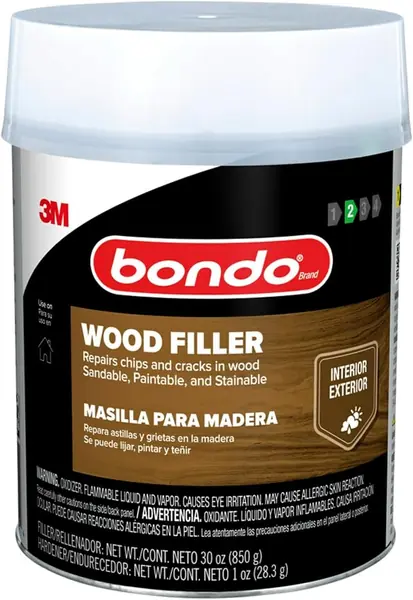
Bondo Wood Filler Best for Hard, Permanent Repairs

Bondo two-part wood filler quart with a tube of cream hardener

Hard structural repairs

Shop Score 91/100
Container Size
30 oz with 0.5 oz hardener
Sandable In
15 minutes
Type
Two-part resin
Stain Or Paint
25 minutes
View on Amazon

The first thing you notice is the clock. Squeeze the cream hardener into the resin, stir until the color is even, and you have only a few minutes of spreadable life before the batch starts to pull. Mix small. A golf-ball-sized scoop goes further than it looks, and a full tub mixed at once is a batch you throw away.

What you get for that hurry is hardness. Cured Bondo does not shrink, does not dent under a thumbnail, and sands to a featheredge under a random orbital. It is the filler we hand out for a rotted sill end, a window frame, a fence post, a kicked-in door edge — anything that has to stay hard through weather.

Finishing is where it needs a decision. Paint sticks beautifully to it. Stain is another matter, because the cured resin is denser than wood and does not take pigment the way surrounding grain does, so on stained work test a patch on scrap and plan to seal over it.

That leaves it as the toughest repair in this group and the least fussy about weather, and as the wrong tool for filling pores: too thick to enter them, too fast to spread across a panel. If your project is a finish-grade surface, take one of the water-based fillers. If it is a repair that has to survive a winter, take this one.

Worth Noting

  • Fast set leaves little time to spread
  • Not the filler to use under stain
Our Verdict

When a repair has to be hard, permanent and paint-ready, Bondo is what we use: a two-part resin that sets in minutes and refuses to shrink, indoors or out.

Check Latest Price
6.

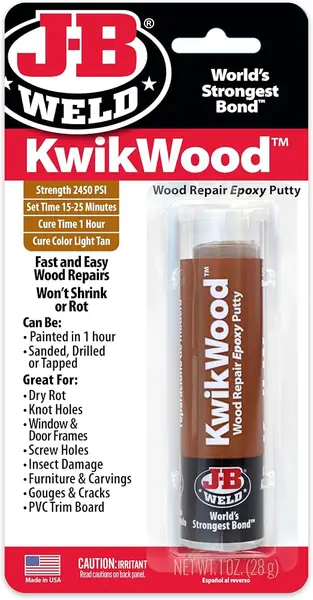
J-B Weld KwikWood Epoxy Putty Best Putty Stick for Quick Fixes

J-B Weld KwikWood tan epoxy putty stick in a one-ounce tube

Small quick fixes

Shop Score 90/100
Color
Tan
Full Cure
1 hour
Size
1 oz stick
Work Life
15 to 25 minutes
View on Amazon

There is no tub to dry out and no board to mix on. KwikWood is a putty stick: slice off a coin, knead it in your fingers until the color is uniform, press it into the damage, and pare the excess with a knife before it sets. That format is why it is the one we keep within reach rather than boxed up with the tubs.

For a chewed windowsill, a stripped hinge-screw hole or a gouge in a painted door frame, it is the fastest route from damage to a paintable surface. It holds its shape on a vertical edge instead of sliding, cures hard within the hour, and takes a drill and a screw without crumbling.

The limits are quantity and time. A one-ounce stick covers a handful of small repairs and no more, and the work life is short — knead it, place it and be done, because a piece you keep fiddling with starts to drag and pick up grit. For a large rotted section, step up to PC-Woody; for pores and panel work, none of the epoxies are the right answer.

Worth Noting

  • One-ounce stick covers small repairs only
  • Short work life punishes fiddling
Our Verdict

For a chewed sill, a stripped screw hole or a gouge in trim, we reach for the KwikWood stick: knead, press, and it is sandable within the hour.

Check Latest Price
7.

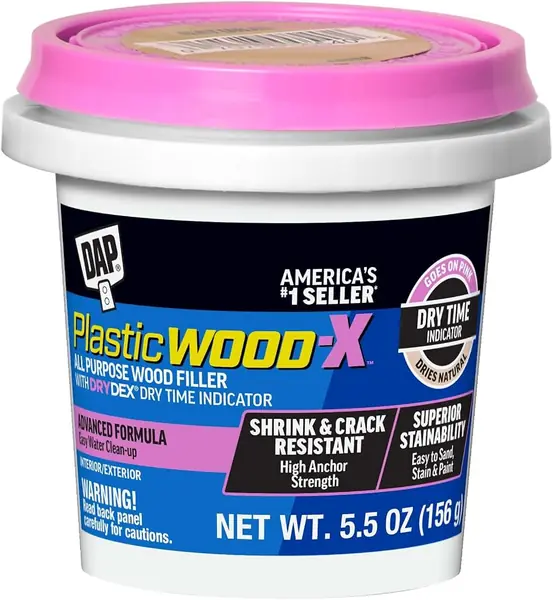
DAP Plastic Wood-X with DryDex Best for Trim and Vertical Surfaces

DAP Plastic Wood-X natural wood filler in a small round tub

Trim and nail holes

Shop Score 89/100
Container Size
5.5 oz
Base
Latex
Use
Interior and exterior
Color Indicator
Pink to natural
View on Amazon

Pink is a strange color for wood filler until you have spent a morning crouched over a row of brad holes. Plastic Wood-X goes on pink and dries to a natural tan, so you can see exactly which holes you have filled and, more usefully, which ones are ready for paper.

The body is thick and knife-grade, which is what you want on vertical casing and door trim: it stays where you put it instead of sliding down the face. Brad holes and small dents fill in a single pass, and it sands smooth without the fuzzy edge you get from softer fillers.

For trim, casing and painted built-ins, this is our pick of the group. The indicator saves a second walk around the room, and the stiff body means less cleanup on the face of the trim. It is not a grain filler and is not meant to be, deeper gouges have to go in layers, and the tub is small — buy for the job in front of you rather than the one you might start next spring.

Worth Noting

  • Small tub covers trim work only
  • Deep fills need a day and a half to dry
Our Verdict

For nail holes and casing, the pink-to-natural indicator on DAP Plastic Wood-X tells you when to sand, and the stiff body stays put on vertical trim.

Check Latest Price
8.

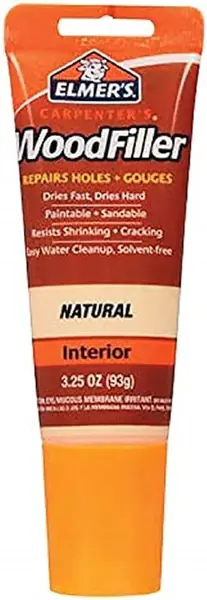
Elmer's Carpenter's Wood Filler Best for Budget Interior Touch-Ups

Elmer's Carpenter's Wood Filler in a 3.25-ounce natural squeeze tube

Budget interior touch-ups

Shop Score 88/100
Color
Natural
Use
Interior only
Size
3.25 oz
Dry Time
12 to 24 hours
View on Amazon

It costs the least of anything here, and for a certain job that is the entire recommendation. Elmer's is a small squeeze tube of thick, water-based paste for nail holes, hairline cracks and small dents in interior woodwork that is going to be painted.

The pointed tip is genuinely handy for getting filler into a nail hole without smearing the trim, and the paste is thick enough not to run down a vertical face. It knocks down easily with paper and leaves a smooth, paintable surface — we got a clean, flat patch without much work at all. The label allows twelve to twenty-four hours before sanding, so plan it as an overnight step rather than a same-hour one.

The tube is the weak point. Ours stiffened between sessions, and once that happens there is no bringing it back, so buy it for a job you will finish in one sitting rather than for the drawer of odds and ends.

That makes it a paint-grade filler, full stop — and judged on that, it earns its spot. Under a coat of paint, the tube does what the fancier fillers do at a price that makes it easy to keep one on hand.

Worth Noting

  • Interior use only, not for exterior repairs
  • Stain can wipe off the cured patch
Our Verdict

Elmer's is the tube to keep for painted interior trim and nail holes: cheap, easy to sand, and honest about being a paint-grade fix.

Check Latest Price

How We Tested Wood Fillers on Real Projects

We built the shortlist by pulling every wood filler we could find and sorting them by what they actually are: water-based paste, acrylic latex, two-part epoxy, and kneaded putty sticks, split again by interior-only and exterior-rated formulas. Price per ounce went into that sort too — a small tube and a big tub tell you nothing until you know how far an ounce spreads over open grain. Fourteen fillers made the cut, and we spent six months with them.

Most of the work happened on a reclaimed white oak tabletop with wide-open grain and a stack of pine boards. We spread each filler thin with a plastic card, let it cure, then sanded flush with 220-grit and counted how quickly the paper loaded up — some clogged within a few passes, others cut clean and feathered into the surrounding wood. We noted whether filler pulled back out of the pores under the sander. Working time got timed on a scrap dollop, and once cured we pressed a thumbnail into each patch and dabbed stain and clear coat over it to see whether the color took evenly or wiped away.

Hole and trim work got its own round: nail holes in door casing and baseboards, where we watched for sagging on vertical surfaces, and a rotted corner on an exterior windowsill that we misted with a hose over several weeks. Two-part resins were mixed on a scrap board with the garage door open, and the hardener was handled as the irritant the label says it is. We opened every container on arrival and again weeks later, looking for skinning and dried rims. Through all of it we kept one rule: filler is a cosmetic repair, never a structural one.

How to Choose a Wood Grain Filler

Grain Filling Is a Different Job From Hole Filling

Open-pored woods such as oak, ash, mahogany and walnut need a filler thin enough to be pushed into the pores and sanded flush, which is a different behavior from the stiff paste that bridges a gouge. Look for a product sold as a grain filler, or a water-based filler you can loosen with water until it moves under a squeegee. Our top pick comes at this from both directions.

The trap: a paste stiff enough for a knot hole skims across the pores instead of entering them. You sand the surface flat, it looks filled, and the first coat of finish opens the grain right back up. Buy enough to coat the whole panel in one pass, because a half-filled board never levels evenly.

Match the Filler to the Finish, Not Just the Wood

"Stainable" on a label means the filler accepts stain, not that the patch will match the wood around it. Filler is denser than grain, so it usually drinks more pigment and dries darker, and epoxy or resin fillers barely take a light stain at all.

There are two ways around that. Tint the filler itself before it cures — DAP Premium is built for exactly that — or buy a filler made in a wood tone close to your project and adjust from there. Either way, smear a test patch on scrap cut from the same board and finish it before you commit the repair.

Working Time Sets the Size of the Job You Can Do

Two-part products start curing the moment they are mixed. A fast resin gives you minutes and a rock-hard patch; an epoxy paste gives you a working window long enough to fill and sculpt a big cavity; a water-based filler stays spreadable for as long as you like but makes you wait before sanding.

Choose by how fast you work and how large the area is, not by which one dries hardest. Mix only what you can spread, too — a batch that outlives your attention is a batch in the trash, and that goes double for anything with a hardener.

Interior, Exterior, and Wood That Has Gone Soft

Water-based fillers are the easiest to sand and the least weatherproof. Several products here are labeled interior only or listed as not water resistant, and a topcoat only goes so far on a horizontal exterior surface where water sits.

If the wood is soft, crumbling or missing — a sill end, a door bottom, a post base — filler alone will not fix it. You need an epoxy that consolidates and rebuilds the section, and the job is to remove the punky material first. Check the label's exposure rating before you open the container, because the wrong filler outdoors fails within a season.

Do Not Buy More Filler Than You Will Use

Half-used containers are where filler money goes to die: the lid goes back on loose, the surface skins over, and the next repair starts with a chisel. Buy the small tube for a trim job and the pint for a tabletop.

If you do a lot of small repairs spread over months, a product that reconstitutes with water survives a year on the shelf far better than a latex paste in a tube, and a kneaded wood putty stick sidesteps the problem entirely because there is nothing to dry out.

Frequently Asked Questions

Final Verdict

If you are filling pores, cracks and small holes on bare interior wood, buy GoodFilla. It thins into grain, sands flat, and tints to the surrounding wood instead of sitting on top of it as a pale patch. For a repair in the middle of a visible panel, DAP Premium's mix-in color gets closer to the wood than any after-the-fact staining.

And if the wood is soft or missing altogether, skip the fillers entirely and reach for PC-Woody — no water-based product here will rebuild a rotted sill the way an epoxy paste does.