↑↓ navigate ↵ open Esc close All results →

Best Wood Finish Restorers of 2026

Surface damage often draws the eye long before the piece itself—a chair leg gouge across a hallway, a cloudy drink ring on a tabletop, or claw skids near an entry door. Before hauling out the sander for a full strip-down, a finish restorer can blend raw wood back toward the surrounding stain or lay fresh gloss over worn topcoats.

Matching the formula to the existing finish outweighed brand or bottle price across six months of running 14 restorers on furniture, trim, and flooring. A polish formulated for polyurethane floors can leave a milky haze over lacquered cabinetry, just as a dark walnut tint turns golden oak muddy.

One-coat coverage claims also quickly show their limits when an uneven sheen forces three extra passes; across dull tabletops, scuffed hallways, dark cabinets, mixed floors, and full-room hardwood, matching formula to substrate saves hours of rework.

Our Top Picks

The Best Wood Finish Restorers

1.

Howard Restor-A-Finish Best Overall
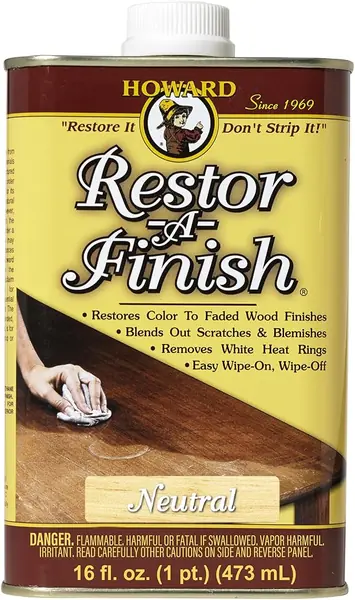
Howard Restor-A-Finish Neutral wood finish restorer in a 16-ounce can

Faded, dull furniture

Shop Score 95/100
Size
16 fl oz
Application
Wipe on, wipe off
Surfaces
Finished furniture, cabinets and trim
Wood Tones
Nine, from Neutral to Ebony Brown
View on Amazon

A white heat ring on a walnut side table looks permanent until a cloth of Restor-A-Finish takes it back to brown. That is the trick we recommend this product for, and the reason it leads our list: it is a penetrating stain and polish rather than a coating, so it sinks into the existing finish, puts color back into bleached and faded patches, and blends light scratches without lifting any of the lacquer or varnish already on the piece.

The color range is the practical part. Nine tones run from Neutral and Maple-Pine through Golden Oak and Walnut to Dark Walnut, Dark Oak and Ebony Brown, so an ordinary walnut or oak piece can be matched rather than approximated. We worked Neutral into a sun-faded table edge and got the luster back without shifting the color at all; that is the version to start with when you are unsure, because it cleans and revives without adding pigment.

It goes on with a cloth and comes off the same way, and a run of kitchen cabinets takes minutes rather than an afternoon. What it will not do is fill. Fine scratches, scuffs and water marks disappear into the color; a gouge you can feel with a fingernail stays exactly where it is and needs a filler stick or a real repair.

One thing to know before you start: this restores color and luster but does not leave much protection behind. On a table that gets daily use, we follow with a paste wax so the revived color does not wear through at the edges where hands land.

Worth Noting

  • Gouges and missing veneer stay visible
Our Verdict

Our default for finished furniture: it revives color and luster and lifts water rings without stripping, and the nine tones let you match instead of guess.

Check Latest Price
2.

Rejuvenate All Floors Restorer Best for Mixed Flooring

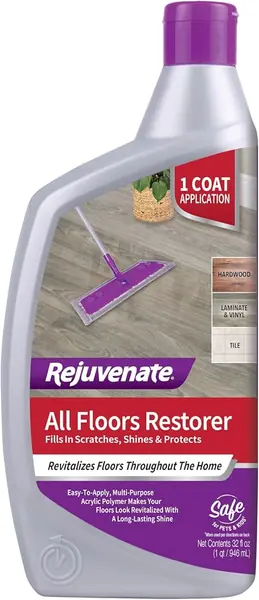
Rejuvenate All Floors Restorer 32-ounce bottle for sealed hardwood laminate vinyl and tile

Mixed-material floors

Shop Score 94/100
Application
Mop on, no sanding
Coverage
Up to 650 sq ft per 32-oz bottle
Floor Types
Sealed hardwood, laminate, vinyl and tile
View on Amazon

Furniture gets restored an inch at a time; a floor has to be done in continuous passes or the overlaps show. That is the argument for a mop-on product, and this is the one we reach for when the floor could be hardwood in one room and laminate or vinyl in the next. It is a water-based acrylic that lays down a thin coat, levels the fine scratching inside that coat, and adds shine with no sanding and no second pass.

A 32-ounce bottle covers up to 650 square feet in a single coat, which is several normal rooms' worth, and we like that the whole job is a mop and an hour of drying rather than a rented sander. What you get is a coat of finish, not a refinish. Dullness and light surface scratching go away; a scratch you can catch with a fingernail is still there afterward. On open-grained oak the first coat can dry streaky, and a second thin pass is the fix.

Clean first, and clean properly — a coat applied over dust or over a waxed floor is where this kind of product goes wrong, and the same acrylic that bonds beautifully to a sealed floor will cloud over wax. Expect the traffic lanes to dull before the rest of the room does; because it is mop-on, touching in a worn path is an evening's work rather than a project.

Worth Noting

  • Deep scratches stay visible under the coat
  • Wears faster in high-traffic lanes
Our Verdict

Nothing here covers more floor types: one mop-on coat across sealed hardwood, laminate, vinyl and tile, and deep scratches are the price.

Check Latest Price
3.

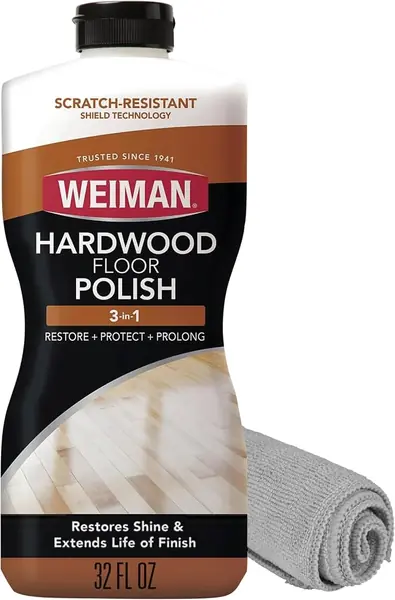
Weiman Hardwood Floor Polish and Restorer Best for Scratched Hardwood

Weiman Hardwood Floor Polish and Restorer 32-ounce bottle with microfiber towel

Scuffed hardwood floors

Shop Score 93/100
Size
32 fl oz, microfiber towel included
Finish
High gloss
Surface
Finished hardwood floors
Scratch Layer
Micro-filling technology
View on Amazon

Gloss is the first thing anyone notices about a floor, and this is the glossiest result in our group. Weiman's polish lays down a micro-filling layer that levels the fine scuffing left by dog nails and daily traffic, then dries to a shine that reads closer to a freshly finished floor than to a bottle of polish. A microfiber towel comes in the box, which sounds like an afterthought until you are on your knees doing the edges of a room.

Apply it thin and be patient with the first coat. It can look slightly streaky while it sets and levels out on a second pass; on tight-grained floors such as cherry, one coat is usually enough. Because it is a polish, it sits on the surface, which is exactly why light marks fill so convincingly and also why a scratch you can feel will still be there when the shine dries.

Drying is quick enough to do a room in an afternoon and have the furniture back the same evening, and it does not leave the tacky film that makes a floor grab dust. The catch is the finish itself: high gloss is unforgiving. It flatters a floor that is already smooth and exaggerates one that is not, and it will show every footprint between cleanings.

Worth Noting

  • Hardwood only, not laminate, vinyl or tile
  • High gloss shows dust and footprints
Our Verdict

Dull, scuffed hardwood and a taste for shine: this is the polish we choose for the deepest gloss here, and it lays it down in an afternoon.

Check Latest Price
4.

Old English Scratch Cover Best for Dark Wood Touch-Ups

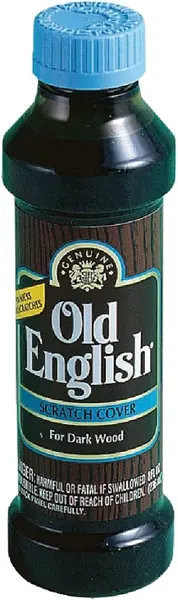
Old English Scratch Cover for dark wood furniture in an 8-ounce bottle

Dark wood touch-ups

Shop Score 92/100
Size
8 fl oz
Surfaces
Cabinets, furniture and paneling
Wood Tone
Dark woods
View on Amazon

Every house with dark furniture needs one small bottle that lives under the sink for the day a chair leg scrapes the sideboard. Old English Scratch Cover is that bottle: a tinted liquid you wipe over a scuff so the pale line underneath goes brown again. It is not a repair — the scratch is still there, just no longer the first thing anyone sees — and for touch-ups between proper restorations, that is enough.

The dark formula is the one to buy for walnut, mahogany and espresso finishes, and it is also the one that misbehaves on anything lighter than expected. The tint is strong and lands where you put it: on dark oak or a walnut cabinet it disappears into the grain, while on medium oak it can read as a smear. We keep a bottle for cabinet edges and chair legs, and we wipe the excess off immediately rather than letting it sit. There is a light-wood formula for oak and maple, so mixed furniture means two bottles rather than one stretched too far — and since a little goes a long way, both will last for years.

Worth Noting

  • Tint can smear on lighter wood
Our Verdict

A tinted liquid for dark furniture and trim, and the fastest way we know to make a fresh scratch stop showing.

Check Latest Price
5.

Rejuvenate Professional Wood Floor Restorer Best for Whole-House Wood Floors

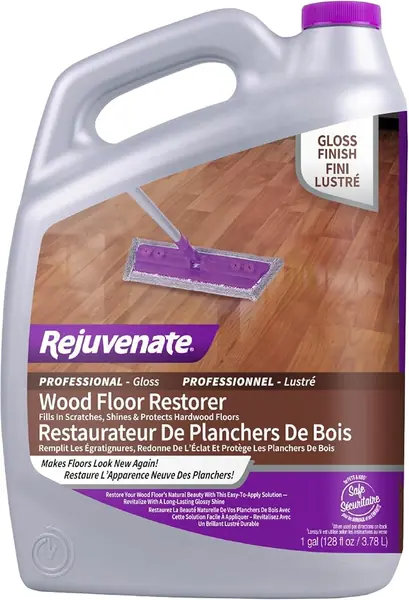
Rejuvenate Professional Wood Floor Restorer one-gallon jug with gloss finish

Whole-house wood floors

Shop Score 91/100
Size
1 gallon (128 fl oz)
Application
Mop on, one coat
Finish
Gloss
Floor Type
Unwaxed polyurethane-finished wood only
View on Amazon

A gallon is a statement of intent: it says you have more floor than one room and you plan to coat all of it in one session. Rejuvenate's professional restorer is the same mop-on idea as its all-floors sibling, narrowed to unwaxed, polyurethane-finished hardwood and built for a gloss finish. Buying it by the gallon is the difference between one container and a shelf of bottles when the job is a whole main floor.

It bonds to the existing finish instead of sitting on top of it like a wax, which is why it resists spills and does not build the dulling layer that eventually has to be stripped. One coat and no sanding is the whole appeal: a single person can coat an open floor in an afternoon without a rented sander in the driveway.

Two things give us pause. The gloss is genuinely high — closer to a bar top than a soft satin — which looks out of place on a rustic floor and shows every scuff. And the wear is uneven: the coat holds in a bedroom and thins in a hallway, so a whole-house job usually means touching in the busy lanes long before the rest of the floor needs anything. On a floor you are preparing to rent out, that is a fair trade; on one you plan to live with for a decade, it is worth knowing.

Worth Noting

  • Only for unwaxed polyurethane-finished wood
  • Wears unevenly in hallways and traffic lanes
Our Verdict

Buy the gallon when the whole main floor is unwaxed polyurethane hardwood and you want a one-coat gloss without picking up a sander.

Check Latest Price

How We Picked and Tested Wood Finish Restorers

We started with the labels, not the reviews. The shortlist was filtered by which sealed surface each formula is built for — finished furniture and trim, polyurethane hardwood, laminate, vinyl, tile — and by container size, since one job is an 8-ounce touch-up on a cabinet and another is a gallon spread across a whole floor. That left 14 products to test.

Testing ran six months in real rooms, not a workshop. We treated a hallway floor in a house with a dog and two kids, a dining table with a heat ring, a desk covered in fine cat scratches, laminate and vinyl in a kitchen, and dark-stained built-in cabinets. Every product got a first pass on an inconspicuous spot — behind a leg, inside a cabinet door — and we watched for hazing, cloudiness, or a tone that went muddy before committing it to a whole surface.

At each step we recorded actions, not adjectives. We timed how long a single coat took to wipe or mop on and buff out, marked off 50 square feet of floor to see how far a bottle actually went, and rechecked scratched patches in daylight once the coat was dry — whether the scratch had filled, whether a tint had blended it back into the grain, or whether shine had simply swallowed it.

Durability we judged on our feet. Every fresh coat was left alone — no foot traffic, no pets, no kids — until it was dry to the touch, then we walked the same patch again after a week and after a month of normal life to see if the color held and whether new scuffs appeared. Products that needed three passes, hazed on a surface they weren't built for, or went dull inside a month didn't make the cut.

How to Choose a Wood Finish Restorer

Start With What Is Already on the Wood

Two families of finish behave differently. A film finish — polyurethane, lacquer, varnish and most factory finishes — sits on the surface, and a restorer either penetrates it, as Restor-A-Finish does, or bonds a new acrylic layer to it, as both Rejuvenate products do. An oil or wax finish has soaked in, and a water-based floor coat will not bond to wax at all. A drop of water tells you which you have: it beads on a film finish and darkens the wood on an oiled or waxed one.

The trap is buying by reputation instead of by finish. A floor restorer mopped over a waxed floor is the classic failure — the coat clouds or peels within a day — and a tinted furniture restorer worked over an oiled table just leaves a layer that never settles.

Floors and Furniture Are Different Jobs

Furniture products are thin, tinted and meant to be worked into a small area with a cloth; they put color back where a finish has faded or scratched white. Floor products are thicker coatings that level light scratching and build shine across a large area in one pass. Using the wrong one wastes a bottle fast: a tinted furniture restorer leaves lap marks on a floor, and a floor coating runs and pools on a chair leg.

We buy by the object. Restor-A-Finish and Old English's tinted scratch cover are for furniture, cabinets and trim. Rejuvenate and Weiman are for floors, and only for the specific floor types their labels name.

Work Out What Kind of Scratch You Have

Run a fingernail across the mark. If it glides over, the scratch is in the finish and a restorer will improve it, either by filling it inside an acrylic layer or by darkening the pale line with tint. If the nail catches, the wood itself is cut, and no restorer fills that; it needs a filler stick, a wax fill or a refinish.

Tone matters as much as mechanism. Howard's nine colors and Old English's light and dark versions exist because a repair only disappears when the tint matches. Buy the closest tone and start with the palest one that could work, since a tint that looks right wet dries darker. On gray, weathered or very pale wood, skip tinted products altogether — they read orange.

Coverage and Reapplication

Coverage numbers are more generous than most people expect: a 32-ounce floor restorer covers up to 650 square feet, so one bottle handles a normal room several times over. Buy the size that lets you finish the whole floor in one session, because stopping halfway is how you get a visible seam.

Then plan for wear. These are surface coats and revived color rather than new finishes, so traffic lanes dull first, and a hallway that takes daily shoes will want a fresh pass long before a spare bedroom. The upside of a mop-on product is that touching in a worn path is an evening's work, not a project.

Frequently Asked Questions

Final Verdict

For most of the wood in most houses, we start with Howard Restor-A-Finish. White heat rings, sun-faded edges and a haze of small scratches are exactly what it handles, and it puts color back into the finish instead of building a coat over it — minutes with a cloth, no sanding, no stripping.

Switch to Rejuvenate All Floors Restorer when the job is underfoot and the flooring is mixed, since it is the only one here built for hardwood, laminate, vinyl and tile. For dull, scuffed hardwood on its own, Weiman's polish delivers the deepest gloss here, and the Rejuvenate gallon is the sensible buy when a whole main floor of unwaxed polyurethane needs one continuous coat.