↑↓ navigate ↵ open Esc close All results →

Best 10-Inch Miter Saws of 2026

Clearance behind the fence, single- versus dual-bevel tilt, and vertical baseboard capacity against the backstop decide how a 10-inch miter saw actually fits a shop—yet none of those show up in a quick glance at a spec sheet. Positive stops, bevel detents, and alignment guides only matter if the saw drops a square cut on the first pass and the hundredth.

Six months of cutting hallway baseboard, nested crown for a built-in, and framing lumber for a deck across eight sliding and fixed-head models underscored one practical check before buying: verify the tooth count on the included blade. While some saws ship with a 60- or 80-tooth finish blade, many still include a coarse framing disc that splinters trim until swapped out.

From compact saws light enough to carry with one hand to heavy gliders built for a stationary bench, each model here suits a different mix of job-site portability and shop capacity.

Our Top Picks

The Best 10-Inch Miter Saws

1.

SKIL MS6305-00 Dual Bevel Sliding Miter Saw Best Overall
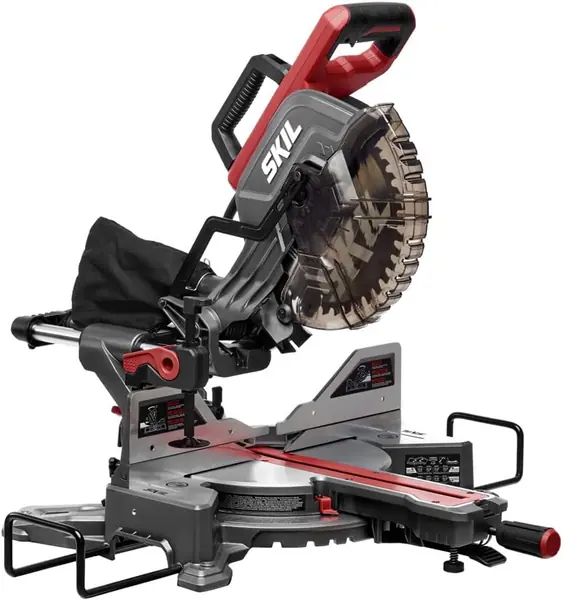
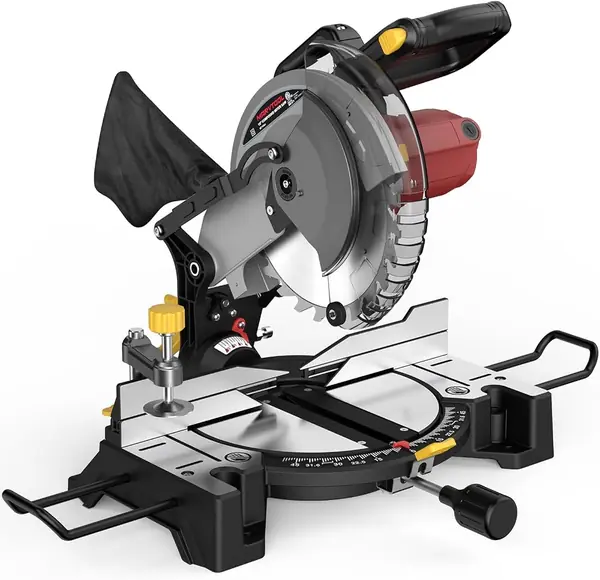
SKIL MS6305-00 10-inch dual bevel sliding miter saw in multi-color with shadow line

All-around home shop

Shop Score 94/100
Weight
39.4 lb
Crosscut Capacity
2x12 at 90 degrees, 2x8 at 45 degrees
Blade Size
10 inches
Bevel Stops
Left 0, 45, 48 degrees; right 0, 45 degrees
View on Amazon

A sliding dual-bevel head is where 10-inch saws usually get expensive, and the SKIL MS6305-00 undercuts the other sliding dual-bevel machines in this group while matching their reach. The 15-amp motor turns 4,800 rpm, the table swings 50 degrees each way with 11 positive stops, and the head tilts to 45 and 48 degrees left and 45 right. It crosscuts a 2x12 at 90 degrees and a 2x8 at 45, which is more stock than a fixed-head saw of any price will take.

What settled it for us was the shadow line. An LED throws the blade's own silhouette onto the workpiece, so the kerf lands exactly where the teeth will go instead of beside a laser dot you have to re-trust every time you change blades. We also came to like the cam miter lock: it lets you creep up on an angle without hunting for a detent, which is how most real corners get fitted.

The bevel scale is where it asks for patience. The stops are not the crispest in this group, so give it a few minutes with a square and a 45-degree drafting triangle before the first project rather than fighting an angle mid-cut. Set that way, it holds, and the cuts come out as square as machines that cost a good deal more. It is also light enough at 39.4 pounds that one person can move it off a bench at the end of the day.

Worth Noting

  • Dust bag leaves chips across the bench
Our Verdict

This is the saw we point most woodworkers to: dual-bevel capacity, sliding reach, and a shadow line that ends the guessing, all without premium pricing.

Check Latest Price
2.

Bosch CM10GD 10-Inch Glide Miter Saw Best for Small Shops

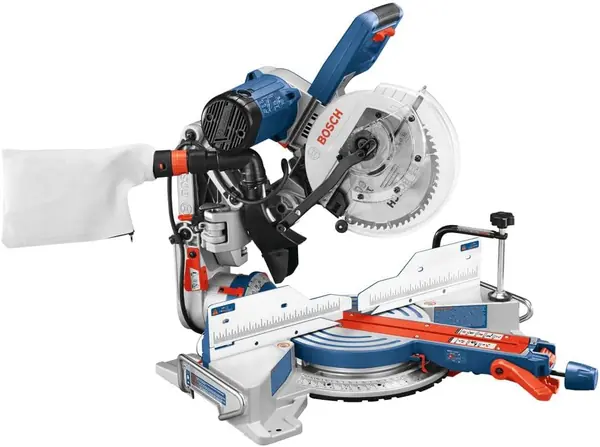
Bosch CM10GD 10-inch dual bevel glide miter saw in blue with axial glide arms

Small shops

Shop Score 93/100
Weight
64 lb
Speed
4,800 rpm
Crosscut Capacity
12 inches at 90 degrees
Vertical Capacity
5-1/2 inches baseboard, 6 inches crown
View on Amazon

The Bosch CM10GD has no slide rails, and that is exactly why it earns a place here. The head rides on articulated hinge arms that fold back over the base, and Bosch rates the saving at up to 10 inches of front-to-back depth against a rail saw of similar capacity. The payoff is a saw you can leave set up on a bench that still has to be a workbench the rest of the week, or push back toward a wall in a one-car garage.

None of that costs capacity. It crosscuts 12 inches at 90 degrees, stands 5-1/2 inches of baseboard against the fence and nests 6 inches of crown, and runs a 15-amp motor at 4,800 rpm. The bevel lock lever and range selector sit at the front of the base, so you set an angle from where you are standing instead of reaching around the back of the machine with a workpiece already clamped.

The glide itself is what we kept coming back to. The travel is smoother than the rail saws in this group, and with the carriage on sealed hinge arms there is no exposed tube in the slide path collecting pitch and sawdust. One practical note: the 60-tooth blade in the box is a general-purpose cutter, and painted trim wants an 80-tooth, so price that in with the saw.

Worth Noting

  • 64 pounds, so plan a permanent bench spot
  • Bevel stops can arrive out of square
Our Verdict

If bench depth is the constraint, this glide saw gives you 12 inches of crosscut in a footprint a rail saw cannot match.

Check Latest Price
3.

Makita LS1019L 10-Inch Sliding Miter Saw Best for Crown Molding

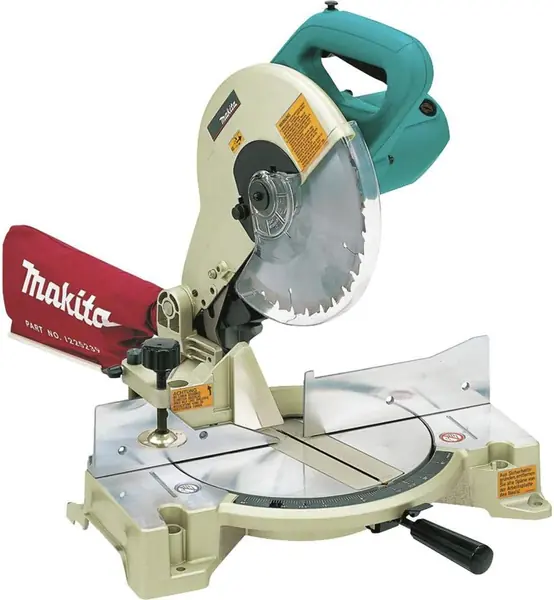
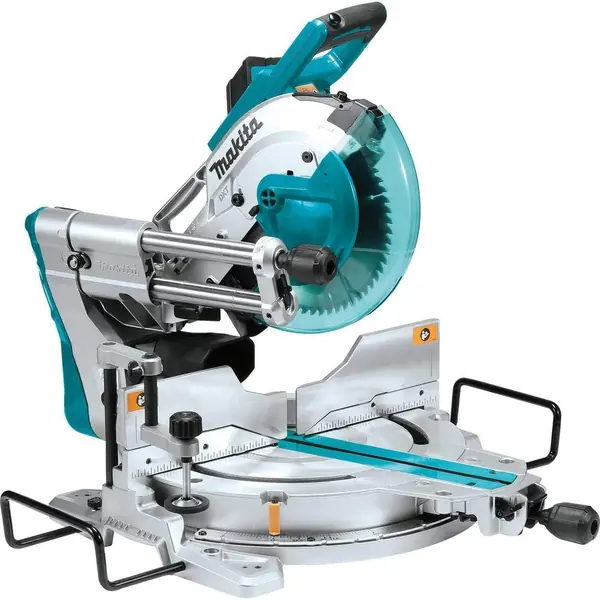
Makita LS1019L 10-inch dual bevel sliding miter saw with steel rails and laser

Crown and trim

Shop Score 92/100
Speed
3,200 rpm
Rail System
Two steel rails, front and back
Baseboard Capacity
4-3/4 inches
Nested Crown Capacity
6-5/8 inches
View on Amazon

6-5/8 inches of nested crown molding off a 10-inch blade is 12-inch-saw territory, and that figure is the first thing we check when a saw is going to spend its life on trim. Add 4-3/4 inches of baseboard standing against the fence, and the LS1019L will also cut a 4x4 in a single pass — the sort of capacity that normally forces you up a blade size and into a heavier machine.

The 15-amp direct-drive motor uses a soft start, so the head comes up to speed without the lurch that rocks a lighter saw on its stand. It runs at 3,200 rpm, slower than most of this group, which is a deliberate trade for torque and a cleaner cut in hardwood. Dust collection is the best here by a wide margin; the chute and bag actually catch the stream instead of dusting the bench behind the fence.

The rail arrangement is the other half of the design. The two steel rails are mounted front and back rather than as one tube, so the carriage stays compact and the saw can sit flush against a wall, which matters in a garage where every inch of bench counts. For finish work — casing, crown, stair trim — this is the saw we reach for.

One caution before the first cut: check the fence and the 45-degree bevel against a square, and check the carriage for slop on the rails. Alignment is what separates a good one of these from a frustrating one, and it is worth returning a saw that will not true up rather than living with joints that will not close.

Worth Noting

  • Heavy enough to live on one bench
Our Verdict

We recommend it for crown, baseboard, and one-pass 4x4 cuts: nothing else here matches its capacity and dust control.

Check Latest Price
4.

DEWALT DWS713 10-Inch Compound Miter Saw Best Compound Saw for Trim

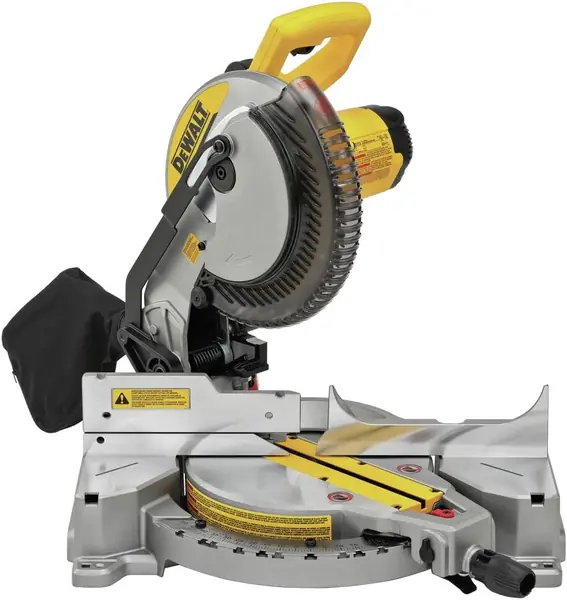
DEWALT DWS713 10-inch single bevel compound miter saw in yellow and black

Trim and framing

Shop Score 91/100
Weight
38.1 lb
Speed
5,000 rpm
Crosscut Capacity
2x6 at 90 degrees, 2x4 at 45 degrees
Miter Stops
14 positive stops
View on Amazon

The DWS713 is built for the trim carpenter who never tilts the blade to the right, and we like it precisely because it does not charge for that ability. It is a fixed-head, single-bevel compound saw: 14 positive stops on a stainless plate, a 15-amp motor spinning at 5,000 rpm, and a tall sliding fence that stands 4-1/4 inches of baseboard up on edge.

Detents are the whole game on a saw like this, and these engage cleanly at the common angles, so a run of casing does not turn into a series of square checks. The blade in the box is an 80-tooth, which is already a trim blade rather than the ripper most saws ship with — you can hang casing the day it arrives without buying anything else.

At 38.1 pounds it sits on a bench or a stand and stays put, and the included vertical clamp holds a piece of casing flat against the fence while you bring the head down. What we appreciated most was how little there is to think about between cuts: no rails to check, no bevel to reset for a square cut, and a head that reaches speed fast enough to keep a rhythm going.

Worth Noting

  • No slide, so crosscuts top out at 2x6
  • Dust bag is small and fills fast
Our Verdict

For casing, baseboard, and 2x4 framing, we recommend this trim saw: simple, square, and quick to set up.

Check Latest Price
5.

Metabo HPT C10FCG2 10-Inch Miter Saw Best Budget

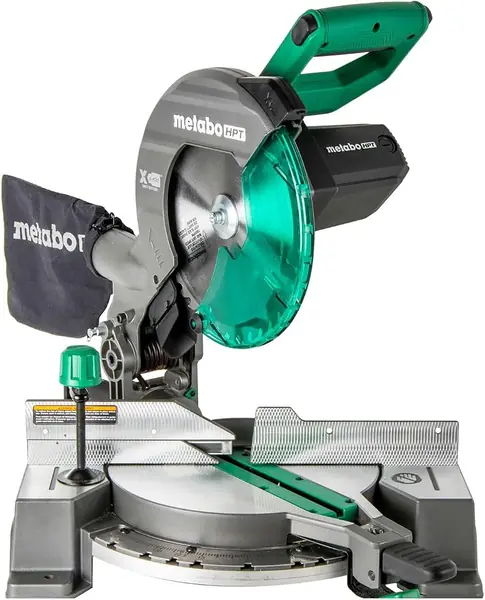
Metabo HPT C10FCG2 10-inch compound miter saw in green with a 24-tooth blade

Budget-minded beginners

Shop Score 90/100
Weight
24.2 lb
Bevel Range
0-45 degrees left
Miter Range
52 degrees left and right
Warranty
5 years on the tool body
View on Amazon

24.2 pounds is a different class of tool from the 38- and 39-pound saws here. You carry the C10FCG2 out with one hand, set it on a pair of sawhorses or a folding stand, and put it back on a shelf when the project ends — which is how a lot of home shops actually use a miter saw, and not something a 60-pound glide saw lets you do.

The five-year warranty on the tool body is the longest in this group, and we think this is the best value among the compact saws. Fifteen amps and 5,000 rpm, an LED shadow line instead of a laser, a table wide enough to support trim without a stand, and a miter scale that swings 52 degrees in both directions with positive stops. It handles 2x6 and 4x4 stock, and it goes through 2x4s faster than its weight suggests.

Set it down on something flat and check the fence with a square before the first project; a light saw rewards being set down level, and the shadow line does the work of a laser with nothing to adjust or replace. Beyond that there is very little to nurse — the miter release falls to hand and the blade change is straightforward.

Worth Noting

  • Bevel tilts left only, to 45 degrees
  • Wide boards need two passes
Our Verdict

If the saw comes out of a closet for weekend projects, this light, inexpensive machine with a five-year warranty is where we point budget buyers.

Check Latest Price
6.

Makita LS1040 10-Inch Compound Miter Saw Best for Light Job-Site Work

Makita LS1040 10-inch compound miter saw in beige with a dual post pivot arm

Light job-site work

Shop Score 89/100
Weight
27 lb
Speed
4,600 rpm
Bevel Range
0-45 degrees left
Miter Range
45 degrees left, 52 degrees right
View on Amazon

For more than the SKIL costs, the LS1040 gives you a fixed head, a single bevel, and no sliding rails. That looks like a bad trade until you pick it up: 27 pounds, a compact machined base, and a direct-drive motor with a soft start that comes up smooth and holds speed through a cut.

The miter scale runs 45 degrees left and 52 degrees right with nine positive stops at the angles that matter, and the dual-post pivot arm keeps the head rigid instead of letting it wander. It ships with a 40-tooth micro-polished blade that is a decent general-purpose cutter, and the socket wrench and vertical vise in the box mean you can change it and clamp stock without a trip to the hardware store.

We like this saw for the shop that cuts 2x4s and door trim all day and wants a machine that stays square with no attention. The fence and table are heavy gauge, the angle settings repeat, and at 27 pounds one person moves it between benches without thinking about it. Where the money goes is build and smoothness rather than features, and for a lot of small shops that is the right place to spend it.

Worth Noting

  • Bevel is left-tilt only, to 45 degrees
  • Fixed head limits wide crosscuts
Our Verdict

We like it for straight crosscuts and single-bevel trim: it does the work without the weight or the price of a slider.

Check Latest Price
7.

DOVAMAN DMS01A 10-Inch Sliding Miter Saw Best for Mixed-Material Projects

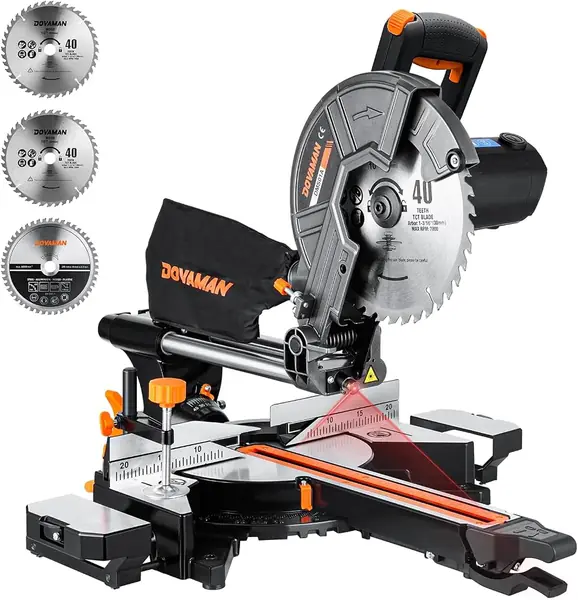
DOVAMAN DMS01A 10-inch sliding miter saw in black with laser guide and side tables

Mixed-material projects

Shop Score 87/100
Weight
37.5 lb
Speeds
5,000 and 3,200 rpm
Included Blades
Three TCT blades
Cutting Capacity
3.5 x 13.4 inches
View on Amazon

Three carbide blades, two speeds, a laser, and a long slide in one box: the DMS01A is aimed at the shop that cuts more than wood. The 15-amp motor runs at 5,000 rpm for lumber and drops to 3,200 for plastic and soft metal, and the blade guard and vise clamp come with it. The handle and trigger are ambidextrous, so a left-handed reach is as comfortable as a right-handed one.

Capacity is the reason to look twice. The slide takes the head out to a listed 3.5 x 13.4 inches of cut, enough for a wide shelf or a stack of trim in one pass, and the rails and side tables give long stock somewhere to land instead of hanging off the end of the table.

Two things to sort before you buy blades. Check the arbor size against whatever finish blade you plan to run, because the included set is what fits out of the box, and expect the laser to need aligning before it agrees with the teeth. The two-speed dial is genuinely useful — the slower setting is easier to control in plastic than any single-speed saw here.

We see this as a second saw, or a mixed-material bench saw, rather than the one machine in a trim carpenter's truck. For a shop cutting vinyl plank, aluminum trim, and the occasional 2x, it earns its space, and the extra blades mean you are not shopping for tooling on day one.

Worth Noting

  • No blade brake, so the blade coasts
Our Verdict

We see it as a mixed-material bench saw — three blades, two speeds, and 13 inches of slide for wood, plastic, and aluminum.

Check Latest Price
8.

MarvTool JS-1017C3 10-Inch Compound Miter Saw Best for Light Home Projects

MarvTool JS-1017C3 10-inch compound miter saw in grayish white with extension tables

Light home projects

Shop Score 86/100
Weight
20.5 lb
Speed
5,000 rpm
Bevel Range
0-45 degrees left
Included
36-tooth blade, two extension tables
View on Amazon

15 amps, 5,000 rpm, a 10-inch blade, a vise clamp, and two extension tables: read as a shopping list, the JS-1017C3 sounds like a saw from one of the big brands. The 36-tooth blade in the box will break down framing lumber, and the guard and clamp mean you can start cutting the day it lands rather than adding a blade and a hold-down to the order.

At 20.5 pounds it is the lightest machine in this group, and the body is compact enough at 19.5 inches long to live on a shelf between projects. The extension tables are the useful part in a small shop: long trim and shelf stock have somewhere to sit, so a board is not hanging off the end of the table while you cut it.

Two details worth knowing before the first cut. The angle dial is stiff when new and smooths out with a drop of lubricant, and the side extension tables have to come off before you swing the head over for an angled cut — a thirty-second job, but one that surprises people mid-project.

We think of it as a first saw for light work — shelves, a fence repair, a floor patch — where the budget is tight and the cuts are square and simple. Judged that way, 20.5 pounds and a 5,000 rpm motor is a lot of machine for very little money, and it leaves room in the budget for a good finish blade later.

Worth Noting

  • Single bevel swings left only, 0-45 degrees
Our Verdict

We think it is the right first saw for square cuts and simple miters on a tight budget, at 20.5 pounds.

Check Latest Price

How We Tested the 10-Inch Miter Saws

We built the shortlist from every current 10-inch compound and sliding saw we could find from brands with parts and service behind them, then filtered by the things that actually decide a purchase: crosscut capacity at 90 and 45 degrees, single versus dual bevel, miter range and where the positive stops land, weight, and how much room the head needs behind the fence. Eight saws came in.

Testing ran six months alongside real work — baseboard around a hallway, nested crown for a built-in, framing stock for a deck, plywood for shop cabinets. Every workpiece was clamped or held flat against the fence, eye and hearing protection stayed on, and nobody reached past a spinning blade or lifted the head before it stopped.

Each saw got the same first cut: a board sliced in two, one half flipped end for end, and the joint held up to a shop light to reveal any gap. That told us how square a saw was out of the box and how much adjustment it took to get there. We swung the head to the common trim angles and checked each detent by feel and by square, noting which ones needed re-zeroing. Vertical capacity got tested with a scrap of baseboard and a length of nested crown stood against the fence, and we pushed each saw against a wall to see how far the head traveled behind it.

We timed blade changes and checked arbor fit, ran a dozen cuts in a row to see how much dust landed in the bag versus on the bench, and watched how the stock blade held its edge as the months went on. Ease of use, fit and finish, cutting speed through thick stock, and what each saw delivered for the money all went into the final ranking.

How to Choose a 10-Inch Miter Saw

Fixed Head or Sliding

A fixed-head 10-inch saw crosscuts roughly 2x6, because the blade only travels down through the stock. Sliding rails pull the head forward and add several inches of width — the SKIL reaches 2x12 at 90 degrees and 2x8 at 45 — but you pay in weight, bench depth, and one more adjustment to keep true. If your material is trim, 2x4s, and the odd 2x6, a fixed head does the job and is lighter to live with.

If you break down shelves, decking, or thick posts, buy the slide. The capacity difference is not marginal; it is the difference between one pass and two, and two cuts in thick stock rarely line up the way you want.

Single or Dual Bevel

Single-bevel saws tilt the head to the left only, which covers most casing, baseboard, and picture-frame work. Dual-bevel saws tilt both ways, so a compound cut on a piece that has to stay face-up does not require flipping it and cutting from the back. We reach for dual bevel when a project has a lot of matched corners and the grain has to run one way.

The trade is weight and money. Dual-bevel heads are heavier, and the right-hand bevel is often the least-used setting on a home-shop saw. Be honest about whether you cut compound miters monthly or once a season before you pay for it.

Baseboard, Crown, and the Fence

Vertical capacity decides trim work, not blade size. Baseboard stands on edge against the fence, and crown is usually cut nested against it at the spring angle, so a tall sliding fence matters more than a wide table. The saws here run from 4-1/4 inches of baseboard on the DEWALT to 6-5/8 inches of nested crown on the Makita LS1019L.

If crown is on your list, compare nested capacity figures rather than assuming a 10-inch blade is too small — several of these cut crown that used to require a 12-inch machine.

Weight, Footprint, and Where It Lives

A saw that stays on a bench can weigh 60 pounds; a saw that goes into a truck should weigh 25. Depth matters as much as weight. A rail saw needs clear space behind the fence for the head to travel, while the Bosch CM10GD folds its hinge arms back over the base and saves up to 10 inches.

The trap is the word compact. In a listing it usually describes the body, not the room the head needs behind the fence, so measure the bench — and remember the dust bag and the stock you are cutting need clearance too.

Plan on a Better Blade

Most saws ship with a general-purpose blade, and the difference a finish blade makes on painted trim is the cheapest upgrade in this purchase. Look for an 80-tooth blade in the same diameter, and check the arbor size before you order: 5/8 inch is the common standard here, and a machine that takes something else will need an adapter.

Keep the stock blade for framing and pressure-treated stock, where tips take a beating anyway, and swap to the fine blade for anything that will be seen.

Frequently Asked Questions

Final Verdict

The SKIL MS6305-00 is the saw we point most woodworkers to. It slides to 2x12, bevels both ways, and puts an LED shadow exactly on the cut line — the three things that decide whether a miter saw earns bench space — without the premium the Bosch and Makita ask.

Buy the Bosch CM10GD instead if the saw has to sit close to a wall and you cannot spare the depth behind the fence; its glide arms buy back up to 10 inches. Buy the Metabo HPT C10FCG2 if the saw comes out of a closet for weekend projects and you want a light 24.2-pound body and the longest warranty for the least money.