↑↓ navigate ↵ open Esc close All results →

Best Crown Molding Jigs of 2026

Crown molding sits at an angled spring profile between wall and ceiling, forcing a miter saw user to balance the stock upside down against the fence at that exact angle while cutting compound miters—a setup that easily lets trim shift mid-cut or pulls fingers close to the blade. A dedicated crown jig provides a rigid seat and backstop so the molding stays put and hands stay clear.

Cutting inside and outside corners in 3-1/2- and 5-1/4-inch molding for a hallway and a built-in bookcase over six months with 12 crown jigs showed that rigid mounting and zero upward creep under blade contact matter far more than trying to cut molding flat on the table.

Verify saw compatibility carefully before ordering, as each of these four jigs locks solidly onto specific 10- and 12-inch miter saws to keep trim from riding up mid-cut.

Our Top Picks

The Best Crown Molding Jigs

1.

Bench Dog 10-027 Crown Molding Jig Best Overall
Bench Dog 10-027 silver crown molding jig with adjustable fence risers

Universal miter saws

Shop Score 92/100
Mounting
Portable, no saw attachment
Fence Risers
Adjustable for crown and cove
Crown Capacity
Up to 6 inches wide
Fits Miter Saws
10-inch and larger regular or sliding
View on Amazon

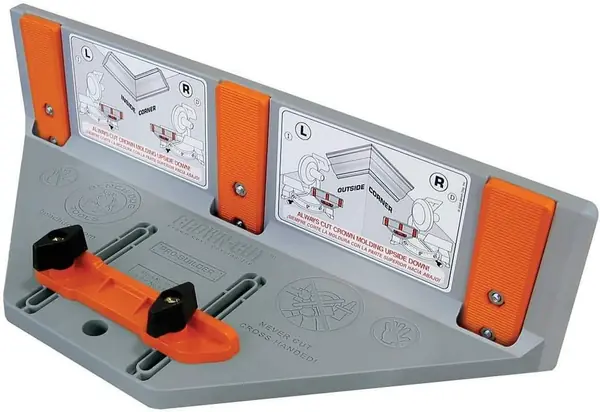
The Bench Dog 10-027 solves the problem most crown jigs create: it doesn't care which 10-inch or larger miter saw you own. The jig sits on the saw table with adjustable fence risers that hold crown up to 6 inches wide at the spring angle you set. We like that it doesn't need to be bolted down, so it moves from the bench to a job site without leaving brackets behind.

What earns it top billing is the combination of breadth and simplicity. The molded pictures on the face show how the crown should sit, which removes the upside-down-and-backwards hesitation that makes crown cuts feel harder than they are. We found it easy to set the risers once and keep the same reference for repeat cuts. We also appreciate the support for cove and crown up to 6 inches, since wide profiles are where a fussy jig shows its weaknesses.

Because it isn't bolted down, you do need to keep it from sliding on a slick table; a clamp or non-slip mat solves that. The real charm is that it can be lifted off and set aside between cuts, leaving the saw ready for the next trim piece. For a small shop or a job site where the saw does double duty, that flexibility matters as much as the angle itself.

Worth Noting

  • Needs a clamp or mat on slick saw tables
Our Verdict

We recommend the Bench Dog 10-027 as the default crown jig because it fits most 10-inch and larger miter saws and holds wide crown without permanent mounting.

Check Latest Price
2.

DEWALT DW7084 Crown Stops Best for DEWALT Saws

DEWALT DW7084 silver and black steel crown stops for miter saws

DEWALT miter saws

Shop Score 91/100
Saw Compatibility
DW703, DW706, DW708, DW712, DW715, DW716, DW717, DW718, DWS780
Positioning
Vertical against saw fence
Construction
Two steel crown stops
View on Amazon

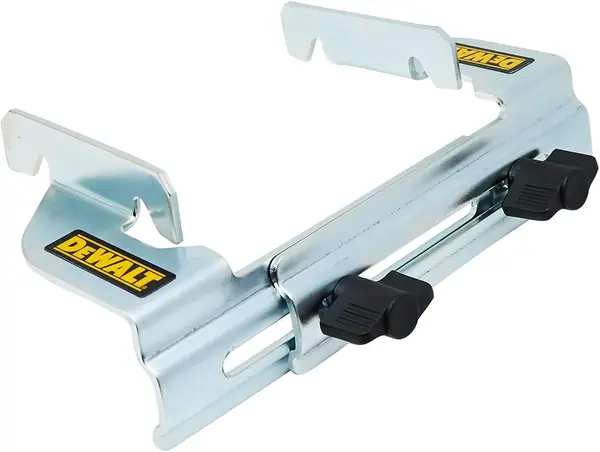
For a DEWALT saw on the list, the DW7084 is the least fussy way to add crown support. The kit is two steel stops, one for each side of the blade, that position crown vertically against the fence so the saw's miter scale handles the angle. We appreciate that there are no plastic risers to flex and nothing to assemble.

What we like most is the repeatability. Once the stops are set, each length returns to the same spot, which matters when you are cutting a room's worth of pieces and want every joint to close the same way. They don't ask you to learn a second set of angles; the crown sits where it will sit on the wall, and the saw does the rest. The stops are simple and tough, and the small footprint means they can stay on the saw between projects.

The stops are small enough to leave on the saw, and the steel construction shrugs off bumps in a crowded shop. On a one-off cut they may be more support than you need, but on a room's worth of trim we want them in place before the first piece goes down. That is the kind of low-drama setup we keep coming back to.

Worth Noting

  • No corner-angle protractor included
Our Verdict

For a DEWALT saw on the list, we think the DW7084 is the simplest way to add repeatable crown support.

Check Latest Price
3.

Bosch MS1233 Crown Stop Kit Best for Bosch Saws

Bosch MS1233 crown stop kit with left and right stops and knobs

Bosch miter saws

Shop Score 90/100
Saw Compatibility
GCM12SD, CM10GD, CM12, CM8S, CM12SD, 5412, 4410, 4405, 4310, 4212
Storage
Flips back over fence
Cut Method
Nested crown; no beveling
Not Compatible
5312, 4412, 3912, 3915
View on Amazon

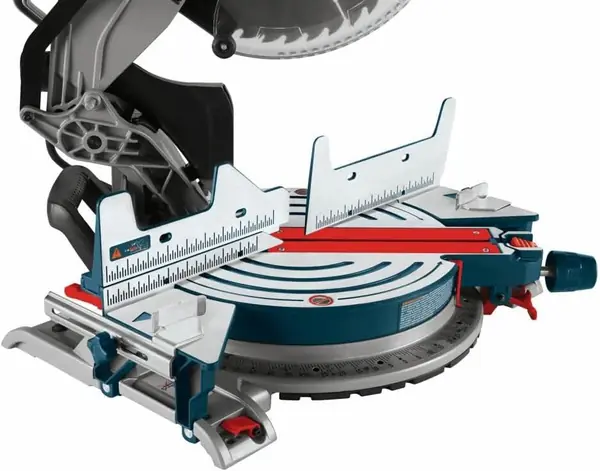
The model list is the first thing we check with the Bosch MS1233, because this kit is not universal. It is made for a specific group of Bosch miter saws, and several models are explicitly left out. That sounds like a drawback, but the payoff is a pair of stops that mount cleanly and flip back over the fence when the cut is done.

For a saw on the list, the design is tidy. The left and right stops let you nest crown against the fence for a simple miter cut, with no bevel to reset between pieces. We like that the stops stay on the tool and fold out of the way of other cutting, so you are not hunting for them in a drawer when the next crown job starts.

The mount is the whole story here: a dedicated stop that lives on the saw is faster to use than a loose jig, and the Bosch hardware feels purposeful in place. The flip-back feature is the detail that keeps it on the saw rather than in storage. That permanence is worth the fit check; once the stops are on, there is nothing to remember and nothing to carry.

Worth Noting

  • Fits only select Bosch miter saw models
Our Verdict

We like the MS1233 for a compatible Bosch saw because the stops flip out of the way and stay on the tool.

Check Latest Price
4.

AltitudeCraft 2-in-1 Crown Jig Set Best for Corner-Angle Cuts

AltitudeCraft 2-in-1 crown molding jig set with protractor and metal stops

Corner-angle cuts

Shop Score 86/100
Included
Crown stops and miter saw protractor
Stop Fit
DEWALT-compatible
Protractor
360° with inner miter scale
Stop Material
Heavy-duty metal
View on Amazon

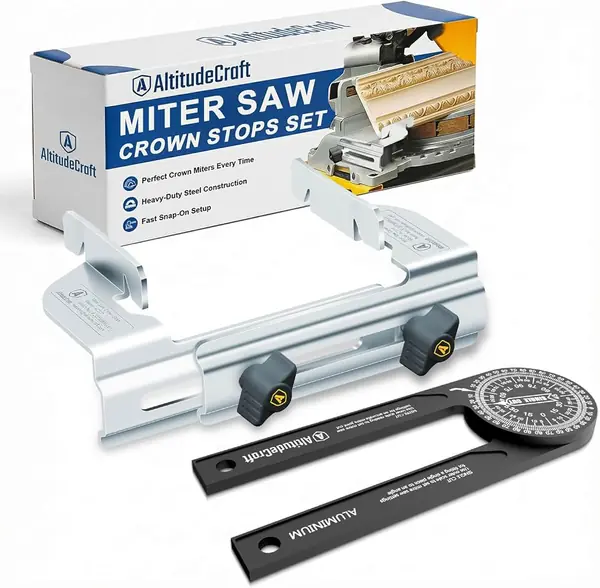
A protractor and a pair of crown stops in one box is a practical idea for trim work, because angle finding and holding are two separate jobs. The AltitudeCraft set pairs a 360-degree miter saw protractor with metal stops, and the protractor is the part we reach for first on walls that are nowhere near square.

The stops are built to hold crown in a nested position at the spring angle, and the protractor's inner scale is meant to give you the miter setting without doing the math. We like that combination for a first crown project, where the hardest part is often trusting the number on the saw. The set is compact and light enough to keep with the saw, too.

The catch is fit: the stops are made for DEWALT-compatible saws, not every miter saw. On an older room with out-of-square corners, the protractor is the part that keeps this set in the case rather than on a shelf. We see it as a useful second tool for someone who already knows the saw will take the stops, not as a universal first purchase.

Worth Noting

  • Crown stops fit DEWALT-compatible saws only
Our Verdict

We see the AltitudeCraft set as a practical choice for a DEWALT-compatible saw when you also need help reading corner angles.

Check Latest Price

How We Tested Crown Molding Jigs

We started with the crown jigs and crown stop kits sold for miter saws, reading each maker's compatibility list and setting aside anything that didn't name the 10- and 12-inch saws most people own. From there we narrowed to twelve jigs across a range of prices and mounting styles, including portable units that travel between saws and stops that bolt to the fence.

Those twelve lived on miter saws in a garage shop for six months while we ran trim for a hallway and a built-in bookcase. We cut inside and outside corners in 3-1/2- and 5-1/4-inch molding, plus wide profiles at the top of what each jig would take, and we mounted every jig only on the saws its maker lists. At each mount we checked for wobble, then leaned the crown into the fence and watched whether the jig shifted under the pressure.

To judge seating, we nested each piece at both common spring angles and watched the gap at the fence line as the blade entered the cut, flagging any molding that crept upward. We held the work with the jig and fence and kept our hands outside the blade path for every cut. We also timed setup from box to first cut, noted how each one stores or flips back between cuts, and checked a 360-degree protractor against corners we'd already measured with a framing square.

At the end of six months we re-checked hinges, welds, and knobs for play, since a jig that loosens over a season is no bargain no matter what it cost.

How to Choose a Crown Molding Jig

Start With the Saw, Not the Jig

A universal jig such as the Bench Dog sits on the table and can move between saws; dedicated crown stops like the DEWALT DW7084 and Bosch MS1233 are tied to specific models and often stay on the saw. The trade-off is freedom versus integration. Check the model list before you buy, especially if your saw has a sliding carriage or a tall fence.

A jig that doesn't fit your saw is not a bargain, no matter how well it holds crown. Measure your fence height and confirm the mounting points before ordering a brand-specific kit.

Match the Spring Angle and Crown Width

Crown molding is installed at a spring angle, the angle between the back of the profile and the wall. Common profiles are 38, 45, and 52 degrees. A jig with fixed positions is quick for those standards; an adjustable fence or spring base covers the in-between profiles.

Width matters too. The Bench Dog holds up to 6 inches, while some adjustable jigs stop at 5-1/2. Measure the tallest piece you plan to run and test-cut a scrap pair before committing to a full room.

Plan for a Secure Seat

Crown is tall and top-heavy, so the jig has to do more than set an angle; it has to keep the molding from sliding or riding up as the blade enters. A clean table, a non-slip pad, and steady pressure on the stock help, and a clamp can steady a portable jig that isn't mounted.

If a jig lets the crown creep during test cuts, stop and reset it rather than chasing the error through the room. The cut should feel boring and repeatable.

Decide How Much Angle Help You Want

Your saw's miter scale can handle square walls, but older rooms rarely cooperate. A separate protractor or a set like the AltitudeCraft's 2-in-1 kit helps you read the corner and transfer that number to the saw without math. If you already own an angle finder, put the money into a sturdier jig instead.

For a single room with standard corners, the saw scale and a test cut may be all you need.

Frequently Asked Questions

Final Verdict

The Bench Dog 10-027 is the jig we recommend first because it works on most 10-inch and larger miter saws and holds up to 6-inch crown without permanent mounting. That breadth makes it the safe default for a shop with one saw and a mix of trim jobs.

If your saw is a listed DEWALT, the DW7084 is the simpler support and our pick for repeatable nested cuts. For a compatible Bosch saw, start with the MS1233 and verify the model list. The AltitudeCraft set is the one to consider when corner-angle measurement matters.