↑↓ navigate ↵ open Esc close All results →

Best Miter Saws of 2026

Shoppers often buy a miter saw for maximum crosscut width alone, only to discover what that extra reach costs in bench depth and weight. A sliding compound saw handles wide bookcase shelves but stays bolted in place, whereas a compact cordless model rides to the job site yet lacks the fence height to nest tall crown. Getting the balance right turns out square baseboards, shelves, and picture frames on the first pass.

Through nine months of cutting baseboard, nested crown, and shelf stock across eight corded bench anchors and compact battery saws, bevel geometry proved just as decisive as capacity. A single-bevel head tilts only one direction, forcing woodworkers to flip long molding end-for-end and recalculate compound angles mid-run.

Factory lasers only help when aligned straight out of the box, and stock dust bags rarely capture more than half the sawdust a blade throws. The six saws ranked below span from heavy stationary shop machines to portable trim-call models.

Our Top Picks

The Best Miter Saws

1.

DEWALT DWS779 12-Inch Sliding Miter Saw Best Overall
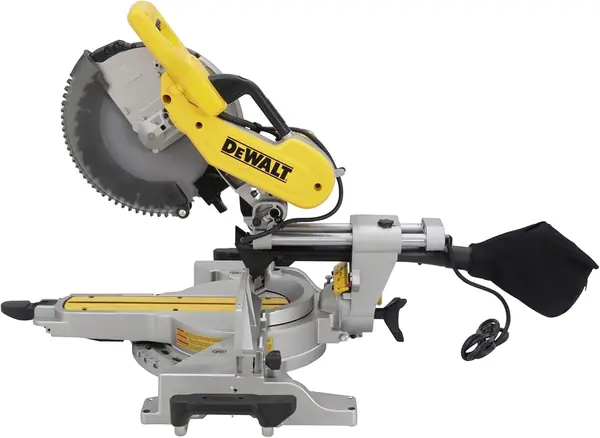
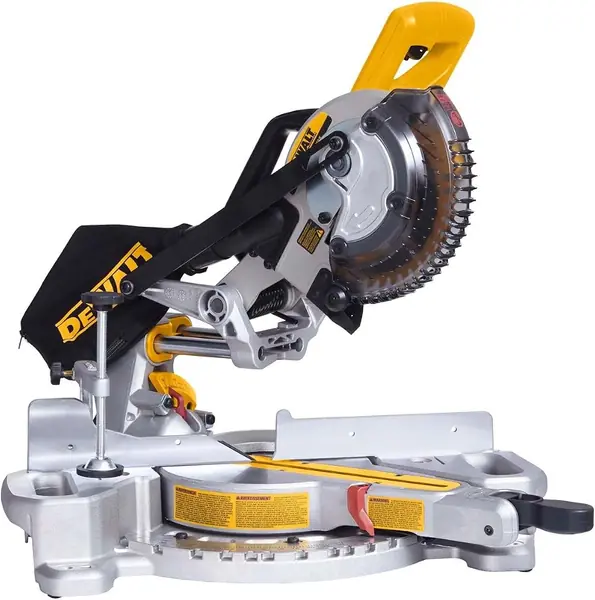
DEWALT DWS779 12-inch sliding compound miter saw in yellow and black on its base

Shop-based woodworking

Shop Score 96/100
Blade Size
12 inches
Weight
67.7 lb
Crosscut Capacity
2 x 14 at 90° and 2 x 10 at 45°
Nested Crown Capacity
7-1/2 inches
View on Amazon

A 2x14 in a single pass is the reason this saw holds the top spot. The DWS779 crosscuts 2 x 14 dimensional lumber at 90 degrees and 2 x 10 at 45, and it stands 7-1/2 inches of crown molding against the fence. Those are the biggest stated numbers in this group, and they translate into shelving, stair stringers and window casings that get cut once and fit.

Repeatability matters as much as reach. Ten positive stops on a stainless detent plate, a cam-lock handle and a detent override let you swing to 45 for a casing, come back to zero, and land on the same angle; miter travel runs 0 to 50 degrees both ways. In our cuts the saw arrived square and stayed that way through a long run of repetitive 45s, which is exactly what we watch for on any saw with a sliding head.

The 15-amp motor turns a 12-inch blade at 3,800 rpm and holds speed in thick stock instead of bogging and burning. A vertical clamp, blade wrench and dust bag come in the box, and the clamp is one more thing you do not have to shop for. Fit the blade to the job — a fine-tooth blade for trim, the included general-purpose blade for framing and decking — and this saw handles everything a shop-based woodworker asks of it.

Worth Noting

  • No cut-line light or laser
  • 67.7 pounds limits job-site portability
Our Verdict

This is the saw we recommend to anyone who cuts casework and trim in a fixed shop: it swallows a 2x14 in one pass and holds its angles.

Check Latest Price
2.

SKIL MS6305-00 10-Inch Dual Bevel Sliding Miter Saw Best Value

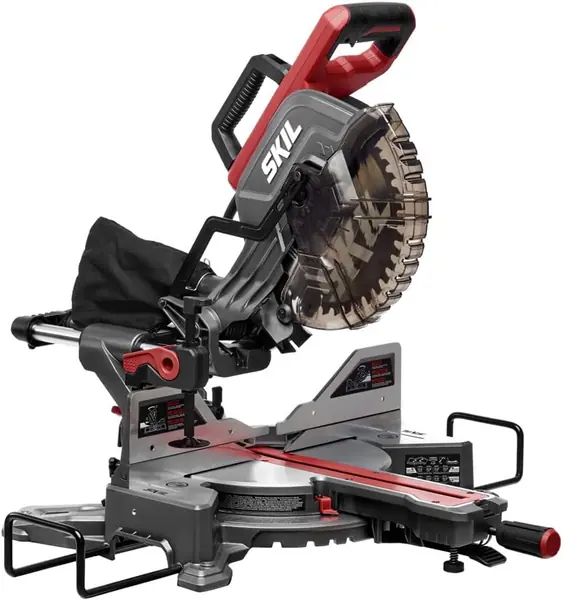
SKIL MS6305-00 10-inch dual bevel sliding miter saw in red and black

Budget trim work

Shop Score 95/100
Blade Size
10 inches
Weight
39.4 lb
Crosscut Capacity
2 x 12 at 90° and 2 x 8 at 45°
Bevel Stops
Left: 0°, 45°, 48° / Right: 0°, 45°
View on Amazon

The least expensive dual-bevel slider in this group is also the one with the feature we care most about: an LED shadow line that casts the blade's silhouette onto the board, so the cut lands on the pencil line with nothing to adjust or re-align. Eleven positive stops and 50 degrees of miter travel both ways put the common angles a click away, which is what sold us on it for trim work.

It cuts more than the blade size suggests: 2 x 12 at 90 degrees and 2 x 8 at 45, with tall sliding fences that hold 4-1/2 inches of base upright and 6-1/4 inches of crown nested. The 15-amp motor spins a 10-inch blade at 4,800 rpm, quick for this class, and with a fine blade fitted the trim cuts come off clean.

Bevel changes are the fussy part. The scale and its detents take a careful hand, so we set the bevel against a square once and left it there rather than trusting the pointer. That workaround takes five minutes and settles the one complaint we have about an otherwise generous saw.

Worth Noting

  • Dust bag catches very little
Our Verdict

Dual-bevel sliding capacity and a shadow line at the low end of the price range make this the saw we suggest for a first trim setup.

Check Latest Price
3.

DEWALT DCS361B 20V MAX 7-1/4-Inch Miter Saw Best Cordless

DEWALT 20V MAX cordless 7-1/4-inch sliding miter saw in yellow and black

Trim on site

Shop Score 94/100
Blade Size
7-1/4 inches
Weight
30 lb
Power Source
20V MAX battery, tool only
Vertical Capacity
3-5/8-inch nested crown and 3-1/2-inch base
View on Amazon

No cord and 30 pounds is the whole pitch. This saw goes up a flight of stairs, into a closet and onto a roof deck without an extension cord trailing behind, and it sits steady on a small bench because the rails are short and the body is light. For a remodel where the saw moves room to room, that is the difference between cutting in place and cutting in the driveway.

Capacity is trim-scale: 3-5/8 inches of nested crown and 3-1/2 inches of base standing against the fence, with a 7-1/4-inch blade doing the work. DEWALT's own figure is 183 cuts of 2x4 pine per charge, and that lines up with what we saw running baseboard — the saw is quiet and quick in pine and lets you know when you ask too much of it.

What surprised us is how often it replaces the big saw rather than supplementing it. For one room of baseboard, a set of shelves or a run of fence boards, setup takes less time than dragging out a corded saw and finding an outlet, and the shadow line means you are not leaning over to sight a laser. It is not a framing saw and does not pretend to be one.

Worth Noting

  • Tool only, no battery or charger
Our Verdict

For punch-list trim and remodels where there is no outlet, we take this one: 30 pounds, no cord, and a cut line that needs no adjusting.

Check Latest Price
4.

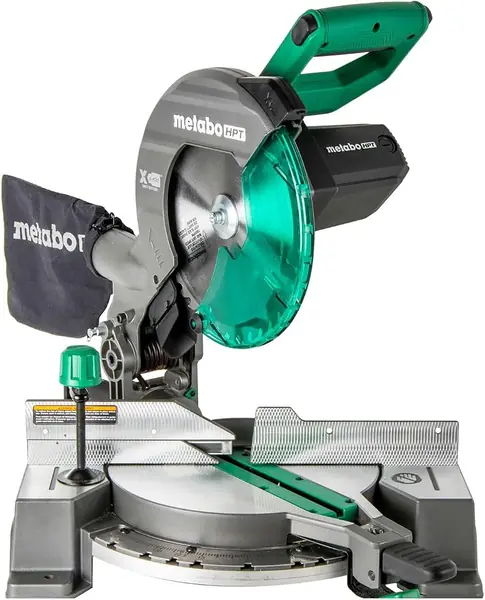
Metabo HPT C10FCG2 10-Inch Compound Miter Saw Best Budget

Metabo HPT C10FCG2 10-inch compound miter saw in green and black

Occasional home projects

Shop Score 90/100
Blade Size
10 inches
Bevel Range
0° to 45° left
Warranty
5 years, tool body
Miter Range
52° left and right
View on Amazon

At 24.2 pounds this is the lightest saw in the group, and that is most of the argument for it: one hand takes it off a shelf, sets it on a Workmate, and you are cutting. We like it for the jobs where a miter saw is a convenience rather than the point — a fence repair, a closet rod, one door casing.

The 15-amp motor runs a 10-inch blade at up to 5,000 rpm, the miter table swings 52 degrees both ways, and the shadow line does the same no-adjustment trick as the more expensive saws. Without a sliding head, anything wider than the blade's reach gets flipped and cut from both sides, so treat this as a crosscut and trim saw rather than a board-breaking saw.

Build quality is the surprise. It is not a heavy tool, but the table is large, the fence is straight, and the five-year tool-body warranty is longer than the three-year coverage on the DEWALT and SKIL saws. For what it costs, that combination is hard to argue with.

Worth Noting

  • Bevels left only, never to the right
Our Verdict

Twenty-four pounds, a clean cut and the longest warranty here — that is why we keep this one for the small jobs.

Check Latest Price
5.

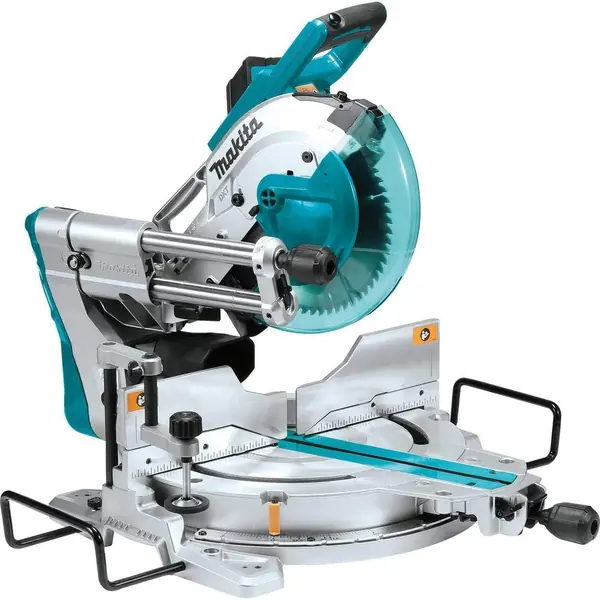
Makita LS1019L 10-Inch Sliding Miter Saw Best for Small Shops

Makita LS1019L 10-inch dual-bevel sliding miter saw in teal and silver

Small shops

Shop Score 89/100
Blade Size
10 inches
Nested Crown Capacity
6-5/8 inches
Speed
3,200 rpm
Bevel Type
Dual bevel
View on Amazon

Front-mounted rails are the idea worth paying for. The head travels on two steel rails bolted to the front of the saw, so the body can sit flush against a wall instead of needing clearance behind it. In a garage where the saw bench doubles as an assembly surface, that turns a saw you drag out into a saw that lives there.

Dust collection is the other thing we noticed: the duct and bag keep most of the spoil out of the air, which is unusual on a miter saw, and the soft-start direct-drive motor comes up to speed without the lurch a belt-driven head gives you. Capacity covers 6-5/8 inches of nested crown and 4-3/4 inches of baseboard, and the saw takes 4x4 stock in a single pass.

The laser tracks the kerf and the cut quality is finish-grade, so nothing about this saw feels built to a price. It is also the most expensive one here, and that is the honest trade: you are buying a smaller footprint, cleaner air and a smoother start, not deeper cuts than the 12-inch DEWALT. Fit a 60-tooth blade and it leaves a glue-ready edge on casing.

Worth Noting

  • Alignment and 45-degree bevels can arrive off
Our Verdict

For a shop where the saw bench sits against a wall, we think the flush-cutting rails and the dust collection justify the premium.

Check Latest Price
6.

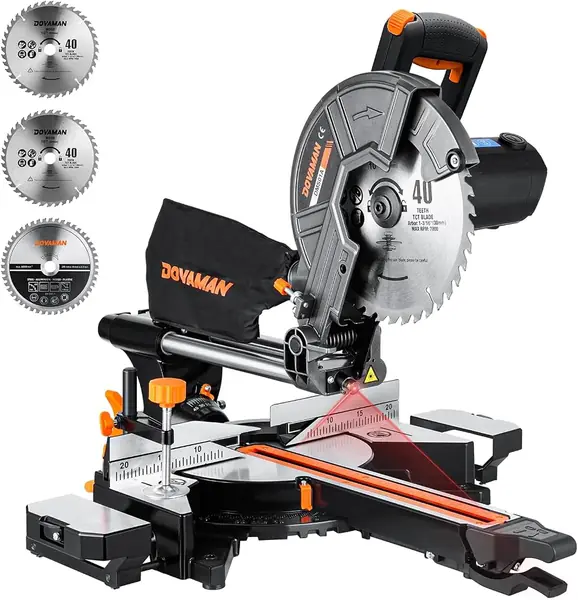
DOVAMAN DMS01A 10-Inch Sliding Miter Saw

DOVAMAN DMS01A 10-inch sliding miter saw in black with side extension tables

First shop

Shop Score 87/100
Blade Size
10 inches
Weight
37.5 lb
Bevel Range
0° to 45°
Max Crosscut
3.5 x 13.4 inches
View on Amazon

Three blades in the box is an odd place to start a saw review, but it tells you what DOVAMAN is up to: two 40-tooth and one 48-tooth carbide blade ship with the saw, along with a laser, a hold-down clamp and extension rods on both sides. For a first shop buying everything at once, that is a meaningful head start.

The 15-amp motor has two speeds, 5,000 and 3,200 rpm, and the rails give it a stated maximum cut of 3.5 x 13.4 inches, which covers most shelving and decking stock. Nine positive stops handle the miter side, the bevel runs from zero to 45, and at 37.5 pounds it is portable without feeling flimsy on the bench.

What surprised us is how much of the layout feels considered rather than cost-cut: the extension rods hold a long board without a second pair of hands, the clamp is included, and the slower speed setting is genuinely useful with the multi-material blades. Details like that usually disappear at this end of the market.

Worth Noting

  • Bogs down in thick hardwood
Our Verdict

We point first-time buyers here when the budget is tight: three blades, a laser and two speeds for less than the other sliders cost.

Check Latest Price

How We Tested the Best Miter Saws

We compared current corded and cordless saws on stated crosscut capacity, bevel range and positive stops, miter detents, footprint with the rails extended, price against what each could actually cut, and warranty terms, and passed on any listing that didn't publish a bevel range or miter stops at all. From that shortlist we brought in eight saws and spent nine months with them in a basement shop and on trim calls during a garage and porch renovation.

Each saw was clamped to a bench and put through the same work: crosscutting shelf stock and framing lumber, cutting baseboard flat and in position, and standing nested crown against the fence to see if the blade cleared it. To judge squareness, we cut a board, flipped one offcut, and pressed the two faces together to look for daylight. We swung the table to 0 and 45 degrees repeatedly to see whether the detents repeated, tilted the head through its full bevel to feel where the stops landed, and lined up each laser on a pencil mark to check it against a square.

Because these saws move, we carried every one up a flight of stairs and measured how much bench it ate with the rails run out. Dust got its own session: after several dozen cuts we looked at what the bag caught and how much landed on the floor.

We listened to each motor start cold, noted whether it jumped or came up soft, fed stock at a steady rate to watch for bogging and burn marks, and watched the included blades dull to see how long they held an edge. We pulled the plug or the battery before every blade change, checked that each guard retracted and returned freely before each session, and held short offcuts with the clamp, hands clear of the blade path.

How to Choose a Miter Saw

Match Capacity to What You Actually Cut

Capacity is where miter saws differ most and where listings mislead most. A 10-inch saw without a slide crosscuts a 2x6; the sliding 10-inch saws here reach 2 x 12 at 90 degrees and 2 x 8 at 45, and the 12-inch DEWALT goes to 2 x 14 and 2 x 10. The same split shows up vertically, from roughly 3-5/8 inches of nested crown on a compact cordless to 7-1/2 inches on the big slider. Write down the widest board and the tallest crown in your plans, then check the number — a saw that needs two passes for every shelf is a false economy.

Decide Single or Dual Bevel Before Anything Else

A single-bevel saw leans left only, so a right-hand bevel means flipping the stock and losing your reference face. Dual-bevel saws swing both ways and are worth the money if you cut crown, casings or anything with matching miters and bevels; the SKIL and the 12-inch DEWALT are dual. If nearly every cut you make is a 90, a single-bevel 10-inch saw like the Metabo does the job for less and weighs less. Check the stops too: a detent you can feel at 0, 22.5 and 45 beats a printed scale every time.

Know Where the Cut Line Comes From

Three systems turn up: a laser, an LED shadow line, and nothing at all. A shadow line throws the blade's own silhouette onto the board, so it cannot drift out of alignment and it follows the kerf of whatever blade you fit; lasers need adjusting, and on a less expensive saw they often arrive a little off. A saw with neither is not a dealbreaker — you line the teeth against the pencil mark — but if you cut trim all day, the shadow line is the convenience we would pay for first.

Check the Footprint Before the Features

Rails decide where a saw can live. Rear-mounted rails, the usual arrangement, need clearance behind the saw, which pushes the bench out from the wall; Makita's front-mounted rails let the LS1019L sit flush. Weight runs from about 24 pounds on the Metabo to 67.7 on the DEWALT slider, and that is the difference between a saw you carry to the work and one you bolt to a stand. If it only ever moves across the shop, weight buys stability; if it rides in a truck, weight is the whole decision.

Plan for the Dust

Dust collection is the most oversold line on a miter saw listing. Even saws that claim high capture rates leave a pile behind the fence, and the bags on less expensive models fill fast and pass the fines straight through. Treat the bag as a courtesy and budget for a shop vac and an adapter, or set the saw where sweeping up is easy. Dust handling has never been the reason we chose one saw over another.

Frequently Asked Questions

Final Verdict

For most woodworking, we point people to the DEWALT DWS779. It crosscuts a 2x14, nests 7-1/2 inches of crown, and returns to the same angle every time you swing the head back to zero.

When the bench sits against a wall and the dust is what bothers you most, the Makita LS1019L is the better buy. When the saw has to go to the work instead, take the cordless DEWALT and a couple of 5.0Ah packs.