↑↓ navigate ↵ open Esc close All results →

Best Sliding Compound Miter Saws of 2026

Every miter saw feels tight on a showroom display, yet half a degree of bevel or miter slop shows up instantly at home when trim miters gape and demand caulk. What separates dependable sliders from frustrating ones is arriving square out of the box and holding detent stops cleanly under heavy crosscuts.

Nine months of running eight saws — from a 7-1/4-inch cordless unit carried up stairs and a forward-rail glide model built for shallow benches to full-size sliders — put them through baseboard, nested crown against the fence, and 2x12 framing on sawhorses. Cut-line visibility proved nearly as decisive as blade quality: a shadow line projects the true kerf width directly onto the stock, whereas a laser throws a narrow stripe that still has to be indexed against the teeth.

Bench depth, portability for stairs or trim trailers, and multi-material capability for wood and aluminum vary by shop, while reliable stops and clear cut lines remain non-negotiable across all of them.

Our Top Picks

The Best Sliding Compound Miter Saws

1.

DEWALT DWS780 12-Inch Sliding Miter Saw Best Overall
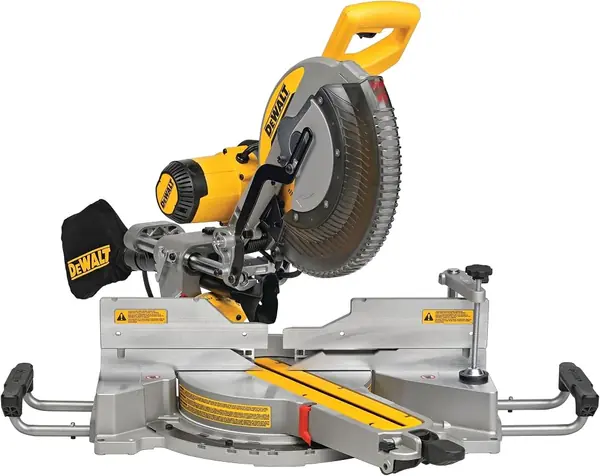
DEWALT DWS780 12-inch double-bevel sliding compound miter saw in black and yellow with dust bag

Trim and framing

Shop Score 96/100
Weight
54.7 lb
Blade Diameter
12 inches
Bevel
Double bevel, left and right
No-load Speed
3,800 rpm
View on Amazon

A shadow line is what we point people to first on this saw. A light beside the blade casts its silhouette on the stock, so the kerf itself becomes the line you follow — nothing to adjust, and nothing that drifts out of alignment the way a laser can. Put a pencil mark under the shadow and the tooth lands on it.

Fifteen amps turning a 12-inch blade at 3,800 rpm is more motor than a home shop usually needs, and the double-bevel head lets you cut a compound angle with the stock still flat against the fence. Baseboard, casing, shelving, deck boards: we did not find a cut in that range where the saw felt out of its depth, which is exactly what we want from the one saw in the shop. The miter handle is a cam lock, and the stainless detent plate has stops where you actually cut.

Weight is what you plan around. At 54.7 pounds the DWS780 belongs on a stand, and a saw this size needs clearance behind it for the rails to travel. Measure the wall-to-front space before it arrives, because a slider parked against a wall will not make a wide cut.

The detent plate is the part we keep coming back to. Swing the head from 0 to 45 and the stop is where the scale says it is, with no rocking around to find it — and that is what makes a repeatable cut repeatable.

Worth Noting

  • Dust bag leaves the fines on the floor
Our Verdict

We recommend this 12-inch dual-bevel slider to anyone who wants one saw that handles trim, crown, and framing without a second machine.

Check Latest Price
2.

DEWALT DCS361B 20V MAX 7-1/4-Inch Miter Saw Best Cordless

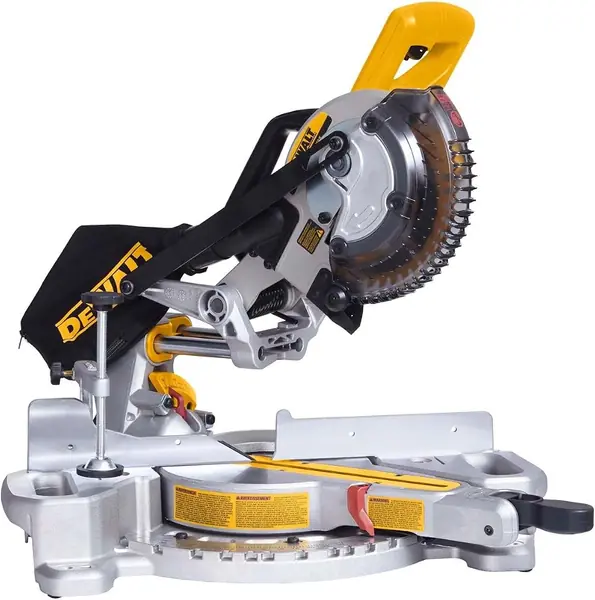
DEWALT 20V MAX cordless 7-1/4-inch sliding miter saw in black and yellow, tool only

Finished-room trim work

Shop Score 95/100
Weight
30 lb
Blade Diameter
7-1/4 inches
Nested Crown Capacity
3-5/8 inches
Battery Platform
20V MAX
View on Amazon

Carrying the saw to the work is the whole idea here. At 30 pounds with no cord to chase, this is the saw you set on a pair of sawhorses in a hallway and use to run baseboard through three rooms without dragging an extension cord up the stairs. We think that freedom is worth more than capacity for anyone whose work is mostly trim.

The capacity it does have is trim-shaped: 3-5/8 inches of nested crown and 3-1/2 inches of base standing against the fence, 11 positive stops at the angles you actually cut, and a cut-line indicator that needs no calibration. DEWALT rates a charge at 183 cuts of 2x4 pine, and the saw runs on the same 20V MAX packs as the rest of the line.

Where it makes sense is a truck that already carries those packs, or a remodel where every cut happens three rooms from the nearest outlet. It is not a stand-in for a 12-inch saw on wide stock, and thick hardwood wants a slower feed than the corded saws here. On finished floors, that is a trade we make gladly.

Worth Noting

  • Bare tool, so battery and charger cost extra
Our Verdict

For trim work in finished rooms, we take the cordless DEWALT: 30 pounds, no cord, and enough capacity for crown and base.

Check Latest Price
3.

Bosch CM10GD 10-Inch Dual-Bevel Glide Miter Saw Best for Small Shops

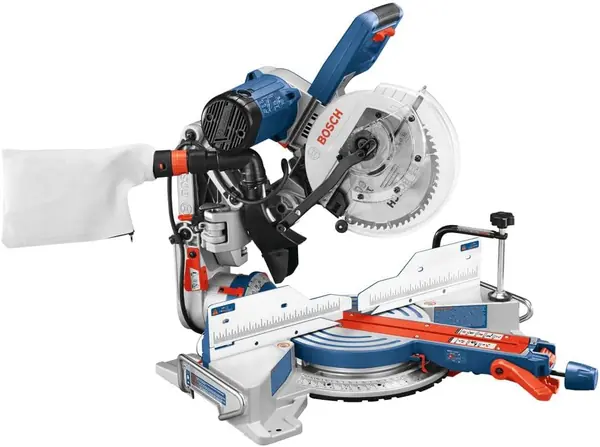
Bosch CM10GD 10-inch dual-bevel glide miter saw in blue with articulated hinge arms

Narrow shops

Shop Score 92/100
Weight
64 lb
Blade Diameter
10 inches
Nested Crown Capacity
6 inches
Crosscut Capacity
12 inches
View on Amazon

The CM10GD does away with rails. Two articulated hinge arms carry the head instead, and the payoff is depth: Bosch puts the savings at up to 10 inches of front-to-back footprint compared with a sliding saw of similar capacity, which is the difference between a bench against the wall and a bench pulled out into the room.

The controls are arranged for close quarters too. The bevel lock lever and range selector sit at the front, so you set an angle without walking around the head. A 15-amp motor spins a 10-inch blade at 4,800 rpm, and the saw crosscuts 12 inches of stock, taking 6-inch crown nested or 5-1/2-inch baseboard standing against the fence.

What we keep noticing is how little room the saw takes up while still cutting like a full-size slider. Drop the head through a 12-inch crosscut and the arms fold into space the head already occupied, so nothing swings out behind you into a walkway. In a one-car garage or a basement bay, that is the difference between a saw you leave set up and one you put away.

Worth Noting

  • Pricier than the 12-inch saws here
  • 64 lb keeps it on one bench
Our Verdict

Our pick when the saw has to live against a wall: the glide arms save bench depth and the cut quality holds up.

Check Latest Price
4.

Makita LS1019L 10-Inch Dual-Bevel Sliding Miter Saw Best for Crown Molding

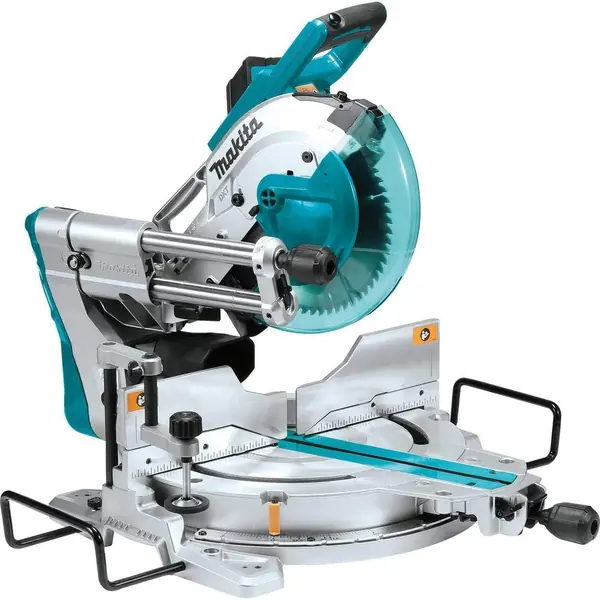
Makita LS1019L 10-inch dual-bevel sliding miter saw with laser guide and steel rails

Crown and casing

Shop Score 91/100
Weight
57.9 lb
Blade Diameter
10 inches
Nested Crown Capacity
6-5/8 inches
Vertical Capacity
5-1/4 inches
View on Amazon

Six and five-eighths inches of nested crown from a 10-inch blade is the number to start with. That is crown you would normally need a 12-inch saw to cut, so this one handles full crown returns without a bigger machine and the bench space that comes with it.

The rails are how Makita fits that capacity into a smaller body. Two steel rails ride on linear ball bearings in a single slide-glide action, and the design keeps the saw compact enough to work flush against a wall. Vertical capacity is 5-1/4 inches, so tall baseboard stands up against the fence instead of lying flat.

A direct-drive gearbox and guard free up that height — there is no belt housing eating the space above the table. A laser marks the cut, the head bevels in both directions, and the saw weighs 57.9 pounds, a few pounds more than the DEWALT 12-inch and noticeably less than the Bosch glide.

Where this one earns its place is finish carpentry: crown, casing, and any job where you cut the same angle forty times and want the fence doing the holding. If most of your cutting is 2x stock for decks and outbuildings, a 12-inch saw is the better use of the bench. For trim, nothing in this group feels more settled.

Worth Noting

  • Highest price in this group
Our Verdict

Finish carpenters should start here: 6-5/8-inch nested crown from a 10-inch blade, with rails that do not need room behind the saw.

Check Latest Price
5.

SKIL MS6305-00 10-Inch Dual-Bevel Sliding Miter Saw Best Value

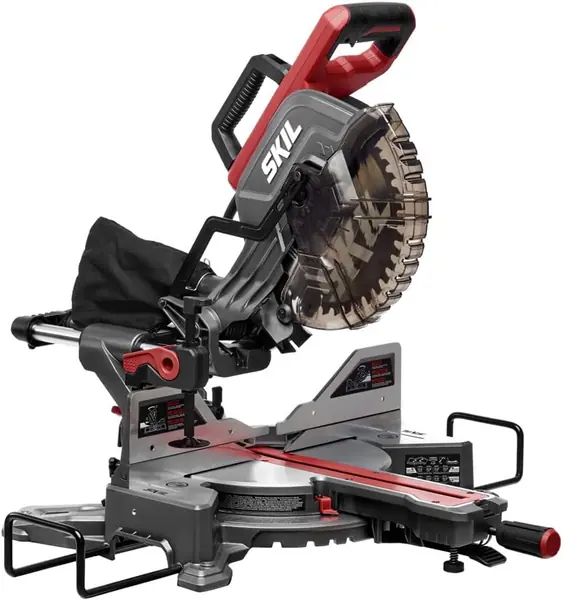
SKIL 10-inch dual-bevel sliding compound miter saw with LED shadow line and dust bag

Weekend trim projects

Shop Score 90/100
Weight
39.4 lb
Blade Diameter
10 inches
Crosscut Capacity
2x12 at 90 degrees, 2x8 at 45 degrees
Bevel Stops
Left 0, 45, 48 degrees; right 0, 45 degrees
View on Amazon

Dual bevel, a 15-amp motor turning 4,800 rpm, an LED shadow line, and a 2x12 crosscut: this is a lot of saw for the money, and after using it on shelving and trim we think it is the value pick of the group. Nothing about the cut quality left us wanting a more expensive saw.

Two features do the heavy lifting. The shadow line shows the actual kerf rather than a laser dot, so you line up a pencil mark and cut, and it never needs calibrating. The head also bevels both ways with stops at 0, 45, and 48 degrees, which saves flipping stock on a compound cut. At 39.4 pounds it is close to the lightest full-size corded saw here.

Where it lands is the weekend trim shop: dual bevel, a shadow line, and enough motor for 2x stock without the premium the DEWALT and Makita carry. The fence takes 6-1/4-inch crown nested, the horizontal handle with a center trigger works in either hand, and the whole package moves in one trip from the truck.

Worth Noting

  • Bevel scale takes a nudge to hit exact angles
Our Verdict

We think this is the best value in the group: dual bevel, a shadow line, and 39.4 pounds without a premium price.

Check Latest Price
6.

DOVAMAN DMS01A 10-Inch Sliding Miter Saw

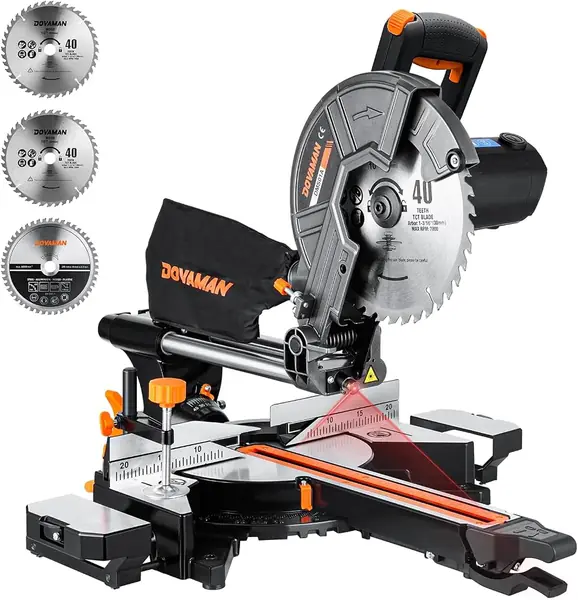
DOVAMAN 10-inch sliding miter saw in black with laser guide and three TCT blades

First mixed-material shop

Shop Score 87/100
Weight
37.5 lb
Blade Diameter
10 inches
Maximum Cut
3.5 x 13.4 in
Speed
3,200 and 5,000 rpm
View on Amazon

Three carbide blades in the box — two 40-tooth and one 48-tooth — say what DOVAMAN built this saw for: a shop cutting wood, plastic, and the occasional soft metal without buying a second machine. There is a two-speed switch at 5,000 and 3,200 rpm, a 13-inch slide that opens the cut to 3.5 by 13.4 inches, a laser, and side tables that pull out for long stock.

For a first saw, we think that is a lot of capability for the outlay. The ambidextrous switch and the two speeds make it easy to hand to someone who has not used a slider, and the extension tables mean a 10-foot trim board is not fighting a 20-inch table. It cuts square, and for a shop being outfitted from scratch, that is most of the argument.

Worth Noting

  • Single-direction bevel means flipping stock
  • Motor takes a beat to reach full speed
Our Verdict

A sensible first sliding saw for a mixed-material shop, as long as you accept a one-way bevel and a slow spin-up.

Check Latest Price
7.

DOVAMAN 12-Inch Dual-Bevel Sliding Miter Saw Best for Budget 12-Inch Cuts

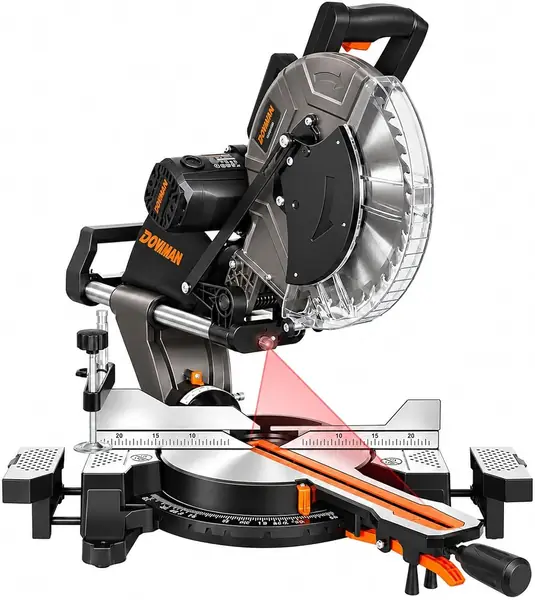
DOVAMAN 12-inch dual-bevel sliding compound miter saw in black with laser guide

Budget 12-inch cuts

Shop Score 85/100
Weight
53.9 lb
Blade Diameter
12 inches
Bevel
0-45 degrees, dual
Maximum Cut
4.2 x 13 in
View on Amazon

Twelve inches of blade, a 4.2 by 13 inch maximum cut, and a dual-bevel head, in a saw that costs less than several of the 10-inch models here. If your projects keep running into stock that is too wide for a small saw, that combination is the reason to look at this one.

The rest of the spec sheet is fuller than the price suggests: 15 amps at 3,800 rpm, nine positive stops, an ambidextrous switch with a safety lock, a dust bag, a material clamp, and a spare set of carbon brushes. The 40-tooth blade it ships with is a framing and decking count, so plan on a finer blade for finish trim.

We think that is the right trade for a shop that needs a 12-inch crosscut a few times a month rather than every day. The capacity is real, the bevel swings both ways with a lock that does not creep, and at 53.9 pounds it is manageable on a stand you leave set up. That is the bargain: capacity first, polish second.

Worth Noting

  • Laser can arrive out of line
Our Verdict

Buy this if you need 12-inch capacity and the budget will not stretch to a premium slider; the cuts are square, the polish is thin.

Check Latest Price

How We Tested the Best Sliding Compound Miter Saws

We started with roughly 30 saws from brands with a track record in woodshops, then narrowed the field on the things that actually change a buying decision: blade size and motor power, dual versus single bevel, crosscut and nested-crown capacity, and how much bench depth the rails or glide arms eat when fully extended. Eight saws made the cut, and we ran them for nine months.

Testing happened where these saws live: a garage shop, a driveway with two sawhorses, and a finished bedroom where the baseboard had to meet an out-of-square corner. In each session we cut the same stock — 1x4 and 3-1/4-inch base, crown nested against the fence, and 2x12s to find the real crosscut limit — clamping short pieces against the fence and supporting long stock at table height on both sides so nothing bound or lifted mid-cut. We checked whether the first cut was square out of the box, rechecked after every stop adjustment, and stacked identical cuts face to face to see daylight through the gap.

We timed miter and bevel changes from one detent to the next, watched whether the shadow line or laser fell on the same side of the kerf as the teeth, and noted how much dust landed in the bag versus on the floor and the fence. Each saw got weighed and hauled up a flight of stairs, and we logged what came in the box, from the blade and material clamp to batteries and wrenches. At the nine-month mark we rechecked square, looked for rust on the tables, and judged which saws still felt worth what they cost.

How to Choose a Sliding Compound Miter Saw

Blade Size Comes First

A 10-inch sliding miter saw handles most trim, and the lighter ones here come in under 40 pounds. A 12-inch saw buys wider crosscuts and more bevel capacity, and it charges you in weight and bench space: the 12-inch models in this group run about 54 pounds, and one 10-inch saw here weighs more than that anyway.

Measure the widest board you cut and buy for it with an inch of margin. Between sizes, the smaller saw is the one that stays set up.

Shadow Line, Laser, or Neither

A cut-line guide is what separates a confident cut from a pencil squint. A shadow line throws the blade's silhouette onto the stock, so the kerf itself is the mark and there is nothing to calibrate. A laser draws a line that can drift and takes a hex key to bring back.

We prefer a shadow line, and it is what the DEWALT DWS780 and both SKIL saws use. A laser is not a dealbreaker — just check it against a test cut before you trust it on finish work.

Single Bevel or Dual Bevel

A single-bevel saw tilts the head one way; a dual-bevel tilts both, so the other half of a compound angle does not require flipping the workpiece and losing your reference face. If you cut crown and casing regularly, dual bevel is worth paying for.

If your work is square cuts and the occasional 45, a single-bevel saw saves money — just remember that every left-hand bevel becomes a stock-flipping operation, and on long stock that is a two-person job.

Where the Saw Sits

Every slider needs somewhere for its travel to go. Conventional rails run out the back, so the saw has to stand clear of the wall, often far enough that the bench has to move. Compact rails and glide-arm designs cut that down: Bosch puts the CM10GD up to 10 inches shallower than a comparable slider, and the Makita's rails let it work flush against a wall.

Measure the depth you have, subtract the stock, and pick a design that fits. A saw you have to pull into the room is a saw you stop using.

Dust and the First Cut

Assume dust collection is a compromise. Bags on these saws catch the chips and let the fines through, so a shop vac on the port does more than any bag design; if the saw lives in a basement, plan the hose run before you set the bench.

Then check the saw before its first project: cut a scrap, stand it on edge, and compare it to a framing square. Detents move in shipping, and five minutes with a test board saves a ruined run of casing.

Frequently Asked Questions

Final Verdict

For most woodworkers we recommend the DEWALT DWS780. The shadow line makes every cut easier to place, the double-bevel head handles compound angles without flipping stock, and 12 inches of blade covers trim and framing from one machine.

Two situations call for something else. If the saw travels to finished rooms, the 30-pound cordless DEWALT is the one to carry. If your bench sits against a wall, the Bosch glide buys back the depth a rail saw needs.