↑↓ navigate ↵ open Esc close All results →

Best Miter Saws for Trim Work of 2026

An open gap at a crown return or a wedge of daylight under a baseboard miter shows from across the room, and both failures trace straight to a saw that refuses to hold its setting. Trim work leaves no margin for a half-degree of drift once framing rough-in gives way to finish molding.

Nine miter saws — corded and battery, single- and double-bevel — cut nested crown and standing baseboard across an upstairs hallway, a basement build-out, and a rental turnover over 10 months of hauling between sites. First-time buyers routinely overrate blade diameter while overlooking fence height, yet a 12-inch blade cannot nest crown against a short fence.

Every model among these seven matches real molding profiles, holds calibration through transport, and casts a trustworthy cut line right on the pencil mark. Some stay anchored against a shop wall all season while others carry easily up a stairwell, so the right match comes down to where the trim is cut.

Our Top Picks

The Best Miter Saws for Trim Work

1.

DEWALT DWS716XPS 12-Inch Miter Saw Best Overall
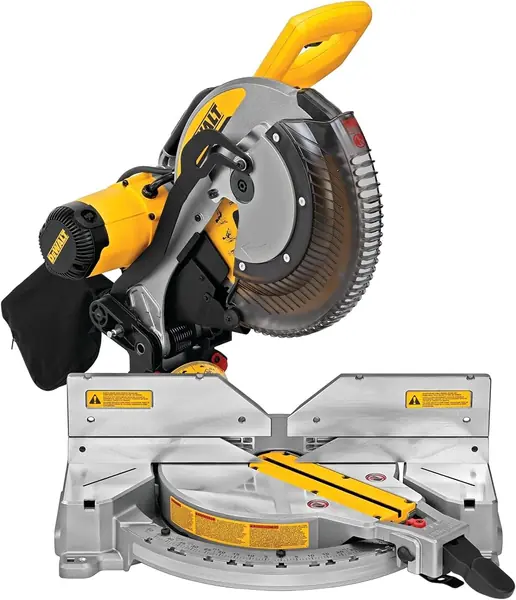
DEWALT DWS716XPS 12-inch double-bevel compound miter saw in yellow and black with dust bag

Crown and baseboard

Shop Score 95/100
Blade Size
12 inches
Bevel Type
Double, 0 to 48 degrees both ways
Nested Crown Capacity
6-5/8 inches
Base Molding Capacity
6-1/2 inches
View on Amazon

Two numbers decide this saw for trim: 6-5/8 inches of nested crown and 6-1/2 inches of baseboard standing against the fence. That is the most baseboard height in this group, with crown capacity to match it, and it is why this is our top pick. The 12-inch blade helps, but the tall sliding fences are what let you stand a piece of five-inch base upright and cut a 45 without shimming it off the table.

The XPS light throws a shadow of the blade onto the material instead of a laser line, so what you line up is the kerf itself. On stained or dark trim, where a red dot vanishes, that is genuinely useful. The head bevels 0 to 48 degrees in both directions with positive stops at 0, 22.5, 33.9 and 45; 33.9 is the crown stop and it is there on both sides. The miter table swings 50 degrees left and right on 14 detents with a cam lock, and a 15-amp motor turns the blade.

What you give up is reach. There is no sliding carriage, so wide casing heads, deep shelves, and anything past the crosscut capacity need a flip or a different saw. For crown, base, casing and shoe molding the fences do the working, and for trim that is the trade worth making.

Worth Noting

  • 49-pound head needs two hands
Our Verdict

Our pick for trim: it holds more baseboard and crown against the fence than anything else here, and the shadow line puts the kerf where you can see it.

Check Latest Price
2.

Makita LS1019L 10-Inch Sliding Miter Saw Best for Crown Molding

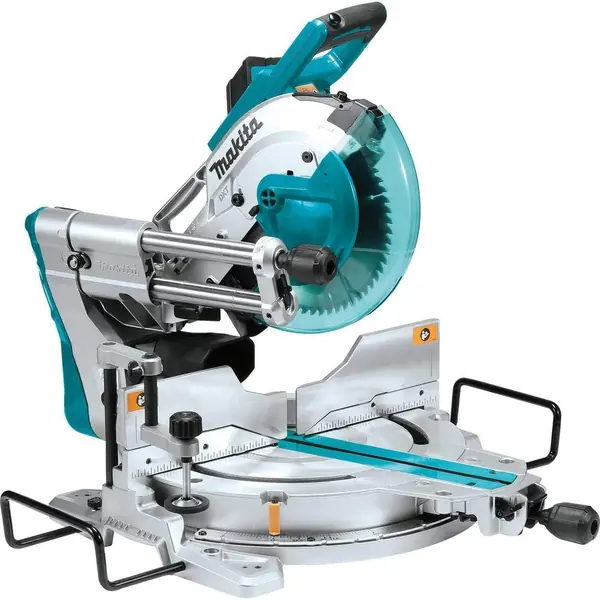
Makita LS1019L 10-inch sliding compound miter saw with laser and vertical vise

Crown molding

Shop Score 94/100
Blade Size
10 inches
Bevel Type
Dual-bevel sliding
Nested Crown Capacity
6-5/8 inches
Baseboard Capacity
4-3/4 inches
View on Amazon

A 10-inch blade with 12-inch crown capacity is the trick here: 6-5/8 inches nested, 4-3/4 inches of baseboard standing, and 4x4 stock in a single pass. The two steel rails are mounted at the front, so the head travels over the table rather than behind it, and the saw can sit flat against a wall. In a hallway or a closet, that is the difference between a workable setup and a shuffle.

We noticed the soft start on the first cut — no lurch when the trigger goes down, and the blade is at speed before it touches pine. The linear ball-bearing rails pull smooth through a full stroke, and the dust collection is the best in this group by our reckoning; the bag fills instead of the floor.

Check it before you trust it on crown. Hold a straightedge across both fence halves, make a test cut at 45, and flip one piece to compare the joint. Some of these arrive with a fence knocked back or a bevel that will not quite land on the detent, which is a shipping problem rather than a design one, and ten minutes with a square and a scrap of pine settles it.

Where it earns its place is the combination: close to the capacity of a 12-inch saw in a 10-inch body, front rails that let it tuck against a wall, and dust control that keeps a finished room cleaner. If crown is the job, this is the saw we take.

Worth Noting

  • Heavy for a 10-inch saw
Our Verdict

For crown, this is the one we take: a 10-inch slider carrying 12-inch capacity, with front rails that sit flush to a wall.

Check Latest Price
3.

DEWALT DCS361B 20V MAX 7-1/4-Inch Miter Saw Best Cordless

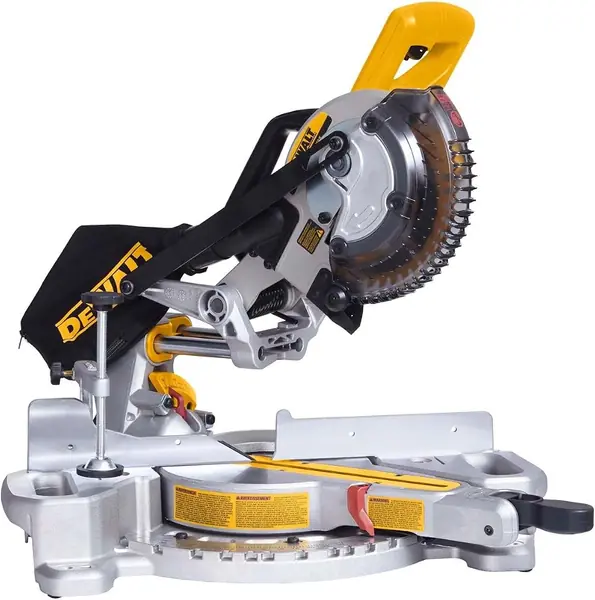
DEWALT DCS361B 20V MAX cordless 7-1/4-inch sliding miter saw in black and yellow

Punch-out trim work

Shop Score 93/100
Blade Size
7-1/4 inches
Weight
30 lb
Nested Crown Capacity
3-5/8 inches
Power Source
20V MAX battery
View on Amazon

Seven and a quarter inches of blade, 30 pounds, no cord. This is the saw for the second floor of a house with the furniture already in it. It carries 3-5/8 inches of nested crown and 3-1/2 inches of base standing against the fence, which covers casing, shoe, and standard base; five-and-a-half-inch base and big crown profiles belong to the corded saws.

What we like is how little ceremony it requires. Set it on a bench or on the floor, click a pack in, and cut. DeWalt rates it at 183 cuts of 2x4 pine or 275 cuts of 3-1/4-inch pine baseboard per charge, which in practice is a room or two of trim. The cut-line indicator is fixed and needs no adjustment, and 11 detents cover the angles trim actually uses. Check your packs before you plan a day around it: the largest high-capacity 20V batteries do not seat in this slot.

Power is the honest limit. It is a small saw with a brushed motor, and it does its best work in pine, MDF and composite; in thick hardwood you will hear it laboring. Keep a sharp 40- or 60-tooth blade on it, let it reach full speed before the teeth meet wood, and it holds its line.

Worth Noting

  • Bare tool with no battery or charger
Our Verdict

We recommend it where the outlet is not: a cordless trim saw with a fixed cut line and room for standard base and crown.

Check Latest Price
4.

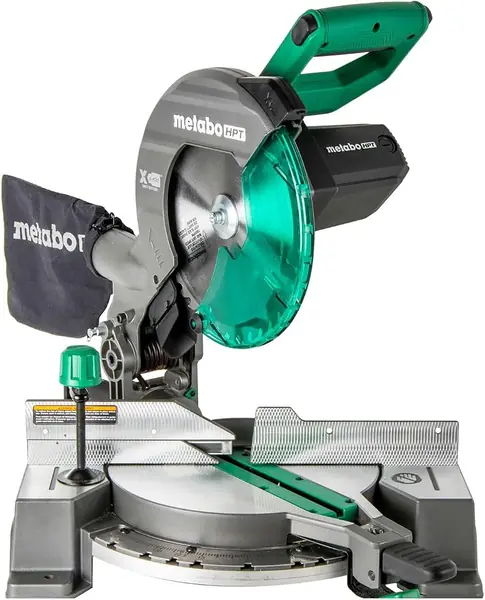
Metabo HPT C10FCG2 10-Inch Miter Saw Best Budget

Metabo HPT C10FCG2 10-inch single-bevel miter saw in green with 24-tooth blade

Baseboard and casing

Shop Score 90/100
Blade Size
10 inches
Weight
24.2 lb
Bevel Type
Single, 0 to 45 degrees left
Miter Range
0 to 52 degrees both ways
View on Amazon

This is the least expensive saw here, and it is a real 15-amp 10-inch machine: up to 5,000 rpm, a table that swings 52 degrees both directions, and a five-year warranty on the tool body. That warranty is what we keep coming back to at this price, since nothing else in this group covers the saw that long. At 24 pounds it moves easily and sits steady on a bench.

Base, casing, and shoe come out clean, and the table is wide enough for four-inch stock. Pair it with a 60- or 80-tooth blade and it turns into a credible finish saw, because the blade in the box is a general-purpose one. Tall crown is where it runs out, so hold your widest profile against the fence before you commit to it.

Worth Noting

  • Single bevel means flipping crown end for end
  • Fixed head limits wide crosscuts
Our Verdict

For one room and a fixed budget, this is the saw we point to: 15 amps, a five-year warranty, and the lowest price in this group.

Check Latest Price
5.

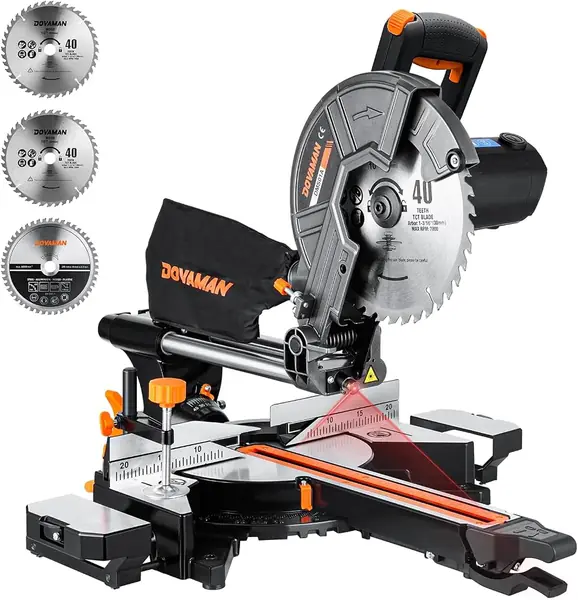
DOVAMAN DMS01A 10-Inch Sliding Miter Saw Best Value Slider

DOVAMAN DMS01A 10-inch sliding miter saw in black with laser guide and extension tables

Wide casing

Shop Score 88/100
Blade Size
10 inches
Speed
5,000 or 3,200 rpm
Max Crosscut
3.5 by 13.4 inches
Included Blades
Three TCT
View on Amazon

Three blades, two extension tables, and 13 inches of rail travel arrive in the box. This 10-inch slider crosscuts 3.5 by 13.4 inches, more reach than several of the fixed-head saws here, and the head has nine positive stops, a laser, and a two-speed switch: 5,000 rpm for wood, 3,200 for plastic and soft metal.

That reach is the whole argument. Wide fascia, shelf stock, and head casing that need a flip on a non-slider come off in one pass here, and the extension tables mean a 12-foot length of base is not balanced on a two-foot table. We also appreciate the ambidextrous layout, because the controls fall under either hand.

Setup is where you spend your time. The motor takes a beat to spin up and there is no blade brake, so wait for it to stop before you lift the head. Treated as a paint-grade saw it is fine; in thick hardwood it slows down and you learn to let the blade do the work.

Worth Noting

  • Laser needs aligning before cuts land true
  • Aftermarket blades need an arbor adapter
Our Verdict

Thirteen inches of crosscut and three blades for about what a plain 10-inch costs — that is the value case that keeps it here.

Check Latest Price
6.

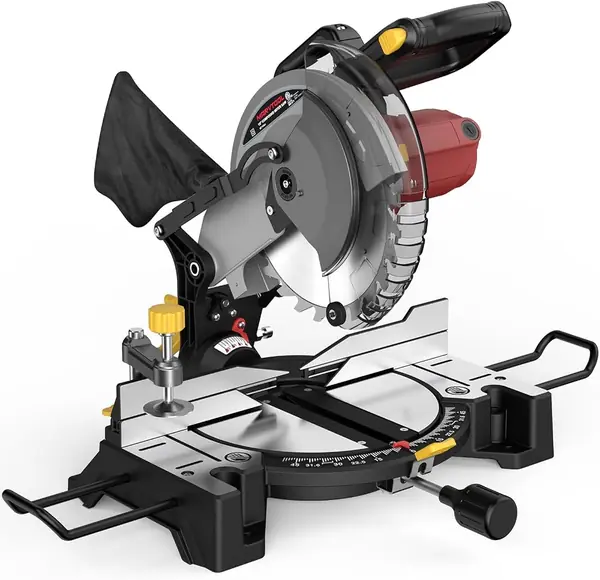
MarvTool 10-Inch Compound Miter Saw Best for One-Room Projects

MarvTool 10-inch compound miter saw in grayish white with blade guard and vise clamp

One-room projects

Shop Score 87/100
Blade Size
10 inches
Weight
20.5 lb
Speed
5,000 rpm
Bevel Range
0 to 45 degrees left
View on Amazon

At 20.5 pounds this is the lightest corded saw here, and it is a full 15-amp, 5,000-rpm 10-inch machine with a 36-tooth blade, two extension tables, and a two-year warranty. The head locks down into the base with a knob, which counts for something in a garage where bench space is contested.

One room of base and casing goes quickly with it. The table is wide enough for four-inch stock, the vise clamp holds trim steady, and it walks through 2x4 hardwood without complaint.

Where it lands for us is a homeowner's saw for a defined project: light enough to keep on a shelf between rooms, steady enough on a bench, and accurate once it is set. Clamp a shop-made wooden fence to the stock one and the scale reads more easily and short cutoffs stop diving under the blade.

Worth Noting

  • Miter table only swings left
  • 36-tooth blade is coarse for trim
Our Verdict

The lightest corded saw here, and we like it for a single room of base and casing.

Check Latest Price
7.

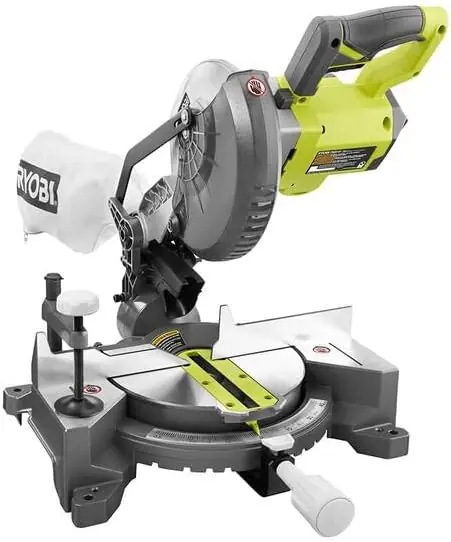
RYOBI P553 18V 7-1/4-Inch Miter Saw Best for Small Cordless Jobs

RYOBI P553 18V ONE+ 7-1/4-inch cordless miter saw in gray and green

Small cordless jobs

Shop Score 86/100
Blade Size
7-1/4 inches
Weight
19 lb
Power Source
18V ONE+ battery
Miter Range
0 to 45 degrees
View on Amazon

Nineteen pounds and a 7-1/4-inch blade: this is the smallest saw here, and it runs on the 18V ONE+ packs a lot of garages already have. It miters 0 to 45 degrees, handles 2x4s and standard trim stock, and stores in a cabinet instead of on a corner of the floor.

We like it for the small job: a closet's worth of base, a few pieces of shoe, a shelf bracket in a corner where running an extension cord is more work than the cuts. It is quiet, it sets down on a floor or a bench, and it does not need a dedicated work surface.

The honest read is that this is the least capable cutter here, and it is priced like it in a group where you can spend a lot more for a lot more saw. A compact pack runs it through trim; a 2Ah pack slows audibly under load partway through, so keep a 4Ah on hand. Before you need to change the blade, break the arbor screw loose, because they come tight from the factory.

Worth Noting

  • Struggles in thick hardwood
  • Battery and charger sold separately
Our Verdict

We treat it as a small-job saw: 19 pounds and no cord for a handful of trim cuts, not a whole house of baseboard.

Check Latest Price

How We Tested the Best Miter Saws for Trim Work

We started by reading spec sheets and reviews for more than 40 saws, then filtered for what trim actually demands: fence height to nest crown, bevel travel that reaches the angles a profile needs, a cut-line system, and a footprint that fits against a wall. We bought nine — corded and battery, single- and double-bevel, fixed head and sliding carriage — and ran them for 10 months.

Testing happened where trim gets cut: a finished upstairs hallway, a basement build-out, and a rental turnover, with every saw riding in a truck bed between them. We ran nested crown and vertical baseboard at each saw's stated capacity, with nothing on the table that wasn't supported at both ends, everything clamped to the fence, and the head lifted only after the blade stopped. We swung through every miter detent, then rechecked square after transport to see what had drifted. Laser and shadow line went up against a pencil mark, and we deliberately bumped the housing to see where the line landed afterward.

We weighed each saw, measured the bench it occupied, and timed repeated cuts in base and crown to get a feel for speed. We counted teeth on the included blade, then looked for tearout on painted poplar — a saw that ships with a fine trim blade saves you the price of one later. After ten cuts in the hallway we swept up what the dust bag missed, and we watched for the slow stuff: fences that flexed under a clamp, detents that went vague after a dozen moves.

How to Choose a Miter Saw for Trim Work

Match the fence to your molding, not the blade to the saw

Crown molding is cut nested, sitting at the angle it will hang, and baseboard stands on edge against the fence, so the figure that decides whether a saw can do your trim is vertical capacity, not blade diameter. The two get sold as though they were the same thing. A 10-inch slider in this group carries 6-5/8 inches of nested crown, while a 12-inch fixed head can stop at 5-1/2.

Measure the tallest crown and the widest base you plan to run, then compare those numbers to the fence. If a listing gives you nothing to compare, clamp the molding to a bench at its nested angle and hold a square against it.

Single or double bevel

Most crown is cut with the head tilted, so bevel direction matters. A compound miter saw that is single-bevel only tilts one way, which means flipping the molding end for end for the opposite corner — and flipping reverses which face rides the fence and where your pencil line sits. A double bevel mirrors the angle instead, and the positive stops at 33.9 degrees exist for crown work.

For a room or two of baseboard the flip is an inconvenience. For a house full of crown, we think the double bevel pays for itself in bad cuts avoided.

The cut line is the accuracy feature

There are two systems: a laser, or a shadow of the blade itself. A shadow shows the actual kerf, needs no adjustment, and stays visible on dark stain. A laser draws a thin line that has to be brought onto the blade and can wash out in daylight.

Whichever you get, check it before you trust it. Lower the head beside a scrap and watch where the mark falls relative to the teeth, then adjust or allow for it.

Sliding carriage or fixed head

A slide buys crosscut reach for wide casing heads, shelf stock and fascia, and costs weight plus depth behind the saw. Look at the rail design: front-mounted rails let a saw sit close to a wall, which is what you want in a hallway. A fixed head with tall fences is lighter, simpler, and handles crown and base all day.

If nearly every cut you make is four inches wide or less, the slide is money you do not need to spend on a trim saw.

Blades and dust

The blade in the box is general purpose, usually 24 to 40 teeth, and it will leave a rougher edge than painted or stained trim wants. Budget for a 60- or 80-tooth blade with the saw; we treat it as part of the purchase price rather than an upgrade for later.

Dust matters when you are cutting in a furnished room. A bag helps, a shop-vac hookup helps more, and not every saw ships with a hose adapter, so check before the sawdust starts.

Frequently Asked Questions

Final Verdict

The DEWALT DWS716XPS is the saw we point most trim work at. It holds 6-5/8-inch nested crown and 6-1/2 inches of baseboard against its fences, and the XPS shadow line puts the kerf where you can see it on stained stock.

If you also cut wide casing heads and shelving, the Makita LS1019L adds a slide and still carries 6-5/8-inch crown in a 10-inch body. Working upstairs in finished rooms, take the cordless DCS361B.