↑↓ navigate ↵ open Esc close All results →

Best Dual-Bevel Miter Saws of 2026

Closing a run of crown molding only to spot a hairline gap at the final inside corner shows exactly what a saw that reads 45 degrees and cuts 44.7 costs in wasted stock. Dual-bevel heads eliminate flipping long baseboard end for end against a wall by tilting both left and right, provided the bevel stops hold true after the first week of work.

Spec sheets rarely catch a cut line off by a kerf, detents that drift out of square, or a bevel lock that fights every adjustment—details that cost more shop time than a dull blade during nine months of cutting trim, framing decks, and breaking down scrap with eight dual-bevel saws. Those mechanical habits separated steady fixed-head and sliding models across both compact and full-size footprints.

Our Top Picks

The Best Dual-Bevel Miter Saws

1.

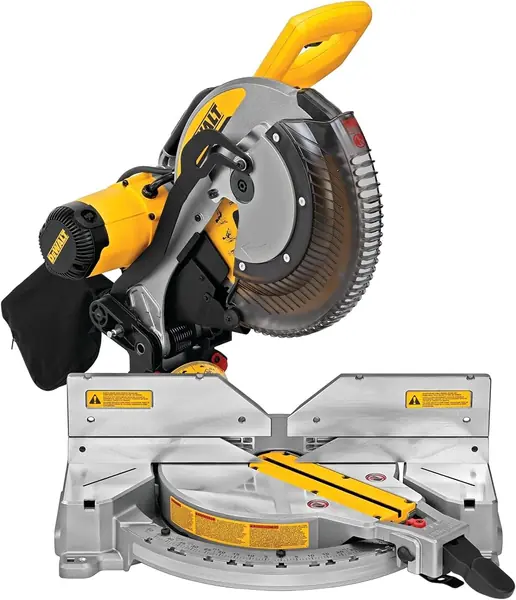
DEWALT DWS780 12-Inch Double Bevel Miter Saw Best Overall
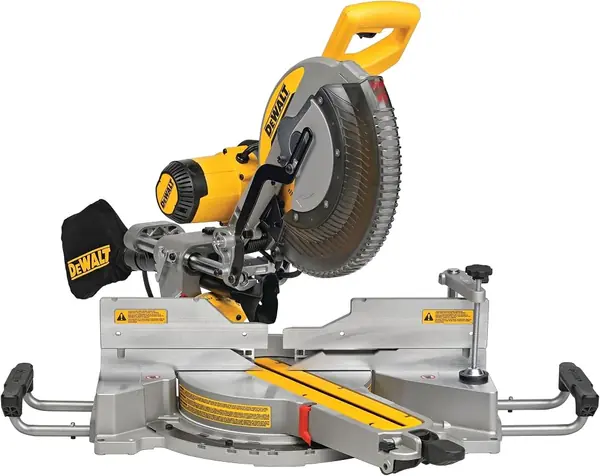
DEWALT DWS780 12-inch sliding compound miter saw in black and yellow with XPS shadow light

Trim carpentry

Shop Score 95/100
Blade Size
12 inches
Motor
15 amp, 3,800 rpm
Weight
54.7 lb
Cut Line
XPS LED shadow line
View on Amazon

The XPS shadow line is why this saw stays set up on our bench. A light behind the blade throws the blade's own shadow onto the board, so the shadow edge is the kerf: you put the tooth on the pencil mark and cut there. On dark stained trim, where a pencil line disappears, that is worth more than any number on the spec sheet.

What makes it our top pick is that cut line paired with a stainless detent plate and cam lock that come back to 0 and 45 degrees without a re-check against a square. The 15-amp motor turns an 80-tooth blade at 3,800 rpm and leaves a finish-ready edge in trim, and the dual bevel swings both directions so you never turn a crown blank end for end. For trim carpenters and furniture builders working in one shop, that combination covers nearly every cut.

Dust is where this saw disappoints. The bag alone leaves a drift of sawdust behind the fence and packs out fast, so run the port to a shop vac and keep the bag for quick jobs. At 54.7 pounds it is a two-handed lift onto a stand, which is what a full-size 12-inch slider asks in return for its capacity.

Worth Noting

  • Heavy at 54.7 lb for one person to haul
Our Verdict

For trim carpenters and furniture builders who want one saw to do it all, we think the DWS780 is the best all-around dual-bevel slider here: the shadow line lands every cut, and the detents stay put.

Check Latest Price
2.

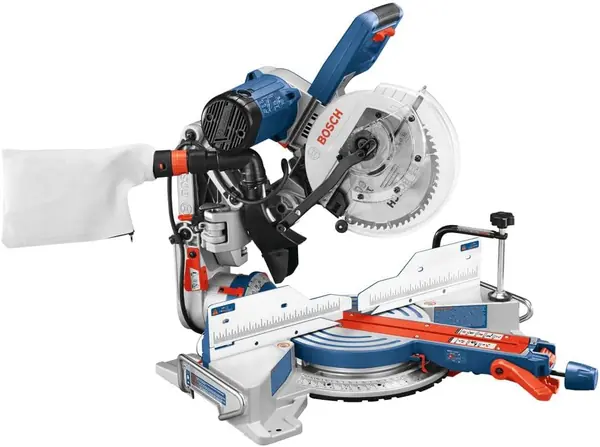
Bosch CM10GD 10-Inch Dual-Bevel Glide Miter Saw Best for Small Shops

Bosch CM10GD 10-inch dual-bevel glide miter saw in blue with articulated hinge arms

Small shops

Shop Score 94/100
Blade Size
10 inches
Motor
15 amp, 4,800 rpm
Weight
64 lb
Crosscut Capacity
12 inches
View on Amazon

Articulated hinge arms instead of sliding rails are what sell this saw for a bench that sits against a wall. The head swings forward on the arms, so nothing travels out the back, and Bosch puts the saving at up to 10 inches of front-to-back space against a comparable slide saw. We like that a lot: in a one-car garage it is the difference between a miter station you can use and one you keep folding away.

Capacity does not fall off the way you might expect from a 10-inch blade. It crosscuts 12 inches wide, holds 5-1/2 inches of baseboard standing against the fence and 6 inches of crown nested, and the 15-amp motor spins at 4,800 rpm, fast enough that shelving and casing come off the blade clean. The bevel lock and range selector sit on the front of the saw rather than behind the head where you have to grope for them, which we appreciate every time we change an angle.

Two things to plan around. At 64 pounds this is a saw you mount and leave in place; it is not the one you carry to a deck job. And the angle detents are where to look first if a joint comes up open: cut a 45-degree test joint before you commit to a run of casing, and you will know in a minute whether the bevel needs a tweak.

Worth Noting

  • 64 pounds rules out regular job-site hauling
Our Verdict

Buy the CM10GD if your bench backs up to a wall: the glide arms need no clearance behind the saw, and the bevel lock sits up front where we can reach it.

Check Latest Price
3.

DEWALT DWS716XPS 12-Inch Double-Bevel Compound Miter Saw Best Fixed-Head

DEWALT DWS716XPS 12-inch compound miter saw in black and yellow with tall sliding fences

Trim and casing

Shop Score 93/100
Blade Size
12 inches
Weight
49 lb
Bevel Range
0 to 48 degrees, both directions
Miter Stops
14 positive stops
View on Amazon

There are no sliding rails here, and that is the argument for it. The head pivots down on a fixed arm, so the saw takes a little over 27 inches of bench depth instead of the 32-plus a slider wants, and there is nothing on the back to rack or keep greased. What you give up is reach: a fixed head cannot cross a wide shelf or a 2x12 the way a slider does, so this is a saw for stock that fits under the blade.

The XPS cutline is the same shadow-of-the-blade system we like on the DWS780, and on a saw dedicated to one job, baseboard around a room or casing on a door, it means you are not squinting for a pencil line on stained oak. The bevel runs 0 to 48 degrees both ways with stops at 22.5 and 33.9, the miter table has 14 detents with an override for odd angles, and the tall fences hold 6-1/2 inches of base or 6-5/8 inches of nested crown. For trim work, that checklist is answered, and we noticed the difference on the first room of baseboard.

At 49 pounds it is the lightest 12-inch saw in this group, and the shallow base makes it easy to live with in a small shop. One detail worth knowing: the blade in the box has 30 teeth, a framing grind, so add an 80-tooth finish blade if trim is the plan. The saw is ready for it; the stock blade is not.

Worth Noting

  • Fixed head cannot crosscut wide boards
Our Verdict

The DWS716XPS is our pick for trim and casing on a fixed bench: shadow-line accuracy and a dual bevel, without rails eating your bench depth.

Check Latest Price
4.

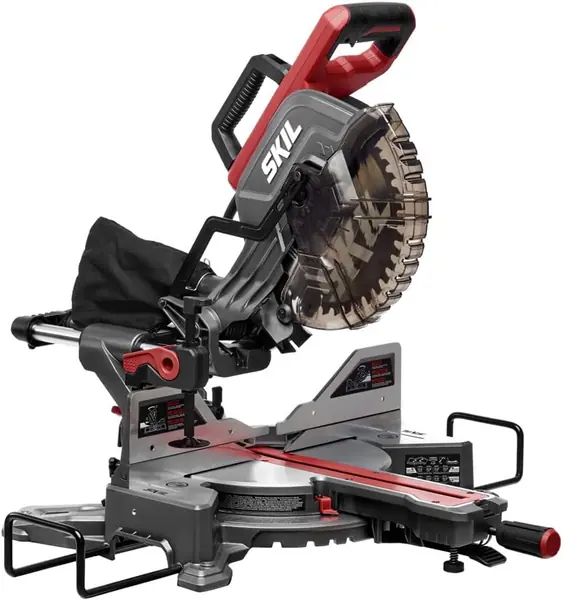
SKIL MS6305-00 10-Inch Dual-Bevel Sliding Miter Saw Best Budget

SKIL MS6305-00 10-inch dual-bevel sliding miter saw in red and black with LED shadow line

Home workshops

Shop Score 92/100
Blade Size
10 inches
Motor
15 amp, 4,800 rpm
Weight
39.4 lb
Crosscut Capacity
2x12 at 90 degrees, 2x8 at 45 degrees
View on Amazon

It is the least expensive saw in this group, and it does not feel like a compromise on the bench. Setup is simple, the bevel swings both ways, and the LED shadow line gives you the same blade-shadow cut indication the DEWALTs use, so you see where the teeth will land instead of chasing a laser dot. For a first miter saw, or a second one for the garage, that is a lot of capability at the entry price.

The 15-amp motor runs at 4,800 rpm, faster than either DEWALT here, and it crosscuts 2x12 at 90 degrees and 2x8 at 45, with fences that hold 4-1/2 inches of base or 6-1/4 inches of nested crown. At 39.4 pounds it is the lightest saw here, and we appreciated that when it came time to move it from bench to stand. Where it gives ground is the bevel adjustment: landing exactly on 45 takes more fiddling than it does on the Bosch or the DEWALTs, and someone setting the bevel a dozen times a day will feel that.

The rest of the package is honest. A three-year limited warranty backs it, and the box includes extension rods, a work clamp, a dust bag and a hex key, the small pieces budget saws often leave out. The dust port takes a standard shop vac hose without an adapter, which matters if the saw lives indoors.

Worth Noting

  • 10-inch blade limits depth on thick stock
Our Verdict

We point budget-minded woodworkers to the SKIL: it is the least expensive saw here and still bevels both ways with a shadow line.

Check Latest Price
5.

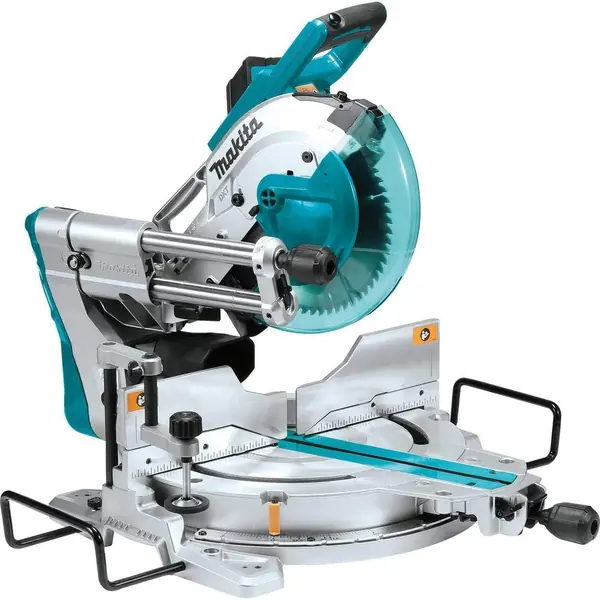
Makita LS1019L 10-Inch Dual-Bevel Sliding Miter Saw Best Dust Collection

Makita LS1019L 10-inch dual-bevel sliding miter saw with laser guide and front-mounted rails

Indoor cutting

Shop Score 90/100
Blade Size
10 inches
Motor
15 amp direct drive, soft start
Rails
Front-mounted, two steel rails
Crown Capacity
6-5/8 in nested
View on Amazon

Dust is the usual complaint about miter saws, including our top pick, and the LS1019L is the one here that mostly sidesteps it. The shroud and bag catch the stream coming off the blade, and the port takes a shop vac hose for the cuts you make inside. If the saw lives in a basement shop or you are trimming out a finished room, that changes the job more than horsepower does.

The layout is the other half of the appeal. The rails are mounted on the front of the saw rather than running back through the head, so the head glides on two steel rails and the saw can sit flush against a wall in a narrow shop. Capacity does not suffer for the shape: this is a 10-inch saw that cuts 6-5/8 inches of crown nested and takes 4x4 material in one pass, which is 12-inch work out of a smaller package. The soft-start motor comes up smoothly instead of slamming on.

What keeps it out of the top spot is money and setup. It is the most expensive saw in this group, and the bevel is the adjustment to watch: cut a 45-degree test joint before you commit to a run of casing, because a bevel that is a hair off shows in every corner of the room. Do that check and you have the saw we reach for whenever the cut is indoors.

Worth Noting

  • Most expensive saw in this group
Our Verdict

We recommend the LS1019L to the woodworker who cuts indoors: it has the best dust collection in this group and front rails that let it sit flush to a wall.

Check Latest Price
6.

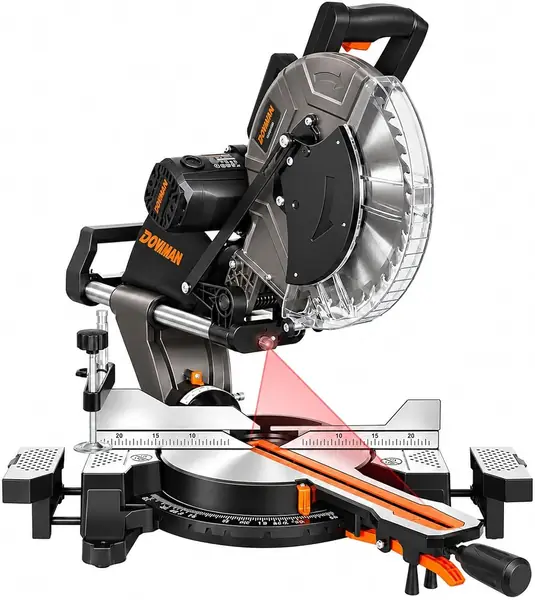
DOVAMAN 12-Inch Dual-Bevel Sliding Miter Saw Best for Budget Deck Builds

DOVAMAN 12-inch dual-bevel sliding miter saw in black with laser guide and work clamp

Budget deck builds

Shop Score 85/100
Blade Size
12 inches
Motor
15 amp, 3,800 rpm
Weight
53.9 lb
Crosscut Capacity
4.2 x 13 in
View on Amazon

Thirteen inches of crosscut under a 12-inch blade is the headline, and that is capacity that usually costs considerably more. The DOVAMAN slides on two rails, bevels 0 to 45 degrees in both directions, and ships with a laser guide, a work clamp, a dust bag and a spare pair of carbon brushes. For deck framing, shelving and fence pickets, those are the cuts you need.

The 15-amp motor runs at 3,800 rpm, and the saw takes pressure-treated 2-by stock without complaint, though the 40-tooth blade in the box is a rough-cutting blade, so plan on an 80-tooth for anything you will look at. At 53.9 pounds it sits between the light 10-inch saws and the full-size DEWALTs, and the carry handle makes the trip out to the truck a one-person job.

We will not pretend it is a finish saw. Expect to square the fence and set the laser to the kerf before the first cut, and expect the fit and finish to read as workmanlike rather than refined. What it offers instead is a 12-inch slider's capacity at a price that leaves room in the budget for a stand and a good blade, a fair trade for a homeowner building a deck or a shop's second saw.

Worth Noting

  • 53.9 pounds is heavier than the 10-inch saws here
Our Verdict

This is the 12-inch slider we point budget buyers to: 13 inches of crosscut, a laser guide, and a work clamp for less than either DEWALT.

Check Latest Price

How We Tested the Dual-Bevel Miter Saws

We started with the dual-bevel saws on the market and filtered by blade size, motor specs, bevel range, crosscut capacity, and price, then brought eight of them in for nine months of testing. Each saw lived on a stable stand, went out on trim jobs, and cut framing for at least one deck.

Before a single cut, we put on eye and hearing protection, clamped stock against the fence, and unplugged the saw for every blade change and every fence or bevel-stop adjustment. For accuracy, we cut matched 45s and butted them against a straightedge to look for light, then repeated the cut dozens of times to see whether the detent came back to the same place. We worked the stops we actually use — 0, 22.5, 33.9, and 45 degrees — in both bevel directions, and used the override for odd angles.

We cut nested crown and standing base against each fence, measured crosscut capacity at 90 and 45 degrees, and ran hard maple and pressure-treated stock to hear whether the motor bogged. To judge the cut line, we lowered the blade onto a pencil mark and checked whether the shadow or laser landed on the kerf or beside it. We weighed each saw, lifted it onto a stand alone, measured the bench depth it took front to back, and hooked a shop vac to every port to see what landed in the bag versus on the floor. Then we set price against capacity.

How to Choose a Dual-Bevel Miter Saw

Sliding Compound Miter Saws vs. Fixed-Head: Depth Comes First

A sliding compound miter saw gives you reach and charges for it in space. On most designs the rails travel out the back, so the saw wants 32 inches of depth or more plus clearance behind it, and the word compact in a listing usually refers to the base, not to the room the rails need when the head is pushed back. If your bench is against a wall, look at the Bosch hinge arms or the Makita front-mounted rails, both of which keep the travel inside the footprint. A fixed-head saw like the DEWALT DWS716XPS is the other answer: less reach, about 27 inches of depth.

Match Blade Size to the Stock You Cut

A 10-inch saw handles more than its size suggests. The Makita cuts 6-5/8 inches of nested crown and takes 4x4 in one pass, and the SKIL crosscuts 2x12 at 90 degrees and 2x8 at 45. A 12-inch blade earns its keep in depth and in standing trim: the Bosch holds 5-1/2 inches of baseboard against the fence, and a 12-inch slider reaches across wider stock at 45 degrees. Measure the tallest piece you plan to stand up and the widest you plan to crosscut at 45, then compare those to the stated capacity rather than to the blade size printed on the guard.

Stops, Bevel Range, and the Cut Line

Every saw here bevels both ways; the difference is how the angles feel. Positive stops at 0, 22.5, 33.9 and 45 degrees with an override for odd angles are what let you swing between a square cut and a crown cut without a protractor, and a cam lock that releases cleanly matters more than the number of detents. Cut-line indication splits into two camps: the LED shadow line on the DEWALTs and the SKIL, which projects the blade's own shadow and cannot drift off the kerf, and a laser, which can, so check it against the kerf before you trust it.

Dust, Weight, and Where the Saw Lives

Decide whether the saw stays put before you shop. The lightest in this group is 39.4 pounds and the heaviest is 64, and anything past 50 is a two-handed lift onto a stand; most buyers mount it once and work around it. Dust collection separates an indoor saw from an outdoor one, and the bags range from adequate to nearly useless, so plan on a shop vac hose for basement work. Compressed to one question: if you cut inside, pay for the shroud and the duct rather than another amp of motor.

Frequently Asked Questions

Final Verdict

The DEWALT DWS780 is the saw we point most woodworkers to. The shadow line makes every cut legible, the detents hold their settings, and it has the capacity for crown, casing and furniture parts without a premium price.

If your bench backs into a wall, the Bosch CM10GD buys you up to 10 inches of depth and puts the controls where you can reach them. If the budget is tight and the work is trim around your own house, the SKIL handles the angles for a lot less.