↑↓ navigate ↵ open Esc close All results →

Best Miter Saw Stands of 2026

Set a sliding miter saw on sawhorses and the first long board you feed across the table makes the whole rig want to tip or walk mid-cut. A proper stand fixes both problems at once, locking the saw at a back-saving height and keeping stock level on both wings so the blade tracks your layout line.

Over eight months under a full-size sliding saw, 12 stands — from compact shelf-sized folders to wheeled rigs hauled across gravel — showed how little a generous load rating predicts stability. What keeps a cut quiet is a rigid frame and feet that plant evenly on the floor, not a big number printed on the carton.

The six models ranked below span from a 26-pound folder for a one-car garage to a rolling frame built for rough ground, all steady through full-width crosscuts. Fit settles the choice among them: whether mounting brackets ship in the box, how far the material arms extend, and how much floor space the frame claims when folded.

Our Top Picks

The Best Miter Saw Stands

1.

DEWALT DWX724 Compact Miter Saw Stand Best Overall
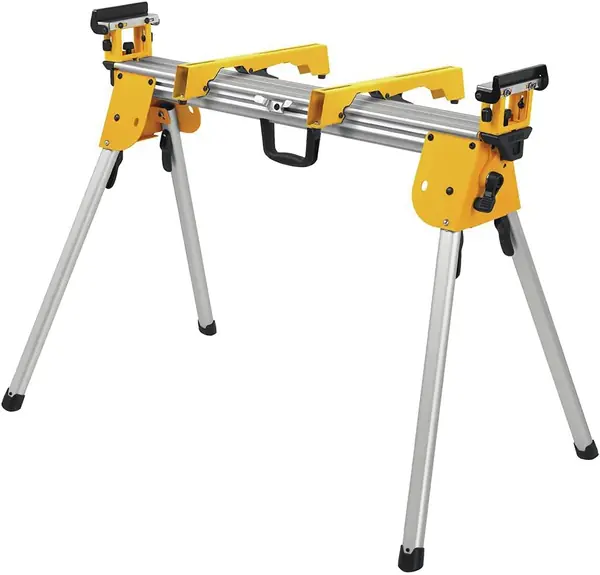
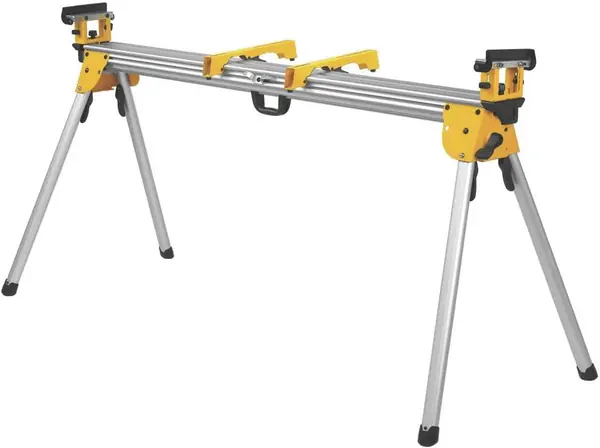
DEWALT DWX724 compact miter saw stand in black and yellow aluminum with folding legs

Portable trim work

Shop Score 95/100
Material Support
Up to 10 ft
Load Capacity
500 lb
Weight
29.8 lb
Material
Aluminum
View on Amazon

Forty inches of beam does not sound like much until you slide it out. The DWX724 reaches about 10 feet of material support, enough to keep the tail of a 12-foot board level through the cut instead of letting it drop and pinch the blade. The two convertible work supports double as stops, and they ride closer to the blade than most stands we have used, which is exactly what short trim offcuts need.

Aluminum at just under 30 pounds is the compromise we like best here. It is light enough to carry out to the driveway in one hand, and the frame still takes 500 pounds, so a 12-inch sliding saw sits on those rails without the bed shivering when the head comes down. The leg lock levers are the part we appreciated most: they open and close with a positive snap, so setup is a few deliberate moves rather than a wrestling match.

The mounting rails are the universal type, which means a Makita, a Bosch, or a Ridgid saw bolts up as readily as a DEWALT, and the brackets come in the box. Folded, the frame stands against a garage wall or slides into a truck bed beside the toolbox.

Where it runs out is reach. Sixteen-foot baseboard wants the bigger DWX723, and if that is your bread and butter the compact frame will feel short every afternoon. For 8-foot 2x4s, door casing, and deck boards, we never once wished for a different stand.

Worth Noting

  • Beam is short for 16-foot trim runs
Our Verdict

For most home shops and trim jobs, this is the stand we recommend: 500 pounds of capacity, 10 feet of support, and a folded frame you can carry in one hand.

Check Latest Price
2.

Bosch T4B Gravity-Rise Miter Saw Stand Best Rolling Stand

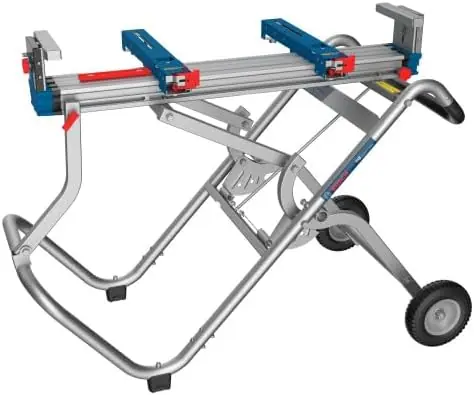
Bosch T4B gravity-rise miter saw stand with two large pneumatic wheels and steel frame

Jobsite terrain

Shop Score 94/100
Material Support
Up to 16 ft
Weight
76.7 lb
Wheels
8 in. pneumatic
Outfeed Adjustment
Up to 12 in.
View on Amazon

The foot pedal is the reason to buy this one. Step on it and the gravity-rise frame lifts the saw bed into working position; step again and it folds down for the road. We have wrestled enough stands in and out of trucks that this alone made us forgive the weight.

And there is weight, about 77 pounds before a 12-inch saw goes on. What buys it back is a pair of 8-inch pneumatic wheels, which roll over gravel, turf, and a rutted driveway apron in a way hard shop casters simply do not. The adjustable leveling feet matter just as much on a sloped driveway, where a frame with fixed feet rocks no matter how carefully you set it down.

Support runs out to 16 feet, and the outfeed adjusts through 12 inches of height so the arms can meet the saw bed instead of stepping above or below it. Our one gripe is the width of the extensions, which could cradle crown and base molding better at full stretch.

The instructions are the weak link; expect to study the diagrams before the frame makes sense. That does not change what the stand does on a site, which is to put a heavy saw exactly where you want it without a lift. It is the most expensive stand here, and for a saw that travels we think it earns that.

Worth Noting

  • About 77 pounds before the saw goes on
Our Verdict

For a saw that moves between a trailer and a job, this is the stand we want: it lifts itself, rolls over rough ground, and holds 16 feet of stock.

Check Latest Price
3.

DEWALT DWX723 Heavy-Duty Miter Saw Stand Best for Long Boards

DEWALT DWX723 heavy-duty aluminum miter saw stand with long extending support beam

Long board runs

Shop Score 93/100
Material Support
Up to 16 ft
Load Capacity
500 lb
Material
Aluminum
Beam Length
5-1/2 ft
View on Amazon

Sixteen feet of material support is a different category of help. Run a wall of baseboard and the far end of the board sits on a stop instead of in a helper's hands, which means one person can mark, cut, and fit without walking around the stand for every piece.

The beam extends to 5-1/2 feet and stays straight at full reach. Boards sit level with the saw bed even with the arms pushed all the way out, and that is the difference between a stand you fight and one you forget about mid-cut.

Aluminum keeps the frame around 29 pounds, and the leg lock levers fold it into a package that fits across a truck bed; we carried it up a flight of stairs without a second trip. What it does not have is wheels. With a 12-inch saw bolted on, moving it is a two-hand lift, so this is the stand for a shop with a parking spot rather than a van.

Sort out the brackets before you order. This stand is sold both with and without the DEWALT mounting brackets, and the brackets are the only thing that attaches a saw to the rails. Check which version is in your cart, because a bare stand and a saw with nothing to bolt to is a wasted Saturday.

Worth Noting

  • No wheels; heavy once the saw is mounted
Our Verdict

For baseboard, crown, and long decking, we accept the lifting to get 16 feet of reach on a stand that folds into a truck.

Check Latest Price
4.

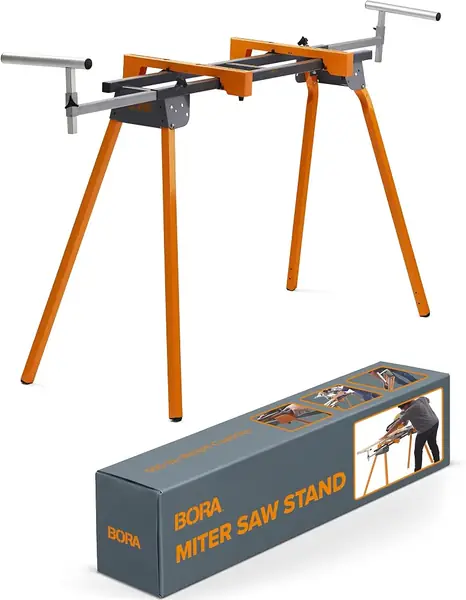
BORA Portamate PM-4000 Miter Saw Stand Best Value

BORA Portamate PM-4000 folding miter saw stand with quick-release mounting brackets

First shop setup

Shop Score 92/100
Material Support
114 in.
Load Capacity
500 lb
Working Height
36 in.
Saw Size
Up to 12 in.
View on Amazon

Five hundred pounds of capacity and 114 inches of support for less than half the price of our top pick is the whole case for the PM-4000. Nothing about the folding frame feels like a corner was cut: the legs lock open on quick-release collars, and the steel has no rattle in it when you shake the stand.

The working height is what sold us. Thirty-six inches puts the saw bed at roughly kitchen-counter level, which keeps you upright through a long run of cuts instead of stooping over a low trestle. The quick-release tool mounts are the other half of the value: pop the saw off and the same frame will carry a planer or a jointer.

What it does not have is wheels or a handle. The folded frame is a two-hand carry, so plan on a spot against the wall rather than a spot in the truck. In a shop where the stand lives ten feet from the bench, we never missed them.

Worth Noting

  • No wheels or handle for carrying
Our Verdict

This is the value pick we hand to anyone setting up a first shop: 500 pounds, 114 inches of support, and folding legs for a budget price.

Check Latest Price
5.

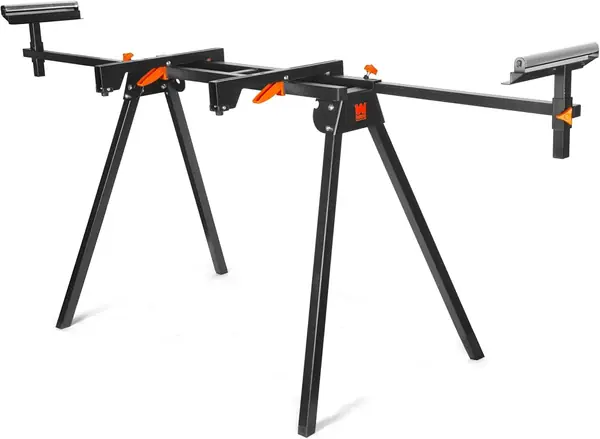
WEN MSA200 Collapsible Miter Saw Stand Best for Tight Storage

WEN MSA200 collapsible steel miter saw stand with two adjustable rollers and folding legs

Small shops

Shop Score 90/100
Material Support
Up to 8 ft
Load Capacity
350 lb
Weight
26.1 lb
Working Height
31 in.
View on Amazon

Folded, the MSA200 is a flat bundle you can hang on two hooks or slide behind a shelf, and that is the reason we keep coming back to it. At 26 pounds it is also the easiest stand here to carry in one hand, which matters when the saw lives in a closet and the work happens in the driveway.

It is still a real stand. The frame carries 350 pounds, the arms extend from 36 to 80 inches to support boards up to 8 feet, and the two height-adjustable rollers let long stock feed without snagging on the saw bed. Quick-release brackets lift the saw off in one motion when you want the bench back for something else.

The bed sits at 31 inches, a few inches below the taller stands here. That is comfortable for most bench work and short sessions, and it is the one number to check against your own bench height if you are tall. For the least money in this group you give up wheels and reach, not stability, and in a garage that has to be a workshop and a parking space both, that trade is easy to make.

Worth Noting

  • Rollers need a firm shove to adjust
Our Verdict

If your shop has to fold away at the end of the day, we recommend this one: light, flat-folding, and steady under a 10-inch saw.

Check Latest Price
6.

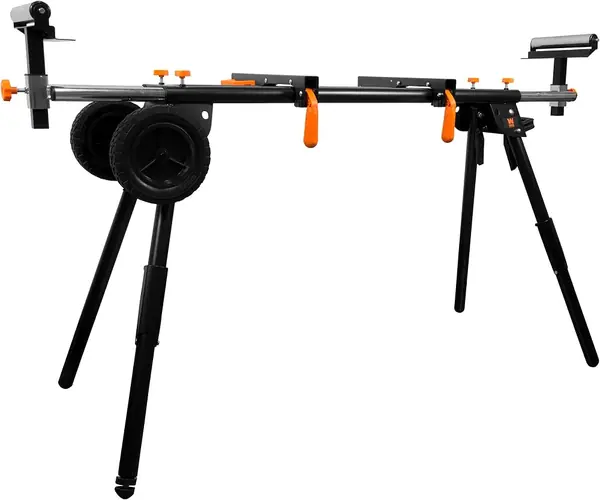
WEN MSA330 Rolling Miter Saw Stand Best for Garage and Driveway

WEN MSA330 rolling miter saw stand with three onboard outlets and never-flat wheels

Garage and driveway

Shop Score 89/100
Material Support
Up to 10.5 ft
Load Capacity
330 lb
Working Height
33 in.
Outlets
Three 15A 120V
View on Amazon

Three 15-amp outlets ride on the frame, which sounds like a gimmick until you are set up in a driveway with one cord run to the house and a work light that needs somewhere to plug in. That is the feature we noticed first, and it is the one that makes this stand easy to like.

The rest is a capable rolling stand: a 1-1/2-inch steel frame that puts the saw at 33 inches, arms that slide from 32 to 79 inches for boards up to about 10-1/2 feet, two height-adjustable rollers, and 8-inch never-flat wheels that stay round on a shop floor.

Wheels are also where the compromises show. The 330-pound rating is the lowest in this group, and with a 12-inch slider bolted on the frame can feel light-footed when you push a long board across it; the short wheelbase does not help on an uneven driveway either. Keep it on concrete with a 10-inch saw and it behaves, and that is how we use it.

Worth Noting

  • Won't stand upright when folded
Our Verdict

We like it as a garage stand for a 10-inch saw: it rolls, it holds 10-1/2 feet of stock, and the outlets save a cord run.

Check Latest Price

How We Tested Miter Saw Stands

We started with every stand sold for a full-size saw, then narrowed by the questions shoppers actually ask: do the mounting brackets come in the box, how far do the material supports extend, how much does the frame weigh, and what does the whole set cost. Twelve stands made the cut, and we bought them at retail or borrowed them the way a reader would.

Each one went together on a garage floor with one person and a stopwatch, and we wrote down every step that needed a second set of hands or a trip back to the hardware store. Before any cutting, we bolted a saw to the stand's own brackets and checked that the hardware matched the saw base; where the kit didn't line up, we stopped and noted it. We also tracked how the saw's cord ran, since a cord that snags on the frame every time you pivot the head gets old fast.

Cutting happened in a garage, on a driveway, and on rough ground behind a shop, always with the frame on firm footing and any leveling feet cranked down until nothing rocked. We made full-width sliding cuts through long stock and watched the frame and arm joints rather than the blade. With the arms run all the way out, we pressed on the far end to see how much they dipped, and we checked whether the level stops held their height after a few dozen cuts.

Between cuts we folded and unfolded each stand, timed it, rolled the wheeled ones over a curb and through a garage threshold, and measured the folded footprint against a wall. We noted where the working height landed for a taller and a shorter tester. Then we weighed the asking price against what came in the box and how each stand held up after eight months of being set up, knocked down, and set up again.

How to Choose a Miter Saw Stand

Match the Reach to the Stock You Cut

The number in the listing is the total span with both arms out, and it is measured without your saw sitting in the middle of it. For door casing, 8-foot 2x4s, and deck boards, a compact stand with 8 to 10 feet of reach is plenty and easier to live with.

Running baseboard or crown through a whole house is the case for a 16-foot beam: the far end of the board rests on a stop instead of hanging in the air while you feed it. Also check where the stops sit, because a stop close to the blade means short offcuts get real support too.

Stability Is Not the Load Rating

A 500-pound rating tells you the frame will not fold up under a saw. It says nothing about whether the stand rocks, walks, or shivers when a sliding head comes down, and that is the thing you feel on every cut.

Look at leg splay, locking levers, and leveling feet, and expect a stand that feels planted under a 10-inch saw to feel different under a 12-inch slider: the bigger saw carries its mass higher and pushes sideways harder. Wide footprint, low bed, tight levers is the combination we look for first.

Brackets, Rails, and What Comes in the Box

Slotted rails and a pair of brackets are what turn a folding chop saw stand into a platform for your saw, so check what comes in the box before you compare anything else. Some listings in a model line are sold with the brackets and some without, and a stand with no brackets holds nothing.

Then check the bolt kit against your saw's base slots, because that is where a universal design actually proves universal. Quick-release mounts are worth a little more money: they let you lift the saw off in one motion instead of unbolting it.

Wheels, Weight, and Getting It There

Decide what the stand has to cross before you decide whether it needs wheels. Pneumatic wheels earn their keep on gravel, turf, and a rutted driveway; on a shop floor, hard never-flat wheels roll fine and cannot go soft.

Weight cuts both ways. A 26-pound folding stand goes into a trunk alone, while a 77-pound rolling stand stays where you park it and saves your back on the move instead. Count the lift, not just the roll: every stand here that rolls still has to be raised onto a tailgate.

Height, and What It Costs Your Back

Working heights in this group run from 31 to 36 inches, and the difference shows up at the end of a day rather than in the cut. Thirty-six inches suits most bench-height work and keeps you upright; a 31-inch bed is fine for short sessions and lower benches.

Match the outfeed to the saw bed as well, with adjustable arms or rollers, because a support sitting an inch proud of the bed turns every long board into a rocking cut.

Frequently Asked Questions

Final Verdict

Weight, reach, and a frame that does not shiver are the whole job of a miter saw stand, and the DEWALT DWX724 delivers all three at a price most shops can justify: 500 pounds of capacity, 10 feet of support, and a folded frame one person can carry.

Step up to the DWX723 if your work runs to 16-foot baseboard, or to the Bosch T4B if the saw has to roll across a yard. The BORA PM-4000 is the budget answer that does not feel like a compromise.