↑↓ navigate ↵ open Esc close All results →

Best Miter Saws for Small Shops of 2026

A miter saw claims far more depth than its base footprint suggests. The blade diameter gets the attention on the spec sheet, yet the sliding head dictates where the tool can live: rearward rails need open clearance behind the fence, and in a small garage shop that space is usually a wall. Buy more travel than the room allows and the saw ends up parked in the middle of the aisle.

Eight saws spent nine months on a shop bench set a foot off a garage wall, cutting base molding and nested crown so rear clearance was tested before anything else. A couple arrived square from the carton while others needed an hour of truing before the first keeper cut, and repeatable miter detents paired with a sharp stock blade mattered far more than extreme bevel angles.

Weight ultimately decides how often a small-shop saw comes off the shelf: a 55-pound slider demands two hands and a clear landing spot, whereas a 24-pound unit gets pulled out for a single piece of trim. Across these five models, the lineup spans dedicated trim cutters, nested-crown capacity, cordless portability, and light afternoon setups.

Our Top Picks

The Best Miter Saws for Small Shops

1.

DEWALT DWS715 12-Inch Single-Bevel Compound Miter Saw Best Overall
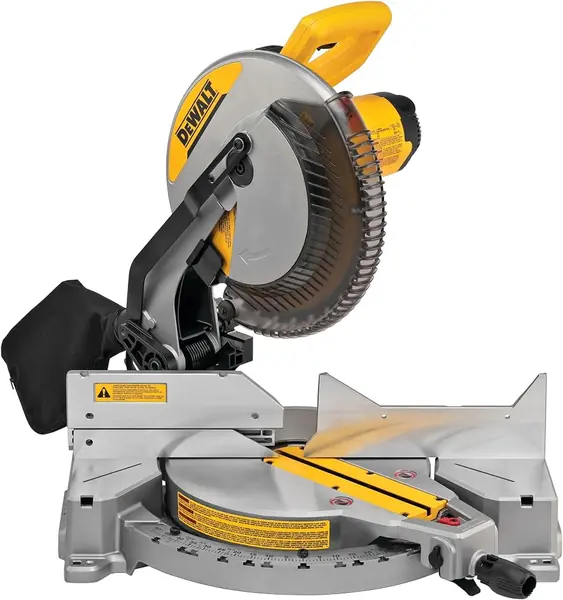
DEWALT DWS715 12-inch single-bevel compound miter saw with yellow and black housing and dust bag

Trim and framing

Shop Score 96/100
Weight
42.8 lb
Blade Size
12 inches
Miter Stops
14 positive stops
Crosscut Capacity
2 x 8 in. at 90 degrees; 2 x 6 in. at 45 degrees
View on Amazon

A fixed-head saw is the quiet advantage in a small shop: with no rails running backward, the whole thing measures roughly 27 by 22 inches and can sit with its back near a wall. That's the first reason we keep coming back to the DEWALT DWS715. It's a 12-inch single-bevel compound miter saw with 14 positive stops and a 15-amp motor, and the detents land where they should without hunting. The tall fences hold 5-1/2 inches of base molding upright and the same of crown nested — the number we check first, because crown is where small saws give up.

Capacity reads better than a fixed head suggests. DEWALT rates it at 2 x 8 dimensional lumber at 90 degrees and 2 x 6 at 45, which covers shelving, decking, and just about any trim cut in a house. What it won't do is crosscut a glued-up panel or a wide shelf in one pass; that's a slider's job. At 42.8 pounds it stays manageable for one person with the built-in handle, so stowing it under the bench between projects is realistic.

The compromise is the bevel — 0 to 48 degrees left, 3 degrees right. For a mirror-image compound cut you flip the workpiece, a two-minute nuisance rather than a problem, and most trim work never asks for it. Where the single-sided head does hurt is a run of crown cut in position, and that job belongs to a double-bevel saw.

Worth Noting

  • Dust bag is small and fills fast
Our Verdict

We recommend the DWS715 as the small-shop default: full 12-inch trim capacity, no rear clearance needed, and 42.8 pounds one person can move.

Check Latest Price
2.

DEWALT DWS780 12-Inch Double-Bevel Sliding Miter Saw Best for Crown and Wide Stock

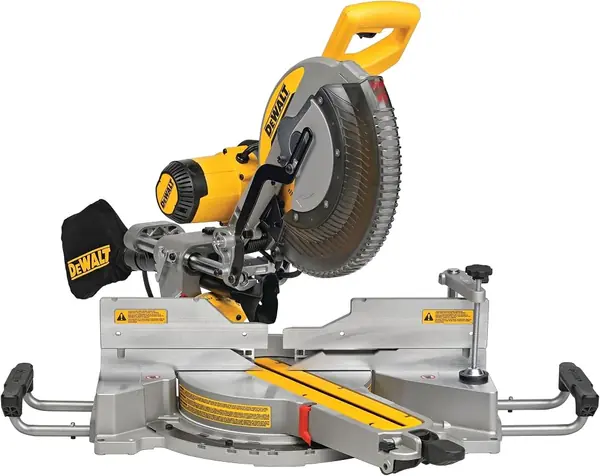
DEWALT DWS780 12-inch double-bevel sliding miter saw in yellow and black with dust bag

Crown and panels

Shop Score 95/100
Weight
54.7 lb
Blade Size
12 inches
Head
Sliding
Bevel
Double bevel, tilts left and right
View on Amazon

The DWS780 is the only 12-inch sliding double-bevel saw in this group, and that fact sets its role. A sliding head takes a wide shelf or a glued-up panel in one pass instead of two, and a double bevel means you swing the head toward the molding instead of unclamping and flipping it. In a shop that builds cabinets or runs crown through a whole house, that's not a luxury.

The XPS shadow line is the feature we appreciate most. Rather than a laser that drifts off the kerf, an LED casts the blade's own shadow on the board, so the line you see is the line the teeth will follow — on dark stained crown, that's the difference between marking twice and cutting once. At 54.7 pounds this is also the heaviest saw here, and that mass is why a big slider stays planted mid-cut rather than skating.

Dust is where it loses us. DEWALT advertises over 75 percent capture, but the bag and the port clog and chips fly past both; a shop vac on a short hose is close to mandatory. We still recommend it for trim-heavy work, because the capacity and the shadow line buy back the cleanup time — and nothing else on this page crosscuts a wide panel in one pass.

Worth Noting

  • Rails need clearance behind the saw to slide
Our Verdict

We recommend the DWS780 for shops where crown and wide stock are routine and the bench has a permanent home for a 54.7-pound saw.

Check Latest Price
3.

Metabo HPT C10FCG2 10-Inch Compound Miter Saw Best Lightweight

Metabo HPT C10FCG2 10-inch single-bevel compound miter saw in green and black

Small trim jobs

Shop Score 94/100
Weight
24.2 lb
Blade Size
10 inches
Warranty
5 years
Miter Range
0-52 degrees left and right
View on Amazon

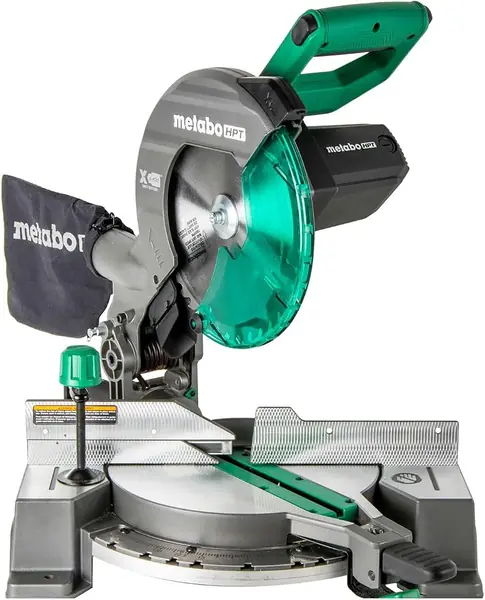
Twenty-four pounds is the number that matters here. It's the lightest saw in this group, light enough to carry from the bench to the driveway with one hand — and light enough that you'll put it away instead of leaving it out. We think that makes the C10FCG2 the right first saw for a shop where the bench has to be cleared for assembly. Metabo HPT backs it with a five-year warranty, the longest here, and prices it below everything else on this page.

The trade is a 10-inch single-bevel head. Baseboard, casement, and 2x material are comfortable territory. The bevel goes to 45 degrees left only, which you work around by flipping the workpiece for the mirror-image cut. Miter travel runs 0 to 52 degrees both ways with positive stops, and we found the LED shadow line genuinely useful on dark trim, where a pencil line disappears.

The table is smaller than the 12-inch saws' here, so long boards want a roller stand at the far end. That's the trade for the weight, and it's a small one — the saw arrives nearly assembled, and the controls are simple enough that a first-time user can be cutting accurate miters the same afternoon.

Worth Noting

  • 10-inch blade caps crosscuts around 2x6
  • Included blade is too coarse for finish trim
Our Verdict

For a shop that shares its bench with everything else, this 24.2-pound saw delivers a five-year warranty and accurate cuts for the least money here.

Check Latest Price
4.

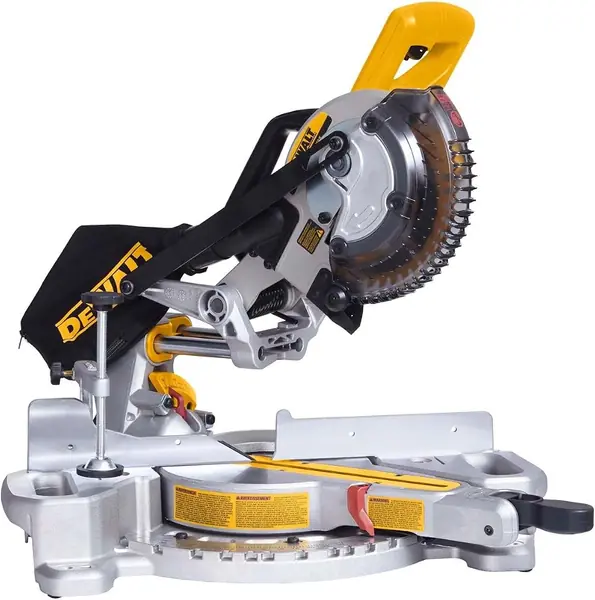
DEWALT DCS361B 20V MAX 7-1/4-Inch Cordless Miter Saw Best Cordless

DEWALT DCS361B 20V MAX 7-1/4-inch cordless sliding miter saw in yellow and black

Cordless trim work

Shop Score 93/100
Weight
30 lb
Blade Size
7-1/4 inches
Power
20V MAX battery, tool only
Nested Crown
3-5/8 inches
View on Amazon

Cutting trim in a finished room is where a cord turns into the enemy: no outlet within reach, a cord dragging across new flooring, a breaker panel two floors down. The DCS361B solves that. It's a 20V MAX cordless slider with a 7-1/4-inch blade, 30 pounds on the scale, and 11 detents, and it runs on the packs from the rest of DEWALT's 20V line.

We like it best as a second saw rather than an only saw. Thirty pounds and no cord means it goes up a flight of stairs or out to the driveway without a plan, and the sliding head gives 3-5/8 inches of nested crown and 3-1/2 inches of vertical base — enough for a room's worth of casing and baseboard. The cut-line indicator earns its keep too: it shows the kerf before the blade drops, so you cut to the pencil line instead of beside it.

Two things to get right before you buy. DEWALT rates a 5Ah pack at 183 cuts of 2x4 pine, and we think two packs is the sensible kit — one cutting, one charging. Then plan around the blade: this is a trim saw, and for a punch list of casing and shelving that's a better arrangement than dragging a 12-inch saw and an extension cord through someone's finished house.

Worth Noting

  • Bare tool: battery and charger sold separately
  • Largest high-capacity packs will not seat
Our Verdict

Trim work away from an outlet suits the DCS361B, provided you already own 20V MAX packs and don't expect 12-inch capacity.

Check Latest Price
5.

DOVAMAN DMS01A 10-Inch Sliding Miter Saw

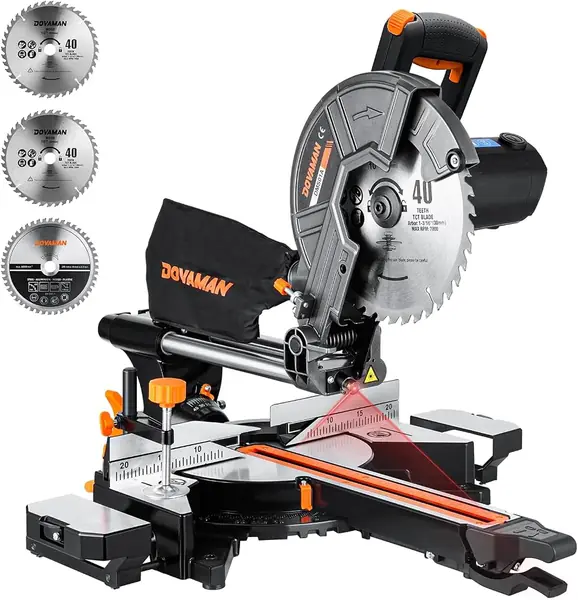
DOVAMAN DMS01A 10-inch sliding miter saw in black with laser guide and side tables

Light-duty DIY

Shop Score 87/100
Weight
37.5 lb
Blade Size
10 inches
Speeds
5,000 and 3,200 rpm
Max Crosscut
3.5 x 13.4 inches
View on Amazon

Three TCT blades, a material clamp, and spare motor brushes ship in the box — more than any other saw here gives you. The DMS01A is a 10-inch slider with 13 inches of rail travel and folding side tables, and it crosscuts up to 3.5 by 13.4 inches, which is wider stock than the fixed-head 10-inchers here handle, for less money than any DEWALT on this page.

The two-speed switch is the interesting part. At 3,200 rpm the saw is meant for plastic and soft metal; at 5,000 it's a wood saw, and we think that's a sensible feature on a machine sold to people who take on mixed projects. The motor is the gamble: some of these saws have quit after a few months of steady cutting, so treat the DMS01A as a weekend saw rather than a shop workhorse.

The arbor is a 30mm size, so most aftermarket 10-inch blades need an adapter, and with the rails and side tables deployed it takes more bench length than the 12-inch DEWALT here. Line up a longer bench and the right blade before you start, and it will do everything a garage shop asks of a second saw.

Worth Noting

  • Slow spin-up and no blade brake
  • Laser may need adjusting to cut true
Our Verdict

Weekend projects that need sliding capacity on a small budget fit the DMS01A, though the motor keeps it out of daily production work.

Check Latest Price

How We Tested Miter Saws for a Small Shop

We started with spec sheets, comparing saws sold without a stand on footprint, crosscut capacity at 90 and 45 degrees, miter range and detent count, bevel direction, weight, and dust port size. That narrowed the field to eight saws a one-person shop could reasonably house, and we priced what each needed on top — a stand, a better blade — before it was ready to work.

Each saw went on the same bench, with a garage wall about a foot behind the fence so we could watch how far the head traveled before it hit anything. We ran base molding around a stairwell and a half bath, cut nested crown for a built-in, and stood base molding against the fence to check vertical capacity. Every workpiece was clamped against the fence; no saw was ever run on the floor.

Out of the box, we checked each saw against a framing square and made a test cut through a 1x4, then bumped the table on purpose to see how quick and how repeatable re-squaring was. We timed a run of 20 identical cuts to judge speed, and pushed the included blade through the same stretch of MDF to see how long it held an edge before it started burning. Nine months in, we re-checked each saw for square and for slop in the detents.

We hooked a shop vac to every dust port, and on a few cuts ran nothing but a respirator, then wiped the bench to see how much fines had escaped. Each saw got lifted on and off the bench alone, twice a session. The cordless model ran on the maker's own packs, and we counted how many a morning of trim work burned through and priced replacements separately, since it ships as a bare tool.

How to Choose a Miter Saw for a Small Shop

Start With Clearance, Not Blade Size

Most sliding saws run their rails backward over the bench, so a slider needs a few inches of clear space behind the fence line — often the exact space a narrow shop doesn't have. A fixed-head saw needs only its own footprint and can back up near a wall, which is why the DEWALT DWS715 is our default here.

Put a tape on the bench and check the head's travel before you buy. A saw that has to be dragged out and re-squared for every cut stops getting used, and the listing's length and width tell you the footprint but say nothing about what happens behind the fence.

What Blade Size Actually Buys

Diameter is a capacity decision. A 12-inch fixed-head compound miter saw such as the DWS715 cuts 2 x 8 lumber at 90 degrees and 2 x 6 at 45; a 10-inch saw tops out around 2 x 6, which handles baseboard and shelving but stops short of wide trim.

If you cut crown, the height figures matter as much as width — look for nested crown and vertical base against the fence. Wide panels and built-up headers are the point where a slider earns its bench space.

Single Bevel or Double Bevel

Single-bevel saws tilt one way, usually 45 to 48 degrees left with a few degrees to the right, and you flip the workpiece for the mirror-image cut. Double-bevel saws tilt both ways, so the head moves instead of the board.

For baseboard, casement, and shelving, single is fine and saves money and weight. For a house full of crown, where you cut mirror-image angles all day, double is worth the premium. A miter is a swing and a bevel is a tilt; compound cuts use both at once.

Weight and Where the Saw Lives

Twenty-four pounds and fifty-five pounds are different tools in practice. The Metabo HPT goes on a shelf when the bench is needed for assembly; the DEWALT DWS780 wants a permanent home on something solid. None of the saws here includes a stand, so budget for a bench, a shelf, or a miter saw stand as part of the purchase.

A lighter saw with a carry handle gets used more often than a heavier one you dread lifting, and in a shop that doubles as a garage, that frequency is most of the value.

Dust, and Corded Versus Cordless

Dust is the part of miter saw work nobody plans for. Collection bags on these saws are small, and the ones advertising high capture rates still spill chips at the port; a shop vac on a short hose is the practical fix and, in a small shop, the difference between cutting near finished work and not.

Corded saws deliver constant power for the least money. Cordless, like the DEWALT DCS361B, makes sense when the saw travels to the work — and only if you already own the batteries, since a bare tool plus packs and a charger can cost more than the saw.

Frequently Asked Questions

Final Verdict

Most small shops should start with the DEWALT DWS715. It does a 12-inch saw's work on trim and framing, backs up near a wall, and weighs little enough for one person to move; the single-bevel head is the only real compromise.

If crown and wide panels are routine, step up to the DWS780 and give it a permanent bench. If the bench has to be clear every evening, the 24.2-pound Metabo HPT is the one you'll actually carry out.