↑↓ navigate ↵ open Esc close All results →

Best 6-Inch Bench Grinders of 2026

High-speed bench grinders strip metal quickly from an axe or mower blade, yet that same RPM can blue and ruin a chisel edge in seconds if pressure gets careless. Low-speed machines trade speed for cooler grinding, though either speed relies on the same fundamentals: a true-spinning wheel, a rigid tool rest that holds a repeatable bevel, and a base that stays planted.

Bolted to a workbench across nine months of sharpening chisels, plane irons, and axes, 12 six-inch grinders quickly separated smooth-running motors from units that buzzed and walked across the top. First-time buyers rarely realize that factory wheels often ship coarse and slightly out of balance, meaning early vibration sometimes traces back to the stone rather than the bearings.

Balancing occasional yard-tool touch-ups against fine woodworking edge prep determines whether a single-speed budget machine or a slower, heavier grinder belongs on the bench.

Our Top Picks

The Best 6-Inch Bench Grinders

1.

DEWALT DW756 6-Inch Bench Grinder Best Overall
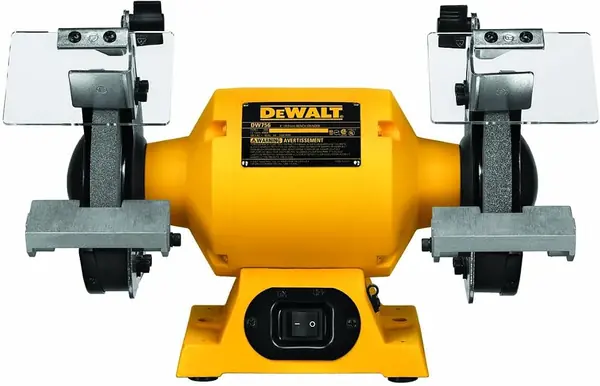
DEWALT DW756 yellow and black 6-inch bench grinder with two grinding wheels and cast-iron base

General shop grinding

Shop Score 95/100
Motor
5/8 hp
Speed
3,450 rpm
Weight
30.4 lb
Wheel Size
6 in.
View on Amazon

The 5/8-hp motor and cast-iron base are what make the DW756 the grinder we trust for a mixed shop. At 3,450 rpm it has enough speed for deburring, rust removal, and reshaping a mower blade, and the 30.4-pound body gives it the mass to stay settled once it is bolted down. We also appreciate the rear exhaust ports in the wheel guards, a small detail that helps keep the grinding area from loading up with debris.

What we like most is how little drama the machine adds to a job. The precision-machined aluminum tool rests give you a steady ledge for a chisel or a length of bar stock, and they adjust with a solid feel that lighter grinders often lack. Vibration still depends on the wheels: a poorly dressed wheel can shake any 6-inch grinder, but the cast base and wide footprint give the DW756 a calmer starting point.

For a shop with a dedicated spot, the DW756's combination of power, mass, and smooth running is the one we choose first. The cast-iron housing and broad base make it feel like a tool you can leave set up, and the 3,450-rpm speed gives you room to work beyond a quick touch-up. That permanence is the point: this is a grinder to bolt down and build your sharpening routine around.

Worth Noting

  • At 30.4 pounds it is not portable
Our Verdict

For a mixed home shop, the DW756 is the 6-inch grinder we recommend: its 5/8-hp motor, cast-iron mass, and 3,450-rpm speed handle sharpening and real metal removal without feeling fragile.

Check Latest Price
2.

BUCKTOOL 6-Inch Low-Speed Bench Grinder Best Low-Speed

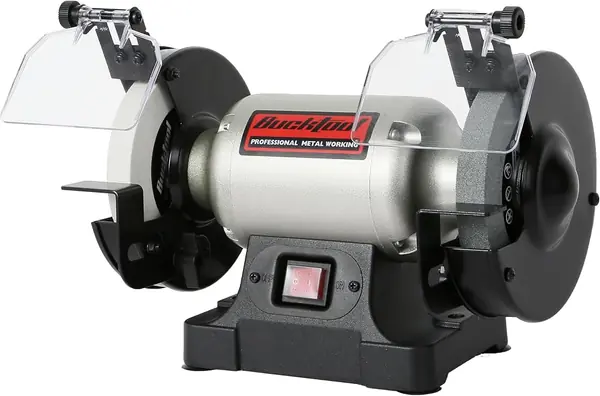
BUCKTOOL 6-inch low-speed bench grinder with two aluminum oxide wheels and clear eye shields

Woodworking edge tools

Shop Score 91/100
Motor
1/3 hp
Speed
1,750 rpm
Weight
22.4 lb
Wheels
60- and 80-grit
View on Amazon

The 1,750-rpm spindle is why the BUCKTOOL earns its place here. That low speed gives you more time to watch the edge and less chance of overheating a chisel or plane iron, which matters more in a woodworking shop than raw removal rate. We like the 60- and 80-grit aluminum oxide wheels as a starting pair: the coarser wheel shapes an edge, and the finer one refines it without forcing you to buy another wheel immediately.

The cast aluminum base and rubber feet make this a stable little machine, and the tool-free work rest is easy to set for wheel clearance. We did find one limitation worth planning around: the rest does not tilt to a repeatable bevel angle, so for consistent chisel work you will want a separate angle jig. The clear eye shields and spark arrestor are welcome safety details, especially in a small shop where the grinder sits close to your work.

At 22.4 pounds, it is heavy enough to feel solid but light enough to move onto a shelf when the job is done. The two-year warranty adds some peace of mind, and the low-speed motor is the reason we prefer it for edge tools. If your bench grinder is mainly a sharpening station, this is the one we point you toward.

Worth Noting

  • 1/3 hp limits heavy stock removal
Our Verdict

Woodworkers who sharpen chisels and plane irons should put the BUCKTOOL on their short list; we like its cool-running 1,750-rpm motor and the ready 60/80-grit wheels.

Check Latest Price
3.

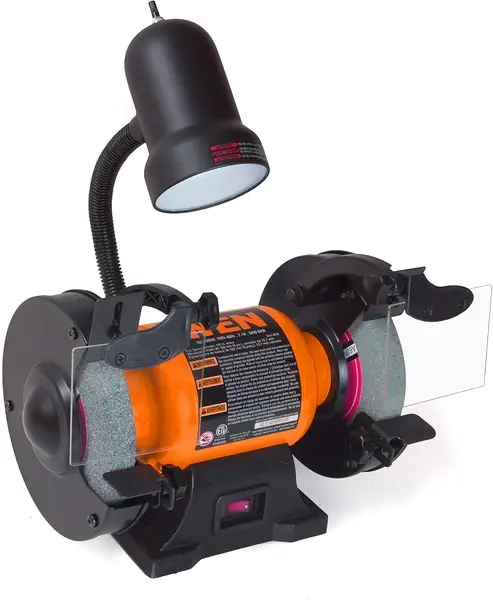
WEN BG4276 6-Inch Bench Grinder Best Budget

WEN BG4276 orange and black 6-inch bench grinder with flexible work light and two wheels

Occasional sharpening

Shop Score 90/100
Motor
2.1 amps
Speed
3,450 rpm
Weight
16 lb
Wheels
36- and 60-grit
View on Amazon

The lowest price in this group is the WEN's opening argument, and it backs that up with a 2.1-amp motor, two 6-by-3/4-inch wheels, and a flexible work light. The 36- and 60-grit wheels cover coarse reshaping and general sharpening, while the eye guards and two-year warranty make it feel less like a disposable bargain. At 16 pounds, it is also the easiest grinder here to lift onto a bench by yourself.

The work light is the detail we did not expect to use as much as we do. It bends to put light right at the wheel contact point, which is handy when you are touching up a chisel or a mower blade in a garage with overhead light behind you. The 3,450-rpm speed is fast enough for light deburring and rust removal, and the wheel guards come off without a fight when you need to change a wheel.

We think the WEN makes the most sense for a first grinder or a second machine for light tasks. Its 16-pound body is easy to store, and the price leaves room for a better wheel or a wire brush. It is not the grinder we choose for long sessions of heavy stock removal, but for occasional sharpening and touch-up it is a smart budget buy.

Worth Noting

  • Lighter 16-pound body can transmit vibration
Our Verdict

The WEN is our budget high-speed pick: a 3,450-rpm motor and flexible work light make light sharpening and touch-up easy for the money.

Check Latest Price
4.

VEVOR 6-Inch Low-Speed Bench Grinder Best Budget Low-Speed

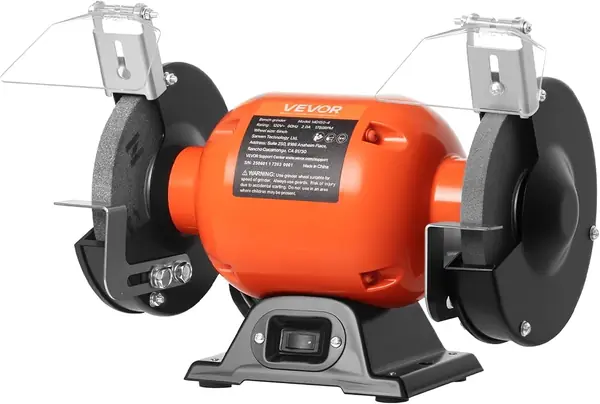
VEVOR orange and black 6-inch low-speed bench grinder with two grinding wheels and eye shields

Budget sharpening

Shop Score 89/100
Motor
250 watts
Speed
1,750 rpm
Weight
17.3 lb
Wheels
36- and 60-grit
View on Amazon

The 250-watt low-speed motor is the VEVOR's reason to exist: at 1,750 rpm it gives you the slower, cooler grinding action that chisels and plane irons like, without the BUCKTOOL's higher price. The cast-iron body, steel plate base, and rubber feet add stability, and the 36- and 60-grit wheels are ready to work out of the box. On paper, it looks like a budget copy of the low-speed formula.

We think the VEVOR is at its best as a dedicated sharpening station. The adjustable eye shields and tool rests are easy to set, and the slower wheel speed gives you a longer look at the edge before heat builds. The 17.3-pound body is heavy enough to sit still on rubber feet, though we still prefer bolting any grinder down.

The price is the real story: it is the least expensive way here to get a low-speed 6-inch grinder, and that saving can go toward a better wheel or an angle jig. The 17.3-pound body is easy to move, but the cast-iron base is still heavy enough to want a permanent spot. For weekend sharpening and light deburring, it covers the basics.

Worth Noting

  • 250W motor can slow under firm pressure
Our Verdict

We see the VEVOR as the budget route to low-speed sharpening, with a 1,750-rpm motor and cast-iron body that deliver controlled edge work for less than the BUCKTOOL.

Check Latest Price
5.

Woodskil 6-Inch Bench Grinder Best for High-Speed Home Grinding

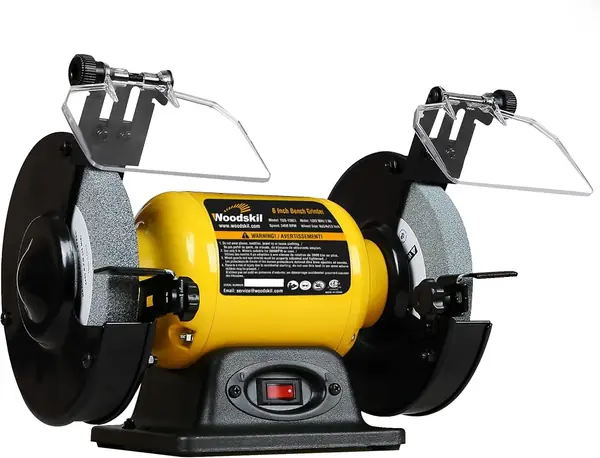
Woodskil 6-inch bench grinder with two aluminum oxide wheels, steel base, and clear eye shields

High-speed home grinding

Shop Score 88/100
Motor
1/2 hp
Speed
3,450 rpm
Weight
17 lb
Wheels
36- and 60-grit
View on Amazon

The 1/2-hp motor and CSA listing are the two details that set the Woodskil apart in this group. It drives 6-inch wheels at 3,450 rpm, includes 36- and 60-grit aluminum oxide wheels, and mounts on a pre-drilled steel base that is ready to bolt to a bench. At 17 pounds, it is easier to move than the DEWALT, which helps in a small shop.

We like the safety package: the clear eye shields and spark arrestors are exactly the features we look for on a grinder that will sit in a home shop. The steel base is rigid, and the 1/2-hp motor has enough power for general sharpening and deburring without feeling strained. For a buyer who wants a high-speed machine with a certification behind it, this is a sensible step up from the budget WEN.

Where the Woodskil loses ground is value. It costs more than the WEN and VEVOR, and while the CSA listing and 1/2-hp motor are real advantages, they do not make it a better first grinder for most shoppers. We see it as a solid niche choice for someone who specifically wants the certification and a little more motor than the budget high-speed pick.

Worth Noting

  • Costs more than comparable WEN and VEVOR budget grinders
Our Verdict

Buy the Woodskil if you want a CSA-listed high-speed grinder with a rigid steel base and do not mind paying more than the budget picks; we think it is a solid niche choice.

Check Latest Price

How We Tested Six-Inch Bench Grinders

We started with research, not a shopping cart: reading listings for every six-inch bench grinder we could find, comparing wheel size and arbor fit, speed, motor ratings, and price, then narrowing to 12 machines — budget single-speed models through low-speed grinders built for woodworking edges. We noted up front which ones arrived with eye shields, spark arrestors, and a tool rest worth adjusting.

Every grinder was bolted to the same benchtop and used on weekend afternoons and the odd weeknight for nine months, sharpening a chisel set, two plane irons, an axe, mower blades, and a drawer of kitchen knives. To read vibration and wheel balance, we set a nickel on edge on the tool rest and watched whether it stayed up, then dressed each wheel and checked again. Motor power got judged under load: we leaned in with a chisel and watched how much speed it lost, then ran the same chisel on a high-speed and a low-speed machine to see how each treated the steel.

Bevels were set with a machinist's square and checked after every pass, and we pressed down on the tool rest to see whether it flexed. An infrared thermometer tracked how hot each edge got, and we watched for straw or blue discoloration on the high-speed machines. A decibel meter at ear height recorded noise, though pitch mattered as much as the number.

Last, we priced replacement wheels that matched each grinder's arbor and maximum speed rating, and noted the grits that came in the box. Every machine wore its guards while it ran, and we mounted each one the way it should be mounted: bolted down, shields in place, glasses on.

How to Choose a 6-Inch Bench Grinder

Start With Speed, Not Wattage

High-speed models turn at about 3,450 rpm and low-speed models at about 1,750 rpm. High speed removes metal quickly, which suits deburring, rust removal, and lawn-tool repair. Low speed gives you more time to control the edge and is gentler on chisels, plane irons, and other woodworking tools that lose temper when they overheat. The trap is assuming low speed is automatically safer or better: a dull wheel and heavy pressure can burn an edge on either machine. If most of your work is sharpening, start with a low-speed model such as the BUCKTOOL; if you need one grinder for general shop abuse, the DEWALT's 3,450-rpm speed is the more versatile choice.

Check Power and Wheel Fit

Six-inch wheels are the common size here, and many use a 1/2-inch arbor, but check the spindle and wheel bore before you order replacements. Motor ratings are not interchangeable: a 5/8-hp high-speed motor and a 1/3-hp low-speed motor do different jobs, and amps alone do not tell you how much torque you get at the wheel. More power helps when you are removing stock or leaning into a mower blade; for light sharpening, a smaller motor can be enough. The practical test is whether the wheel keeps turning under firm pressure or slows down and forces you to back off.

Plan for Vibration and a Solid Mount

Vibration usually starts at the wheel, not the motor. A wheel that is out of round, loaded with metal, or poorly seated will shake even a good grinder, so budget for a dressing tool and check the wheels before you blame the machine. A heavier cast-iron base helps, and rubber feet reduce some movement, but neither replaces bolting the base to a rigid bench. If you cannot drill into your bench, use a mounting board you can clamp down. The DEWALT's 30.4-pound body is the most planted here; lighter models need a solid mount to feel settled.

Look at the Tool Rest and Guards

A tool rest that only moves in and out is fine for general deburring, but woodworkers sharpening a bevel need a rest that can hold a consistent angle or a jig that does the same job. Check that the eye shields and spark arrestors adjust and stay where you set them; those parts are not decoration. We also look for tool-free adjustment, because you will move the rest as the wheel wears. If the rest only sets clearance to the wheel, plan on an angle jig for repeatable chisel edges.

Wheels, Grits, and What Comes Next

Most 6-inch grinders arrive with a coarse wheel and a medium wheel: 36-grit for fast shaping and 60- or 80-grit for a finer edge. That is enough to start, but the included wheels are often the first upgrade. A wire wheel on one side turns the machine into a rust and burr remover; a white aluminum oxide wheel runs cooler on harder steels. Match any replacement wheel to the grinder's speed and arbor size, and never exceed the wheel's rated maximum speed. If you plan to sharpen often, add a dressing tool and an angle jig to the budget.

Frequently Asked Questions

Final Verdict

For most home shops, the DEWALT DW756 is the 6-inch bench grinder we recommend: its 5/8-hp motor, cast-iron base, and 3,450-rpm speed give you enough power for sharpening, deburring, and real metal removal.

If woodworking edge tools are the main job, choose the BUCKTOOL for its 1,750-rpm low-speed control and cooler cutting. The WEN is the budget high-speed alternative, and the VEVOR is the cheaper low-speed route when the BUCKTOOL is more than you want to spend.