↑↓ navigate ↵ open Esc close All results →

Best Drill Bit Sharpeners of 2026

A dull drill bit does more than slow down a pass—it skates off the mark, smears holes out of round, and builds enough friction to turn the cutting edge blue right before finishing a job. A dedicated sharpener costs less than replacing a couple of quality bit indexes and keeps worn flutes cutting cleanly.

Whether a sharpener gets used or pushed to the back of a shelf depends on alignment setup rather than motor wattage; if indexing a bit takes three tries, buying new bits starts looking tempting again. Working through a can of bits dulled on deck framing, masonry, and winter bench projects across nine months with ten sharpeners showed the value of true chuck repeatability.

Evaluating claimed diameter ranges, fixed versus dialable point angles, collet hold, replacement wheel pricing, and manual clarity narrowed the field to five machines that seat and grind a bit the same way twice.

Our Top Picks

The Best Drill Bit Sharpeners

1.

Drill Doctor 750X Best Overall
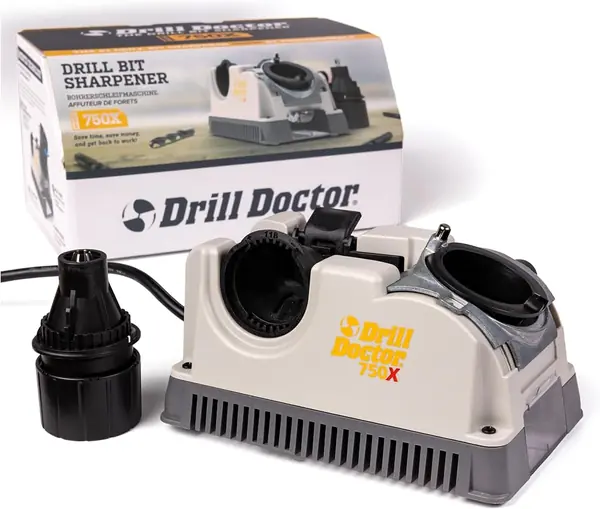
Drill Doctor 750X electric drill bit sharpener with 3/4-inch chuck and diamond wheel

Full bit indexes

Shop Score 92/100
Point Angle
115 to 140 degrees
Bit Size Range
3/32 to 3/4 inch
Grinding Wheel
Preinstalled 180 grit diamond
Included Chuck
3/4 inch
View on Amazon

A 3/4-inch twist bit is usually the first one a shop gives up on, and the 750X is the Drill Doctor that takes it. From 3/32 inch to 3/4 inch, with a point angle you can set anywhere between 115 and 140 degrees, it covers the pilot bits and the boring bits and everything in between. That range is why it is our top pick: it sharpens what a woodshop actually dulls.

The routine is the same on every Drill Doctor — chuck the bit, set the angle, swing it against the wheel — and the 750X adds a split-point port with a Push to Stop feature, so you can create a split point instead of only restoring one. We paid close attention to that stop, because an over-split bit cuts worse than the dull one you started with, and a physical limit is a better teacher than a steady hand.

Materials do not change the procedure. Carbide, cobalt, high-speed steel, black oxide, TiN coated, masonry: the 180 grit diamond wheel grinds all of them, and the only adjustment is patience. The pleasant surprise is how little steel a light pass removes — we kept the touches short and the bits came back with an edge and their full length.

It wants about a foot of bench and a free outlet, and it earns that space the first time a big bit comes back cutting. If your index stops at half an inch and the bits in it are 118 or 135 degrees, the 500X runs the same wheel through the same routine.

Worth Noting

  • Manual is thin for first-time setup
Our Verdict

Our pick for a shop that wants one sharpener for the whole index: the 750X covers 3/32 to 3/4 inch at any angle you set.

Check Latest Price
2.

Drill Doctor 500X Best for Split Points

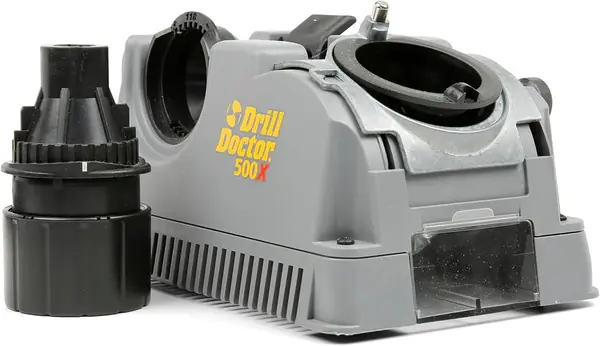
Drill Doctor 500X gray drill bit sharpener with 1/2-inch chuck and diamond wheel

Split point work

Shop Score 91/100
Point Angle
118 or 135 degrees
Bit Size Range
3/32 to 1/2 inch
Grinding Wheel
Preinstalled 180 grit diamond
Included Chuck
1/2 inch
View on Amazon

Put the 500X beside the 750X and most of it is the same machine: a 1/2 inch chuck, a preinstalled 180 grit diamond wheel, the split-point port with its Push to Stop, the same chuck-and-swing motion. The differences sit at the edges — a half-inch maximum bit size, and two point angles instead of a dial that runs 115 to 140 degrees. The chuck comes with it, along with a wheel hub wrench and a six-foot cord, so there is nothing else to buy before the first bit.

For a woodshop whose index stops at half an inch, that is not much of a compromise; you get the same edge without a setting you never touch. We think this is the right Drill Doctor for a garage setup that drills wood, hinges, and the occasional bracket. The caution is the split port: leave a bit in too long and it comes back over-split, cutting worse than it did when it was merely dull. Short touches and a look at the point between them are the fix.

Repetition is where the 500X quietly wins. The chuck holds the angle you set, so a coffee can of dull bits becomes a batch job — chuck, touch, swap, repeat — instead of an evening. What we liked most is how little of the machine you actually handle: the chuck and the port are the only two places your hands go, which is why the learning curve is measured in bits rather than days.

Worth Noting

  • Stops at 1/2 inch bits
  • Two point angles only
Our Verdict

We think the 500X is the right Drill Doctor for a home shop whose bits stop at half an inch and whose drawer is full of split points.

Check Latest Price
3.

MDPSDS Drill Bit Sharpener Best Budget

MDPSDS RS-1 compact electric drill bit sharpener with built-in grinding wheel

Starter bit sets

Shop Score 87/100
Point Angle
130 degrees
Bit Size Range
1/8 to 15/32 inch
Grinding Wheel
Built-in
Weight
2.59 lb
View on Amazon

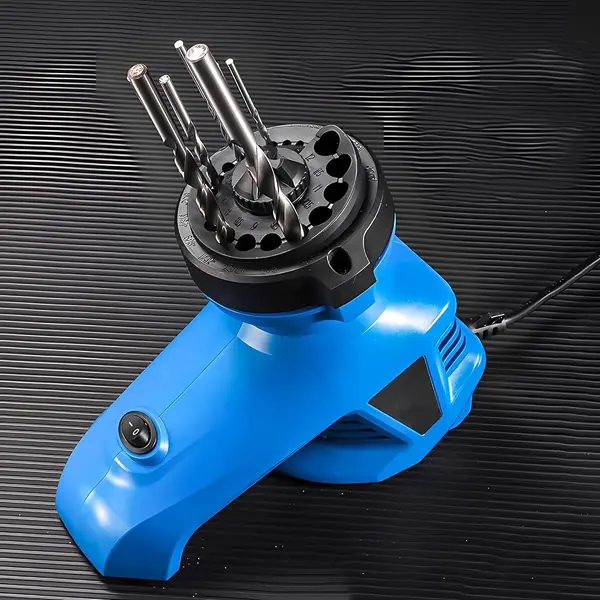
There is no chuck, no collet, no angle dial, and nothing to adjust: the MDPSDS is a 95-watt box with a built-in wheel, a positioning plate, and a switch. Plug it in, set the bit against the plate, touch it to the wheel. For someone who has never owned a sharpener and has a shoebox of dull bits, that simplicity is the entire pitch.

The plate fixes the angle and your hand sets the pressure, and that second part is where the machine asks something of you. At the small end of its range a bit can vanish in a few seconds if you lean into the wheel; the technique that worked for us was short taps with a look at the point in between. Nothing about it is hard, but nothing about it is foolproof either.

In our view this is a first sharpener, not a lifetime one. It does its best work on the mid-size bits that fill a starter index, and it spends far less than the replacements it saves you from buying. The wheel is built in, so the machine's life is tied to it — confirm a replacement wheel is sold for it before you order.

Worth Noting

  • Range stops at 15/32 inch
  • Fixed 130-degree angle
Our Verdict

Buy it if you own a small index of mid-size bits and want to stop replacing them, and you accept that the pressure is your job.

Check Latest Price
4.

VEVOR MR-20G Drill Bit Sharpener Best for High Volume

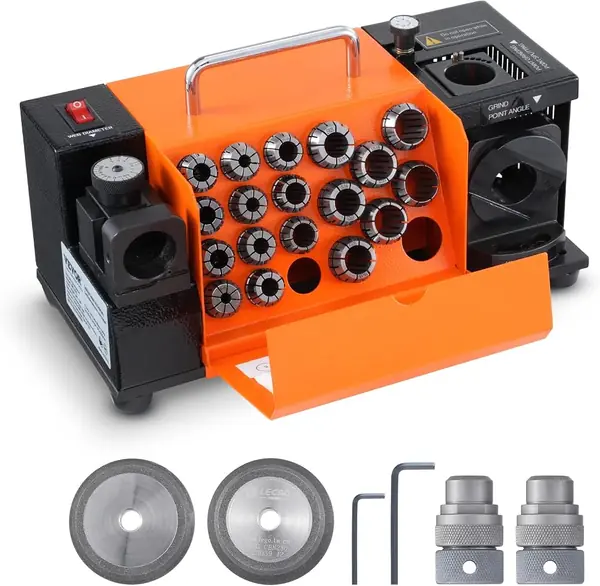
VEVOR MR-20G black and orange drill bit grinding machine with collets and two wheels

High-volume shops

Shop Score 86/100
Point Angle
95 to 135 degrees
Bit Size Range
3 to 20 mm
Collets Included
18 (3 to 20 mm)
Grinding Wheels
CBN and SDC
View on Amazon

Twenty-point-one pounds is what separates this from every bench box here. The MR-20G is a collet grinder with a steel body, a 120-watt DC motor turning 4,500 rpm, and enough mass that nothing walks when you swing a bit into the wheel. The weight is the feature — a grinder that does not shift is a grinder whose results repeat — and it is why this is our pick for a shop that sharpens every week.

Eighteen collets run from 3 to 20 mm, and the bit is held by its shank rather than cradled against a plate, which is what lets one setting work bit after bit. Two wheels ship in the box: CBN for high-speed steel, SDC for harder stock. Point angle and lip relief both adjust between 95 and 135 degrees, and the open cover lifts off so you can brush the dust out instead of blowing it around.

Where it stops is at the top of the range. Twenty millimeters is just over 25/32 inch, so the one-inch bits some indexes carry are out. We also noted that the collets are metric, which means a fractional bit takes the nearest size up and wants a check for a snug, true seat before you grind. Neither point matters to a shop that works in millimeters all day.

Worth Noting

  • Costs the most of any machine here
  • 20.1 pounds needs a permanent bench spot
Our Verdict

For a shop that sharpens every week, the MR-20G is the machine we point to: collets, two wheels, and mass that keeps the grind repeatable.

Check Latest Price
5.

AR MR-13A Drill Bit Sharpener Best for Small Metric Bits

AR MR-13A drill bit grinding machine with thirteen collets and a CBN wheel

Small metric bits

Shop Score 85/100
Point Angle
95 to 135 degrees
Bit Size Range
3 to 15 mm
Grinding Wheel
CBN
Collets Included
13 (3 to 15 mm)
View on Amazon

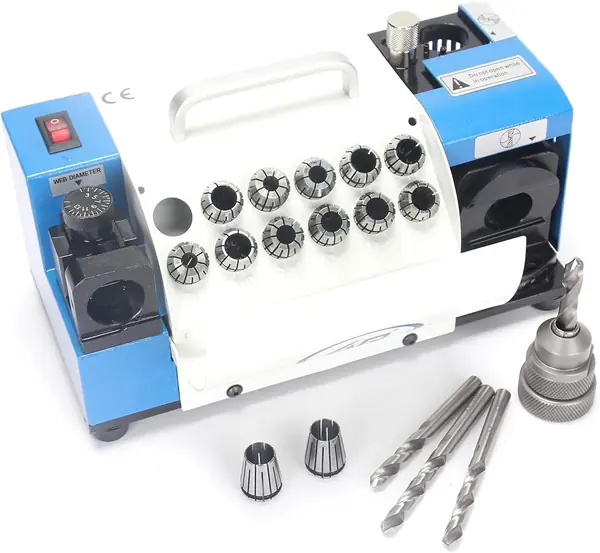
Thirteen collets from 3 to 15 mm, a point angle you dial between 95 and 135 degrees, and a CBN wheel turning at 4,400 rpm on a DC motor: the MR-13A is a small collet grinder rather than a benchtop box, and it shows in the way it holds a bit. The open-type cover lifts away so you can brush the grinding dust out instead of blowing it around the shop.

Our read is that it suits a bench where the bits are small, metric, or both — a drawer of 1/8 inch bits that get used hard, a set of odd sizes nothing local stocks. The collet is what does the work: the shank is held on its own diameter, so the next bit goes in the same way and comes out with the same grind, without you re-aiming anything between them.

The trade is reach. Fifteen millimeters is about 19/32 inch, so half-inch bits fit with room and the 5/8 inch bit in your index does not. For a bench that never chucks anything that large, that boundary costs nothing. What we kept coming back to is the dial: 95 to 135 degrees is a real range, not a token second setting, and it is the reason to choose this over a fixed-angle box.

Worth Noting

  • Bit range ends at 15 mm
Our Verdict

Choose this one if your bits are metric or small and you want the angle to be a dial setting rather than a guess.

Check Latest Price

How We Tested Drill Bit Sharpeners

We started with more than 30 sharpeners and narrowed to ten using the specs that matter before anything gets plugged in: the bit size range each one claims, whether the point angle is fixed, switchable, or adjustable by dial, which chucks or collets come in the box, and whether replacement wheels are sold at all. Bench footprint and weight knocked out a few more. The ten we tested were bought at retail and run on the same bench.

Testing ran nine months, on a shop bench with a drill press and two handheld drills, with side trips to a deck rebuild and a brick wall where masonry bits go dull fast. We started each machine the same way: the manual, then setting up a 3/16-inch bit with no help, timed. Then we re-chucked that same bit five times to see whether it landed at the same angle every pass, since a machine that grinds a different facet each time wastes steel and patience.

Next we ran genuinely dull bits through and looked at what came off — whether the point finished centered, how much steel a single pass removed, and how each machine behaved at the bottom of its range, where a small bit is easy to grind into nothing. On the machines that cut split points, we checked that the split stopped where it should instead of running into the cutting edge. We noted whether the base walked under load or needed clamping, and weighed the wheels before and after to gauge wear.

Every unit got the same handling over those months, in batches, with safety glasses on and machines unplugged before we cleared grit or swapped a wheel. Value was purchase price measured against what a wheel costs and how often one is needed. The sharpener that stayed on the bench longest wasn't the most capable on paper — it was the one we could set up without thinking.

How to Choose a Drill Bit Sharpener

Buy for the sizes you actually dull

Pull ten bits out of your index — the ones you reach for, not the ones still in the wrapper — and note the smallest and the largest. That pair matters more than any other number, because a sharpener only works on bits its chuck or collet will hold, and the ends of a range are where the real limits hide: a half-inch chuck and a 15/32 inch maximum are the difference between sharpening your biggest bit and not.

The small end deserves the same look. At the bottom of any range the wheel takes material off fast, and a heavy hand can turn a 1/8 inch bit into a stub. If you drill a lot of pilot holes, the machine's smallest collet is the specification to check first.

Point angle: fixed, two settings, or a dial

Most woodshop bits are 118 degrees; 135 degree bits are the ones bought for metal and for starting holes without skating. A fixed 118 degree machine is fine if that is your whole index, one that switches between 118 and 135 covers a mixed drawer, and a dial like the 750X's 115 to 140 degrees lets you bias an angle for a particular job. Note that one budget machine here fixes at 130 degrees, which behaves more like a 135 bit than a 118.

Split points are a separate question. They cut down walking when you start a hole, and only some machines can create one rather than merely restore it.

How the bit is held decides your evening

The fixture is the whole tool. A drill bit grinder that grips a bit by its shank in a collet repeats a setting bit after bit; a plate-and-hand design asks you to re-aim every time. Both produce an edge, but only the first turns a coffee can of dull bits into a batch job.

If you sharpen the one bit that went dull mid-project, the cheaper design is enough, and the money goes further on a better wheel. If you plan to work through the whole index, pay for collets and a positive stop.

Wheels and what you will replace

Diamond and CBN wheels do the cutting, and they wear. A 180 grit diamond wheel is the common fit for high-speed steel, CBN holds its form well on the same stock, and SDC is the one for carbide. Before you buy, find out whether a replacement wheel is sold for that model — a machine with no available wheel becomes a doorstop the day the grit dulls.

Bench space, weight, and where the grit goes

These run from a couple of pounds to a 20 pound collet machine, and the weight is doing a job: a heavy grinder stays put when you press a bit into the wheel, and a light one can skid. If your bench is short, measure before you buy and plan on clamping the base down, since mounting holes are not universal.

Grinding throws a little grit and a lot of fine dust. A spot with a shop vac nearby, or at least a bench you do not mind wiping, is the right home for it.

Frequently Asked Questions

Final Verdict

For a general woodshop, the Drill Doctor 750X is the machine we point to. It takes the whole index from 3/32 to 3/4 inch — including the pilot sizes the collet grinders here cannot reach — sets any point angle from 115 to 140 degrees, and creates a split point rather than only restoring one.

If your bits stop at half an inch, the 500X does the same work on them with the same wheel. If sharpening is weekly production, the VEVOR's collets and its 20 pound body are the step up; the rest of us can stay with the Drill Doctor.