↑↓ navigate ↵ open Esc close All results →

Best Bench Grinders of 2026

A bench grinder has two personalities, and wheel speed decides which one you get. A fast wheel — 3,450 to 3,600 rpm — throws sparks and removes metal in a hurry, which is what a banged-up mower blade wants. Drop to 1,750 rpm and the same stone cuts cooler, so a chisel or plane iron keeps its temper instead of bluing at the tip.

That one choice ripples outward — into wheel life, into how much control you have at the tool rest, into whether the machine walks across the bench when you lean on it. We ran 12 grinders for nine months in garages and basement shops, sharpening chisels, axes, and mower blades, and the ones that stayed put and ran smooth earned their place. Horsepower gets the attention; balanced wheels and a base that doesn't shift matter more.

The grinders worth keeping are rarely the ones with the loudest spec sheet. They're the ones whose tool rests still sit close to the wheel after a year and whose stones still run true. Here's what held up.

Our Top Picks

The Best Bench Grinders

1.

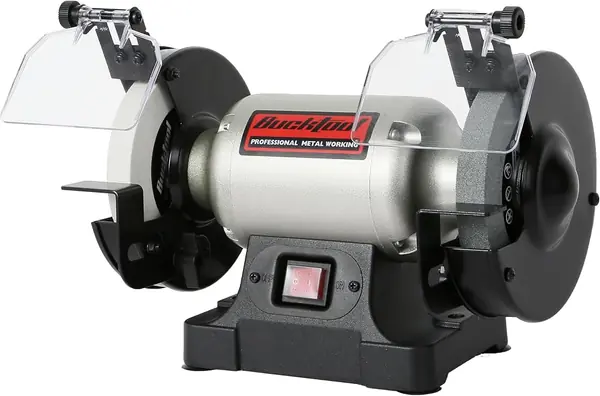
BUCKTOOL 8-Inch Dual Speed Bench Grinder Best Overall
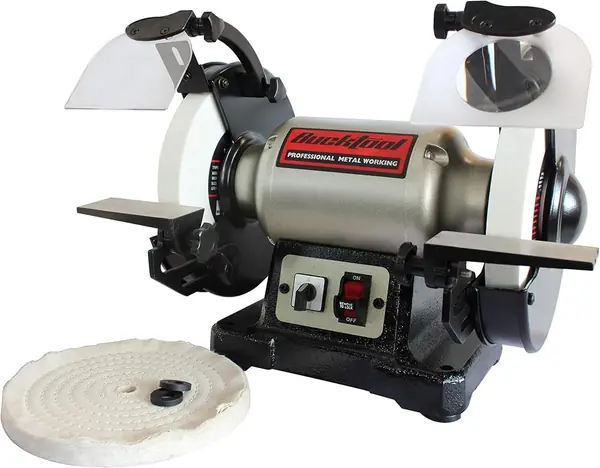
BUCKTOOL 8-inch dual speed bench grinder with cast iron base and two wheels

General shop grinding

Shop Score 93/100
Motor
1/2 HP, 120V
Wheel Diameter
8 in
Weight
45 lb
Spindle Speeds
1,725 and 3,450 RPM
View on Amazon

Two spindle speeds, 1,725 and 3,450 rpm, are the reason this grinder takes the top slot. At the low setting you can hold a plane iron or a gouge against the wheel without watching the temper leave the steel, and the motor carries real torque at that speed instead of limping. Flip the switch and a mower blade or an axe head comes back into shape quickly. Few machines in this group give you both.

What settled it for us was how still it sits. A 45-pound body on a cast iron base with rubber feet means you can lean into a chisel without the grinder walking across the bench, and the wheels on this one spin true out of the box — the balance is the most consistent of the 8-inch grinders here. If you have only used a light 6-inch machine, the difference in how the work feels under your hands is the real surprise.

The two cast aluminum rests adjust independently, so you can take up wheel wear on one side without disturbing the other, and both sides carry white aluminum oxide wheels — 80 grit on one, 120 on the other. A 3X magnifier on the eye shield turns out to be genuinely useful for detail sharpening, there is a buffing wheel in the box for polishing, and the two-year warranty is standard for the class.

Worth Noting

  • Fine 80/120 grit wheels are slow for heavy removal
Our Verdict

For most shops this is the bench grinder we recommend: two speeds cover sharpening and stock removal, and a 45-pound cast iron body stays put while you work.

Check Latest Price
2.

RIKON 80-805 8-Inch Low Speed Bench Grinder Best for Sharpening

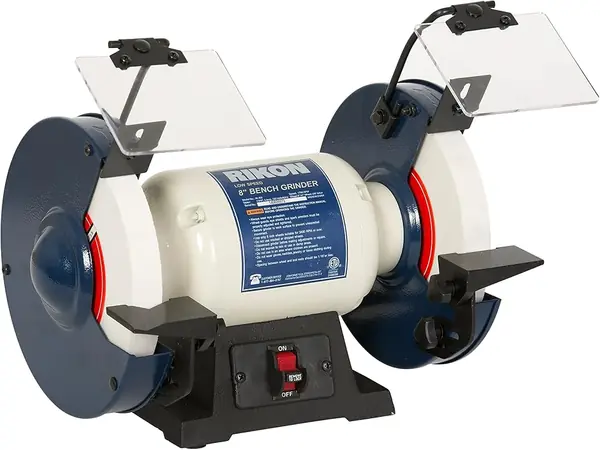
RIKON 80-805 blue 8-inch low speed bench grinder with two white wheels

Sharpening turning tools

Shop Score 92/100
Motor
1/2 HP, 120V
Wheel Diameter
8 in
Spindle Speed
1,750 RPM
Included Wheels
60 and 120 grit white aluminum oxide
View on Amazon

1,750 rpm is the number that matters here, and it is why we send woodturners to this machine first. Half the spindle speed of a standard grinder means far less heat at the edge, so a bowl gouge spends less time against the abrasive and comes away with its temper intact, even in unsteady hands.

The rest of the package is aimed at the same job. Both wheels are white aluminum oxide — 60 grit for shaping, 120 for the finishing pass — and the left rest has a groove cut for drill bits. A diamond wheel dresser comes in the box, which matters more than it sounds: every low-speed grinder's wheels need truing eventually, and having the tool on day one saves an order.

Ours needed that dresser. The wheels are the weak point of an otherwise solid machine — they can arrive out of round, and getting them to run clean takes a few minutes at the dresser or, in stubborn cases, a set of self-leveling washers under the flanges. We think the cast iron base, the quiet running and the five-year warranty still make this the sharpening station to buy, and the 37-pound body sits on a bench without being bolted. Budget the setup time and it rewards you.

Worth Noting

  • Takes a while to reach full speed
Our Verdict

This is the grinder we point woodturners and hand-tool sharpeners to, because 1,750 rpm protects an edge where a high-speed wheel would burn it.

Check Latest Price
3.

JET IBG-8 8-Inch Industrial Bench Grinder Best for Heavy-Duty Use

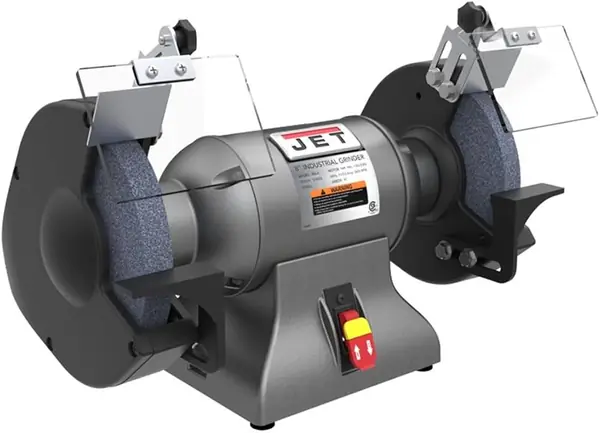
JET IBG-8 gray cast iron industrial bench grinder with two vitrified wheels

Heavy daily grinding

Shop Score 91/100
Motor
1 HP, 115V
Wheel Diameter
8 in
Spindle Speed
3,600 RPM
Weight
44 lb
View on Amazon

Put a wire wheel on one side and a coarse stone on the other and the IBG-8 barely notices. One horsepower at 3,600 rpm is more motor than most benches ever ask for, and it is why the spindle holds speed when you lean into a mower blade instead of bogging and recovering.

The money goes into the frame. Cast iron guards, a cast iron base, adjustable rests that do not flex, and 44 pounds of machine that sits still without being bolted down — though the base is pre-drilled if you want it fixed in place. It carries a CSA/CUS listing, which not every grinder in this group does.

The 36- and 60-grit vitrified wheels are coarse enough for real shaping, and the rests are the sturdiest of the 8-inch machines here; we could set an angle and trust it through a pass. The stones themselves are the first thing you will want to change if you sharpen weekly — a CBN wheel on this motor makes a serious setup.

Where it earns its place is a shop that grinds something most weeks: fewer passes, less heat, no fighting the machine. For a bench that sees a mower blade twice a season it is more grinder than you need, and the BUCKTOOL dual-speed does the same work with a smaller footprint and a smaller bill.

Worth Noting

  • More machine than a light-use bench needs
Our Verdict

Buy this if your grinder works for a living: 1 HP at 3,600 rpm and a cast iron frame that holds speed and angle through heavy daily grinding.

Check Latest Price
4.

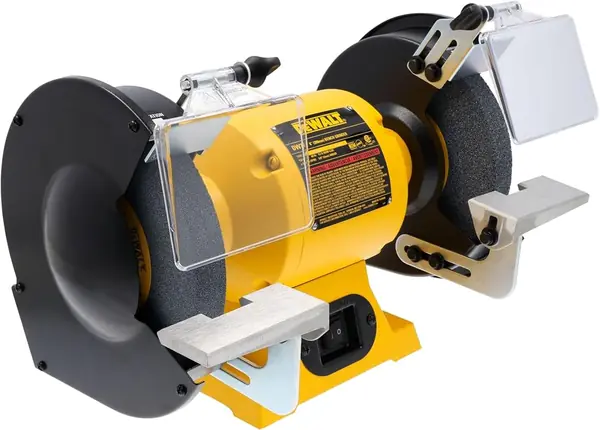
DEWALT DW758 8-Inch Bench Grinder Best for Fast Stock Removal

DEWALT DW758 yellow and black 8-inch bench grinder with cast iron base

Fast stock removal

Shop Score 90/100
Motor
3/4 HP
Wheel Diameter
8 in
Spindle Speed
3,600 RPM
Tool Rests
Machined aluminum
View on Amazon

Cast iron from the base to the motor housing and 3/4 HP at 3,600 rpm make the DW758 the fastest-cutting 8-inch grinder in this group — the one we reach for when the job is removing metal rather than finessing an edge.

The machined aluminum rests are the detail that makes it usable. Stamped rests flex, and you end up chasing the angle through a pass; these hold where you set them. Rear exhaust ports in the wheel guards keep the stream of grit moving away from the work instead of back at your hands.

Balance is the thing to check first on this machine. It spins up smooth when the wheels are true, but the stones can arrive out of round and set up a wobble you feel through the tool rest — dress them before you judge the grinder, and check that the flange washers sit flat. Once it settles, the cast iron base is easy to bolt down and the whole thing feels built for a decade of shop use.

Worth Noting

  • Louder and buzzier than the low-speed grinders
Our Verdict

The grinder we reach for when the job is removing metal: 3/4 HP at 3,600 rpm cuts fast, as long as you dress the wheels before judging it.

Check Latest Price
5.

BUCKTOOL 6-Inch Low Speed Bench Grinder Best Low-Speed Value

BUCKTOOL 6-inch low speed bench grinder with cast aluminum base and eye shields

Small benches

Shop Score 89/100
Motor
1/3 HP, 120V
Wheel Diameter
6 in
Spindle Speed
1,750 RPM
Weight
22.4 lb
View on Amazon

On a bench that already holds a vise at one end and a sharpening stone at the other, a 22-pound grinder with a 14-inch footprint is the difference between a tool you use and one you keep in a cabinet. This one earns the counter space: 1,750 rpm, the same slow speed the dedicated sharpening machines run, at a fraction of their bulk.

Six-inch wheels at that speed take material off slowly enough to control, and the white aluminum oxide 80-grit wheel leaves a cleaner edge than the gray stones most budget grinders ship with. The 60-grit brown wheel on the other side handles the rougher work. Balance is what this machine gets right — the wheels run true, and it stays quiet enough that you do not mind it running while you think.

The 1/3 HP motor is honest about what it is. Chisels, plane irons, axes and mower blades are all well within it; grinding a chip out of a heavy bar is not. We were also impressed by how little it costs to get into low-speed sharpening this way, and the two-year warranty covers a machine sitting at the bottom of the price range for its class. Just know the rests slide in and out to take up wear rather than tilting to a bevel angle — a jig holds the angle, or your hands do.

Worth Noting

  • Rests do not tilt to a set bevel angle
Our Verdict

The low-speed grinder we recommend for a small bench: 22 pounds, true-running wheels, and a 1,750 rpm spindle that will not burn a chisel.

Check Latest Price
6.

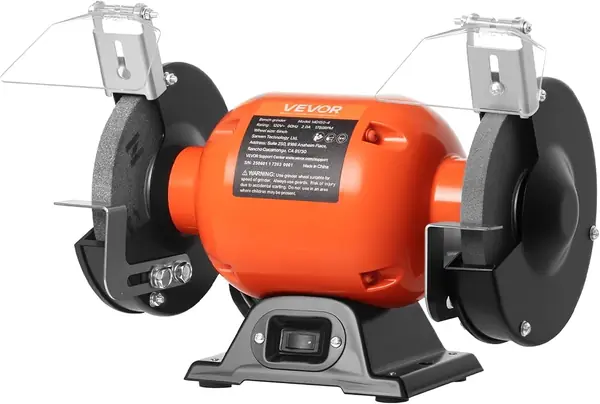
VEVOR 6-Inch Low Speed Bench Grinder Best Budget

VEVOR 6-inch low speed bench grinder in orange and black with rubber feet

Occasional home sharpening

Shop Score 88/100
Motor
250W (2.0A), 120V
Wheel Diameter
6 in
Spindle Speed
1,750 RPM
Weight
17.3 lb
View on Amazon

The cheapest grinder in this group is also a low-speed machine, which is the combination most home shops are actually looking for: one wheel for chisels and hatchets, one for lawn equipment, and no midrange money spent to get there.

We were skeptical of 250 watts in a cast iron body, and it is the least motor here — lean on the spindle and it will slow. Used the way it is meant to be used, with light pressure and the work resting on the tool rest, it grinds a mower blade cleanly and, more to the point, it does not shake. The cast iron frame and rubber feet keep it planted, which is the thing cheap grinders usually get wrong.

The 36- and 60-grit brown aluminum oxide wheels are coarser than the white stones on the sharpening-focused machines, so this one is happier shaping an axe edge than polishing a chisel. The work rest adjusts without tools and the eye shields tilt where you need them. What you do not get is mass or motor headroom — a handful of tools a month is its comfort zone, and that is a good zone for the money.

Worth Noting

  • Least powerful motor here; light pressure only
Our Verdict

The cheapest way into a slow-speed wheel, and a good one if you sharpen a few tools a month and do not need motor headroom.

Check Latest Price
7.

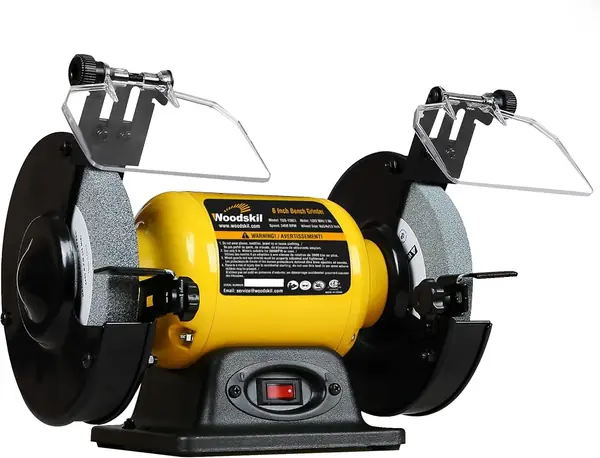
Woodskil 6-Inch High Speed Bench Grinder Best for Light High-Speed Work

Woodskil 6-inch high speed bench grinder with steel base and eye shields

Light high-speed work

Shop Score 87/100
Motor
1/2 HP, 2.8A
Wheel Diameter
6 in
Spindle Speed
3,450 RPM
Base
Pre-drilled steel plate
View on Amazon

Half a horsepower is the most motor in any six-inch grinder here, and it is paired with the highest spindle speed of the small machines — 3,450 rpm. On a 6-inch wheel that combination is quick.

It is also the only 6-inch grinder in this group that runs at high speed, which makes it the one for lawn equipment, axe heads and anything you are reshaping rather than finishing.

The base is pre-drilled steel plate rather than cast iron, and the machine carries a CSA listing — worth noting, since not every grinder here claims one. Eye shields and spark arrestors are included, the 36- and 60-grit wheels cover shaping and a general edge, and the work rest adjusts without tools.

What we noticed in use is the spin-up: it comes to speed fast, and the steel base is rigid once it is bolted down. On its rubber feet alone it has less damping than the cast iron machines, so put two bolts in it. What we cannot tell you yet is how the motor holds up after a few years of steady work — that is the honest gap with a newer machine. Treat this as the low-cost way onto a small bench with real cutting speed, and a good second grinder if you already own a slow one.

Worth Noting

  • High-speed only, so thin edges heat fast
Our Verdict

A sensible pick if you want high-speed cutting on a small bench: the most motor in any 6-inch grinder here, plus a CSA listing.

Check Latest Price

How We Tested the Bench Grinders

We started with every 6-inch and 8-inch grinder we could find from brands with a track record in real shops, then sorted by what changes how a machine behaves: spindle speed, motor size, tool rest design, base weight, and price. Twelve went onto test benches — 2x4 frames topped with plywood, one in a garage and one in a basement shop — and each was bolted down rather than trusted to its rubber feet. Testing ran nine months.

Each grinder worked the same evening rotation: chisels, plane irons, an axe, and a mower blade with a fresh nick in it. We leaned a block of mild steel into the wheel and watched a tachometer to see whether the spindle held speed or bogged down, and set a coin on the base to watch for hop and drift. Wheel balance got checked before the first use, spinning each stone by hand and watching the edge for a wobble.

Tool rests got the fussiest attention. We thumb-pressed each one to feel for flex, checked whether the two sides move independently, and locked each to a bevel angle to see if it drifted under pressure — then kept it close to the wheel face, where it belongs. Swapping to a wire brush and back told us how friendly the arbor is, with every replacement matched to the machine's spindle speed and arbor size and new stones ring-tested before mounting.

Noise got a meter held at ear height, roughly where a face lands at the wheel, and we noted the gap between a low-speed hum and a high-speed shriek. We also taped the footprint of each base and left clearance around the wheels for a workpiece. Safety glasses stayed on the whole time, shields down or not.

How to Choose a Bench Grinder

Start With Wheel Speed, Not Horsepower

A 1,750 rpm machine turns the wheel slowly enough that a chisel or plane iron does not lose its temper in the time it takes you to register the edge. A 3,450 to 3,600 rpm machine removes metal roughly twice as fast and heats the edge just as fast.

Buy low speed for edge tools, high speed for lawn and garden equipment, and a dual-speed machine such as the BUCKTOOL 8-inch if both jobs land on the same bench. More horsepower does not fix the wrong speed: a 1 HP high-speed grinder scorches a skew chisel just as quickly as a cheap one.

Six-Inch or Eight-Inch Wheels

An 8-inch wheel carries more abrasive past the work per revolution and lasts longer before it wears down to nothing, which is why the heavy machines here run 8-inch stones on 1/2 to 1 HP motors. A 6-inch table grinder spins the same kind of edge with less machine around it: lighter, cheaper to re-wheel, easier to fit beside a vise.

Watch the word compact. On a grinder it describes the footprint, not the performance — a 6-inch machine will not match an 8-inch for stock removal no matter how much motor it has, and the 8-inch machines here weigh 37 to 44 pounds for a reason.

The Tool Rest Is Where Accuracy Comes From

Every grinder here has a rest, and they are not equal. Stamped sheet-metal rests flex under a firm hand, so the angle drifts mid-pass; cast aluminum and machined rests hold where you set them. The DEWALT's machined rests and the JET's rigid ones are what let you trust a pass.

Check two things before you buy: whether each rest adjusts independently, so you can take up wear on one wheel without disturbing the other, and whether it tilts. Many rests sold as adjustable only slide in and out. If the rest does not tilt to your bevel angle, you need a sharpening jig to repeat one.

Expect to Dress the Wheels

Almost every grinder in this group arrives with aluminum oxide wheels, and almost every one of those wheels can arrive slightly out of round. That is normal rather than a defect: a diamond dresser — included with the RIKON, worth buying with any of the others — trues the face in a couple of minutes and takes most of the shake out of a new machine.

If a wobble survives dressing, check that the flange washers sit flat and consider self-leveling washers. CBN wheels are the long-term upgrade for anyone sharpening weekly: they run true, hold their shape, and are the single biggest improvement you can bolt onto a budget grinder.

Weight, Mounting, and Noise

Mass is what keeps a grinder from walking when you push a tool into the wheel, and the spread here is wide: 17 to 22 pounds for the 6-inch machines, 37 to 44 pounds for the 8-inch ones. Light grinders need bolting down; heavy ones often just need their rubber feet.

Noise follows the same split. The 1,750 rpm machines are noticeably quieter than the 3,450 rpm ones, which matters in a basement shop. If you grind for more than a few minutes at a stretch, buy the heaviest machine your bench and budget allow.

Frequently Asked Questions

Final Verdict

Two speeds, 8-inch wheels and a cast iron base make the BUCKTOOL 8-inch dual speed the grinder we recommend to most shops. It sharpens at 1,750 rpm and takes material off at 3,450 without swapping machines, and it is the steadiest-running 8-inch grinder in this group.

If you only sharpen edge tools, the RIKON's low-speed motor, included dresser and five-year warranty make it the better long-term buy. If you grind heavy stock most weeks, step up to the JET's 1 HP and cast iron frame.