↑↓ navigate ↵ open Esc close All results →

Best Wire Wheels for Bench Grinders of 2026

Rusty bolts off a mower deck, a patio chair frame that needs stripping, a coffee can of hardware that sat out one winter — a bench grinder with a wire wheel makes quick work of all of it. But the wheel, not the grinder, decides how that goes. One that wobbles, sheds bristles, or arrives with an arbor hole that doesn't match your spindle turns a ten-minute job into an afternoon.

We mounted 14 wheels on a pair of 6-inch bench grinders and a 7-inch pedestal grinder and ran them for four months. Shop the arbor before anything else: most wheels come with a 5/8-inch hole and a reducing bushing for 1/2-inch spindles, and a sloppy bushing turns into vibration the moment you spin it up. Crimped and knotted wire are also different tools — crimped for cleaning and finishing, knotted for heavy scale.

Our picks cover 5-inch grinders and 7-inch pedestal units, fine finishing and rough stripping, plus a couple of two-packs for anyone who'd rather not run out mid-project. All of them fit, run true, and hold their bristles.

Our Top Picks

The Best Wire Wheels for Bench Grinders

1.

DeWalt DW4904 6-Inch Crimped Wire Wheel Best Overall
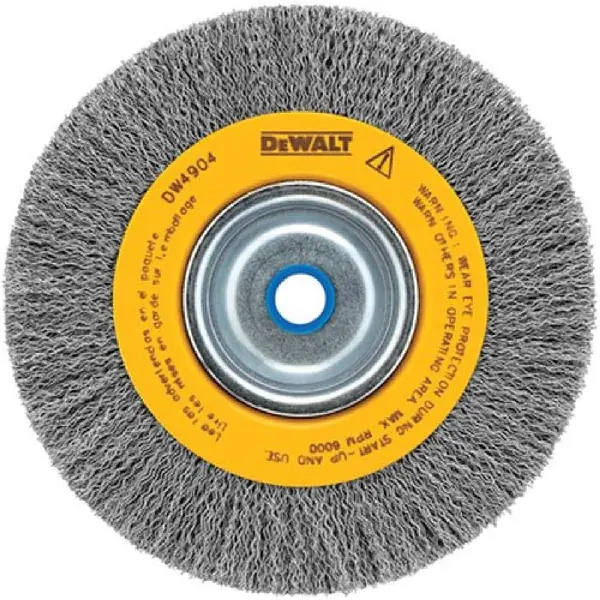
DeWalt DW4904 crimped wire wheel brush with 6-inch wheel and 5/8- to 1/2-inch arbor

Everyday metal cleanup

Shop Score 94/100
Wheel Diameter
6 inches
Arbor
5/8 inch and 1/2 inch
Bristle Type
Crimped wire, medium
Construction
Internal wire holding plate
View on Amazon

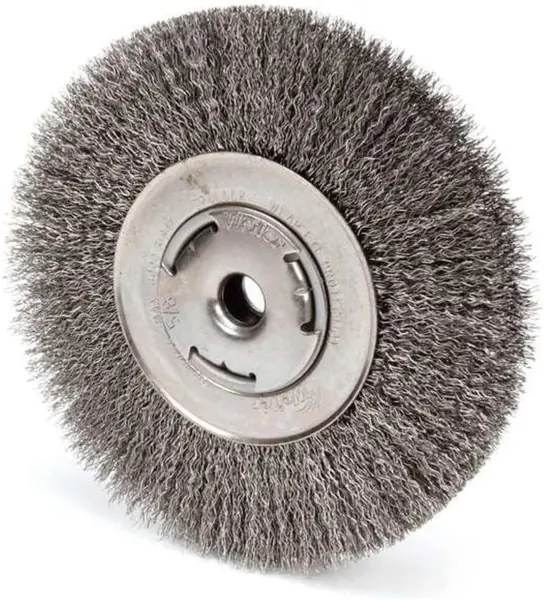
A 5/8-inch bore with a reducing washer for 1/2-inch spindles means the DW4904 goes straight onto either common bench grinder, with no detour to the hardware store for a bushing. That sounds like a small thing until you have had a new wheel sitting on the shelf for a week because the arbor was wrong.

Medium crimped wire is the right grade for general shop work. The bristles flex over rust, paint, and old grease instead of hammering the surface, and they get into the corners of a bracket or around a bolt head where a knotted wheel skips past. We also appreciate the internal holding plate: the tufts are locked into a steel ring rather than stapled loosely through the face, which is the difference between a wheel that keeps its wire and one that decorates your shirt.

Clearance is the thing to check before you power it up. A 6-inch wheel can rub the inside of a close-fitting guard, so mount it, spin it by hand, and confirm it turns free before you flip the switch. Once it was on, ours spun true, with no shimmy and no hunting for a sweet spot on the spindle.

Medium crimped wire will handle everything short of heavy scale. If your work is rust, paint, and general cleanup on steel, this is the wheel to build the rest of the shelf around.

Worth Noting

  • Sold as a single wheel
Our Verdict

Our default pick: it fits either common spindle out of the box, and the internal plate holds its wire at speed.

Check Latest Price
2.

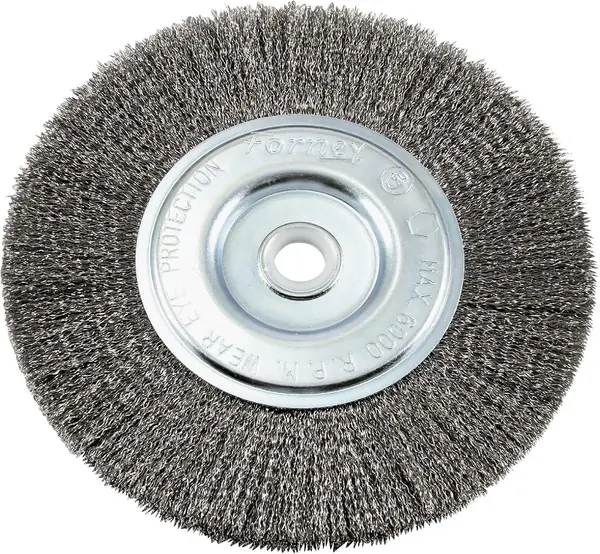
Forney 72747 6-Inch Fine Crimped Wire Wheel Best for Fine Finishing

Forney 72747 fine crimped bench wire wheel, 6-inch, with 1/2- and 5/8-inch arbor bushings

Paint-ready finishing

Shop Score 92/100
Wheel Diameter
6 inches
Arbor
1/2 inch and 5/8 inch
Wire Size
0.008 inch, fine crimped
View on Amazon

At 0.008 inch, the wire on Forney's 6-inch wheel is the finest in this group, and that is exactly what we keep it for: cleaning up after the heavy work is done. Fine crimped bristles blend a surface and pull light corrosion out of pits without leaving the scratch pattern a coarser wheel cuts in, which is why this is the one that goes on when a part is heading for primer.

That fineness sets a ceiling, and it is worth being honest about. Light burrs, paint, and surface corrosion come off happily; heavy scale and weld spatter will have you leaning into the wheel, and leaning is how a wire wheel wears out. Treat it as the second step, with a coarse wheel first and this one to finish, and it earns its place.

Both arbor sizes are covered: 5/8 inch directly, 1/2 inch with a plastic reducing bushing that has a habit of staying on the spindle when you pull the wheel, so check for it before you put things away. Keep one of these and one coarse wheel on the shelf and you can go from stripping to a paintable surface without rethinking your setup. It is also the least expensive single 6-inch wheel in this group, which makes keeping a spare an easy call.

Worth Noting

  • Fine wire struggles on heavy scale and weld spatter
  • Plastic 1/2-inch reducing bushing tends to stick on the spindle
Our Verdict

We reach for this one when a part needs a paint-ready finish, and no other wheel here does it for less.

Check Latest Price
3.

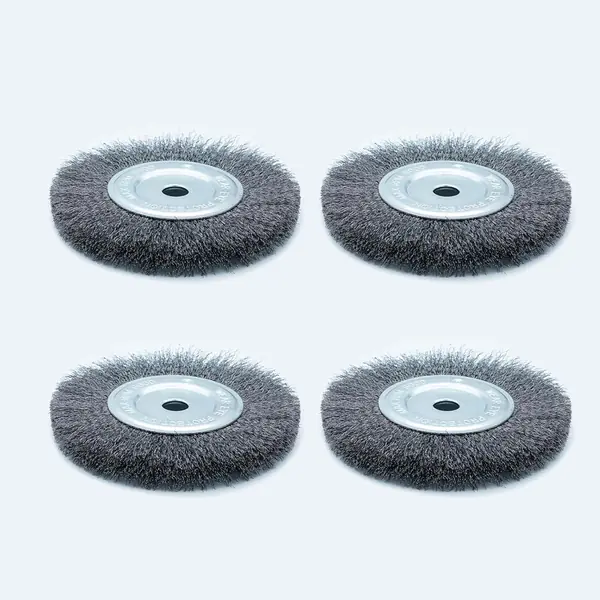
Eco Walker 6-Inch 4-Piece Wire Wheel Set Best Set for Two Grades

Eco Walker four-piece 6-inch bench wire wheel set with coarse and fine crimped carbon steel wheels

Stripping and finishing

Shop Score 90/100
Wheel Diameter
6 inches
Arbor
1/2 inch and 5/8 inch
Wire Sizes
0.008 inch and 0.012 inch
Set Contents
Four wheels in two grades
View on Amazon

Two coarse wheels at 0.012-inch wire and 3/4 inch thick, two fine ones at 0.008 inch and 7/8 inch thick, all 6 inches across and all fitting both 1/2- and 5/8-inch arbors. That is the box.

Having both grades on hand changes the way you work. The coarse pair takes rust, paint, and corrosion off a bracket or a length of tube; the fine pair follows behind to smooth the surface and pull the last of the corrosion out of the pits. Two grades in one order means you stop rationing the aggressive wheel because it is the only one you have.

The reducing washers are small enough to vanish on a crowded bench, so keep them threaded on the wheel when it comes off the grinder. That, plus a quick spin by hand before each mount, is the whole maintenance routine.

Where this set earns its place is a shop that is just getting a grinder going. You get a coarse wheel to learn on, a fine one to finish with, and spares of both, at the lowest cost per wheel here. If you already own a good crimped wheel, buy the coarse pair on its own instead, but as a first purchase this is the box we hand someone.

Worth Noting

  • Small arbor reducing washers are easy to misplace on a bench
Our Verdict

Our choice for a new grinder setup: four wheels in two grades, so stripping and finishing happen back to back.

Check Latest Price
4.

Vouyar 6-Inch Knotted Stainless Wire Wheel Best for Heavy-Duty Cleaning

Vouyar knotted stainless steel bench grinder wire wheel, 6-inch, with 1/2- and 5/8-inch arbor bushing

Heavy-duty cleaning

Shop Score 89/100
Wheel Diameter
6 inches
Arbor
1/2 inch and 5/8 inch
Wire
0.02 inch stainless, knotted
View on Amazon

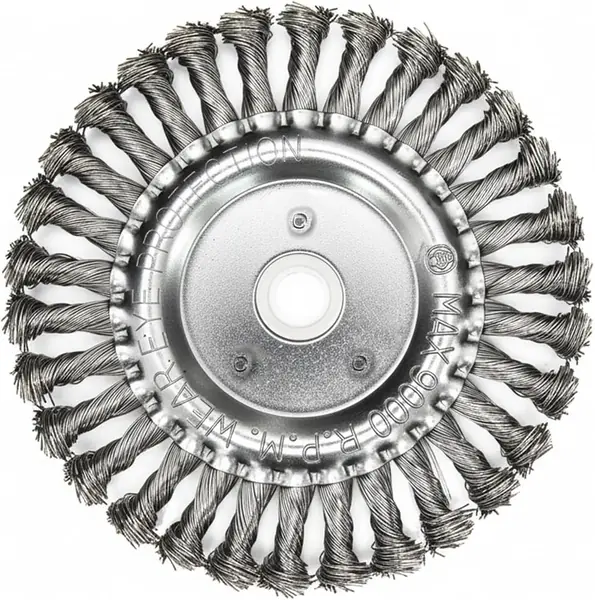
Knotted wire is a different tool wearing the same shape. Instead of flexible crimped bristles that fold over the work, the wire here is twisted into dense knots, so the tips stay stiff and hit hard. At 0.02 inch this is the thickest wire in the group, and it takes heavy scale and weld discoloration down to bare metal in a way the crimped wheels here cannot match.

The stainless construction matters more than it might seem. On stainless work, carbon steel bristles can leave iron particles behind that rust into the surface later, so a stainless wheel is the usual choice when the part itself is stainless. A bushing is included to fit both 5/8- and 1/2-inch arbors, which we appreciated, since it is one less thing to hunt for on a Saturday morning.

It is the wheel we keep for the ugly jobs: rusted trailer hardware, weld prep, the inside corners of a fabrication. If your grinder only ever sees gentle cleanup, a crimped wheel is the better all-rounder; this one is for the work that resists.

Worth Noting

  • Knotted wire marks softer metals
  • One wheel per box
Our Verdict

We keep this one for the work that resists: heavy scale, weld prep, and corners that eat crimped wheels.

Check Latest Price
5.

Weiler Wolverine 7-Inch Wide Face Wire Wheel Best for Large Grinders

Weiler Wolverine 7-inch wide face crimped steel bench grinder wire wheel with 5/8-inch arbor hole

Large pedestal grinders

Shop Score 88/100
Wheel Diameter
7 inches
Arbor
5/8 inch
Wire
0.014 inch crimped steel
Face Width
7/8 inch
View on Amazon

Seven inches across and 7/8 inch wide, this is the widest wheel in the group, and a wide face means fewer passes over a flat plate or a length of angle iron. Weiler makes these in Pennsylvania, and the construction shows it: a solid ring holding a dense 0.014-inch crimped steel fill, with no loose tufts hanging out of the box.

On a grinder with real mass behind it, this is the smoothest wheel we handled, steady enough that a cup of screws on the bench stays where you put it, with a crimped fill stiff enough to bite rather than skate across a rusty surface. Balance is still worth checking on any wheel this size, so spin it by hand on the spindle before you trust it at speed.

What the money buys is consistency and face width rather than a trick: a wheel that covers more surface and holds its shape through a long session. For a grinder you intend to keep, and a lot of flat stock to clean, the coverage is worth the premium.

Worth Noting

  • Needs a bushing for 1/2-inch spindles
  • Wide face needs guard clearance
Our Verdict

We recommend it for a big pedestal grinder, where the wide 7-inch face earns its keep on flat stock.

Check Latest Price
6.

OSFTBVT 6-Inch Crimped Wire Wheel 2-Pack Best for Rough Stripping

OSFTBVT two-pack of 6-inch coarse crimped carbon steel bench grinder wire wheels

Rough stripping

Shop Score 87/100
Wheel Diameter
6 inches
Wire
0.012 inch crimped carbon steel
Pack Size
2 wheels
Face Thickness
13/16 inch
View on Amazon

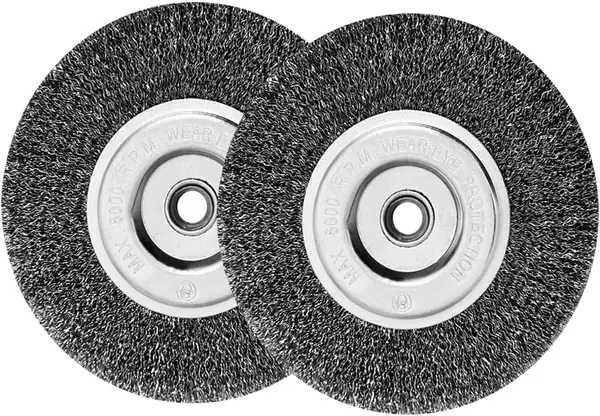
Two 6-inch coarse wheels, 0.012-inch crimped carbon steel, 13/16 inch thick, each fitting both 1/2- and 5/8-inch arbors. Buying them in pairs brings the cost per wheel below the single-wheel picks, which is most of the argument.

At 13/16 inch thick the face is wide enough to cover a flat plate or a length of angle in fewer passes, and the coarse wire has real bite on paint and old rust. Both wheels seated on the spindle with the supplied bushing and needed nothing else to get running.

For a shop that goes through wheels, with rough stripping, farm and trailer hardware, anything you would rather not spend a good wheel on, two you do not mind abusing is a sensible buy. Keep one mounted and one on the shelf, and a worn wheel stops being an emergency. It will not finish like the fine wheels here, and it is not meant to.

Worth Noting

  • ⚠️ Wires can shed under hard pressure
Our Verdict

We treat these as rough-work wheels: cheap enough to abuse, coarse enough to strip paint and rust.

Check Latest Price
7.

IVY Classic 39054 5-Inch Coarse Wire Wheel Best for Small 5-Inch Grinders

IVY Classic 39054 5-inch coarse crimped carbon steel bench grinder wire wheel

Small 5-inch grinders

Shop Score 86/100
Wheel Diameter
5 inches
Arbor
5/8 inch and 1/2 inch
Wire
0.012 inch coarse crimped
Max Speed
4,500 RPM
View on Amazon

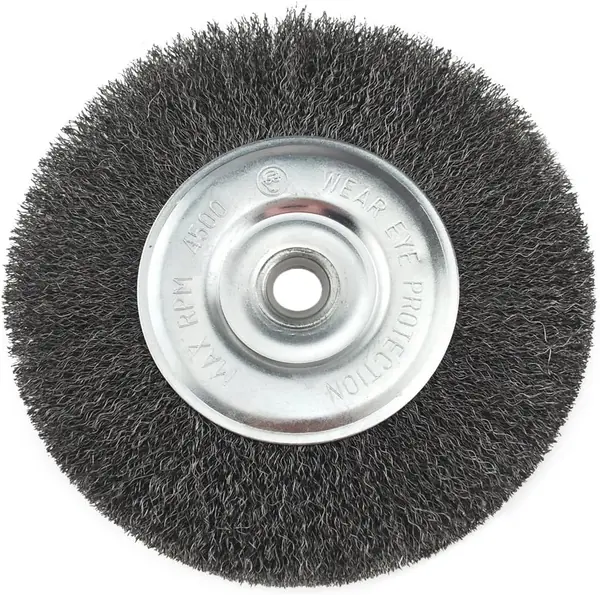
Five inches is the odd size out in this group, and that is the point: plenty of small bench grinders built for home shops take a 5-inch wheel, and a 6-inch one either rubs the guard or will not clear the tool rest. IVY's is a coarse 0.012-inch crimped wheel with a 5/8-inch bore and a 1/2-inch reducer, rated to 4,500 RPM. The 9/16-inch face is narrower than the 6-inch wheels here, and that is a good match for a small motor.

We like it as the budget wheel for a small grinder: light enough that a low-horsepower motor does not bog down, coarse enough for rust and paint on hand tools, and priced so a spare is painless. Check that 4,500 RPM rating against the nameplate before you mount it, because it is a lower ceiling than the 6,000-RPM wheels here, and on a fast buffer it is the number that matters.

Worth Noting

  • Fits 5-inch grinders only
Our Verdict

We like it for a small 5-inch grinder, where a light coarse wheel is all the job asks for.

Check Latest Price
8.

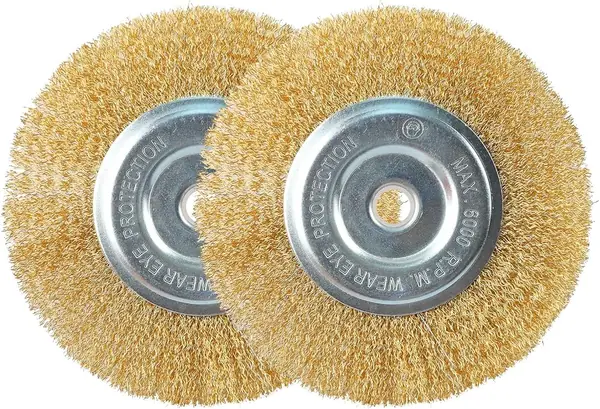
ZORUNNA 6-Inch Brass-Coated Wire Wheel 2-Pack Best for Brass and Aluminum

ZORUNNA two-pack of 6-inch brass-coated crimped wire wheels for bench grinders

Brass and aluminum

Shop Score 83/100
Wheel Diameter
6 inches
Arbor
1/2 inch and 5/8 inch
Wire
0.012 inch brass-coated
Pack Size
2 wheels
View on Amazon

Brass-coated wire is the softer option, and this is the wheel we reach for when the part is brass, copper, or aluminum rather than rusted iron. The coating is slicker than bare steel and leaves a lighter scratch pattern, which is why it is the usual choice for cleaning fittings and pipe without gouging the surface. Two 6-inch wheels come in the box, 0.012-inch wire, fitting both 1/2- and 5/8-inch arbors.

For a woodworker the appeal is hardware: hinges, bolts, and old tools that need corrosion off without losing their surface, and we like the two-pack for exactly that. Keep it for the last pass on a fitting rather than the first pass on a rusted hinge. What it is not is a substitute for a steel wheel on heavy rust.

Worth Noting

  • Brass-coated wire, not solid brass
Our Verdict

We like it for brass and aluminum, where a coated bristle cleans without the bite of bare steel.

Check Latest Price

How We Tested Wire Wheels for Bench Grinders

We started by rounding up every 5-, 6-, and 7-inch bench wheel we could find with a 1/2-inch or 5/8-inch arbor, then sorted them by wire type and diameter, face width, pack size, and cost per wheel. Fourteen made it onto the bench. We mounted them on two 6-inch bench grinders and a 7-inch pedestal grinder, checking that each wheel cleared its guard with room to spare.

Testing looked like our actual shop work over four months: mower blades and a coffee can of rusty hardware on Saturday mornings, old paint off patio chair frames, brass fittings that needed a polish. Before the first spin-up, we read each wheel's maximum RPM rating against the grinder's nameplate and put on a face shield. Then we watched the edge for wobble as it came up to speed, felt for hop through the tool rest, and counted the bristles left lying on the bench after every session.

Each wheel came off and went back on four times, with and without its reducing bushing, so we could see whether the bushing loosened or the plate wallowed out. We also timed how long each one took to bring a stretch of rusty angle iron down to bare metal, and weighed that against how many wheels came in the pack.

How to Choose a Wire Wheel for a Bench Grinder

Start With the Arbor, Not the Wheel

Bench grinders come with either a 1/2-inch or a 5/8-inch spindle, and a wire wheel brush has to match it or it lives in a drawer. Most 6-inch wheels are bored at 5/8 inch and ship with a reducing bushing or washer for 1/2 inch. Check the unthreaded shoulder of your spindle with a caliper, or read the grinder's nameplate, before you order anything.

Watch the bushing, too. A small reducer often stays on the shaft when you pull the wheel, and a lost one means the next wheel will not center. We thread spares back onto the wheel the moment it comes off the grinder.

Crimped or Knotted: Pick the Aggression First

Crimped bristles are wavy and flexible. They bend over rust and paint, follow contours, and leave a finer scratch pattern, which makes them the right choice for general cleaning and finishing. Knotted wheels twist the wire into dense knots so the tips stay stiff and cut hard: that is the tool for heavy scale and weld prep, and it is also the one that will mark aluminum or a polished surface.

Wire diameter runs in the same direction. A 0.008-inch wheel is a finishing wheel, 0.012 inch is general purpose, and 0.014 inch and up is heavy work. If you only buy one, 0.012-inch crimped covers the widest range of jobs.

Balance and Wire Retention Are What You Are Really Buying

A cheap wheel that runs out of round shakes the grinder, walks it across the bench, and leaves a scalloped surface. The better wheels here lock their tufts into an internal plate or a solid steel ring instead of stapling them loosely through the face, and that construction is the difference between a wheel that drops a few bristles when new and one that throws them at you mid-pass.

Spin any new wheel by hand on the spindle, then run it for a minute before you put a workpiece against it. What we pay for is a wheel that runs true and holds its wire, not one with the most bristles in the photo.

Check the Speed Rating and the Guard Clearance

Ratings in this group run from 4,500 to 6,000 RPM. Most bench grinders turn at 3,600 RPM, so a 4,500 rating is fine, but a buffer or a high-speed machine needs the higher number. Match the rating to the machine, not to the price.

Clearance is the other half. A 6-inch wheel on a grinder with a tight guard can rub the casting, and a 7-inch wide-face wheel needs more room again. Mount it, spin it by hand, and confirm nothing touches before you flip the switch.

How Many Wheels, and How Wide

Face widths here run from about 9/16 inch to 7/8 inch. A wider face covers more surface per pass but loads the motor and eats clearance, so match it to the grinder you own rather than the biggest number on the page.

Two wheels beat one swapped back and forth. We keep a coarse wheel mounted and a fine one on the shelf, and multi-packs are the cheapest way to get there without ordering twice.

Frequently Asked Questions

Final Verdict

The DeWalt DW4904 is the wheel we put on the grinder first: it fits either spindle without a trip for parts, the internal plate holds its wire, and the medium crimped grade covers rust, paint, and general cleanup.

If the work is finishing rather than stripping, the Forney's 0.008-inch wire leaves a smoother surface for less money. If you run a big pedestal grinder and want one wide-faced wheel to cover flat stock, the Weiler is the premium answer, provided you have a 5/8-inch spindle and the clearance for it.