↑↓ navigate ↵ open Esc close All results →

Best Bench Grinder Stands of 2026

A bench grinder can only hold a steady bevel if the stand beneath it absorbs vibration instead of amplifying it. Bolt an 8-inch grinder to a lightweight pedestal and the whole assembly walks across concrete, telegraphing chatter straight into a chisel edge—while a tall column only gives an out-of-balance wheel extra leverage unless the feet anchor solidly to the slab.

Evaluating 12 stands across eight months started with basic fit: whether common 6- and 8-inch grinder bases sit flat on the mounting plate and align with its slots without drilling new steel. From there, dead weight, comfortable wheel height, and accessible quench-pot placement separated steady platforms from noisy ones.

Verified plate compatibility and bolt-down feet come standard across the lineup, balancing compact footprints against heavier cast bases for larger grinders.

Our Top Picks

The Best Bench Grinder Stands

1.

JET JPS-2A Bench Grinder Stand Best Overall
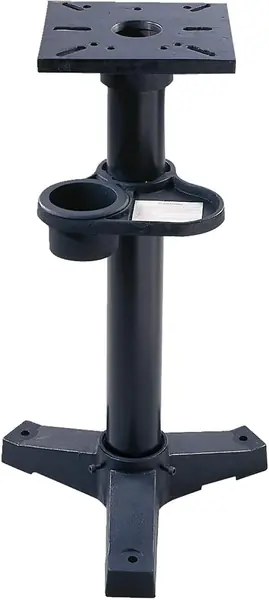
JET JPS-2A black cast iron bench grinder pedestal stand with tool tray and water cup

Permanent shop station

Shop Score 89/100
Weight
52 lb
Material
Cast iron
Quench Tray
Coolant tank and tool tray on an adjustable platform
Mounting Surface
11 x 10 in.
View on Amazon

Fifty-two pounds of cast iron with a milled top deck: the JET JPS-2A is the stand that turns a grinder into a fixed machine. We mounted ours, snugged the base down, and the startup shudder that had been rattling the bench disappeared into the column. There is nothing clever about it — no knobs, no folding parts, no sheet-metal gymnastics — just mass, a wide stance, and a flat plate, which happens to be the exact combination that keeps a grinder from walking.

The plate measures 11 by 10 inches and is drilled and slotted, enough for most 6- and 8-inch bases to bolt down without modification. What we appreciated most is the bracket on the column: the coolant tank and the little tool tray ride on an adjustable platform, so quench water sits where your hand already is instead of on the floor behind the stand. The wide-stance base is the other half of the story — lean into a wire wheel and the stand leans back.

Assembly takes a single Allen wrench and less time than unboxing, though the sheet in the box is brief enough that laying the parts out first saves a wrong turn. The top deck, base, and tray all read as machined rather than cast rough, which is why the column sits square without shimming — the kind of detail you only notice when you are trying to get a tool rest level.

Worth Noting

  • Mounting changes may be needed for non-JET grinders
Our Verdict

If you want a grinder that stops moving, start here: the JET's cast-iron mass and adjustable quench tray make it the steadiest home for a machine that stays in one place.

Check Latest Price
2.

WEN 4288 Bench Grinder Pedestal Stand Best Value

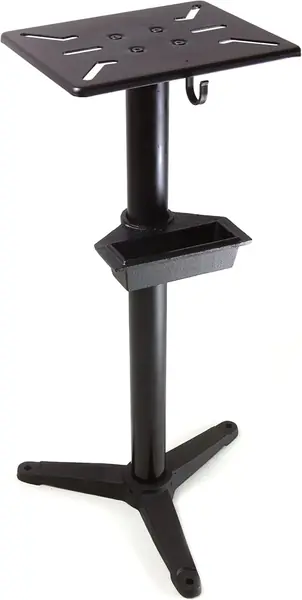
WEN 4288 black cast iron bench grinder pedestal stand with mounting plate and water pot

Budget home shops

Shop Score 88/100
Height
31.5 in.
Weight
13.6 lb
Mounting Plate
9.9 x 12.4 in.
Water Pot
Included
View on Amazon

The water pot is what sold us. A stand is a dumb piece of metal until you are shaping a chisel and want to dunk it without crossing the shop, and the WEN 4288 puts a quenching pot right on the column, within reach of both wheels. It is the sort of small convenience you stop noticing precisely because it works.

The rest is honest hardware: a 9.9-by-12.4-inch cast-iron top plate with slots and holes for a range of bolt patterns, a steel column, and a three-legged base with a bolt hole at each foot. Ours sits under a 6-inch grinder, and the whole arrangement is steady through a full sharpening session — but the anchoring is what makes that true, and the feet are drilled for exactly that reason. Add rubber pads or a plywood pad if you want to protect a finished floor.

Value is the other half of the case: this is a budget stand, and what it saves goes toward a better wheel or a dressing tool, which will change your results more than another ten pounds of pedestal. Bolt the feet down on a level slab and it does the one job a pedestal has.

Worth Noting

  • Height is fixed at 31.5 inches
  • Water pot is small and plastic
Our Verdict

We recommend it as the first stand most woodworkers should buy, as long as a 6-inch grinder and a fixed 31.5-inch height suit the way you work.

Check Latest Price
3.

HTC HGP-10 Adjustable Bench Grinder Stand Best Adjustable Height

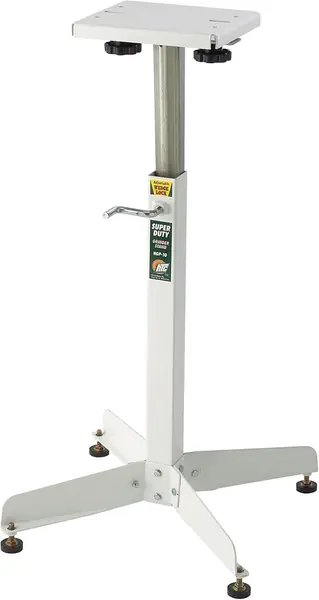
HTC HGP-10 white adjustable bench grinder stand with slotted steel mounting plate

Tall woodworkers

Shop Score 85/100
Weight
19 lb
Mounting Plate
8.5 x 9.5 in.
Height Range
25 to 41 in.
Load Capacity
500 lb
View on Amazon

Twenty-five to 41 inches is a range nothing else here comes close to. That column is the reason to consider the HTC HGP-10: it lets a six-foot-plus woodworker stand upright at the wheel, and it drops low enough to shove the whole grinder under a bench between projects.

The lock is an exclusive wedge that tightens as load bears down on it, and the base is wide, with four non-skid leveling feet that twist to take up a slab sloping toward the garage door. Rated capacity is 500 pounds — far more machine than most shops own, and enough for a buffer or a belt grinder.

Two physical facts shape how it behaves. At 19 pounds it is a light stand, and at full extension the upper section is the part to watch: a heavy 8-inch grinder mounted high, on a base that is not bolted down, can twist the column under side pressure. Bolt the base and treat the leveling feet as leveling, not as anchoring.

Where it earns its place is flexibility — one stand, any user, a working height you can change without unbolting the grinder. If you have a dedicated spot and one operator, a fixed cast-iron pedestal is the simpler buy. If the stand has to move, or the shop has two sets of hands, this is the one we hand people.

Worth Noting

  • Smallest mounting plate of the picks here
  • Pre-stamped leg holes can land off-center
Our Verdict

Our pick when two people share a grinder or you are taller than average: the height range is worth the trade in heft.

Check Latest Price
4.

VEVOR Bench Grinder Stand Best Heavy-Duty Build

VEVOR black cast iron bench grinder pedestal with square mounting plate and water pot

8-inch grinders

Shop Score 84/100
Height
33 in.
Weight
48.5 lb
Mounting Plate
10.6 x 10.6 in.
Material
Cast iron and steel
View on Amazon

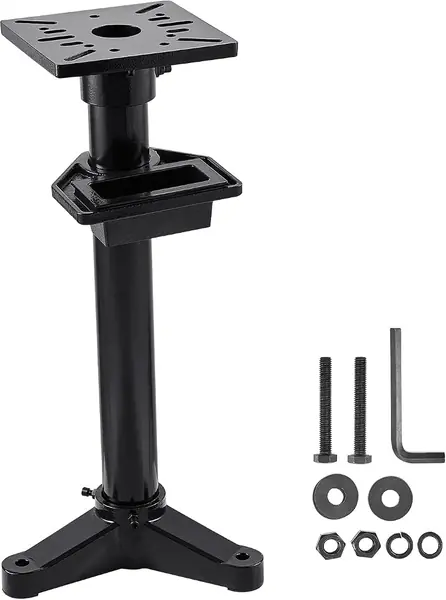
Cast iron is the argument here. At 48.5 pounds the VEVOR pedestal trails only the JET in this group, and the triangular base puts that mass where it does the most work: three wide feet, three pre-drilled holes, and a column that does not ring when the wheel loads up. Bolt it to a concrete floor and, as far as we are concerned, the vibration question is settled before you touch the tool rest.

The plate is 10.6 inches square with pre-cut slots, and the stand carries a water pot that doubles as a small tool tray when you are not quenching. Note which version you are buying — the same stand is sold with 11-by-6.7-inch and 12-by-10-inch plates as well, and the size in the title is the size that arrives.

Budget an hour and a drill if your machine's bolt pattern falls outside the slots; a slotted plate covers a lot of ground but not everything, and drilling cast iron takes a sharp bit and light pressure. At 33 inches the working height lands in the same neighborhood as the WEN and Delta stands, comfortable for most people standing at a 6-inch grinder.

Worth Noting

  • Fixed 33-inch working height
Our Verdict

For an 8-inch grinder that has to sit dead still, we point you to this cast-iron pedestal and its big square plate.

Check Latest Price
5.

Delta 23-040 Grinder Stand Best for Delta Grinders

Delta 23-040 black metal grinder stand with adjustable feet and wide base

Delta bench grinders

Shop Score 83/100
Height Range
32 3/8 to 34 3/8 in.
Feet
Adjustable, with floor-mount option
Base Dimensions
16 x 20 in.
Mounting Pattern
2-hole 6 to 9 1/4 in. apart, up to 8 in. wide; 4-hole 3 1/2 to 6 in. apart, up to 9 1/4 in. wide
View on Amazon

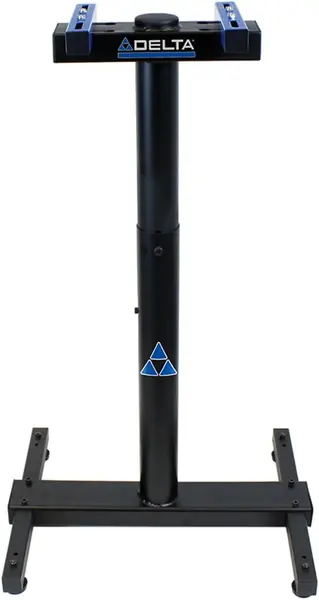
Delta publishes what almost nobody else does: real bolt-pattern ranges. Two-hole grinders with mounting holes 6 to 9 1/4 inches apart and up to 8 inches wide, or four-hole grinders with holes 3 1/2 to 6 inches apart and up to 9 1/4 inches wide. Measure your base against those numbers and you know before you order whether the plate will take it — no guessing from a product photograph.

The footprint is the part we like best. At 16 by 20 inches the base is the widest of the stands here, which matters the moment you lean into a wire wheel, and adjustable feet plus a floor-mount option let you deal with a slab that is not flat. Height runs 32 3/8 to 34 3/8 inches.

The parts count is low and the column keys into the base, so assembly is a short job once everything is laid out on the floor. Set the stand where you will actually grind and level it there rather than in the middle of the shop — a stand that gets dragged into place never sits as well as one leveled where it works.

Worth Noting

  • Built around Delta grinders; other brands may not fit
  • Height range spans only about 2 inches
Our Verdict

Delta owners should start here: the published bolt pattern and the widest base in this group turn fit and stability into one decision.

Check Latest Price
6.

KASTFORCE KF3004 Bench Grinder Stand Best for Vises and Sanders

KASTFORCE KF3004 blue steel bench grinder stand with large flat mounting plate

Vises and sanders

Shop Score 82/100
Height
34 in.
Mounting Plate
13.7 x 10 in.
Material
Painted steel
Load Capacity
500 lb (250 kg)
View on Amazon

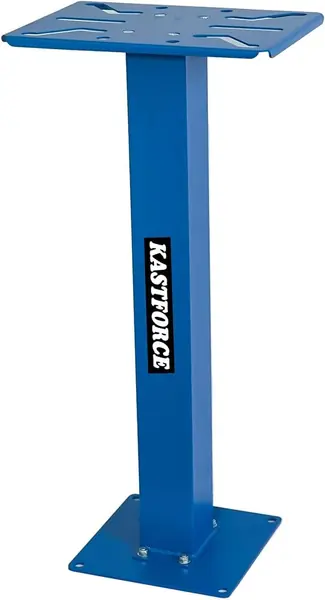
A 13.7-by-10-inch plate is the largest flat mounting surface in this group, and that is what makes the KASTFORCE KF3004 worth a look: a bench vise, a small drill press, a belt and disc sander, or a wet sharpener all have bases that a grinder-sized plate will not hold.

The frame is painted steel, 34 inches tall, rated for 500 pounds, with pre-drilled holes in the feet for anchoring to a floor or a plywood pad. It is a plain, functional stand — no quench pot, no tool tray, nothing on the column but steel, which means nothing to rust or rattle.

Where it gives ground is rigidity. The steel is lighter gauge than the cast pedestals here, so we treat it as a stand for a vise, a sander, or a 6-inch grinder rather than a home for an 8-inch machine run hard. The assembly hardware is the other thing to handle gently: snug the bolts evenly by hand instead of leaning on them with a driver.

Worth Noting

  • Fixed 34-inch working height
Our Verdict

We like it as a general shop pedestal rather than a grinder stand first: the big plate suits a vise or a sander better than a heavy grinder.

Check Latest Price
7.

SUNEX TOOLS 5003 Bench Grinder Stand Best for 6-Inch Grinders

SUNEX TOOLS 5003 black metal universal bench grinder stand with pre-drilled base

6-inch grinders

Shop Score 80/100
Height
36 in.
Grinder Fit
6- and 8-inch bench grinders
Floor Anchoring
Pre-drilled base holes
View on Amazon

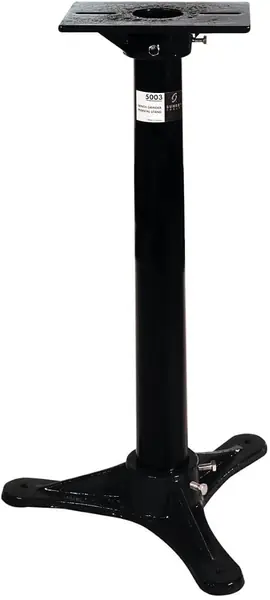
Thirty-six inches is the tallest fixed working height here. For a taller woodworker that is the whole point: a 6-inch grinder's wheels land at standing height and you can work a piece without hunching over the bench for the whole pass.

The stand is built to take 6- and 8-inch grinders, with pre-drilled holes in the base for anchoring to a shop floor, and the column is a straightforward steel tube rather than a casting. There is no quench pot, no tray, and no height adjustment — what you get is a tall pedestal and a flat plate.

If your elbows sit around that 36-inch mark, the simplicity is a virtue, and we like it as a set-and-forget pedestal for a 6-inch grinder on a concrete floor. If you are shorter, or you grind sitting on a shop stool, the wheels end up above your elbows and you will spend every job reaching — the HTC's adjustable column is the better answer there.

Worth Noting

  • Fixed 36-inch height runs tall for shorter or seated users
  • Lacks a built-in quench pot or tool tray
Our Verdict

A solid choice for a 6-inch grinder if 36 inches matches your stance; shorter users should look at the adjustable HTC instead.

Check Latest Price

How We Tested Bench Grinder Stands

We started with spec sheets rather than wrenches, comparing mounting plate dimensions, hole and slot patterns, working height, base footprint, weight, load rating, and price. Anything whose plate couldn't take a common 6- or 8-inch grinder base, or that gave us no way to bolt it to the floor, came off the list. That left 12 stands, which we bought ourselves and ran for eight months.

Each one came out of the box and onto a garage floor. We timed assembly from cardboard to mounted grinder, noted whether the hardware felt like it would survive a second adjustment, and checked that the mounting bolts engaged the grinder's base without bottoming out in the casting. If the base didn't sit flat within the plate's slots, we didn't run it, and a stand that needs a hardware-store run on day one isn't the bargain it looks like.

Then we ground things: mower blades, chisels, lathe tools. We watched for walk, the slow drift across the slab that says a pedestal is too light for the machine on it, and stood a nickel on edge on the plate while the wheel spun to see how much vibration each stand passed along. After anchoring the bases through their bolt holes, we ran the same grind again to judge what the floor bolts actually bought.

On the adjustable stands we raised and lowered the column with a grinder mounted to see whether the collar slipped. We measured the reach from wheel to quench pot, nudged each pot to see whether it tipped, and set every base on a slab with a real slope to judge leveling feet and footprint. The stands rated for a vise got one bolted on and a hand leaning on the handle.

How to Choose a Bench Grinder Stand

Start With the Mounting Plate, Not the Stand

Mounting surfaces in this group run from 8.5 by 9.5 inches to 13.7 by 10 inches, and the bigger plate is not automatically the better buy. What matters is whether the slots and holes land on your grinder's base. Measure the center-to-center spacing of its mounting holes and the width and depth of its base, then compare those numbers to the plate you are considering.

Delta is the only maker here that prints exact ranges, and it is worth checking your base against them whatever stand you buy. If your numbers fall outside the plate you want, budget for drilling it — a slotted plate covers a lot of ground, but not everything.

Weight and Anchoring Do the Real Work

Vibration control is mass plus a rigid connection to the floor. The cast-iron stands here weigh 48 to 52 pounds; the lightest stand here is 13.6. A light pedestal can still be steady — bolt it down through the holes in the feet and it stops moving — but if you cannot put fasteners in your floor, buy the heaviest stand you can lift into place.

One listing trap: shipping weight is not the stand's weight, and package dimensions are not its footprint. Read the product weight and the base dimensions separately, or you will plan a corner of the shop around a box.

Set the Working Height Before You Buy

Fixed pedestals here run from 31.5 to 36 inches, and the HTC adjusts from 25 to 41. To pick a number, stand where the stand will live and measure to your elbow, then subtract the distance from the grinder's base to the center of its wheels. That total is the stand height you want — not the tallest one on the page.

This is also why an adjustable column earns its keep in a shop with two operators of different heights, and why a tall fixed stand is a poor fit for anyone who grinds sitting down.

Quench Pots, Trays, and Feet

The water pot is the extra we notice most, because it keeps quench water at the machine instead of across the shop. The WEN, VEVOR, and JET all include one, and the JET's sits on an adjustable platform so it rises with the tool rest.

Leveling feet matter more than they sound: garage slabs slope toward the door, and a pedestal that rocks is a pedestal that walks. The HTC and Delta give you adjustable feet; the others rely on shimming or bolting.

Assembly, Hardware, and Footprint

Plan on an hour with hand tools. Lay the parts out first and tighten the leg bolts evenly rather than leaning on one until it is torqued — pre-stamped holes can land slightly off, and softer fasteners round over when you rush them.

Footprints run from about 13.7 inches square to the Delta's 16 by 20 inches. Measure that plus the room to swing a workpiece, and remember that anchoring holes are only useful if you are allowed to drill the floor they sit on.

Frequently Asked Questions

Final Verdict

Weight settles this category, and the JET JPS-2A has the most of it: 52 pounds of cast iron, a wide base, and a quench tray that rises to your hand. For a woodworker with a permanent spot for a grinder, that is the one we point to first.

If one stand has to serve a tall woodworker and a short one, the HTC's 25-to-41-inch column is the better buy; if the money is tight and a 6-inch grinder is all you run, the WEN does the job.