↑↓ navigate ↵ open Esc close All results →

Best Whetstones of 2026

A dull edge rarely announces itself all at once—a knife simply starts sawing instead of slicing, or a chisel skates across a shoulder instead of paring cleanly. A whetstone solves that problem for less than the cost of repeated professional sharpening, though a dished or poorly matched stone can leave an edge worse than where it started.

Skipping stone maintenance is the fastest way to ruin a bevel: an unflattened cheap stone hollows in the center and rounds over the edge rather than honing it. Over nine months, 12 soaking water stones, splash-and-go ceramics, diamond plates, and double-sided combos went to work on kitchen knives, bench chisels, plane irons, and a chipped garage-sale cleaver.

Higher grit numbers do not mean better stones—coarse plates repair nicks, mid-grits establish a working edge, and fine stones polish, leaving the middle range doing most everyday sharpening. A non-slip base, flattening stone, and angle guide matter nearly as much as the abrasive itself, across a range spanning compact pocket stones to full sharpening progressions.

Our Top Picks

The Best Whetstones

1.

Sharp Pebble 1000/6000 Whetstone Best Overall
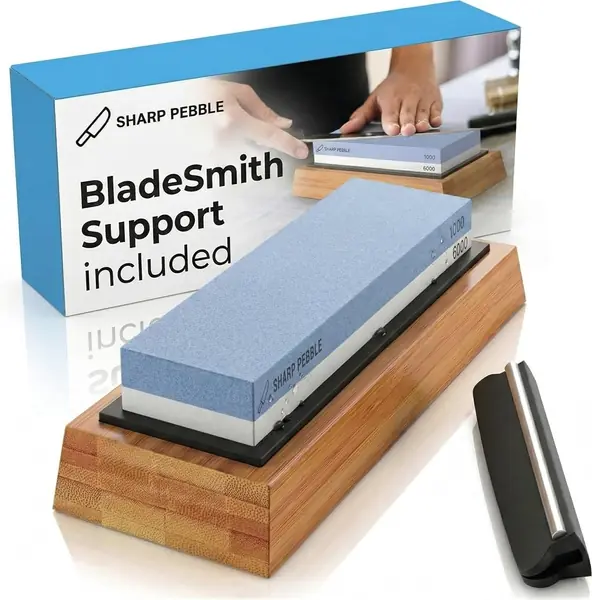
Sharp Pebble dual-grit whetstone in blue and white with bamboo base and angle guide

First-time sharpeners

Shop Score 98/100
Stone Size
7.25 x 2.25 x 1 inches
Grits
1000 / 6000
Base
Bamboo with rubber insert
Abrasive
Corundum water stone
View on Amazon

Most people who buy a whetstone are trying to rescue a drawer of dull knives, and this is the kit we point them to. The 1000-grit side does the real work, grinding a rounded edge back into shape, and the 6000 side polishes what the 1000 leaves behind. The bamboo base with its rubber insert keeps the stone from walking across the counter, and the angle guide gives a first-timer something to lean the blade against while the motion turns into habit. That combination is why it's our default.

It's a water stone, so a session begins with a soak and the surface stays wet while you work; cleanup is a rinse, not a scrub. We paid attention to how it handles tools as well as kitchen knives, and the 1000 grit will bring a tired chisel back, while the 6000 leaves a polish bright enough to show exactly where your bevel is sitting. The kit also includes a written guide, which matters more than it sounds: angle is the entire skill, and a page you can keep at the bench beats a video you watch once.

Where it stops is damage. A chipped or badly nicked edge needs a coarser stone than anything in this box, so if you're rehabbing flea-market tools, add a coarse stone or start elsewhere. For kitchen knives, garden tools, and a first year of learning the motion, we think it's the most complete starting point here — stone, base, guide, and a polishing step in one purchase.

Worth Noting

  • Narrow 2.25-inch face is tight for wide irons
Our Verdict

We recommend it as the stone most people should buy first: two useful grits, a base that holds still, and an angle guide that removes the guesswork.

Check Latest Price
2.

Shapton K0702 #1000 Whetstone Best Splash-And-Go Stone

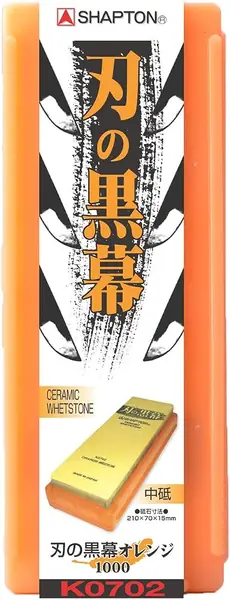
Orange Shapton 1000-grit ceramic whetstone with a plastic storage case

Chisels and irons

Shop Score 97/100
Stone Size
8.3 x 2.8 x 0.6 inches
Case
Doubles as a sharpening base
Grit
#1000
Material
Ceramic
View on Amazon

No angle guide, no bamboo base, no bucket of water — and that's exactly why this stone earns its place. The Shapton is a hard ceramic bench stone that takes a splash and goes to work, and the plastic case it ships in flips over into a holder so it doesn't skate. For anyone who has sharpened before and wants a stone that is ready the moment they are, it's the fastest setup in this group.

The 1000 grit is the workhorse number: coarse enough to reset a bevel on a dull knife or a tired chisel, fine enough to leave an edge that bites. What we noticed is how slowly it dishes. A hard stone holds its flatness, and for plane irons and chisels — where a dished surface quietly rounds the edge you're trying to create — that flatness is worth more than any single line on the box. The feel is firm and a little glassy rather than muddy; if you love the sensation of a soft stone breaking down under the blade, this one will feel different in the hand.

It isn't a kit: no guide, no instruction sheet, nothing to hold your hand through a first session. We recommend it to woodworkers and to anyone who has already worn out a cheap stone and wants a surface that stays true through years of chisels and plane irons.

Worth Noting

  • Single 1000 grit with no coarser or finer step
Our Verdict

We reach for this one when we want an edge back quickly: hard ceramic, no soak, and a case that becomes the holder.

Check Latest Price
3.

SHARPAL 162N Diamond Sharpening Stone Best Diamond Stone

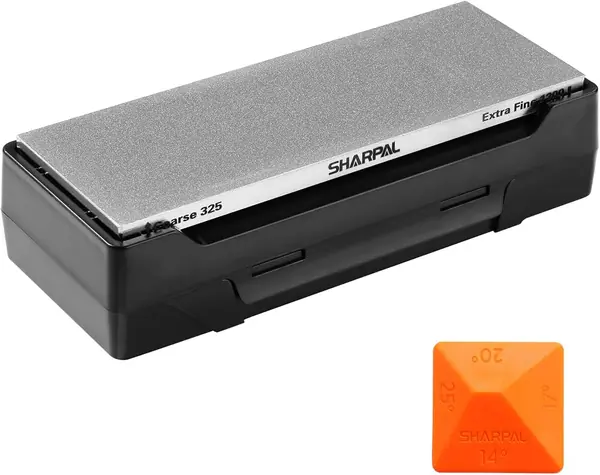
SHARPAL double-sided diamond sharpening stone in black and silver with storage case and angle guide

Reprofiling hard steel

Shop Score 96/100
Stone Size
8 in. x 3 in.
Grits
325 / 1200
Abrasive
Monocrystalline diamond on steel
Angle Guide
Four preset angles
View on Amazon

Diamond doesn't sharpen the way a water stone does; it scrapes. The 325-grit face of this Sharpal takes a new bevel off a hard blade in a hurry, and by hard we mean the stuff that makes a soft stone feel like work — high-speed steel, carbide, ceramic, a chisel that has been abused for years. Flip the plate and the 1200 side hones what the coarse side started.

Two things sold us. The surface is flat and stays flat, because diamond is bonded to a steel plate rather than being a stone that wears into a hollow, and it is the widest working surface in this group — the difference between a plane iron sitting square on the abrasive and sitting on it at an angle. No water bath and no oil, either: pick it up, sharpen, rinse it off.

The case has a rubber pad that doubles as a base, and the clip-on guide offers four preset angles, which we treat as a periodic check rather than a crutch. What this plate is not is a finishing tool: 1200 grit leaves a working edge, not a polished one, and a bright bevel still needs a fine stone. For a shop that sharpens tooling as often as kitchen knives, that trade is easy to take.

Worth Noting

  • Fine diamond side wears faster under heavy pressure
Our Verdict

For hard steel, carbide, and badly worn edges, nothing else here cuts as fast as this diamond plate.

Check Latest Price
4.

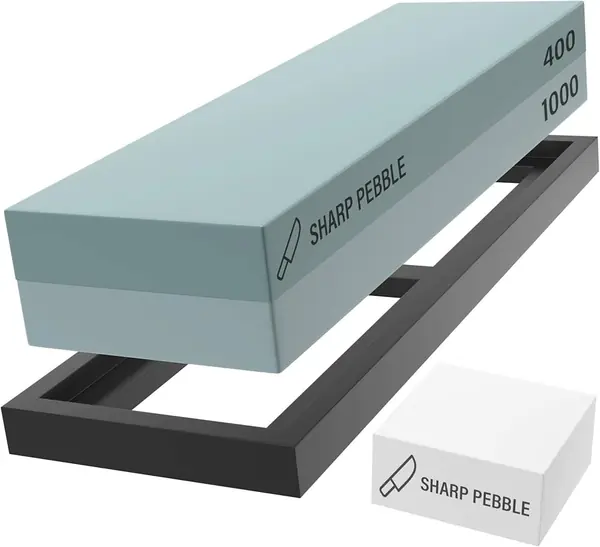
Sharp Pebble 400/1000 Kit Best Budget Kit

Sharp Pebble 400/1000 grit whetstone kit in green and white with flattening stone and rubber base

Budget tool sharpening

Shop Score 95/100
Stone Size
7.25 x 2.25 x 1 inches
Grits
400 / 1000
Base
Non-slip rubber
Flattening Stone
Included
View on Amazon

A flattening stone in the box is the detail that makes this more than a cheaper version of our top pick. Water stones dish as you grind, and a dished stone rounds the very edge you're trying to sharpen — a problem that shows up fast on narrow chisels and plane irons. Getting the tool to true the surface in the same purchase means you can keep the stone flat from the first session instead of ordering something else a month later.

The 400 grit is the half we use for reshaping: it moves metal fast enough to reset a bevel or work out a nick, and the 1000 side finishes well enough for shop work and everyday kitchen knives. The rubber base holds the stone on the bench, and the angle guide is a simple wedge you rest the blade against while the motion becomes muscle memory. Cleanup is water, same as any of these.

We recommend it for a shop where the sharpening is mostly tools — chisels, plane irons, a work knife — and where a full working setup in one box beats a fancier stone with no base and no flattener. Know that 1000 grit is where this kit stops; if you want a polished bevel, the 6000 side of our top pick is the reason to spend more.

Worth Noting

  • Soft stone wears faster than harder ceramics
Our Verdict

We like this as the kit to buy when the tools matter as much as the knives: two grits, a base, and a flattening stone for less money than our top pick.

Check Latest Price
5.

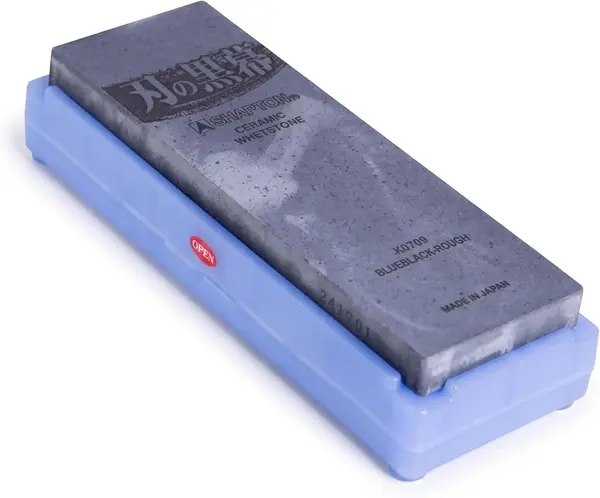
Shapton #320 Coarse Whetstone Best for Repairing Damaged Edges

Shapton 320-grit coarse whetstone in blue and black with plastic storage case

Restoring chipped edges

Shop Score 94/100
Stone Size
8.27"L x 2.76"W x 0.59"H
Case
Doubles as a sharpening base
Grit
#320
Weight
Approx. 17.6 oz (500 g)
View on Amazon

A chipped chisel doesn't need finesse, it needs horsepower, and this is the stone we reach for when a bevel has to be rebuilt from scratch. At 320 grit the Shapton takes metal off quickly enough that reshaping stops being an afternoon and becomes a job you finish. It is genuinely coarse — the scratch pattern it leaves is plain to see — but that is the point of a first stone.

What we didn't expect from a coarse stone is how even it feels: firm and uniform, closer to a smooth ceramic than to the gravelly hardware-store stone the grit number suggests. It also stays flat far longer than a soft water stone. For a woodworker setting a new bevel angle across a set of chisels, that combination means fewer interruptions and less time truing the surface.

The case doubles as a base, and the stone can be used with oil as well as water, which is unusual for a Japanese stone and handy in a cold shop. We recommend it as the first stone in a set rather than the only one: after 320, you still need a 1000 to turn that fresh bevel into an edge.

Worth Noting

  • Leaves visible coarse scratches and needs a finer stone afterward
Our Verdict

We keep this for the ugly jobs: chipped chisels and flea-market finds that need reworking before a finer stone ever touches them.

Check Latest Price
6.

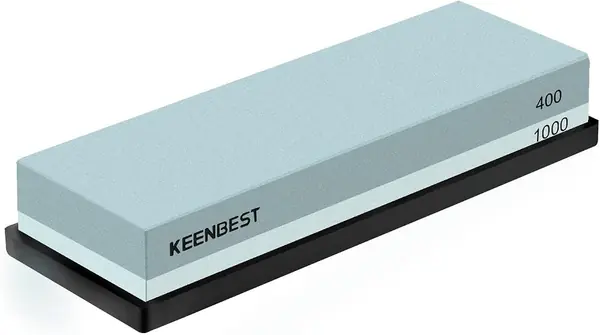
KEENBEST 400/1000 Whetstone

KEENBEST green two-sided 400/1000 grit whetstone with non-slip rubber base

First cheap stone

Shop Score 93/100
Stone Size
7 x 2.2 x 1.1 inches
Grits
400 / 1000
Base
Non-slip rubber
Weight
16 oz
View on Amazon

The least expensive stone in this group is also the simplest: a double-sided 400/1000 water stone, a rubber base, and a short guide. If you've never sharpened on a stone and aren't sure you'll stay with it, that is a low-risk way to find out, and it will still put an edge on an ordinary kitchen knife.

It wants a soak before use, like any water stone, and the rubber base is basic but does keep it from sliding around on a counter. The 400 side is coarse enough to take a ding out of a chef's knife, and the 1000 side refines what it leaves. A seven-inch stone gives you a shorter stroke than the eight-inch bench stones here, which is fine for paring knives and awkward on a long slicer.

The included guide is brief, a page or two, but it covers the angle and the stroke, which is the part that trips up a first-timer. There are no frills beyond that: no flattening stone, no angle wedge, no strop. For the money that is fair, as long as you go in expecting to replace it if sharpening becomes a habit.

We point people here when the goal is to learn the motion without risking much, and when the knives in question are ordinary kitchen knives rather than a shop full of chisels. It is the stone in this group we treat as a starter rather than a keeper — the one you learn on and then upgrade from. That isn't a knock; most people should find out whether they enjoy this before buying a bench setup.

Worth Noting

  • Thin soft stone wears quickly with use
Our Verdict

If you want to find out whether hand sharpening is for you, we suggest starting here rather than spending more on a hobby you may not keep.

Check Latest Price
7.

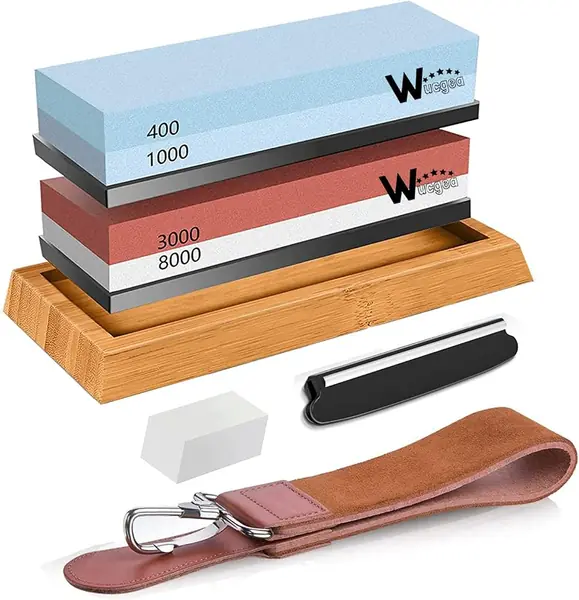
wucgea 8-in-1 Sharpening Stone Kit

wucgea eight-piece sharpening kit with 400/1000 and 3000/8000 stones, wood base, and strop

Full grit progression

Shop Score 92/100
Grits
400/1000 and 3000/8000
Base
Wood
Flattening Stone
Included
Strop
Leather, included
View on Amazon

Two double-sided stones, a wood base, a flattening stone, an angle guide, and a leather strop arrive in one box, covering 400 through 8000 grit for roughly what a single mid-range stone costs. That is a lot of sharpening for the money, and it is the reason this kit is on the list.

The 400/1000 stone does the actual work — 400 for reshaping, 1000 for the edge — and the 3000/8000 stone is the polishing step. Having both means you can take a knife from dull to bright without buying anything else, which is not true of the single-grit stones here. The wood base is a base and no more; it holds the stone steady on a flat, stable surface.

Two things to know before you order. The accessories beyond the stones are barely explained by the included instructions, so you will be working out the extras by trial. And the stones appreciate a pass on the flattening stone before their first use, which the kit supplies.

We recommend this to someone learning on a budget who wants to see what a polished edge feels like without committing to one expensive stone. The finishing stones are not the equal of a premium fine stone, and the strop is a bonus rather than a reason to buy — but as a first full progression, it is the most complete inexpensive kit here.

Worth Noting

  • Stones wear noticeably with steady use
Our Verdict

We point budget-minded sharpeners here when they want the high grits, not just a working edge.

Check Latest Price
8.

Fallkniven DC4 Whetstone Best for Pocket Touch-Ups

Fallkniven DC4 diamond and ceramic pocket whetstone in gold and gray with leather pouch

Pocket touch-ups

Shop Score 91/100
Stone Size
3.94"L x 1.26"W x 0.35"H
Abrasive
Diamond and ceramic
Use
Wet or dry
Sheath
Leather pouch included
View on Amazon

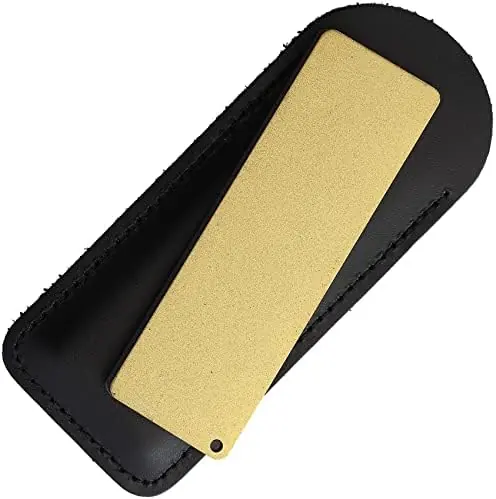
At just under four inches long and about an inch and a quarter wide, this isn't a bench stone — it's the stone that lives in a tool roll or a jacket pocket. One face is diamond, the other ceramic, and it works wet or dry, so a splash from a water bottle is all the setup it needs. The leather pouch keeps the faces from grinding against everything else in the bag.

We keep one within reach for the chisel that dulls halfway through a cut and the pocket knife that has to open a bag of feed. For a quick touch-up it is the fastest thing here: no soak, no base, no setup at all. The diamond face takes a burr off in a few strokes, and the ceramic side refines it enough to get back to work.

What it can't do is the reason to own a bench stone as well. A plane iron or a long chef's knife won't fit on a four-inch surface, and the narrow width makes a full-length stroke impossible, so this is a field tool rather than a shop tool. Held against that job, it does exactly what it promises, and the pouch doubles as a strop if you want a little more polish before the tool goes back in the roll.

Worth Noting

  • Ceramic face can arrive chipped
Our Verdict

We tuck this in a tool bag for touch-ups away from the bench; it isn't a replacement for a full-size stone and doesn't try to be.

Check Latest Price

How We Tested Whetstones

We started with the specs that decide how a stone actually gets used: grit or grit pair, abrasive type, working surface length and width, and whether the box included a base, an angle guide, and a way to flatten it. That list got us to 12 stones, which we bought ourselves and used for nine months. Every one got the same first job: a chef's knife that wouldn't cleanly cut a tomato.

From there each stone went into ordinary rotation. Saturday mornings meant the kitchen counter, where we counted strokes until a tomato sliced under its own weight and a sheet of printer paper cut cleanly from heel to tip. The garage bench got chisels and plane irons, where a narrow stone told us quickly whether it was wide enough to hold a two-inch blade flat. One chipped yard-sale cleaver, kept around deliberately, showed which coarse stones could grind out a nick in a reasonable number of passes and which just polished the damage.

Bases were tested the way they fail: we pressed hard mid-stroke, and stones that walked got marked down no matter how well they cut. Diamond plates got light pressure only, and we watched the surface for scoring. We checked flatness with a straightedge before and after each session and kept track of how often each stone needed flattening, then kept using the finalists for months afterward to see how quickly they dished. Last, we weighed the extras honestly — did the angle guide hold a setting, did the included flattening stone work, did the case double as a base we'd trust.

How to Choose a Whetstone

Match the Grit to the Job, Not the Number

Grit runs coarse to fine, and most shoppers buy a finer sharpening stone than they need. A 1000-grit stone is the workhorse: it brings a dull kitchen knife or a tired chisel back to cutting. Anything around 400 and below is for reshaping damaged edges, and 3000 and up only polishes what a coarser stone has already established. A fine stone will not fix a chipped blade; it will just take a long time failing to.

In practice, one medium stone plus either a coarse or a fine one covers a household or a small shop. Grit ratings are not perfectly standardized between makers, so treat them as a rough order rather than a measurement.

Soaking Versus Splash-and-Go

Porous water stones want time in a bath before they cut properly. Dense ceramic stones take a splash and are ready, and diamond plates need nothing at all. If you sharpen once a month at the kitchen sink, the soak is part of the ritual. If you sharpen mid-project with a tool in one hand, it is the reason the stone stays in the drawer.

Our top pick is a soaking stone and we still recommend it to beginners, because a porous stone gives more feedback and is more forgiving of an unsteady angle. Buyers who sharpen weekly should look at the splash-and-go ceramics instead.

Size and Width Decide What You Can Sharpen

A bench stone around eight inches long and close to three inches wide handles a chef's knife in one stroke and lets a plane iron sit square. Narrow stones — 2.25 inches is common on budget kits — are fine for knives and chisels but make wide irons awkward. Pocket stones under four inches are for touch-ups in the field, not for rebeveling anything.

Measure the widest thing you plan to sharpen before you buy. If you own a 2-3/8-inch plane iron, a 2.25-inch stone will have you working at an angle, which is exactly how bevels get uneven.

Hard Stones Stay Flat; Soft Stones Cut Fast

Every water stone wears as it works, and a dished stone rounds the edges you are paying it to sharpen. Hard ceramics hold their shape for a long time and cost more; soft stones cut quickly and need truing regularly. For chisels and plane irons, flatness matters more than speed — a hollow stone quietly ruins a straight edge.

A flattening stone, a coarse plate you rub the stone against, is the answer either way, which is why we favor kits that include one. Budget for it as part of the purchase if it is not in the box.

What the Extras Are Actually Worth

A non-slip base earns its place, because a stone that slides is a stone that slips. An angle guide is genuinely useful for the first few months and then usually gets left in the drawer, but we would not buy a first stone without one. Strops and polishing compounds are nice to own and rarely decisive.

The stone is the tool; everything around it is support, and it should not drive the purchase. If two kits cost the same and one has a flattening stone, take the one with the flattening stone.

Frequently Asked Questions

Final Verdict

Buy the Sharp Pebble 1000/6000 if you want one purchase that takes a dull kitchen knife or chisel to a usable edge, with the base and angle guide that make the first sessions work. It is the pick we would hand to almost anyone starting out, and the one that leaves the fewest reasons to buy something else later.

Woodworkers who sharpen chisels and plane irons weekly should take the Shapton #1000 instead: similar money, faster cutting, and a hard surface that stays flat far longer, at the cost of no guide and only one grit. If your shop includes high-speed steel, carbide, or a carbide scraper, the SHARPAL diamond plate is the one that will actually bite.