↑↓ navigate ↵ open Esc close All results →

Best Grinding Wheel Dressers of 2026

Bench grinder wheels are meant to fracture and expose fresh grit as they wear, yet in regular shop use they glaze over, load with soft steel, and drift out of round—turning a quick chisel touch-up into a blue, smoking edge. Running a dresser across the face restores flat geometry and opens clean, cool-cutting abrasive.

Shopping by handle comfort is a common misstep; across four months of truing wheels with 16 dressers—spanning star cutters, diamond-coated pads, abrasive sticks, and single-point tools—in a garage shop and shared maker space, cutting material and grit governed every result. Coarse cutters open clogged aluminum oxide fast for heavy shaping, whereas finer diamond surfaces leave a smoother face for honing tools.

Matching the tool to wheel hardness and how often the grinder runs keeps both edges cool and wheel life predictable over multiple seasons.

Our Top Picks

The Best Grinding Wheel Dressers

1.

Norton Dressing Stick Best Overall
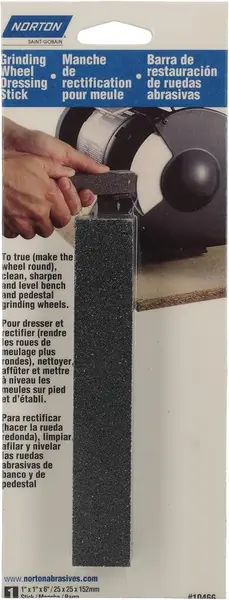
Norton silicon carbide dressing stick, a 1-by-1-by-6-inch abrasive bar for bench grinder wheels

Everyday wheel maintenance

Shop Score 93/100
Dressing Type
Silicon carbide dressing stick
Abrasive
Silicon carbide, vitrified bond
Works On
Conventional vitrified grinding wheels
Dimensions
1 x 1 x 6 inches
View on Amazon

One of the cheapest dressers here is also the plainest: a 6-inch bar of silicon carbide with no handle, no cutters, and no moving parts. You press it against the spinning wheel, keep it moving, and the glazed gray surface opens into fresh abrasive. That simplicity is why we made it our top pick. Nothing on it can come loose, seize, or wear through to bare steel, and it holds its bite longer than the coated diamond pads in this group.

A stick works by breaking down. The silicon carbide is friable, so it crumbles as it rubs and exposes a new edge, and the debris carries the loaded metal out of the wheel's pores. That makes it right for the ordinary case: a wheel that is shiny, gummed up with aluminum or soft steel, or simply not cutting the way it did when it was new. It is also the most forgiving dresser to learn on, because there is no plate to catch and no cutter to jam.

There is a setup step worth doing: drop the tool rest and check that the 1-inch square can reach across the full width of the wheel face, since a stick only dresses where it touches. Expect a cloud of abrasive dust as well, which a shop vac pulled up beside the grinder will mostly catch. Off the machine it earns a second job — run along a burr on a fresh cut, it takes the sharp edge off faster than a file.

Worth Noting

  • Wears down as you dress; it is a consumable
  • Slower than diamond on a badly grooved wheel
Our Verdict

We tell anyone with a bench grinder and no dresser to start here: it opens a glazed wheel at a low cost and outlasts the diamond pads.

Check Latest Price
2.

ATLIN Diamond Dressing Tool Set Best Diamond Set

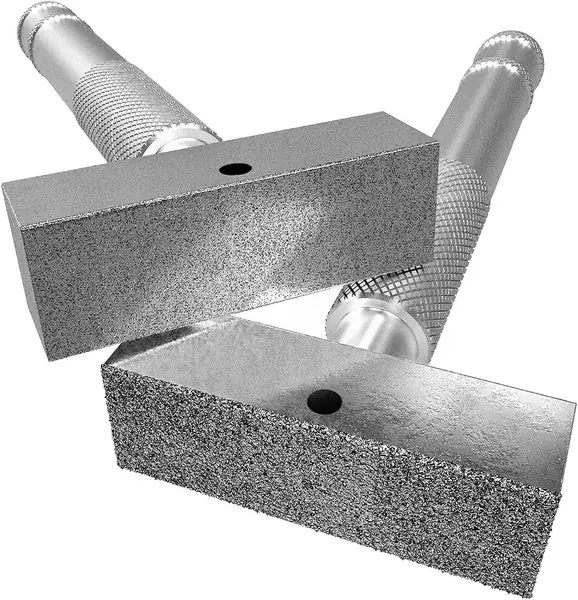
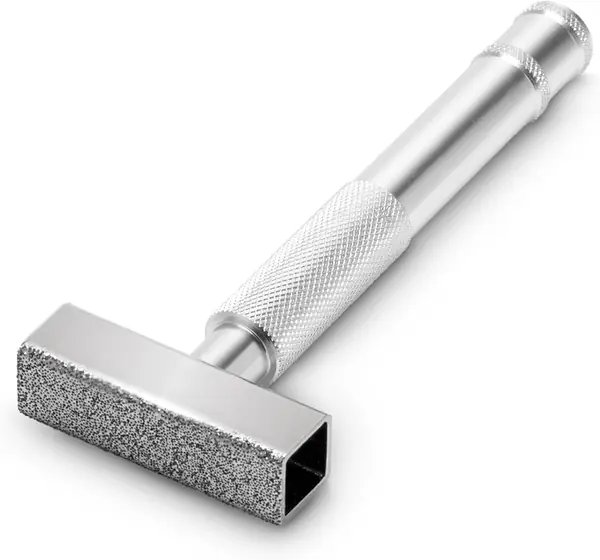
ATLIN diamond dressing tool set with coarse and fine grit heads and knurled handles

Truing and finishing

Shop Score 91/100
Dressing Type
Diamond-coated dressing tools
Diamond Surface
1.77 x 0.59 inches
Grits Included
36 grit and 120 grit
Overall Length
4.5 inches
View on Amazon

The question a diamond dresser raises is which grit to buy, and ATLIN answers it by putting both in the box: a 36-grit head for cutting a wheel back to shape and a 120-grit head for the pass that follows.

We start with the coarse one when a wheel is dished, grooved, or out of round. A few light passes with the head flat against the face and constantly moving takes the high spots down, and then the 120 opens the surface and leaves something that grinds cool. Both heads are diamond matrix bonded to steel with a knurled 4.5-inch handle, so there is nothing to replace and nothing to work loose. What we appreciated most is having the pair on the bench instead of ordering a second grit later.

Technique matters more than the tool. Keep the head moving and take light passes; a diamond pad held in one spot grinds a hollow into the wheel that you will spend the next session removing. And if your wheels never get worse than glazed, this is more dresser than you need — a stick handles that for a fraction of the money.

Worth Noting

  • 120-grit head wears out well before the coarse
  • 36-grit head leaves a rough, open face
Our Verdict

We reach for this set when a wheel has real damage: coarse diamond to true it, fine to finish it, both in one box.

Check Latest Price
3.

POWERTEC 71003 Diamond Wheel Dresser Best Budget Diamond Dresser

POWERTEC 71003 diamond wheel dresser with flat diamond surface and two guide bars

Fast cheap truing

Shop Score 90/100
Dressing Type
Diamond-coated wheel dresser
Grit
36 grit
Diamond Surface
1/2 x 1-3/4 inches
Compatible Wheels
Aluminum oxide, silicon carbide, resin-bonded
View on Amazon

Speed is the whole reason to keep a diamond plate in the drawer. The diamond surface on the 71003 is 36 grit and about the size of a thumb, and with the two guide bars riding the tool rest it takes a glazed wheel down to clean abrasive in a pass or two.

The guide bars are the part we paid attention to. They hold the plate roughly parallel to the wheel face so the cut stays even instead of digging at one corner, and they give you a reference against the rest. At 4-5/8 inches overall the tool stays clear of the guard on a 6-inch grinder, and it works on aluminum oxide, silicon carbide, and resin-bonded wheels.

The part to know before you buy is the coating. It can be uneven, with the odd oversized diamond particle sitting proud of the rest, and those are what score a wheel if you lean in or hold still. Light pressure and constant motion are the whole technique, and once we settled into that rhythm the face came out even. If you want a smoother wheel, finish with a fine diamond or a stick.

Worth Noting

  • Diamond plate wears through to bare steel
Our Verdict

We keep one for quick truing: the guide bars hold the diamond flat, and it flattens a glazed wheel for very little money.

Check Latest Price
4.

Huntington-Desmond #0 Wheel Dresser Best Star Dresser

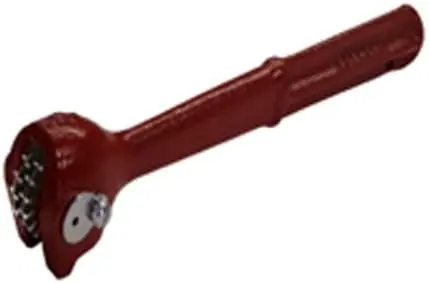
Huntington-Desmond number 0 wheel dresser with a cast-iron handle and replaceable dressing wheels

Heavy stock removal

Shop Score 89/100
Dressing Type
Star wheel dresser, replaceable cutters
Handle
Cast iron
Weight
2.14 lb
Bearings
Dust-protected ball bearings
View on Amazon

At a little over 2 pounds with a cast-iron handle, the Desmond is the only dresser here that feels like a hand tool rather than a consumable. The weight is doing work: it holds the cutters against the face with less push from you, and the whole tool sits steady where a light stick chatters. It is the one we keep on the bench when a wheel needs reshaping rather than a touch-up.

The business end is a set of hardened star cutters on dust-protected ball bearings. Pressed into the wheel, the stars fracture the abrasive and tear the loaded surface away — a far more aggressive action than diamond, and fast on a wheel that is dished, grooved, or glazed. The bearings are the detail that matters. A star dresser whose cutters stop turning skids across the face and gouges it, and these keep spinning under load.

The face it leaves is coarse and open, which is good for heavy grinding where you want the wheel to cut cool and less good for shaping a fine edge, so plan on a finishing pass with a stick or a fine diamond. What the extra money buys is a tool you keep: the dressing wheels are replaceable, the body is cast iron, and nothing else in it wears.

Worth Noting

  • Costs more than every other dresser in this group
Our Verdict

For a shop that reshapes wheels often, we think the extra money buys the steadiest cut here and cutters you can replace.

Check Latest Price
5.

Mudder 3-Piece Diamond Dresser Set Best Multipack

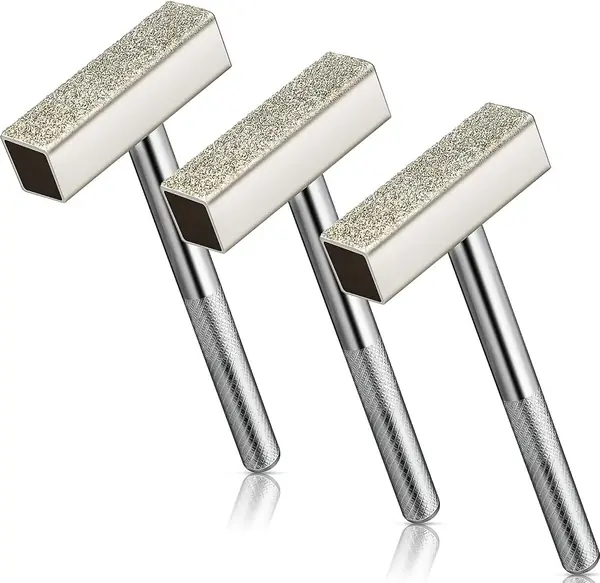
Mudder three-piece diamond dresser set of small silver-coated paddles with textured handles

Multiple grinders

Shop Score 88/100
Dressing Type
Diamond-coated dressing tools
Grit
120 grit
Count
3 dressers
Head Size
1.77 x 0.511 inches
View on Amazon

Three dressers for the price of one is the pitch, and it is a good one for a shop with more than one grinder: one stays at the bench grinder, one goes in the tool chest, one lives with the wire wheel.

Each is a small diamond-coated paddle — 1.77 inches of abrasive on a 4.5-inch steel body with a textured handle. You hold it flat against the face and work it across, which is the right motion for opening a loaded wheel or taking the glaze off one that is still basically round.

What we like is how little ceremony there is. No setup, nothing to adjust, and a spare in the drawer means you never stop work to order another. The wear is the trade: the diamond on these goes smooth sooner than on the pricier pads here, which is exactly why selling them in threes makes sense. Keep them moving, use light pressure, and each one earns its keep.

Worth Noting

  • Diamond goes smooth sooner than the pricier pads
Our Verdict

We like the three-pack math: a diamond paddle at each grinder, and no setup to fuss with when a wheel loads.

Check Latest Price
6.

Gulfmew Star Wheel Dresser Best for Replaceable-Blade Dressing

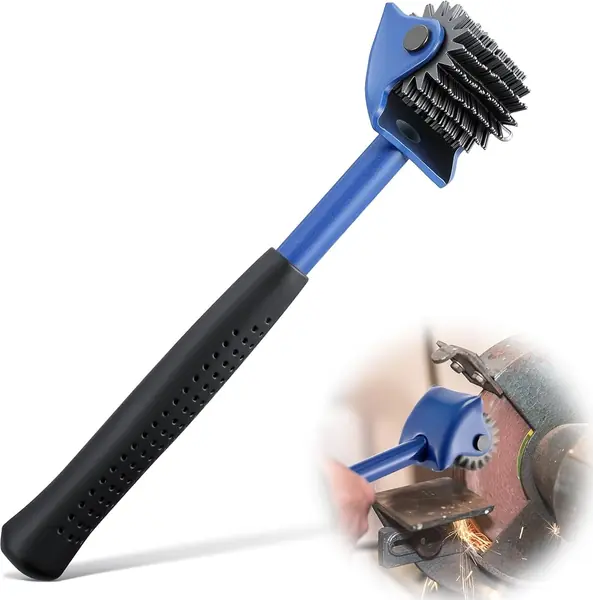
Gulfmew star grinding wheel dresser in blue with a long rubber handle

Replaceable-blade dressing

Shop Score 84/100
Dressing Type
Star-blade dresser
Overall Size
9.65 x 2.87 inches
Handle Length
7.1 inches
Blades Included
40 replacement blades
View on Amazon

Forty spare star blades in the box is the number that gets our attention. Star dressers work with hardened steel cutters that dull and chip, and a dresser with no spares is a dresser with a countdown on it. Gulfmew ships the replacements up front.

The rest of the tool is aimed at control. A 7.1-inch rubber-over-metal handle is the longest in this group, which keeps your knuckles further from the wheel and gives you something to brace against the rest. The head is a replaceable star cutter assembly, and Gulfmew rates it for bench grinders, angle grinders, and die grinders.

We cannot yet judge how long those blades hold up — this is a newer design than the cast-iron Desmond — but the thinking behind it is right: replaceable cutters are how a star dresser should be built, and with forty spares on hand even short-lived cutters leave you well supplied.

The long handle is also the reason to choose it over a short star dresser. With both hands on 7 inches of rubber you can keep the cutters flat and steady across the whole face, which is where a star dresser earns its keep.

Worth Noting

  • Steel star blades dull and need replacing
Our Verdict

This is the star dresser we point at buyers who want spares on hand: long handle, replaceable cutters, forty of them included.

Check Latest Price
7.

Praztech Single Point Diamond Dresser Best for Precision Single-Point Work

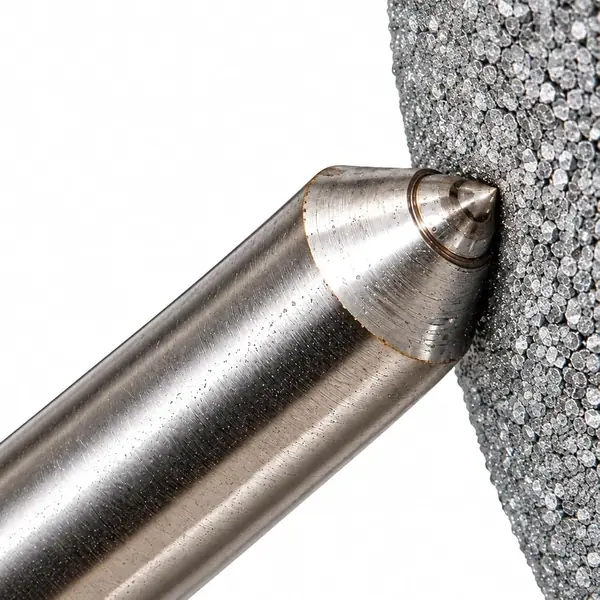
Praztech single point diamond dresser with tapered tip and half-inch steel shank

Precision single-point work

Shop Score 83/100
Dressing Type
Single-point diamond dresser
Compatible Wheels
Aluminum oxide and silicon carbide
Shank
1/2-inch diameter, 6 inches long
Diamond
2.00-carat natural diamond tip
View on Amazon

A single-point dresser is a different animal from everything else here. There is no plate to lay flat and no cutters to spin — just a 2.00-carat natural diamond set in the tip of a 6-inch, 1/2-inch-diameter steel shank, with a tapered point that lets you work the wheel face, its edge, or a radius you are trying to hold.

That is tool-room work. A single point belongs on a machine you can control — a surface grinder, a tool and cutter grinder, or a bench grinder set up with real care. Held by hand against a bench grinder it is unforgiving: it removes very little per pass and it follows every wobble your hand makes.

Against the diamond pads here, the difference is contact area. A pad spreads its cut across a 1.77-inch head and trues a face in a few passes; the point concentrates it, cuts a narrow track, and leaves the rest of the wheel alone until you work across it. On aluminum oxide and silicon carbide it cuts cleanly, and the taper gives a control a flat pad cannot.

We treat the Praztech as a specialized tool rather than a first dresser. Shaping a wheel by hand at a bench grinder, a diamond pad or a star dresser gets you there faster and asks less skill. Truing a wheel on a machine, where the point has to go exactly where you aim it, the 2-carat tip and the long shank are the right configuration to buy.

Worth Noting

  • Removes very little material per pass
Our Verdict

We treat this as a machine-shop tool: a 2-carat point that goes exactly where you aim it, provided the wheel is set up to hold a line.

Check Latest Price

How We Tested Grinding Wheel Dressers

We started by sorting dressers by cutting action rather than by brand: star cutters, diamond-coated pads, abrasive sticks, and single-point tools. From there we filtered by grit, whether the cutting material could be replaced, handle length, and which wheel bonds each tool was rated for. Sixteen made the cut, from small diamond pads to a cast-iron star dresser with replaceable cutters.

Over four months we used them on bench grinders in a garage shop and a shared maker space — Saturday mornings of sharpening chisels, plane irons, mower blades, and lathe tools, plus longer sessions on wheels we had let glaze over and knock out of round. We timed how long each dresser took to cut through the glaze and bring the wheel back to a true face, then judged the finish by how evenly fresh grit showed across the wheel and how the tool cut afterward.

Durability got its own tally. We counted dressings until a diamond surface stopped biting, checked whether blades and cutters could be swapped instead of tossing the whole tool, and assembled every handle ourselves to see whether it seated squarely and stayed tight under vibration. Value came down to how many wheels a tool could bring back before it needed replacing.

Every session ran the same way: eye protection on, a shop vac pulling dust at the grinder, guards and tool rests left in place, light passes moved across the face. We noted how much abrasive dust got thrown, how much each tool chattered, and whether the handle and rest tabs gave us enough control to keep the cut even. Any wheel with a crack or chip stayed on the shelf.

How to Choose a Grinding Wheel Dresser

Start With the Type, Then the Price

Four kinds of dresser do four different jobs, and buying the wrong one is the usual mistake. A silicon carbide stick abrades slowly and forgives everything — the right tool for a wheel that is glazed, loaded, or simply not cutting. A diamond-coated pad cuts faster and flattens a face, which is what you need once a wheel is out of round. A star dresser with rotating cutters is the most aggressive and the one for reshaping a badly dished wheel. A single-point diamond is machine-shop tooling: precise, slow by hand, and worth it only when the geometry matters.

Our own order is a stick first and a diamond pad second, because the stick covers weekly upkeep and the diamond only comes out when the wheel has lost its shape.

Grit Decides What Your Wheel Grinds Like

Coarse dressers leave coarse wheels. A 36-grit diamond opens the abrasive and leaves a face that cuts fast and cool, which is what you want on a bench grinder used for mower blades and mild steel. A 120-grit head smooths that face for finer edge work, but the finer abrasive is also the part that wears out first. If you buy only one dresser, buy coarse: a slightly open wheel is a small penalty, and it is the finish you can improve later with a second, finer tool.

Control Comes From the Handle and the Rest

Every dresser here works better with two hands and a tool rest than with one hand and hope. Guide bars, rest tabs, and long handles are not comfort features: they hold the cutting surface flat so the dresser takes material evenly instead of gouging. The mistake we see most is pressure. Leaning on a dresser loads the wheel, heats it, and leaves score marks, so keep light contact and constant motion across the face, with the tool riding the grinder's rest rather than floating.

Buy the Cutting Material, Not the Handle

Sticks are consumable and cheap, coated diamond pads wear through to bare steel, and star dressers use replaceable cutter wheels that sometimes ship forty at a time. That difference is the long-run cost. Dressing once a season, any of them will outlast your interest; dressing weekly, a rebuildable star dresser or a handful of sticks costs less over a few years than replacing diamond pads. Whichever dressing tool you choose, look at what wears out and whether you can buy just that part.

Match the Dresser to the Wheel

Diamond and star dressers are for conventional abrasive wheels — aluminum oxide and silicon carbide, in vitrified or resin bonds. They are not for diamond or CBN wheels, which are dressed by other means. If the wheel is labeled diamond or CBN, follow the wheel maker's instructions instead of reaching for a dresser. Check the wheel before you buy the tool, and check the wheel's maximum speed against the grinder while you are at it.

Frequently Asked Questions

Final Verdict

Start with the Norton dressing stick. It costs the least of anything here, it is the most forgiving thing to learn on, and it keeps cutting long after the coated diamond pads have gone smooth. Add a diamond dresser when you have a wheel that is out of round rather than merely glazed — the ATLIN set covers the truing pass and the finish pass in one box.

If you reshape wheels often and want a tool that outlives the abrasives, the Desmond star dresser is where the money goes: heavy, bearing-smooth, and rebuildable when the cutters dull.