↑↓ navigate ↵ open Esc close All results →

Best Ceramic Sharpening Stones of 2026

Shopping for a sharpening stone by grit count alone overlooks the details that decide whether it actually stays in rotation on the bench. A dual-grit ceramic block pairs coarse abrasive to establish a fresh bevel with fine abrasive to polish it, yet prep time, dishing rate, and included accessories matter every bit as much as the number printed on the box.

Over seven months, we ran 14 ceramic stones across dull kitchen knives, a chipped paring blade, chisels, and plane irons to see how fast each cut and wore. Requiring a fifteen-minute soak versus a quick splash of water, holding a flat face over repeated sessions, and shipping with a stable base, flattening stone, or angle guide separated convenient setups from frustrating ones.

A home cook reviving chef knives and a woodworker lapping plane irons need different grit pairings and formats, so the seven stones below span starter kits through fast splash-and-go bench blocks.

Our Top Picks

The Best Ceramic Sharpening Stones

1.

Sharp Pebble 1000/6000 Whetstone Best Overall
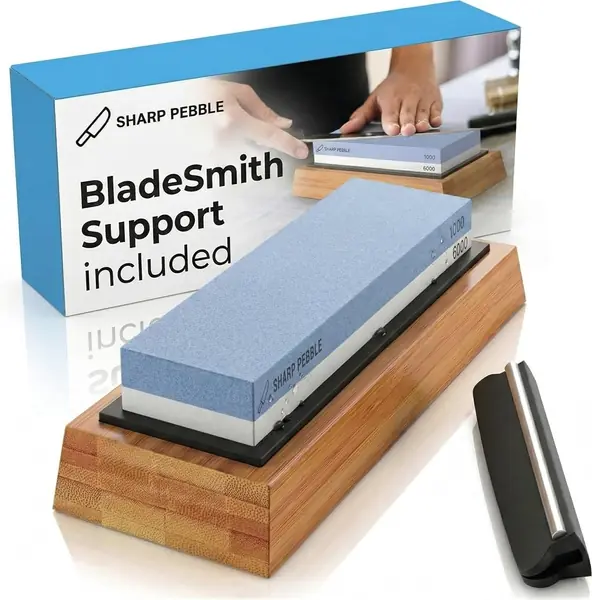
Sharp Pebble blue and white 1000/6000 water stone with bamboo base and angle guide

First-time sharpeners

Shop Score 97/100
Dimensions
7.25 x 2.25 x 1 inches
Included
Bamboo base, angle guide, instructions
Grit Pair
1000 / 6000
View on Amazon

Two pieces in this box do the teaching: an angle guide that clips to the spine of the blade and holds the bevel where it belongs, and a bamboo base with a rubber insert that keeps the stone from skating across the counter. Those are the two reasons people give up on water stones, and this kit answers both. The 1000 side repairs a dull edge; the 6000 side polishes it. We think that pairing is the right place for most households to start.

The stone itself is compact — 7.25 by 2.25 by 1 inch, 2.1 pounds — so it lives in a drawer and comes out without ceremony. It runs on water, never oil, and the supplied instructions walk through the angle and the stroke order instead of assuming you already know them. On a chef's knife, the 1000 side does the honest work of resetting an edge, and a few light passes on the 6000 leave a shine you can feel with a thumbnail.

Where the Shapton #1000 pulls ahead is speed and the hardness of the stone under the blade. This kit answers with the guide, the base, and a second, finer grit, which is the more useful trade if you have never sharpened before and do not yet trust your own hands.

Sharpening on water is messier than dragging a blade through a pull-through: expect a wet counter and a stone that needs drying before it goes back in the box. What you get for that trouble is an edge no pull-through can produce, and a kit that still earns its place after you have outgrown the angle guide.

Worth Noting

  • Narrow 2.25-inch face is tight for wide chisels
Our Verdict

We recommend this as the stone to learn on: the guide and base shorten the learning curve, and the 1000/6000 pair handles everything from a dull chef's knife to a polished bevel.

Check Latest Price
2.

Shapton #1000 Whetstone Best Splash-And-Go Stone

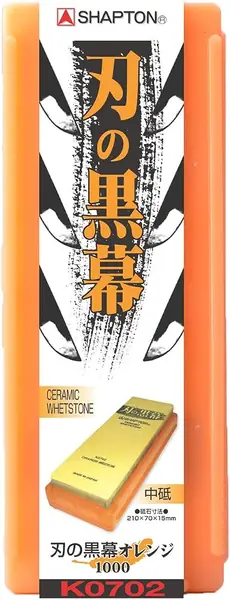
Shapton #1000 medium grit orange ceramic sharpening stone block

Buyers upgrading stones

Shop Score 96/100
Dimensions
8.98 x 3.46 x 1.57 inches
Grit
#1000
Water Setup
Splash and go, no soaking
View on Amazon

A spray bottle and half a minute is the whole setup. Shapton's #1000 is a splash-and-go stone: wet the face, give it a moment, and start sharpening. No bucket, no fifteen-minute soak, no guessing whether the stone has taken up enough water. That single difference changes how often you actually sharpen, because a stone that takes ten minutes to prepare is a stone you find reasons to skip.

It is a hard, dense stone, and the hardness is what we noticed first. It resists dishing, so the face stays flat through a long session and your time goes into the blade rather than into the stone. It also cuts quickly, fast enough to reset a bevel on a neglected knife without turning the evening into a project, and it holds that feel as the surface loads with swarf.

The trade is that it arrives as a bare stone: no holder, no angle guide, no base. Set it on a damp towel or buy a holder and it is ready to work. For anyone past the first few sessions that is a fair exchange, and the stone will outlast the beginner kit it replaces.

Worth Noting

  • Sold without a base or angle guide
Our Verdict

We hand the Shapton #1000 to anyone upgrading from a beginner kit: hard, fast-cutting, and ready with a splash instead of a soak.

Check Latest Price
3.

Shapton #8000 Finishing Stone Best for Chisels and Plane Irons

Shapton #8000 melon-colored ceramic finishing stone for chisels and plane irons

Chisels and plane irons

Shop Score 95/100
Dimensions
8.27 x 2.76 x 0.59 inches
Grit
#8000
Material
Ceramic
View on Amazon

Eight thousand grit is not about making an edge sharper; it is about removing the scratches the previous stone left behind. On a chisel back or a plane iron that shows up immediately: a polished bevel meets wood with less drag and leaves a cleaner surface behind it. This is the stone for the last few minutes of a session, not the first.

The face is ceramic, hard, and slow to wear, so it keeps its flatness and a consistent feel under the blade. Keep water on it as you work; a hard finishing stone tells you when it is running dry, and the feedback turns harsh before the polish does. Light pressure is the whole technique at this grit, since you are refining an edge rather than removing material.

We think of it as the second stone rather than the first. At a premium price and a very fine grit, it has nothing to do with a chipped kitchen knife, and buying it before you own a solid 1000 is spending money in the wrong order. Pair it with the Shapton #1000, or any good medium stone, and it becomes the step that decides how your chisels cut.

Worth Noting

  • Too fine for repair work on damaged edges
  • Premium price for a single grit
Our Verdict

We keep this one for the final passes: it polishes a chisel back to a near-mirror finish and holds its flatness, which is worth the premium to anyone sharpening hand tools.

Check Latest Price
4.

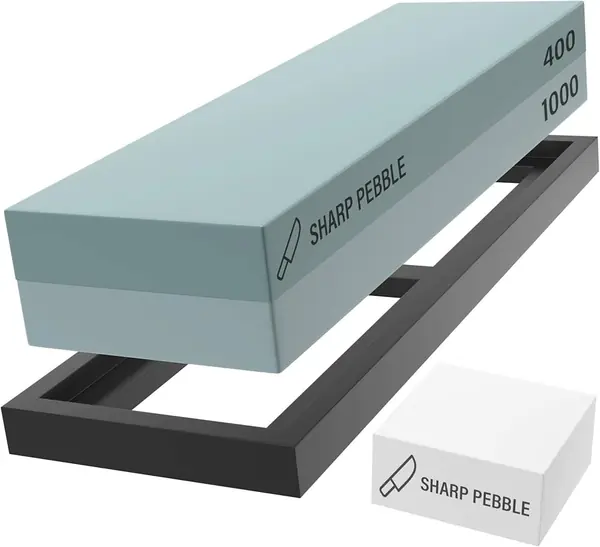
Sharp Pebble 400/1000 Kit Best for Restoring Damaged Edges

Sharp Pebble 400/1000 green and white stone with flattening stone and rubber base

Chipped and damaged edges

Shop Score 94/100
Dimensions
7.25 x 2.25 x 1 inches
Grits
400 / 1000
Included
Flattening stone, angle guide, rubber base
View on Amazon

The flattening stone is the piece most kits leave out, and it is the reason we send people to this box instead of a cheaper 400/1000. A stone that has dished in the middle cannot sharpen evenly no matter how good your hands are; the included flattening stone lets you true the face yourself rather than buying a diamond plate on top of everything else.

The 400 side is for real work: chips, a rolled edge, a knife that has spent years in a pull-through. The 1000 side then refines what the coarse grit started. The rubber base holds the stone still while both hands are on the blade, and the angle guide does the same job as the one in the 1000/6000 kit, so a beginner is not left improvising an angle on the first try.

The instructions come as a digital booklet rather than a card, which is a small annoyance at a wet bench, and the rest of the kit is straightforward. If your household has one drawer of tired knives, this is the grit pair that fixes them; if the knives are merely dull rather than damaged, the 1000/6000 kit skips a step you will rarely use.

Worth Noting

  • Wears faster under frequent, heavy sharpening
Our Verdict

We point people here when the blades in the house have chips and dents: the 400 side does repair work a finishing stone cannot, and the kit keeps the stone flat.

Check Latest Price
5.

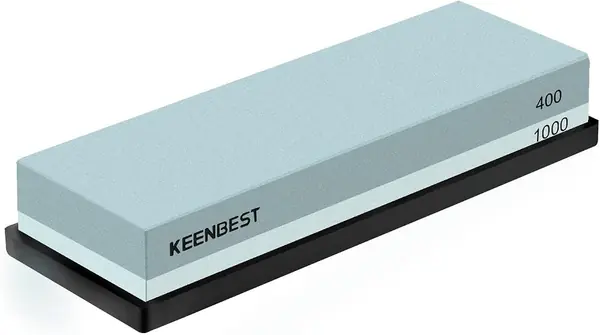
KEENBEST 400/1000 Whetstone Best Budget

KEENBEST green two-sided 400/1000 grit water stone with rubber base

Tight budgets

Shop Score 93/100
Dimensions
7 x 2.2 x 1.1 inches
Grits
400 / 1000
Included
Non-slip rubber base
View on Amazon

It is the least expensive stone in this group, and the box does not pretend otherwise: a 7 by 2.2 by 1.1 inch two-sided stone, a rubber base, and a short guide. One face is 400 grit silicon carbide for resetting a damaged edge, the other is 1000 grit white corundum for the honing passes, and both run on plain water.

What you get for very little money is a stone that sharpens. It raises a usable edge on kitchen knives, it is forgiving of an inconsistent angle, and nothing in the kit is precious enough that a beginner has to handle it carefully. The base holds it steady on a damp counter, and water is the only thing you have to keep buying. A stone you are not afraid to learn on is the one you will actually use.

Worth Noting

  • Short 7-inch face feels cramped on long knives
  • Stone wears quickly with repeated use
Our Verdict

It is the stone we suggest to anyone who wants to try sharpening without spending real money, and to anyone who wants a spare living in a toolbox.

Check Latest Price
6.

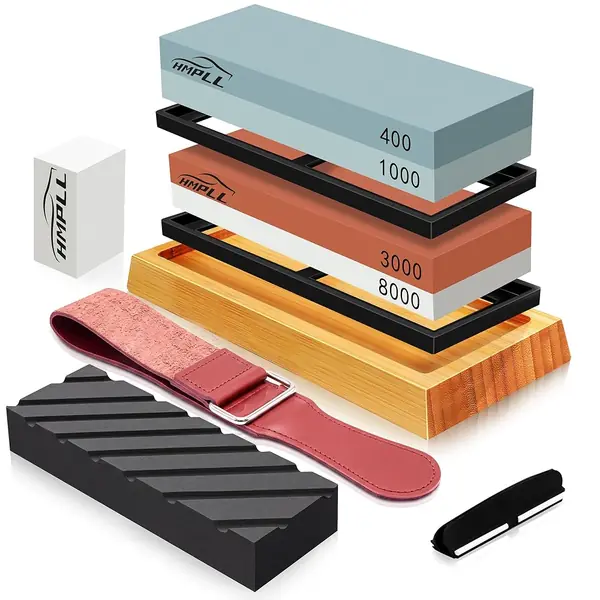
HMPLL 4-Grit Whetstone Set Best for Trying Multiple Grits

HMPLL two double-sided whetstones with bamboo base, flattening stone, and strop

Trying multiple grits

Shop Score 92/100
Grits
400/1000, 3000/8000
Stone Size
7 x 2.36 x 1.16 inches
Pieces In Set
9
View on Amazon

Two double-sided stones, 400/1000 and 3000/8000, plus a bamboo base, silicone holders, a flattening stone, an angle guide, and a leather strop: nine pieces and 5.2 pounds in one box. As a way to try four grits without committing to a stone collection, that is a lot of kit for the money.

We spent most of our time on the 400/1000 stone, which is where a dull knife or a nicked chisel actually gets fixed, and it handles that job without drama. The bamboo base and the silicone holders grip well and keep both hands free for the blade, which is more than some pricier sets manage.

The accessories are better than the usual filler. The flattening stone is genuinely needed once the coarse stone starts to dish, the angle guide gives a beginner a reference point, and the strop is the piece we used least. Cleanup is the honest cost of four grits: four surfaces to rinse, and water that carries the swarf.

Our view is that this is a set for the curious. It lets you feel what a 400 does that an 8000 cannot, and it hands you the flattening stone to keep the coarse side working. What it does best is help you find out which grit you actually reach for, so the next stone you buy can be a good one.

Worth Noting

  • Fine grits stop short of a true polish
  • Stones wear and chip under heavy use
Our Verdict

We see this as a sampler: four grits and a full set of accessories at the price of one good stone, with the coarse stones doing the real work.

Check Latest Price
7.

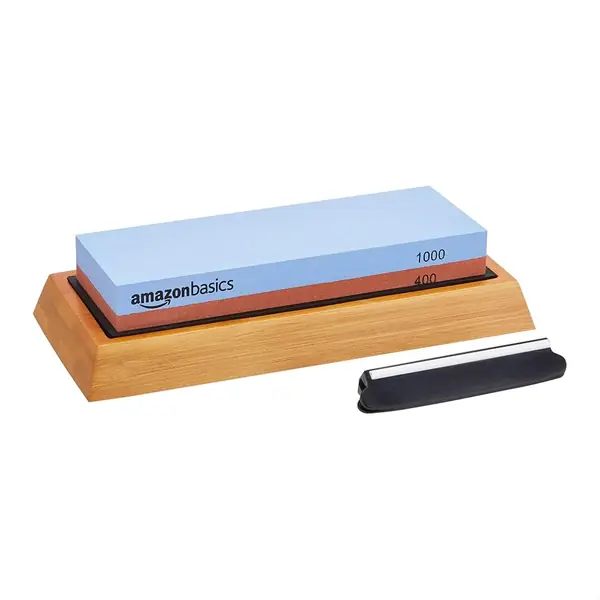
Amazon Basics 400/1000 Whetstone

Amazon Basics black and gray dual-sided 400/1000 whetstone with bamboo base

Low-cost first stone

Shop Score 91/100
Grits
400 / 1000
Included
Angle guide, silicone cradle, bamboo base
Warranty
1-year limited
View on Amazon

A house-brand stone invites suspicion, so it is worth saying plainly what this one is: a 400/1000 two-sided water stone, an angle guide, and a base made from a silicone cradle set inside bamboo. The design is the same idea the pricier kits use.

The silicone insert is the detail we appreciate. The stone sits down inside the cradle instead of riding on top of a flat base, so there is less to go wrong when you are bearing down on the coarse grit. The angle guide is the usual clip-on type, and the two grits cover repair and honing in a single block.

Nothing here is remarkable and nothing is bad, which is exactly what we want from a stone in this price bracket. It is the only stone in this group with a stated warranty, a one-year limited one, and for a household that sharpens a few knives a month that backing matters more than a fifth grit ever would.

Worth Noting

  • No flattening stone in the box
Our Verdict

For a first stone at the low end of this group, we think this one is easy to say yes to: dual grits, a steady base, an angle guide, and a warranty behind it.

Check Latest Price

How We Tested Ceramic Sharpening Stones

We started with research rather than a shopping cart: reading listings and customer reviews for ceramic stones, sorting them by the grit pair each one offered, then dropping anything that shipped without a way to hold it still or keep it flat. Fourteen stones made the cut, and we bought every one of them ourselves and used them for seven months.

Testing happened where people actually sharpen. On Saturday mornings we worked through a drawer of dull kitchen knives on the counter, in the garage we took chisels and plane irons back to a clean bevel, and one long afternoon went to a chipped paring knife that needed coarse work before it could be honed. Every stone sat in a non-slip base on a stable bench, we kept our fingers behind the edge, and we pushed the blade away from the body on every pass.

We timed how long each stone soaked and counted how many splashes it took to raise a working slurry, then noted whether the blade skated across a hard, glassy surface or bit into a softer one that told you where the bevel was. We marked pencil lines on each face and lapped them off to see how flat the stone arrived, measured working face and thickness with a ruler, and checked for dishing with a straightedge after every ten knives.

At the end of seven months we looked for chipped corners, cracked bases, and stone that had gone soft, and we weighed value against what came in the box — base, angle guide, flattening stone, warranty — rather than against grit count alone.

How to Choose a Ceramic Sharpening Stone

Grits Come in Pairs for a Reason

Think of grits as a sequence rather than a number to maximize. A 400 or 320-grit stone does repair: chips, a rolled edge, a bevel that needs resetting. A 1000-grit stone is the workhorse that forms the edge. Anything from 3000 up refines and polishes, and an 8000 is a finishing tool for chisels, plane irons, and razors.

For a kitchen plus a small shop, a 1000/6000 combination covers nearly everything, which is why the Sharp Pebble kit works as a first stone. A four-grit set looks like more value, but the fine faces on inexpensive sets often cut coarser than their labels suggest. Judge a stone by the edge it leaves, not the number printed on it.

Splash-and-Go or a Soaking Bucket

The bonding decides this. Softer, porous water stones need ten or fifteen minutes under water before they cut properly, and they keep wanting water while you work. Harder ceramic stones such as the Shapton line are splash-and-go: wet the face and start. Neither is better in the abstract; they suit different habits.

If you sharpen in five-minute bursts at the end of a work session, splash-and-go is the difference between sharpening and not sharpening. If you sit down for a proper session with the radio on, soaking costs you nothing but a container. Either way, keep the surface wet while the blade is on it.

Hardness, Wear, and What It Costs You Later

A hard stone stays flat and feels precise. A soft stone cuts quickly and dishes in the middle, which leaves a blade that never quite meets the whole surface. Neither is wrong, but they ask different maintenance, and every stone dishes eventually.

Plan for a flattening stone or a diamond plate from the start. The Sharp Pebble 400/1000 kit includes one; the bare Shapton stones do not. Buying the flattening tool with the stone, rather than after the first frustrating session, is the cheaper order of operations.

What's in the Box Does More Than You Think

Two accessories decide whether a first stone gets used: an angle guide that holds the bevel steady, and a base that keeps the stone from sliding while both hands are on the knife. The Sharp Pebble kits include both. The Shapton stones arrive bare, which is fine if you already hold an angle and own a holder, and a false economy if you do not.

A stone that walks across the counter is a stone that ends up in a drawer. If your stone arrives without a base, a damp towel under it will do until a proper holder shows up.

Size and the Edge You're Sharpening

Length and width matter more than they look. A 7-inch stone is fine for a paring knife and tight for a long chef's knife, where the extra inch of a 210mm stone gives you room to keep the blade flat through the whole stroke.

Width matters most for chisels and plane irons. On a 2.2-inch face a wide chisel back overhangs the edges, and an overhanging blade is one that rocks and rounds over the very corner you are trying to establish.

Frequently Asked Questions

Final Verdict

Start with the Sharp Pebble 1000/6000. It is the kit we hand to anyone who has never held a stone: the angle guide and non-slip base take the guesswork out of the first session, and the two grits cover everything from a dull chef's knife to a polished bevel. Nothing else here does as much for a beginner.

If you already sharpen, buy the Shapton #1000 instead, harder and faster and ready with a splash, then add the #8000 when chisels and plane irons become part of the routine. For a drawer full of chipped knives, the Sharp Pebble 400/1000 with its flattening stone is the kit that does the repair work.