↑↓ navigate ↵ open Esc close All results →

Best Diamond Sharpening Stones of 2026

A diamond plate does the unglamorous half of sharpening better than anything else on a bench: it cuts fast, never dishes, and skips the bucket of water and the twenty-minute soak. That matters on the evening you nick a chef's knife on a chicken bone and want the edge back before dinner. What you give up is polish, the mirror finish a fine water stone leaves behind, and past a certain grit most of us can't tell the difference on a cutting board anyway.

Grit numbers on these plates deserve suspicion. A plate labeled 400 can leave a scratch pattern closer to 300, and the coarse side is usually the first thing to wear, so a plate that feels aggressive in month one can go glassy by month six. We tested 12 diamond plates over nine months on chef's knives, chisels, and plane irons, and we paid as much attention to whether a plate stayed put on the counter and sat flat under a wide blade as to how quickly it cut.

Some of what we learned is obvious once you've lived with diamond: a plate that slides is a plate that bites you, so keep it on its base or holder and your fingers behind the edge, letting light pressure do the cutting. The picks below cover the single-stone bench, the full grit progression, and the first setup on a budget. What they share is a surface flat enough and wide enough to actually work on.

Our Top Picks

The Best Diamond Sharpening Stones

1.

SHARPAL 162N Double-Sided Diamond Stone Best Overall
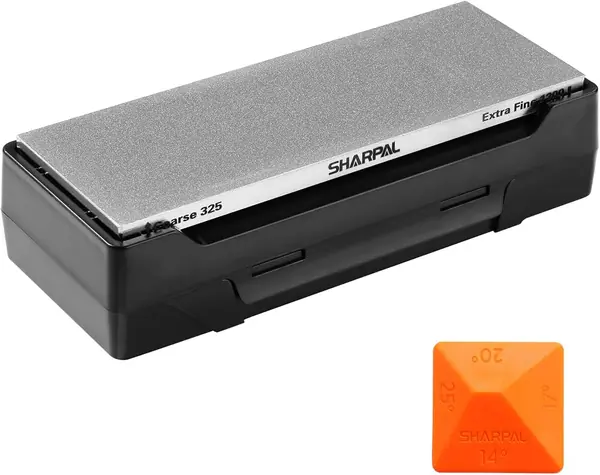
SHARPAL 162N double-sided diamond bench stone in black and silver with storage case

One-stone bench setup

Shop Score 96/100
Grits
Coarse 325 / extra fine 1200
Surface Size
8 x 3 in.
Included
Storage case, non-slip base, angle guide
Base Thickness
0.35 in. steel
View on Amazon

What sold us is the case: it opens into a non-slip base, so the plate stays put on the bench without a clamp, a stone holder, or a folded towel underneath. The stone lifts out and flips, and you are on the fine side without going to find a second plate. In a shop where the bench gets cleared every evening, that one-piece setup is the difference between touching up an edge and putting it off.

Eight inches by three is the right footprint for woodworking, too. A 2 3/8-inch plane iron or a wide paring chisel sits fully on the surface, so you take a full stroke instead of working a bevel in sections and blending the joins. The 0.35-inch steel core is stiff enough that the plate does not flex or ring, and because it is diamond on steel there is no dishing to true up later the way there is with a water stone that has hollowed out under years of chisel backs.

The grits are spaced sensibly for one stone: 325 to reset a bevel or grind out a nick, 1200 to hone. Diamond cuts fast enough that the coarse side feels grabby on a hard blade, and the included four-angle guide is a beginner's aid more than a woodworker's tool. Freehand, you feel the bevel register on the plate and use the guide once or twice to check yourself. A splash of water or a dry surface, and you are done.

At just over three pounds with the case it lives in a drawer without complaint, and the closed case keeps dust and swarf off the diamond between sessions. It also does kitchen duty without a second thought, which is more than we can say for a bench stone that has to soak first.

Worth Noting

  • Coarse side can wear under heavy reshaping
  • 1200 grit stops short of a polished edge
Our Verdict

For most workshops this is the one we hand people first: coarse and fine on a single plate, a case that doubles as a base, and no soaking.

Check Latest Price
2.

Ultra Sharp 8 x 3 Diamond Stone Set Best Full-Size Set

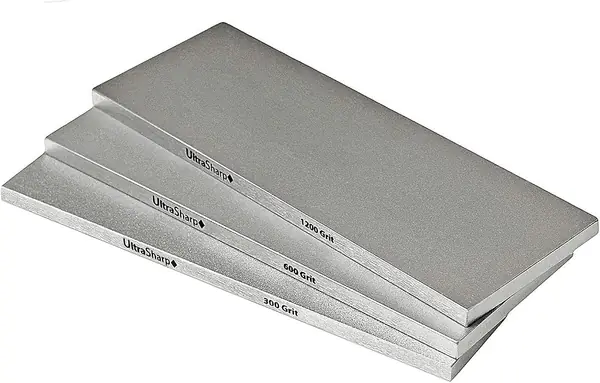
Ultra Sharp three-piece diamond sharpening stone set in silver with stone holder

Full grit progression

Shop Score 94/100
Grits
300 / 600 / 1200
Included
Three plates and stone holder
Warranty
Lifetime
Plate Size
8 x 3 in.
View on Amazon

Flatness is the first thing we check on a diamond plate, and this set is consistent across the whole 8 x 3 surface rather than just down the middle, which is what a chisel back and a plane iron actually test. Three separate plates mean you never flip a wet stone mid-stroke: 300 grit stays set up for grinding, 600 for the middle of the job, 1200 for the finish, each one a quarter-inch of steel under an aggressive, even coat of diamond.

The holder is what makes the set worth the money to us. It grips any stone from 6 to 9 inches long, so it takes all three plates plus whatever water stone you already own, and it lifts the working surface far enough that your knuckles clear the bench on a wide iron. It is the setup we leave standing at the end of the bench rather than packing away.

Before you judge the grits, give the plates a break-in session on a scrap chisel. Fresh diamond cuts coarser than it will after a few weeks, and the first edges off a new plate can feel scratchier than the number promises. Once they settle, the 1200 leaves an even bevel that a strop brings up in a handful of passes.

Worth Noting

  • Plating can delaminate with heavy use
  • Heavier than a single plate to move
Our Verdict

We recommend this set to the woodworker who wants each grit on its own 8-inch plate, with a holder that keeps it off the bench.

Check Latest Price
3.

Work Sharp Benchstone Best for Beginners

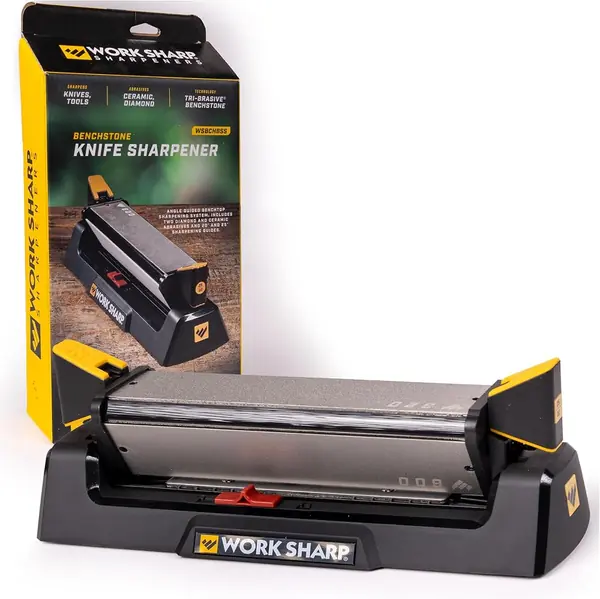
Work Sharp Benchstone three-sided diamond and ceramic sharpener in black with angle guides

Learning to sharpen

Shop Score 93/100
Base
Non-slip benchtop base
Pivot
Follows the blade or locks rigid
Abrasives
400 and 800 grit diamond, fine ceramic
Angle Guides
20 and 25 degrees
View on Amazon

Holding 20 degrees by feel is the skill most people never pick up, and it is why a cheap stone ends up in a drawer. This bench stone takes the problem away: interchangeable guides set 20 or 25 degrees, and the abrasive sits in a pivoting cradle that follows the curve of a blade instead of making you lift your wrist at the tip. We think it is the quickest route to a genuinely sharp edge for someone who has never sharpened anything.

Three surfaces sit on one unit: 400 and 800 grit diamond for the actual work, then a fine ceramic for the finish. The pivot locks out, which is what makes this a shop tool rather than only a kitchen gadget. Locked rigid, the diamond plates behave like a conventional bench stone under a chisel or a plane iron, and the benchtop base keeps the whole thing from walking while you push.

The ceramic is the surface we underrated. It removes very little steel, but it takes the scratches the 800 diamond leaves and turns them into an edge that bites instead of skidding, which is the step most beginners skip. Rinse it after each session, because loaded ceramic stops polishing long before it wears out.

Worth Noting

  • Guides stop at 20 and 25 degrees
  • Instructions leave the pivot technique to trial and error
Our Verdict

If you have never held a consistent angle, start here: the guides and pivoting head do the work your wrist cannot do yet.

Check Latest Price
4.

Atoma 400 Diamond Plate Best for Lapping and Repair

Atoma 400 diamond bench plate in gray with a diamond surface, 8 by 2.77 inches

Lapping and repair

Shop Score 92/100
Surface Size
8 x 2.77 in.
Grit
400
Weight
1.3 lb
Thickness
0.32 in.
View on Amazon

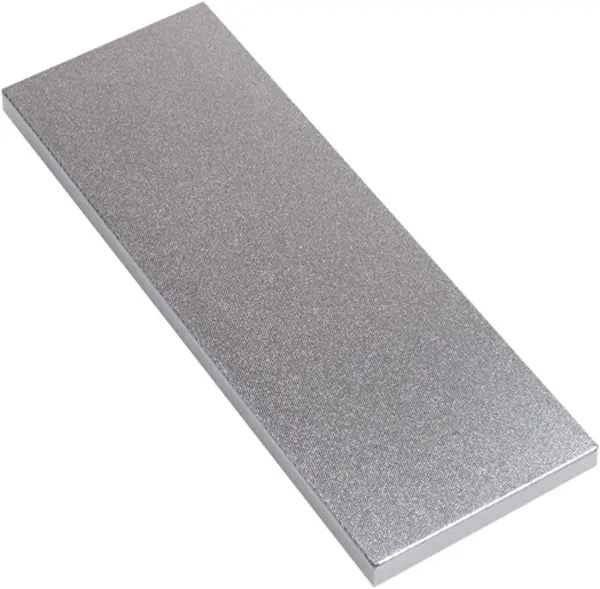
Every other plate here is a sharpening stone first. This one is a maintenance tool: 400 grit diamond on a 0.32-inch steel body, bought to flatten water stones, dress a glazed ceramic stone, and take a nick out of a plane iron in a handful of passes.

At 8 by 2.77 inches it is narrower than the 3-inch plates, and that is the number to think about if you plan to run a wide iron across it. What the narrower footprint buys is flatness you can trust and a cutting speed that borders on too fast. This plate removes steel quickly enough that the risk is going past the nick rather than never reaching it.

What we value most is that the scratch pattern stays shallow. This is a 400 that behaves like a middle step rather than a grinder, so a 1000-grit stone erases its marks in a few passes and you are not fighting the lapping plate for the rest of the session.

Worth Noting

  • Narrower surface than the other plates here
  • Single grit needs a partner stone
Our Verdict

We keep this plate for the jobs the others cannot do: flattening a dished water stone, dressing ceramic, and grinding a nick out of an iron.

Check Latest Price
5.

S SATC 400/1000 Diamond Plate Best Budget

S SATC double-sided diamond sharpening plate in white with 400 and 1000 grit sides

First sharpening setup

Shop Score 91/100
Grits
400 / 1000
Surface Size
8 in.
Style
Double-sided plate
Material
Monocrystalline diamond on steel
View on Amazon

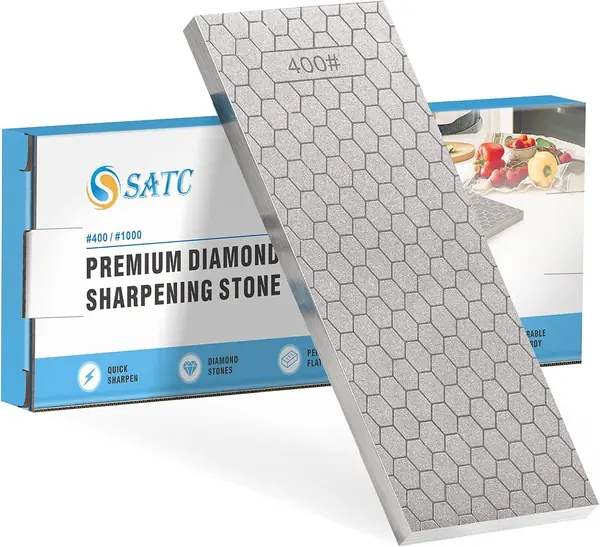
Two grits, one plate, and a price that makes the rest of the category look indulgent. The 400 side takes out a nick, the 1000 side hones, and the plate is a full 8 inches long, so a plane iron still sits on it properly rather than hanging off both ends. Nothing here needs soaking, oiling, or truing.

What surprised us is how little the budget shows while you are actually sharpening. The plate is flat, the diamond cuts, and the two grits land where a general-purpose routine needs them. It is a plain tool with no refinements, and once you are stroking a chisel across it the plainness stops mattering.

Holding it still is the one thing to plan for, because a bare plate walks under pressure. Set it on a damp cloth or drop it into a holder before the first stroke, and rinse the swarf off afterwards so the diamond does not load up between sessions.

Worth Noting

  • No base or case included
  • Top grit stops at 1000 for finishing
Our Verdict

This is where we send a first-time sharpener on a tight budget: two useful grits on a full 8-inch plate, with nothing to assemble.

Check Latest Price
6.

DMT W6EFC Three-Stone Kit Best Compact Set

DMT three-stone diamond whetstone kit in a natural wood box with color-coded stones

Compact progression

Shop Score 90/100
Grits
Coarse 325 / fine 600 / extra fine 1200
Origin
Made in the USA
Storage
Fitted hardwood box
Stone Length
6 in.
View on Amazon

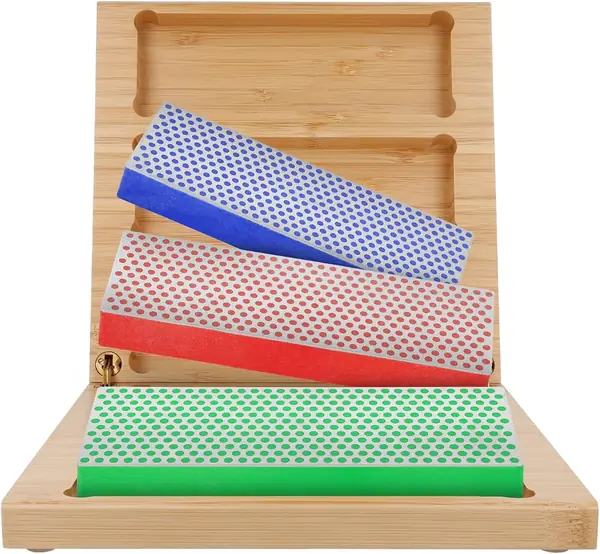
The box is the reason to consider this over a stack of loose plates: three color-coded 6-inch stones sit in a fitted hardwood case, so the progression travels as one piece and nothing gets chipped in a drawer between projects.

Blue is 325, red is 600, green is 1200, and all three cut dry or with a splash of water, which we prefer to a bucket by the bench and oil to clean off a chisel before glue-up. The stones are continuous diamond on steel and cut fast enough that a maintenance session is a couple of minutes rather than an evening.

We like the color coding more than we expected. It removes the small hesitation at the start of each step, which matters when you are teaching someone or working tired at the end of the day, and that small thing turns out to be the difference between using the set and leaving it in the box.

Worth Noting

  • Box holds the stones loosely
  • 6-inch stones are short for wide irons
Our Verdict

A compact three-stone kit we like for keeping the whole progression in one box and carrying it to a job site.

Check Latest Price
7.

DMT D8F Dia-Sharp Bench Stone Best for Bench Touch-Ups

DMT Dia-Sharp fine diamond bench stone in white with non-skid rubber feet

Bench touch-ups

Shop Score 89/100
Grit
Fine
Origin
Made in the USA
Feet
Four rubber feet
Size
8 x 3 x 0.38 in.
View on Amazon

One grit, 8 by 3 inches, four rubber feet, and no holder, case, or second side. Heard as a spec sheet, that sounds like less than the double-sided plates here, and for a beginner it is. For someone who already owns a coarse stone, a fine plate that never leaves the bench is a different and more useful thing.

The surface is continuous rather than interrupted, so there are no gaps for a chisel corner to catch in, and the plate is 0.38 inch of steel with diamond bonded across the full face. It sharpens dry or with water and wipes clean in a few seconds, which is the entire maintenance routine.

Run a fingernail across the face when it arrives. A plate with a bare patch near an edge will not flatten a chisel back evenly, and catching that while you can still return it is worth two minutes of your evening.

What keeps us coming back to this one is the combination of size and feet: a plane iron sits flat with room to spare, and the plate stays where you put it instead of skating across the bench. As a finishing plate for a shop that already grinds on something coarser, that is a complete answer.

Worth Noting

  • Plate can arrive with a slight bow
Our Verdict

We recommend it as an addition rather than a first stone: a fine 8-inch plate that stays set up for touch-ups on the bench.

Check Latest Price

How We Tested the Best Diamond Sharpening Stones

We started with a list of diamond plates and plate sets sold as bench sharpeners rather than pocket gadgets, then filtered by the things that decide whether a plate gets used at all: the size of the working surface, whether the steel core felt thick enough to resist flexing, how many grits came in the box, and what held the thing still. Thickness claims got checked with calipers and a straightedge. From that list we bought 12 plates and sets and used them for nine months.

Testing happened where sharpening actually happens: a kitchen counter on Saturday mornings with a drawer full of dull chef's knives, and a shop bench with chisels and plane irons that needed their backs flattened. We laid a wide plane iron across each surface to see whether it sat fully or hung off an edge, then pressed a chisel back onto the plate and watched for flex.

After that we sharpened, twenty passes a side on a dull knife, counting strokes until a burr came up and slicing paper and tomatoes to check the edge. Every plate stayed on its own base, holder, or feet, with fingers kept behind the edge and light pressure only, since leaning on diamond loads the surface and invites a slip.

We read grit numbers with suspicion. After each session we compared the scratch pattern under a loupe against what the label promised, and logged how the coarse side behaved as the months went on, whether it still cut or started skidding across the steel. We rinsed and dried each plate afterward and noted which ones wanted soaking, oiling, or a break-in we hadn't planned for. At the end we weighed every plate against the grits we had actually reached for, because a three-plate set only earns its place if you keep picking up the middle stone.

How to Choose a Diamond Sharpening Stone

Match the Surface to What You Sharpen

Size is the first real decision. An 8 x 3 inch plate lets a 2 3/8-inch plane iron or a wide chisel sit flat through a full stroke; a 6-inch stone forces you to work a bevel in sections and blend the joins, which is a skill of its own. If your work is mostly chisels under an inch wide, a 6-inch stone is fine and easier to store.

Rigidity matters as much as length. A thin diamond sheet flexes under your hands, and a plate that flexes cannot flatten a chisel back however flat it was when it shipped. We look for a steel core of a quarter-inch or more; the diamond plates here that clear it run 0.25 to 0.38 inch.

Count the Grits You Actually Use

Two grits on one plate, roughly 300 to 400 for reshaping and 1000 to 1200 for honing, cover everything a hand tool needs before a strop. That is the logic behind the SHARPAL and the S SATC: one plate, flipped, with no storage question.

Three plates buy convenience rather than a better edge. The Ultra Sharp set lets you leave every grit standing at the end of the bench, which matters if you sharpen in short bursts between other work. The DMT kit does the same job in a smaller format with a box, at the cost of surface length.

Read the Grit Number With Suspicion

Diamond grit ratings are not standardized between makers, and a diamond 1200 does not leave the same finish as a water stone 1200. Judge a plate by the scratch pattern it leaves on a scrap chisel back rather than the number on the box. If the marks are deeper than your next stone can erase in a dozen strokes, the jump between them is too wide.

A coarse plate sold as a fine one is the most common disappointment in this category, and it is invisible until you put steel on it. Test before you commit a good tool.

Plan for Holding the Plate Still

However good the diamond is, none of it matters if the plate walks across the bench. The fixes, cheapest first: a damp cloth underneath, four rubber feet molded into the plate, a case that opens into a base, or a separate holder that grips the stone and lifts it clear. Check the height of whatever you choose against the way you sharpen, because a holder that raises the plate an inch changes your wrist angle as much as your stone does.

Know What You Give Up Against a Water Stone

Diamond cuts faster, stays flat, and runs dry, which is why we reach for it on chisels and plane irons. What it does not do is polish. A 1200-grit diamond plate leaves a working edge with a visible scratch pattern, so if you want a bright bevel, follow it with a strop loaded with compound or keep a fine water stone for the last step. Buy diamond for the grinding and honing, not for the mirror.

Frequently Asked Questions

Final Verdict

If you want a single stone that takes a chisel from nicked to honed, the SHARPAL 162N is the one we recommend: eight inches of stiff plate, two grits that sit where the work is, and a case that holds the stone still and keeps it clean.

Move up to the Ultra Sharp set only if you want each grit on its own plate and a holder to lift it off the bench. Add the Atoma if you also flatten water stones, because that is a job the finer plates cannot do.