↑↓ navigate ↵ open Esc close All results →

Best Sharpening Stones of 2026

Buying a first sharpening stone often stalls over numbers and rituals — grit ratings, soak-versus-splash prep, and whether a water stone, diamond plate, or puck fits the job. Beneath those labels, the work is straightforward: shave steel cleanly until two bevels meet at a sharp edge that bites into a tomato skin or shears end grain without skating.

Over eight months of regular use across kitchen prep, workbench plane irons and chisels, and a yard hatchet, 12 stones quickly revealed what beginners actually need. A stone wide enough to support an angle and a base that stays planted on the counter take far more guesswork out of honing than a high grit number printed on a narrow block.

The strongest performers held their grit, stayed flatter than expected through repeated sessions, and shipped with practical support like a gripping base, case, or angle guide — asking only for a steady surface and starting coarse enough to establish a bevel.

Our Top Picks

The Best Sharpening Stones

1.

Sharp Pebble 1000/6000 Whetstone Best Overall
Sharp Pebble 1000/6000 blue and white whetstone with bamboo base and angle guide

Beginner home sharpening

Shop Score 97/100
Weight
2.1 lb
Base
Non-slip bamboo
Grits
1000/6000
Stone Dimensions
7.25"L x 2.25"W x 1"H
View on Amazon

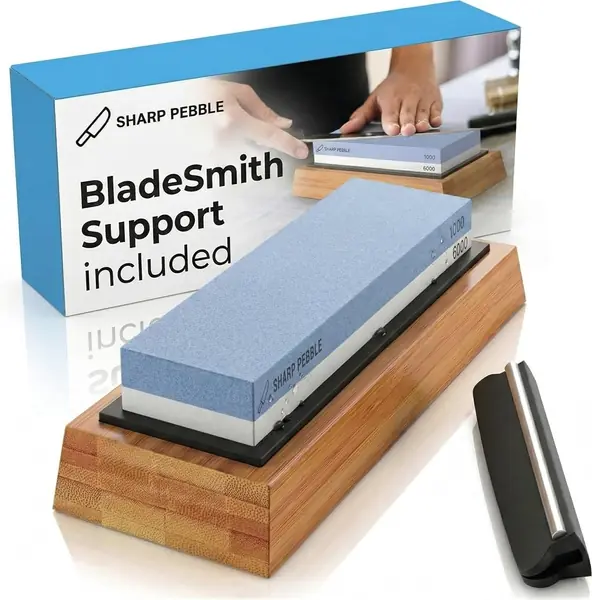
The 1000/6000 combination and the included angle guide are what make this the stone we hand most people first. The 1000 side has enough bite to bring back a tired kitchen edge, while the 6000 side polishes without requiring a second purchase. For anyone who has never used a water stone, that pairing removes the two biggest excuses: not knowing which grit to start with and not knowing how to hold the blade.

We like the bamboo base more than we expected to. It gives the stone a stable, slightly raised platform, and the rubber holder keeps the stone from skating while you work. The angle guide is a useful training wheel for kitchen knives, though we still treat it as a starting reference rather than a permanent crutch; consistent pressure matters as much as the angle. The stone is 7.25 by 2.25 inches, so it is comfortable for chef knives and pocket knives.

The water-only routine is another point in its favor. There is no oil to buy, no oily film to wipe off the counter, and no special cleaner. The 6000 side is the one we reach for at the end of a session, leaving a clean, bright bevel rather than a rough utility edge. It is not the stone for a chipped axe or a badly damaged chisel; that is a job for a coarse stone before this one.

Worth Noting

  • Narrow surface for wide plane irons
Our Verdict

This is the kit we hand a first-time sharpener: two useful grits, a base, and an angle guide for dull kitchen knives and light tool touch-ups.

Check Latest Price
2.

Sharpal 162N Diamond Stone Best Diamond Stone

Sharpal 162N diamond sharpening stone in black and silver with storage case and angle guide

Hard steels

Shop Score 96/100
Diamond Type
Monocrystalline diamond
Kit Includes
Storage case, non-slip base, angle guide
Size And Grit
8 in. x 3 in. / 325&1200 Grit
Base Thickness
0.35 inch
View on Amazon

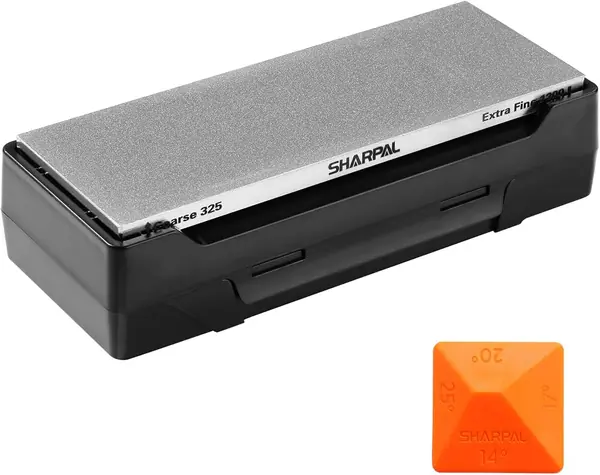
The diamond surface is why we keep this stone within reach. Coarse 325 grit on one side sets an edge quickly, while 1200 grit on the other refines it, and neither side needs a long soak or a bottle of honing oil. For hard kitchen steels, carbide tooling, and any blade that laughs at a soft water stone, that combination is a practical shortcut.

The 8-by-3-inch working area is generous enough for a chef's knife and a wide chisel, and the 0.35-inch steel core gives it a solid, flat feel on the bench. We appreciate the storage case because it doubles as a base with a non-slip pad, so the stone is ready to use without hunting for a holder. The angle guide is a helpful extra, though a diamond plate this fast still rewards a steady hand.

At 3.09 pounds, it is a bench stone, not something we toss in a backpack for a day hike. We also keep an eye on the surface over time: diamond abrasives are aggressive, but they can lose bite with heavy use, so we use this as the hard-steel and quick-reset stone rather than the only stone in the shop. For that role, it is our first choice here.

Worth Noting

  • Heavy for a field bag at 3.09 pounds
Our Verdict

For hard steels and a flat, fast-cutting bench stone, we choose the Sharpal for its 325/1200 diamond surfaces and case-mounted base.

Check Latest Price
3.

King 1000 Water Stone Best Traditional Water Stone

King 1000-grit brown synthetic water stone for sharpening knives and tools

Routine edge maintenance

Shop Score 95/100
Weight
1.1 lb
Grit
#1000
Material
Ceramic
Stone Type
Synthetic water stone
View on Amazon

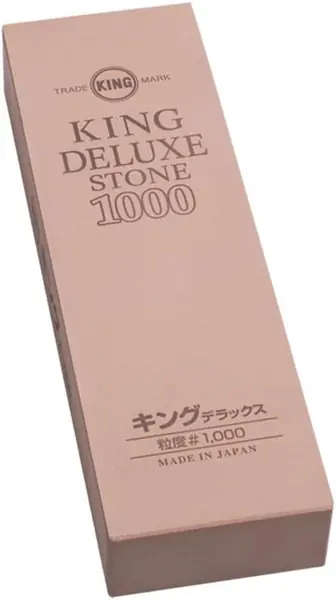
A 1000-grit water stone is the tool we reach for when an edge is sound but tired. The King is a traditional soaking stone with a smooth, creamy feel that lets you hear and feel the bevel settling onto the abrasive, rather than scraping blindly across a hard plate. That feedback is why woodworkers and cooks keep coming back to this format.

We like the way this stone cuts: it is quick enough for routine maintenance but not so aggressive that a few extra passes ruin a delicate edge. At 1.1 pounds and roughly 8 inches long, it is easy to store and easy to bring out for a short session. It works on kitchen knives, chisels, and plane irons, and it wears evenly enough that the surface stays predictable with regular flattening.

What we like is that it asks you to learn one stone well. There are no extra grits to sort through and no guide to distract from the bevel. We use it for kitchen knives and chisels, and it rewards a light, consistent hand. That makes it a good stone for someone who wants to improve technique rather than collect grits.

Worth Noting

  • Single grit needs a coarser stone for repairs
Our Verdict

The King 1000 is the water stone we trust for routine edge maintenance on kitchen knives and chisels.

Check Latest Price
4.

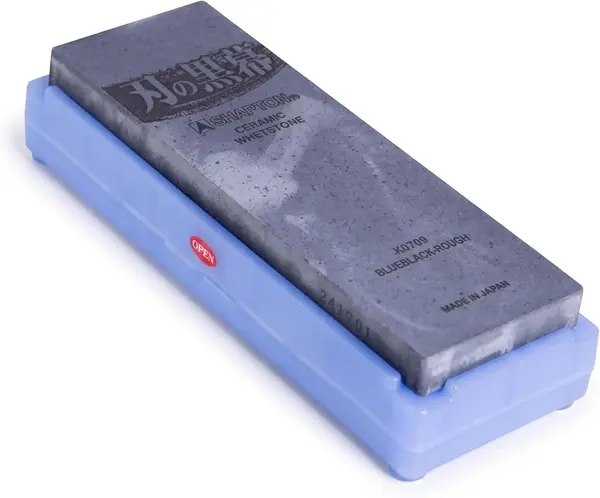
Shapton #320 Whetstone Best Coarse Stone

Shapton #320 blue-black coarse whetstone with a plastic storage case

Coarse edge repair

Shop Score 94/100
Weight
1.1 lb
Grit
#320
Dimensions
8.27"L x 2.76"W x 0.59"H
Case
Doubles as sharpening base
View on Amazon

A 320-grit stone is not for finishing. It is for the chisel with a nick in the edge, the plane iron that has lost its primary bevel, or the hatchet that has been splitting kindling instead of wood. The Shapton cuts that repair work quickly and asks for only a splash of water rather than a long soak.

The plastic case is a nice piece of practical design: it doubles as a sharpening base, so the stone has a stable home on the bench and a safe place to go afterward. At 8.27 by 2.76 by 0.59 inches, it is a full-size bench stone with enough length for a broad tool. The surface feels hard and consistent, and it does not turn muddy the way a softer water stone can.

What we appreciate most is how little maintenance the stone demands during a repair session. A splash of water keeps it cutting, and the hard surface holds its shape well enough that we are not constantly chasing a dished middle. It is a stone with a clear job, and it does that job without fuss. That focus is why it stays on our bench even when other stones are within reach.

Worth Noting

  • Coarse grit needs a finer follow-up stone
Our Verdict

The Shapton 320 is our repair stone for chipped chisels and plane irons, with the speed and hardness we want for rebuilding a bevel.

Check Latest Price
5.

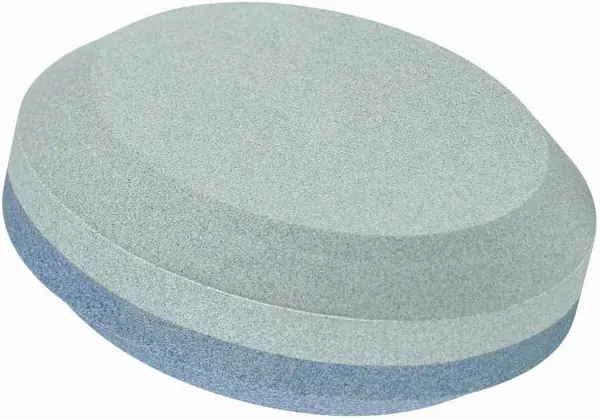
Lansky Puck Best for Axes and Outdoor Tools

Lansky Puck dual-grit black round stone for axes and outdoor tools

Axes and hatchets

Shop Score 93/100
Weight
9.17 oz
Grit
Dual grit
Material
Stone
Form
Puck
View on Amazon

The puck shape is the whole idea. You hold it in one hand and rub it along the bit of an axe or hatchet, letting the round face follow the curve instead of fighting it. That makes it the stone we reach for when the tool is clamped in a vise or when we are working outside with no bench at all.

The dual-grit faces give you a coarse side for a dinged edge and a finer side for the finish, and the stone is small enough to live in a tool bag without adding noticeable weight. We like that it does not need a base or a soak; a little water or a quick wipe is enough to keep it working. The puck is also easy to keep flat because you are moving the stone, not dragging a blade across a bench.

What we like most is the lack of ceremony: no base, no angle guide, no soaking routine. Pick it up, work the bevel, wipe it off, and put it back in the pack. For a tool that lives outside, that simplicity is the feature.

Worth Noting

  • Round face is clumsy on thin knives
Our Verdict

We keep the Lansky Puck with the axe: dual grit, hand-held, and ready for field touch-ups without a base.

Check Latest Price
6.

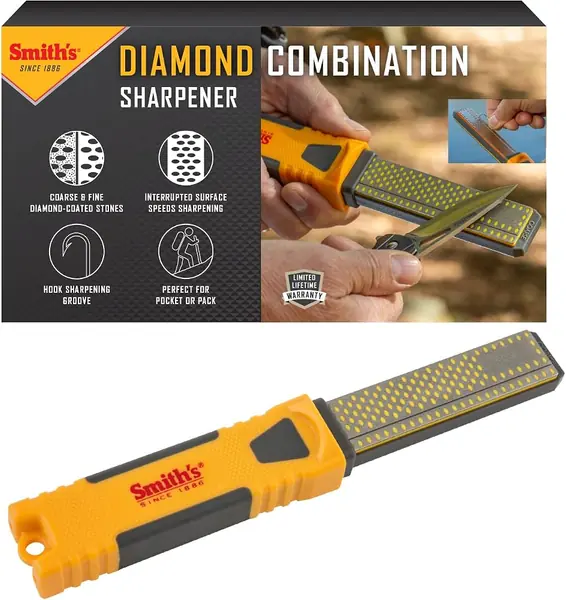
Smith's DCS4 Diamond Sharpener Best Compact Field Stone

Smith's DCS4 yellow compact diamond sharpener with handle and two grit surfaces

Field knife touch-ups

Shop Score 92/100
Grit
Coarse and fine diamond
Storage
Handle stores stone
Micro Pad
Fish hooks and pointed tools
Surface Length
4 inches
View on Amazon

Four inches of diamond surface does not sound like much until you are touching up a pocket knife at a trailhead. The Smith's puts that surface into a compact handle that stores the stone when you are done, so the abrasive is protected and your fingers have a clear place to hold.

Both sides are diamond: a coarse side for a dull or damaged edge, and a fine side for the final passes. The interrupted surface is designed to catch metal filings instead of letting them load up the stone, and the micro pad and groove are there for fish hooks and pointed tools. For a hunting pack or a glove box, that is a useful amount of capability in a small package.

The handle includes a thumb guard, which we appreciate when the stone is wet and the blade is small. The stone clicks back into the handle for storage, and the whole thing disappears into a pack pocket. That is the kind of design that makes a sharpener come along instead of staying in a drawer.

We ended up caring most about the lack of fuss: no base to set up, no oil to carry, no separate case to lose. The stone clicks back into the handle, and the whole tool disappears into a pack pocket. For a knife you carry, that is the detail that matters.

Worth Noting

  • Short four-inch surface takes more passes
Our Verdict

The Smith's DCS4 is our pocket-knife touch-up tool, with diamond surfaces that store inside the handle.

Check Latest Price
7.

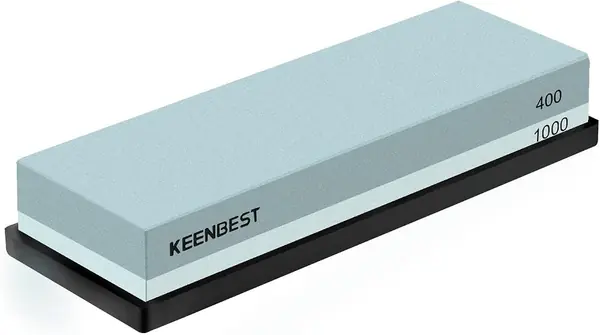
KEENBEST 400/1000 Whetstone Best Budget

KEENBEST 400/1000 green water stone with a black rubber base

Budget home sharpening

Shop Score 91/100
Weight
16 oz
Base
Non-slip rubber
Grits
400/1000
Dimensions
7"L x 2.2"W x 1.1"H
View on Amazon

The KEENBEST is the stone we point to when someone wants to try water sharpening without buying a full kit. One double-sided stone gives you 400 grit for a dinged edge and 1000 grit for the everyday refresh, plus a rubber base to keep it from sliding around the counter.

The stone is 7 by 2.2 by 1.1 inches and weighs 16 ounces, so it stores easily and feels substantial enough in the hand. The 400 side does the rough work; the 1000 side leaves a useful working edge rather than a polished show edge. It is a simple, honest setup, and the rubber base is the detail that makes it usable without a clamp.

We like that it keeps the job simple: one stone, two grits, and a base. There is nothing to assemble and nothing to lose, which is more than we can say for some of the boxed kits here. As a first stone for small kitchen knives or a spare for the drawer, it asks very little and gives you a real edge to learn on. That is a better introduction than a complicated kit you never open.

Worth Noting

  • Small surface for large blades
  • Stops at 1000 grit with no polisher
Our Verdict

We see the KEENBEST as a low-cost way to try water sharpening, with 400 and 1000 grits and a non-slip base.

Check Latest Price
8.

Intelitopia Complete Kit Best for Complete Home Kits

Intelitopia four-grit sharpening stone kit with bamboo base angle guide and strop

Complete home kits

Shop Score 90/100
Weight
5 lb
Base
Bamboo
Grits
400/1000 3000/8000
Angle Guide
Included
View on Amazon

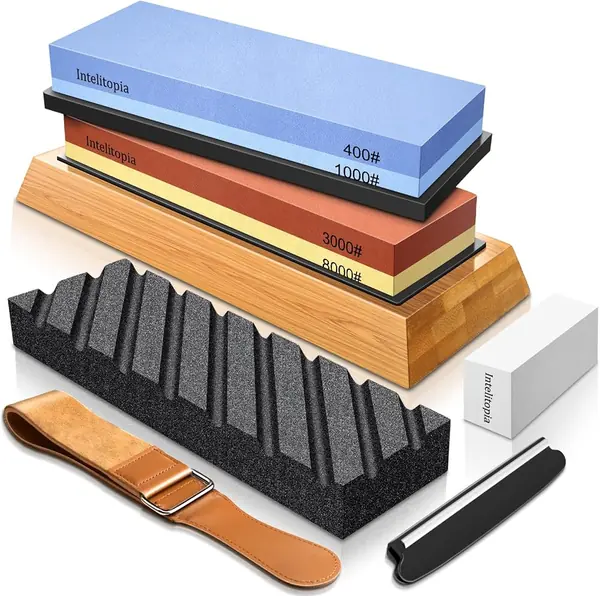
The box is the pitch: two double-sided stones covering 400 through 8000 grit, plus a bamboo base, angle guide, flattening stone, and leather strop. If you want to move from a chipped edge to a polished bevel without buying each piece separately, this kit puts the whole progression in one place.

The grit range makes sense for mixed use. Start at 400 for a damaged kitchen knife or a dull chisel, move to 1000 for the working edge, then use 3000 and 8000 when you want a cleaner finish. The flattening stone is the accessory that earns its place, because water stones eventually dish and a flat surface is what keeps an edge consistent.

The bamboo base and rubber holders give the stones a stable place to work, and the angle guide is a reasonable starting point for kitchen knives. We treat the leather strop as a finishing extra rather than the reason to buy the set. The whole package is best kept in one tray or box so the pieces stay together.

What we like is the convenience of having the whole sequence together, especially for someone setting up a first sharpening station. The stones are not as simple to live with as a single diamond plate, and the kit is more than a casual cook needs. We see it as a starter station rather than a travel kit, and that is the right way to buy it.

Worth Noting

  • Bulky five-pound kit needs storage space
Our Verdict

Our pick for a full progression is the Intelitopia kit, which bundles 400-to-8000 grits, a flattening stone, and a strop.

Check Latest Price

How We Tested Sharpening Stones

We built the shortlist by comparing published grit ranges, usable surface dimensions, format (water stone, diamond plate, or puck), base design, and what came in the box versus sold separately. From several dozen candidates we bought 12 and used them for eight months. Every stone got the same starting job: bring a deliberately dulled chef's knife back to slicing printer paper cleanly, then to cutting a ripe tomato without crushing it.

That work happened where stones actually get used — on a kitchen counter during dinner prep, at a workbench with chisels and a plane iron, in the yard with a hatchet, and out of a hiking pack on a weekend trip.

We timed how long water stones soaked before they stopped bubbling, checked whether an 8-inch blade and a 2-inch iron fit on the surface without overhanging, and set each one on a wet counter to see how much it rocked or slid. Every stone was seated on its non-slip base or a damp towel before we started, we kept fingers behind the edge and stroked away from the body, and anything that cracked or could no longer sit safely in its base left the rotation.

To judge flatness, we drew a pencil grid on each surface and lapped it on wet/dry paper until the grid disappeared, then repeated the check every few sessions. Calipers measured thickness at the start and at the end, and we noted dishing, glazing, chipped corners, and bases that loosened over time. We also weighed what came in each box against the price — clipping on every angle guide to see whether it held the angle or slipped mid-stroke, and packing the compact stones into a tool roll to see how they carried.

How to Choose a Sharpening Stone

Start with grit, not the number of stones

Most sharpening happens in the 400-to-1000 range: coarse enough to repair a nicked edge, fine enough to leave a working one. A 1000/6000 combo covers everyday kitchen knives and light tool touch-ups, while a 320 or 400 stone is the repair tool you add when a chisel or hatchet is badly damaged. We do not start a beginner on an 8000-grit stone; it polishes a sound edge but cannot fix a damaged one.

Match the stone to the edge

A full-size bench stone is usually 8 inches long and 2.5 to 3 inches wide, which gives a chef's knife or a plane iron room to travel. A 2-inch-wide stone can feel cramped under a wide plane iron, while a 4-inch field stone is fine for pocket knives but slow on long blades. The Smith's DCS4 is the right kind of tool for a pack; the Sharpal's 8-by-3 surface is the bench alternative. Measure the widest edge you plan to sharpen before you fall for a compact stone.

Choose water, diamond, or a puck

Water stones, the traditional whetstone format, give the feedback many woodworkers want and can leave a clean finish, but they need water and eventually flattening. Diamond plates cut fast, stay flat, and handle hard steels and carbide, which is why the Sharpal earns a place for difficult edges. A hand-held puck such as the Lansky is the outdoor exception: it follows an axe bit and needs no base. Buy for the work you do most, not the most exotic steel you might meet.

Plan for flatness and a stable base

A dished water stone cannot produce a consistent bevel no matter how good your technique is. Budget for a flattening stone or use a diamond plate, and check the surface with a straightedge. A non-slip base matters just as much: a stone that slides is a cut waiting to happen. Kits that include a bamboo base and flattening stone, like the Intelitopia set, solve both problems in one purchase.

Decide between a kit and a single stone

Kits are tempting because they include the base, angle guide, strop, and sometimes a flattening stone. That convenience is real, but a bulky set can be harder to store and the extra grits may go unused. If you already own a base and know the angle you like, a single stone such as the King 1000 or Shapton 320 is the more focused buy. Start with the edges you own and the space you have.

Frequently Asked Questions

Final Verdict

For most people, the Sharp Pebble 1000/6000 is the stone we recommend: two useful grits, a bamboo base, and an angle guide in one purchase. It is forgiving enough for a first kitchen knife and capable enough for light chisel touch-ups. Choose the Sharpal if you sharpen hard steels and want a flat diamond bench stone; choose the Lansky Puck if the tool that needs work is an axe. The King 1000 remains the quiet favorite for woodworkers who want a traditional water stone.