↑↓ navigate ↵ open Esc close All results →

Best Wood Lathe Tool Sharpening Systems of 2026

A dull bowl gouge beats the lathe to a stop, while a freshly sharpened one peels a shaving thin enough to read through. The problem rarely starts with the grinder itself; it starts when freehanding a fingernail grind eats a little more steel on every trip to the wheel because the bevel angle shifts. A dependable sharpening system locks the tool to a repeatable geometry, so touch-ups shave off a sliver instead of reshaping the edge.

Across nine months of bench testing, we bolted down eight setups—bare jigs, complete kits, and water-cooled machines—and sharpened the same gouges, skews, scrapers, and parting tools on each. Two patterns quickly emerged: the jig beneath the tool matters more than the motor spinning the wheel, and the box price rarely reflects a working rig once attachments sold separately are tallied.

Wet wheels run quiet and nearly burn-proof at a slower pace, whereas dry wheels cut fast, run loud, and punish a careless pause. Wheel diameter—whether a shop runs a 6-inch or 8-inch dry grinder or a 10-inch wet wheel—narrows the field early, and the six systems ranked below range from single-jig add-ons to self-contained stations that match a second grind to the first.

Our Top Picks

The Best Wood Lathe Tool Sharpening Systems

1.

Oneway Wolverine Grinding Jig Best Overall
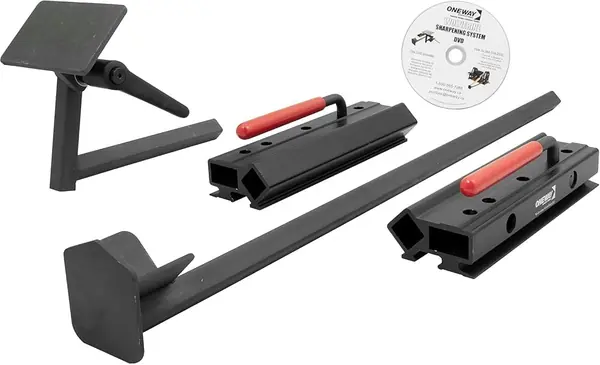
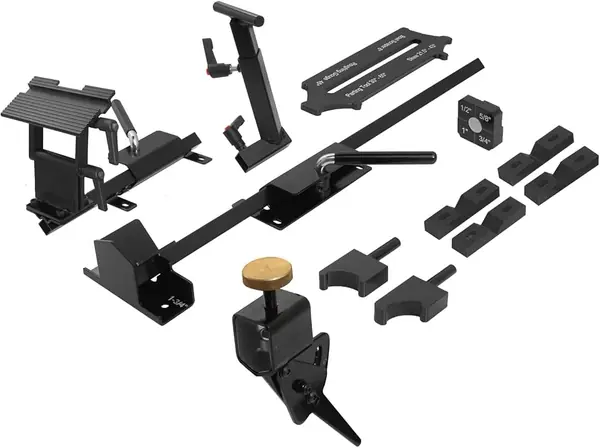
Oneway Wolverine grinding jig with black metal V-arm, two mounting bases and slotted platform

Gouges, skews, scrapers

Shop Score 92/100
Weight
6 lb
In The Box
Two bases and a quad setting jig
V-arm Length
27 inches
Platform Size
3 x 5 inches
View on Amazon

Dull tools don't get sharpened because doing it by eye takes longer than the cut it supports, and that's the problem this jig solves. Two bases bolt to a bench grinder so a rough wheel and a fine wheel each keep their own setup, and the 27-inch V-arm carries a tool at a fixed angle through the whole swing.

Coverage is what earns it the top spot. The 3-by-5-inch slotted platform takes skews, scrapers, parting tools and plane irons flat against the wheel, and the quick-release ratchet handles let you change the platform angle without hunting for a wrench. We were also impressed by how little the setup depends on feel: set the arm, lock it, and the next pass lands in the same place.

The V-arm holds a gouge, but the swept-back fingernail grind most bowl work wants comes from adding the Vari-Grind, which rides the same arm, and we treat the two as one purchase. Jig, attachment and a grinder you already own still add up to a long way under a wet system, and the sharpening happens faster.

Worth Noting

  • First setups take some learning
Our Verdict

For turners who already own a bench grinder, this is the jig we tell them to build around: two bases, a 27-inch V-arm and a slotted platform that repeat angles cut after cut.

Check Latest Price
2.

Pro Grind Sharpening System Best Complete Kit

Pro Grind sharpening system with multi-grind jig, tool rest bar and slotted platform

One-box grinder kits

Shop Score 91/100
Weight
11.6 lb
Platform
3 x 5 inches, slotted
Gouge Jig
Multi-Grind
Grinder Size
6-inch wheels
View on Amazon

For very close to what our top pick costs, the Pro Grind includes the piece the Wolverine makes you buy separately. The Multi-Grind jig handles bowl gouges, side grinds and fingernail profiles, and the tool rest bar, the 3-by-5-inch slotted platform and two bases come in the same box. On day one it is the most complete lathe setup here.

On the wheel it behaves. Gouges and skews came off consistently sharp, and the two bases let us leave a shaping setup and a touch-up setup mounted at the same time instead of swapping wheels. The detail we paid attention to was the clamp that sets the jig's distance from the wheel: the guide bars can shift while you lock them down, so find your positions, mark them, and the drift stops mattering.

Between tool types there is more reconfiguring than we like, since a bowl gouge to a spindle gouge is a reset rather than a slide, and that is roughly the price of a kit costing less than the Wolverine and Vari-Grind together.

One ordering detail: this listing is the 6-inch version, and the same kit is sold for 8-inch grinders. A jig's geometry is built around the wheel under it, so match the purchase to what's on your bench.

Worth Noting

  • Instructions are thin for first-time setup
  • Every tool change means reconfiguring
Our Verdict

Our pick if you want the whole grinder setup in one purchase; the Multi-Grind jig and platform cover more turning tools out of the box than anything else here.

Check Latest Price
3.

Tormek T-4 Best Wet System

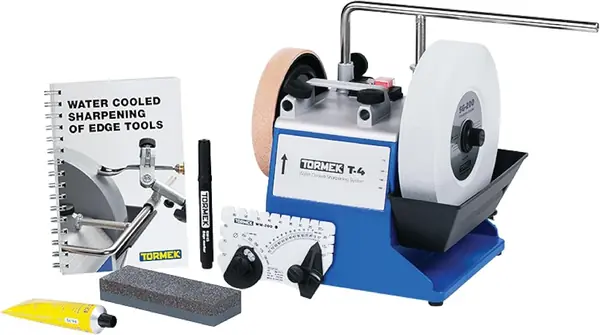
Tormek T-4 blue water-cooled sharpening machine with an 8-inch grinding stone

Burn-free gouge edges

Shop Score 90/100
Weight
19.8 lb
Stone
8-inch water-cooled
Included
Stone grader, angle gauge, honing compound, handbook
Footprint
13 x 9 x 10 inches
View on Amazon

Water cooling is the whole premise. The 8-inch stone turns slowly enough that a bevel never gets hot enough to soften, which matters most on the thin edge of a bowl gouge, where a dry wheel can blue the steel in a careless second. The trade is time: the T-4 removes steel at a rate that asks for patience.

The build explains some of the price. The motor and main shaft sit in a zinc-cast top with integrated sleeves for the universal support, and that rigidity is why a jig setting holds from one session to the next. At 19.8 pounds it sits like a small industrial machine rather than a hobby appliance, and it does not creep across the bench while you grind.

What sold us is how little steel a touch-up removes once a jig is set. You are polishing an existing edge rather than grinding a new one, and the turning tools stay long because of it. The micro-adjust scale on the support makes returning to a setting a matter of reading a number instead of judging by eye.

In the box you get a stone grader, an angle gauge, honing compound and a handbook. What you don't get is a turning jig. Gouges need the SVD-186 R and skews and scrapers need other jigs from the same line, so the real total is higher than the machine alone, the price of a system you build rather than a kit you open.

Worth Noting

  • No turning-tool jig included
  • Premium price against every grinder jig here
Our Verdict

If burned edges are the reason you avoid the grinder, this is the machine we point you to, just plan on buying a gouge jig separately.

Check Latest Price
4.

WEN BG4270T Wet/Dry Sharpening System Best Value Wet Sharpener

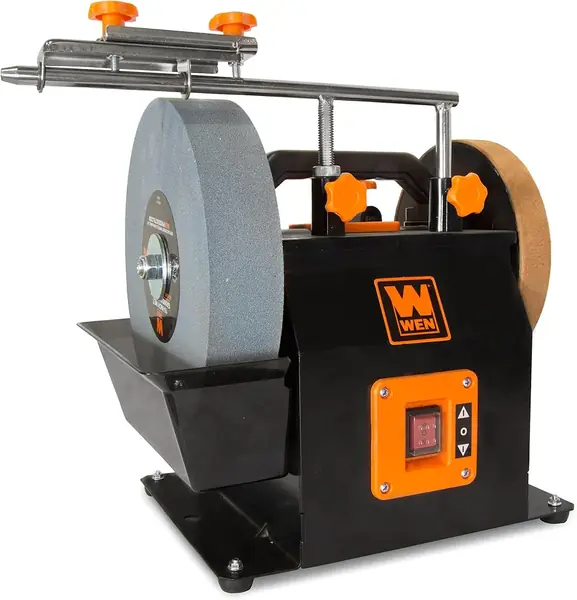
WEN wet and dry sharpener with a 10-inch stone and leather stropping wheel

Budget wet sharpening

Shop Score 89/100
Weight
35.5 lb
Speed
115 RPM
Whetstone
10 x 2 inches, 220 grit
Strop Wheel
8 x 1-1/8 inches, leather
View on Amazon

A 10-inch water-cooled stone, a leather strop, a reversing switch and 115 RPM, for a fraction of what the premium machine here costs. What the extra money buys elsewhere is precision rather than function: the WEN will put a sharp, cool edge on a turning tool, and it will ask you to set it up properly first. For a hobby turner we think that is a fair trade.

The stone is the reason to buy it. At 10 by 2 inches it takes a wide skew in a single pass, and the slow rotation lets you hold a bevel against it long enough to feel what the edge is doing. The leather wheel and the included honing compound leave a polish that shows up in the first shaving off the lathe, and the water reservoir lifts off for emptying without a fight.

For a turner, the part that matters is the universal jig support: it takes other makers' jigs, which is how a bowl gouge gets onto this machine. The jig in the box is for chisels and planer blades, so price the gouge jig as part of the purchase rather than an afterthought.

Give it a permanent spot, since 35.5 pounds is not something you lift onto a shelf, and run it for a while inside the return window. A rumble or a click in the first hours is worth acting on rather than living with.

Worth Noting

  • Stone and strop can arrive out of true
Our Verdict

The least expensive route into water-cooled sharpening, and we think it's a smart buy for a hobby turner who wants a cool, polished edge without a premium machine.

Check Latest Price
5.

Tormek SVD-186 R Gouge Jig Best Gouge Jig

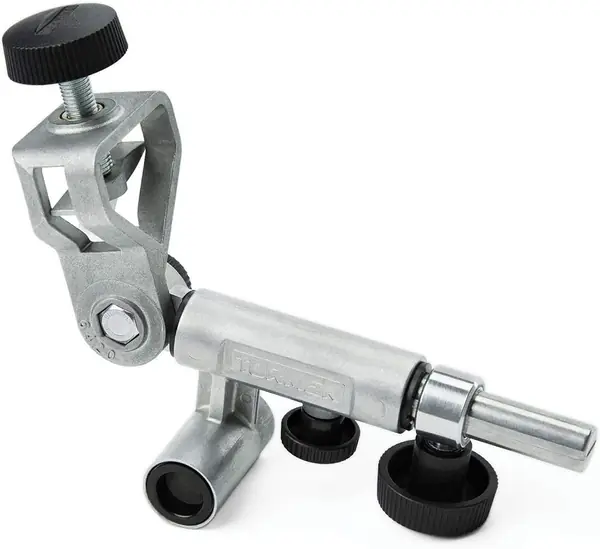
Tormek SVD-186 R gouge jig in silver and black alloy steel

Bowl gouge profiles

Shop Score 88/100
Weight
14.1 oz
Fits
Tormek universal support
Tool Types
Fingernail gouges, V-tools, carving knives
Max Blade Width
1-3/8 inches
View on Amazon

A Tormek on its own is a fine sharpening machine with no way to hold a gouge, and this is the part that closes the gap. The SVD-186 R clamps the tool, sets the side bevel and the swing, and reproduces the same fingernail profile on every touch-up.

What we liked is how conservative it is. Once a profile is set, a touch-up takes seconds and almost no steel, which is exactly what you want from a gouge you would rather not grind away. It takes blades up to 1-3/8 inches wide and also handles bent carving gouges, V-tools and violin knives.

It is built around Tormek's universal support, and that is the compatibility question if your wet sharpener is not a Tormek. Check that the support bar will take the jig, and buy somewhere with returns so you can test the clamp before you dress a wheel to it; the jig is only as good as the bar it rides on.

On a T-4 the pair covers bowl and spindle gouges completely, and it takes less bench space than a grinder with two jig bases bolted to it. If gouges are most of what you turn, the machine-and-jig combination covers your sharpening.

Worth Noting

  • Costs nearly what a complete grinder kit does
  • Covers gouges and V-tools, not skews or scrapers
Our Verdict

We recommend it without hesitation to anyone already running a Tormek who turns bowls; it is the difference between a machine that sharpens and one that repeats.

Check Latest Price
6.

Oneway Wolverine Vari-Grind Attachment Best for Fingernail Gouge Grinds

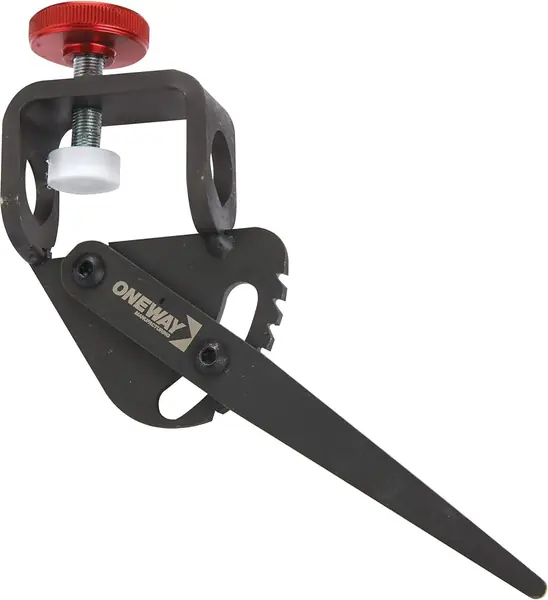
Oneway Wolverine Vari-Grind attachment in black metal with gouge pocket

Fingernail gouge grinds

Shop Score 87/100
Weight
16 oz
Length
11.6 inches
Mounting
Wolverine or any V-arm jig
Profiles
Fingernail and side grinds
View on Amazon

A fingernail grind asks the tool to roll and swing at the same time, and hands alone almost never do that twice the same way. The Vari-Grind clamps the gouge in a pocket and pivots it through that combination, so the tenth touch-up produces the same shape as the first.

At 16 ounces it is a small piece of metal, and the setup carries the learning curve: pocket depth and arm extension decide the profile, and there is some trial and error reaching the angle you are after. Once a gouge is locked in, though, it holds securely enough that we stopped checking it between passes.

What we appreciate most is what it does to your habits. Because the pocket repeats the position, a touch-up is quick enough to do between cuts instead of after the tool goes blunt, and sharpening that happens often is worth more than any single perfect grind.

Worth Noting

  • Gouges only; skews need a separate jig
Our Verdict

Buy it once your V-arm jig is in place and your bowl gouges still come off the wheel with a shape you cannot repeat by hand.

Check Latest Price

How We Tested Wood Lathe Sharpening Systems

We started with what's already bolted to the bench: 6-inch and 8-inch dry grinders, an occasional 10-inch wet wheel, and a V-arm on some but not all of them. From there we filtered by wheel diameter, the tools each jig can hold — gouges, skews, scrapers, parting tools — and the real cost once the jigs sold separately were added in. Anything that couldn't be bolted or clamped down didn't come into the shop.

Eight systems, from bare jigs to complete water-cooled machines, spent nine months on two home benches. Every base was bolted down before the first grind, and on the wet machines we kept the reservoir filled and checked it between passes. We timed the first setup from opening the box to the first spark, and read the instructions at the bench with a dull tool in hand, the way a new owner would.

Then we sharpened the same fingernail gouge, skew, and scraper on each one. We marked the bevel with a felt-tip pen to see exactly where the wheel made contact, counted passes to raise a burr, and checked the edge for blueing after every touch-up. We watched each wheel at startup for wobble, listened for how much the grind howled, and noted which rests stayed rigid when a gouge caught. Every two weeks we returned a jig to its locked setting and reground to see whether the same angle came back.

At the end we added up what a complete setup cost, looked at how the castings and knobs had held up, measured the bench footprint, and checked whether the base could stay mounted while the lathe ran. The systems still in rotation are the ones whose second grind matched the first.

How to Choose a Lathe Tool Sharpening System

Start with what is already in the shop

Two routes get a lathe tool sharp: a dry bench grinder with a jig bolted around it, or a water-cooled machine with jigs that ride its support bar. If a grinder is already on your bench, a base-and-V-arm jig like the Wolverine costs less than a wet machine, sharpens faster, and asks only that you accept a little steel loss and some care at the wheel.

If there is no grinder, price the whole thing before you fall for a jig. A wet sharpener plus a gouge jig is a much bigger purchase than a jig alone, and both routes end with something permanently mounted, so decide where it lives before you order.

Match the jig to the wheel under it

A jig's geometry is set for a specific wheel diameter, because the distance from the tool rest to the wheel face changes with the size of the wheel. That is why the Pro Grind is sold in 6-inch and 8-inch versions and why one bought for the wrong grinder never lines up, no matter how carefully you adjust it.

Wheel wear matters too. A setting made against a fresh 8-inch wheel moves as the wheel shrinks, which is the argument for two bases you can leave bolted down rather than one you re-square every session. Mark your positions once and the wear becomes a number you can return to.

Different turning tools need different holds

Most turning tools fall into two groups. Skews, scrapers, parting tools and plane irons have a flat bevel that wants a slotted platform, where the tool sits flat and slides into the wheel. Gouges want a V-arm and a pocket jig that rolls the tool through the grind, which is what produces a fingernail or swept-back profile.

Count your tools before buying, and check the jig's maximum blade width against your widest gouge. A kit that handles gouges but not skews is half a sharpening station, and the reverse is just as true for someone who turns bowls all day.

Repeatability is the whole point

The first sharpening is easy; the fiftieth is where a jig earns its keep. What you want is a setting that survives being locked down: marked scales, clamps that hold, and a base you never have to re-square. Our Pro Grind pick is the cautionary example, because its guide bars can shift as you tighten them, which makes marking positions the difference between a repeatable grind and a fresh guess.

Sharpening is also a habit. A jig that sets up in a minute gets used between cuts; one that takes ten minutes does not, and a blunt gouge costs more in tear-out and sanding than it ever saves in steel.

Wet or dry, and what it costs you

Water-cooled machines are slow on purpose: the stone never heats a bevel enough to soften it, so you can hold a tool against it as long as you like. Dry grinders take steel faster, and a light touch is what keeps an edge from turning blue.

The trade runs the other way on money and speed. The wet machines here sit at the premium end, the grinder jigs in the middle, and the cheapest route is the one that reuses a grinder you already own. Neither produces a sharper edge; the wet route is simply harder to ruin one on. Whatever you buy, add a diamond truing tool to the order, because new wheels arrive out of round more often than anyone expects.

Frequently Asked Questions

Final Verdict

The Wolverine Grinding Jig is the backbone of the sharpening station we recommend: two bases, a long V-arm and a slotted platform covering gouges, skews and scrapers, all hung on a bench grinder most turners already own. Add the Vari-Grind when bowl gouges are most of your work, and the total still lands below a wet system.

If there is no grinder on your bench and you want one machine that cannot burn an edge, the Tormek T-4 is the alternative we point to, with the SVD-186 R figured into the price, because the machine alone will not hold a gouge.