↑↓ navigate ↵ open Esc close All results →

Best Deck Stains for Pressure-Treated Wood of 2026

Coating a brand-new pressure-treated deck right after installation is one of the fastest ways to ruin a finish. Lumber arrives waterlogged from treatment, and stain applied over trapped moisture sits on top of the grain before peeling away in sheets after its first winter. Giving the wood time to dry lets the right formula soak in, keep the grain visible, and hold up through seasonal weather.

Testing 12 deck stains for a full year across a sun-baked deck, a shaded one that stayed damp, and surrounding railings and waterside boards underscored what most buyers overlook at the paint counter: coverage per gallon dictates the real project cost. A cheaper can that goes half as far quickly loses its price advantage.

Application traits split the field just as sharply as durability—oils wiped on and penetrated with minimal lap marks, while water-based formulas demanded a faster pace and occasional back-brushing to stop edges from drying mid-board. Across cedar tones and weathered grays, the seven stains below held their bond on real boards through four full seasons.

Our Top Picks

The Best Deck Stains for Pressure-Treated Wood

1.

Ready Seal Stain & Sealer Best Overall
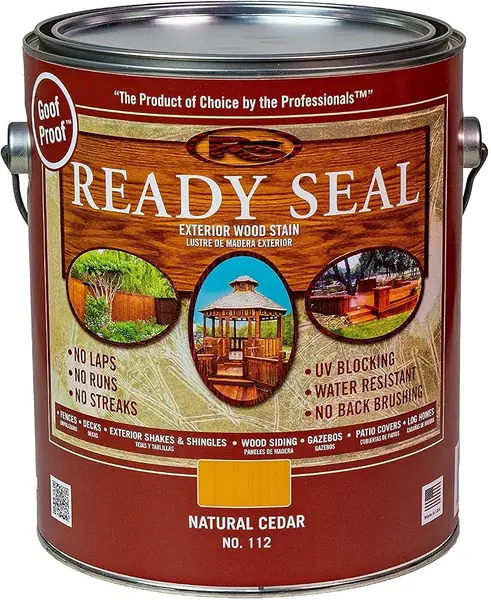
Ready Seal semi-transparent wood stain and sealer in a one-gallon Natural Cedar container

Most pressure-treated decks

Shop Score 92/100
Color
Natural Cedar
Base
Oil-based
Coverage
125-150 square feet per gallon
Opacity
Semi-transparent
View on Amazon

Lap marks are the tell of a deck stained in a hurry, and the usual fix is back-brushing every board while the finish is still wet. Ready Seal is built to make that unnecessary: the oil self-blends, so a wet edge re-wets the dry one and the color closes up behind the roller. On the Natural Cedar we worked with, the finish stayed even across butt seams and board joints without anyone picking up a brush.

That forgiving behavior is most of why this is our top pick. Pressure-treated lumber keeps moving after it is installed, and an oil that soaks into the fibers moves with the boards instead of sitting on top of them. There is no film to lift at the edges and nothing to sand off before the next coat — a refresh is another pass with a roller, which is maintenance we will actually do. The color also lands close to the swatch, a warm mid-brown rather than the orange some cedar tones turn.

The number to plan around is coverage: 125 to 150 square feet per gallon, which is on the thirsty end of this group. Measure the deck, the railings, and the stairs as separate areas, buy the extra gallon, and hold it back for the treads and the sun-facing edge — those go first. On a deck that sees full sun, think of this as a finish you top up rather than one you install once.

Worth Noting

  • Coverage runs 125-150 square feet per gallon
  • Sheer color means board variation shows through
Our Verdict

We recommend Ready Seal to most pressure-treated deck owners: it soaks in instead of filming over, blends its own lap marks, and takes color evenly without back-brushing.

Check Latest Price
2.

DEFY Extreme Wood Stain Best for Large Decks

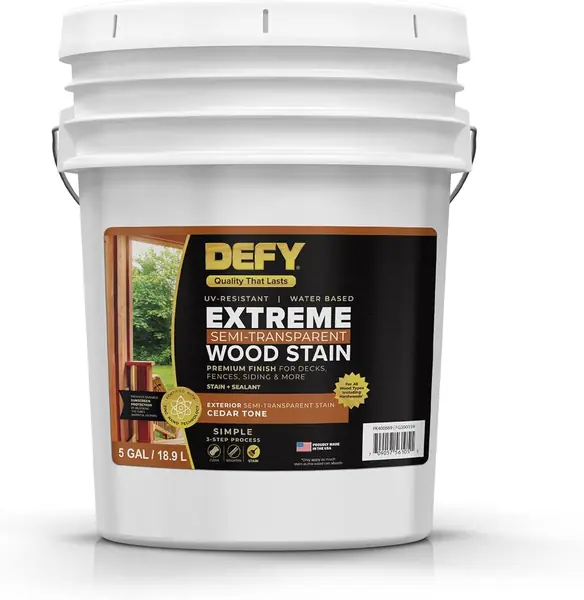
DEFY Extreme five-gallon pail of Cedar Tone semi-transparent wood stain and sealer

Large decks

Shop Score 91/100
Color
Cedar Tone
Base
Water-based
Coverage
100-150 sq. ft. per gallon (for 2 coats)
Size
5 gallon
View on Amazon

Five gallons is a decision, not a purchase. At 100-150 sq. ft. per gallon (for 2 coats), one pail of DEFY Extreme finishes a deck in the 500-to-750-square-foot range without a second order, which is why it is the stain we hand to anyone staring down a big, bare deck they want done in one weekend.

The formula is a water-based acrylic with zinc nano-particles for UV, and it applies like one: sprayer, brush, or roller, soap-and-water cleanup, and a recoat window short enough to get both coats down before the day is out. The Cedar Tone sits on the sheer side of semi-transparent, so expect the grain and some board-to-board variation to read through rather than a solid blanket of color.

A film either bonds to the surface or it does not, and when it does not it lifts in sheets instead of wearing thin. That is the thing we would have buyers think about before committing to a pail this size: the same acrylic that beads water beautifully on a well-prepped deck can let go on a slick, mill-glazed face or on lumber that was still holding moisture when the first coat went down.

So this stays our large-deck pick, and it earns that on the arithmetic as much as the finish: a durable, water-beading coating across a lot of square footage, at a per-gallon cost that lands in the middle of this group. If you would rather have a finish that wears away and never needs sanding off, the penetrating oils above are the safer bet; if the deck is big and the prep time is available, the pail wins.

Worth Noting

  • Sold here only as a five-gallon pail
Our Verdict

We reach for the pail when the deck is big: five gallons of water-based semi-transparent cover 500 to 750 square feet in two coats, and cleanup is soap and water.

Check Latest Price
3.

TWP 1501 Cedartone Stain Best Coverage per Gallon

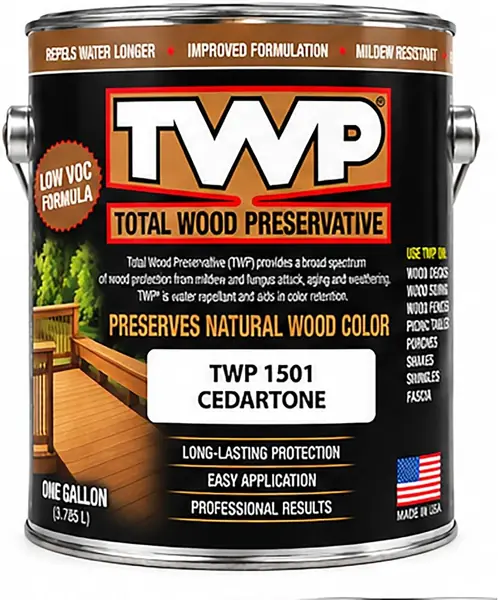
TWP 1501 Cedartone low-VOC wood preservation stain in a one-gallon jug

VOC-restricted states

Shop Score 90/100
Color
Cedartone
Base
Water-based
Coverage
350 square feet
Size
1 gallon
View on Amazon

Where the state caps VOCs, the solvent-heavy oils that dominate deck staining are simply not for sale, and a formulation detail turns into the whole decision. TWP 1501 is the one we point those buyers to, and it happens to be the best coverage per gallon in this guide: water-based, low-VOC, EPA-registered as a wood preservative, and listed at 350 square feet per gallon, well ahead of every other pick here.

It behaves like a penetrating stain rather than a coating. Oxide pigments tint the wood instead of masking it, the finish dries flat and matte, and it soaks in fast enough that a wool pad or a sprayer covers ground quickly. The color runs darker than the Cedartone chip suggests, so test a spare board or the underside of a step before committing to the visible face.

Worth Noting

  • Cedartone reads darker than the swatch
Our Verdict

The one we point to where VOC rules narrow the shelf: a penetrating, low-VOC stain that covers 350 square feet per gallon, more than anything else here.

Check Latest Price
4.

#1 Deck Premium Stain & Sealer Best Budget

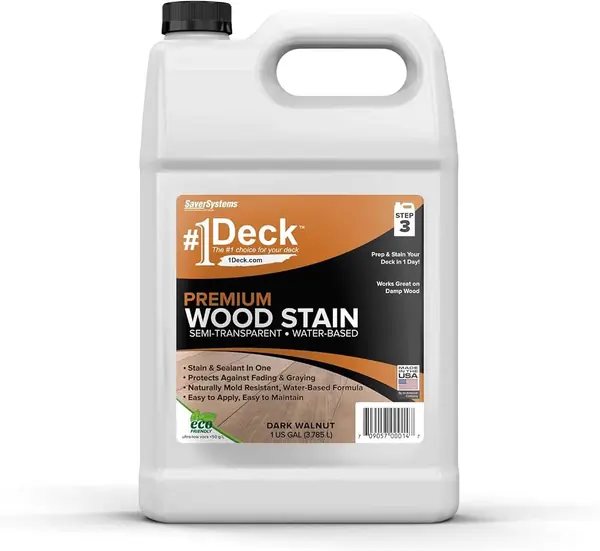
SaverSystems #1 Deck Premium semi-transparent Dark Walnut stain in a one-gallon container

Tight budgets

Shop Score 89/100
Color
Dark Walnut
Base
Water-based
Coverage
100 sq ft
Opacity
Semi-transparent
View on Amazon

Most water-based stains here want bone-dry boards, which means washing the deck and then waiting. This one is the exception: it is formulated to go on wood that is visibly damp, cutting the wait between cleaning and staining. For a deck that has been rained on three weekends running, that is not a small thing.

It is also the least expensive ready-to-use gallon in this guide, and we like it for exactly the jobs where that matters — a first deck, a rental, a fence you are staining because you have to. The Dark Walnut is a rich, even brown that still lets the grain read, and it dries quickly enough that you are not standing around watching it.

The trade-off is consistency. It is thin, almost watery, and it will run down the face of a board and pool at the edge if you load a brush the way you would with an oil. Keep the coat light, work a narrow line at a time, and wipe the drips as you go; do that and the fast dry time works for you instead of against you.

Worth Noting

  • Coverage runs about 100 square feet per gallon
Our Verdict

We like this one for a first deck: it is the least expensive ready-to-use gallon here and it goes on damp wood, so washing and staining can happen in one weekend.

Check Latest Price
5.

SEAL-ONCE Marine Ready Mix Best for Pool Decks and Docks

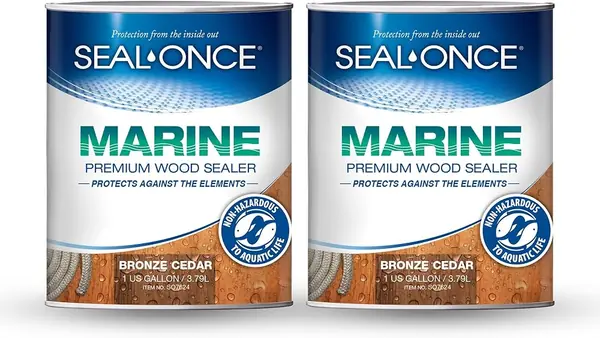
SEAL-ONCE Marine Ready Mix wood sealer in Bronze Cedar, two-gallon size

Waterside decks

Shop Score 88/100
Color
Bronze Cedar
Base
Water-based
Size
2 gallon
Finish
Satin
View on Amazon

A deck around a pool, a dock, or a pier takes more abuse than a back porch: chlorine, splash, salt, and constant moisture. Seal-Once Marine Ready Mix was formulated for exactly those surfaces — water-based, ultra-low VOC, labeled non-hazardous to aquatic life, and finished in a satin Bronze Cedar that looks deliberate rather than painted.

It goes on fast and dries fast, which is why two coats in one day is realistic; cleanup is soap and water while it is still wet. The durability picture is less tidy. This is a coating that can fade and thin inside a year on a sunny, exposed deck, so plan on a recoat when water stops beading rather than on a fixed calendar.

For a pool surround that gets hosed down and splashed all summer, we still think it earns its place: the formulation is built for surfaces that stay damp, the satin sheen hides the scuffs that come with furniture dragged across a deck, and the two-gallon pail covers a generous apron around a pool. Treat it as a maintenance coat and it does its job well.

Worth Noting

  • Can fade and thin within a year in sun
Our Verdict

We keep this one for the deck that gets splashed: a water-based marine sealer for pool surrounds, docks, and piers, finished in a satin Bronze Cedar.

Check Latest Price
6.

Cabot Australian Timber Oil Best for Railings and Furniture

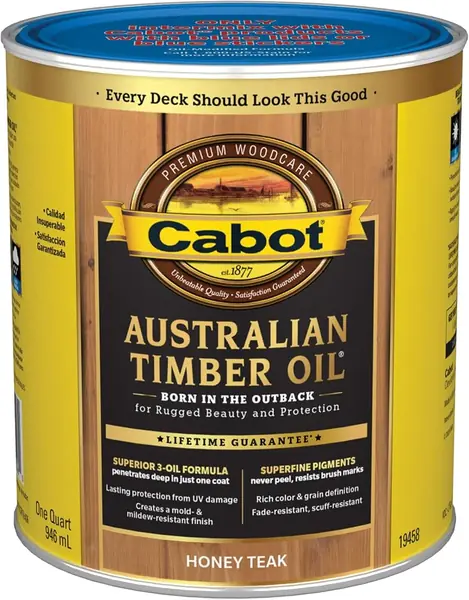
Cabot Australian Timber Oil transparent wood stain in a quart can, Honey Teak

Railings and furniture

Shop Score 87/100
Color
Honey Teak
Base
Oil-based
Coverage
covers up to 200 sq. ft. per quart
Size
Quart
View on Amazon

For railings, a pair of Adirondack chairs, and the cedar trim you want to keep looking like cedar, this is the nicest finish in the group. Cabot blends linseed oil for penetration, long-oil alkyds for durability, and South American tung oil for water repellency, and the transparency is the point: the wood's own color and figure come through, with nothing to chip or sand back later.

Transparent also means exposed. With the least pigment of any finish here, it screens the least sun, so it suits boards already in good condition and pieces you are willing to refresh rather than a gray, weathered floor you want to even out. It is sold by the quart, which makes sense for a railing run and very little sense for a full deck.

Worth Noting

  • Quart size makes full-deck coverage expensive
Our Verdict

We reach for this on railings and furniture: a transparent oil blend that leaves wood looking like itself, with no film to chip or peel.

Check Latest Price
7.

Eco Wood Treatment Powder Concentrate

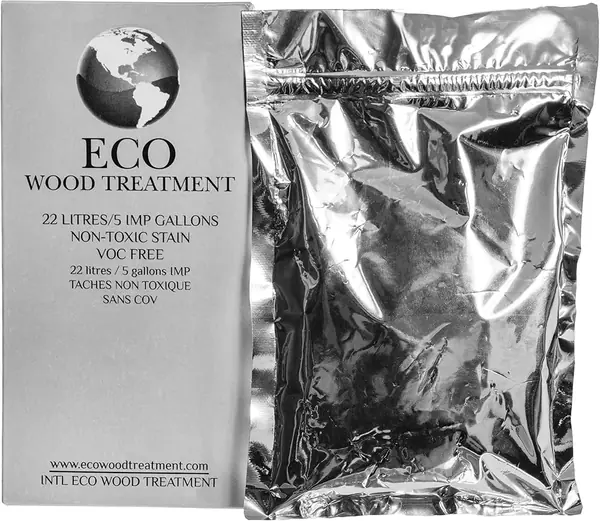
Eco Wood Treatment powder concentrate that mixes with water into a silvery patina finish

Weathered look

Shop Score 86/100
Color
Silvery Patina
Coverage
up to 750 sq ft
Finish
Matte
Form
Powder concentrate
View on Amazon

A five-gallon batch of Eco Wood Treatment starts as a small pail of mineral powder; add water and you have a treatment that bonds with the wood fibers and ages raw lumber toward a silvery, weathered gray. There is no film and no pigment layer, the listing calls for one application, and the coverage behind it — up to 750 square feet per pail — is the highest here.

The gray is the whole product, and it is the part to be careful about. It develops over weeks rather than drying to a final color and keeps shifting after that; on cedar shingles it can go considerably darker than the silver you see on a fence. Species and sun exposure push the result around, so treat a scrap of the same lumber before you commit a whole deck.

That makes it the right answer for one specific buyer: someone with a lot of raw square footage — a fence, a big deck, a barn — who wants the weathered look on purpose and never wants to think about recoating again. If you want color, an even tone across mismatched boards, or anything you would call finished, this is not it.

Worth Noting

  • One color only
Our Verdict

We like it for one job only: turning a large, raw deck or fence silver-gray in a single application with a mineral powder and water.

Check Latest Price

How We Tested Deck Stains on Pressure-Treated Boards

We started with the cans, not the reviews: base, solids, stated coverage, VOC content, and the state rules that restrict solvent-heavy formulas. From that we narrowed to 12 stains in the sizes people actually buy — quarts for railings, gallons for a mid-size deck, pails for the long ones — and gave each a full year on real pressure-treated lumber.

Every stain went onto a new pressure-treated deck in full sun, a shaded deck that never fully dries, and the railings and waterside boards around them, applied by brush, roller, and spray so we could see where a lap mark formed or a section skinned over mid-stroke. We marked off sections and counted square feet per gallon, then ran those coverage numbers against a whole deck to see what each finish would cost across its recoat interval.

We watched whether each finish soaked in or built a film on top, and checked board edges and end grain for lifting. Damp boards got their own test patch after a rain, with recoat and walk-on times timed against the label, and we laid every oil-soaked rag and applicator pad flat to dry outdoors or soaked it in water before disposal.

Color was judged on a board next to the swatch rather than on a paper chip, and we noted how much grain each one left visible. At three, six, and twelve months we walked the same boards looking for fading, graying, discoloration, and peeling, and re-checked which finishes still felt dry to the touch.

How to Choose a Deck Stain for Pressure-Treated Wood

Start With the Boards, Not the Can

Pressure-treated decking is sold wet, and the faces come off the planer slick enough that a finish can sit on the surface rather than sink in. Coat too early and you trap that moisture under a film, which shows up months later as peeling or blotchy color. The honest test is a splash of water: on boards that are ready, it darkens the wood and soaks in within a few minutes.

If water beads and sits there, wait. Weather and shade decide how long — a sunny, windy site dries faster than a north-facing one — and the boards are ready when they stop shedding water and have settled down without gapping.

Penetrating Oil or Film-Forming Acrylic

This is the choice that determines how the finish fails, not whether it will. Penetrating oils such as Ready Seal and Cabot soak into the fibers and wear thin in the traffic lanes; water-based acrylics such as DEFY Extreme and Seal-Once build a coat on the surface that beads water hard but lifts in sheets if it did not bond. On still-moving treated pine, we lean toward a penetrating stain for the first finish and treat a film as something to add later.

One practical wrinkle: a number of the solvent-heavy oils cannot be sold in states with VOC caps. Check the label and your local rules before you plan the weekend around a particular can.

Do the Coverage Math Before You Compare Prices

Coverage per gallon ranges from about 100 square feet to 350 across the products here, which means the price on the can tells you almost nothing about what the deck will cost. Multiply the square footage of the floor by the number of coats, then add railings, stairs, and the fascia as separate areas — they drink more than the deck field and they are always forgotten.

The trap is a cheap gallon with a low coverage figure: at 100 square feet per gallon it costs more per square foot of finished deck than a pricier stain that stretches to 350. Buy to the coverage number, not the sticker.

Decide How Much Grain You Want to Keep

Transparent finishes show everything, including the difference between boards, and they screen the least sun. Semi-transparent is the practical middle — enough pigment to even out a floor and slow graying, not so much that the wood stops reading as wood. Clear waterproofers add no color at all, which is fine for keeping a weathered look and disappointing if you wanted change.

Whatever you pick, the chip in the store assumes bare, evenly prepped lumber. On a deck that has been stained before, or on boards that have already gone silver, the result shifts — so put a coat on an offcut first.

Damp Wood, Dry Time, and Getting Back on the Deck

A few water-based stains are formulated to go on visibly damp wood, which saves the wait between washing and coating; most want the boards dry, and a damp board under a film is how peeling starts. Read that line on the label before you schedule the work.

The other thing worth reading is the recoat window. Two thin coats always beat one flooded coat — heavy application of a clear waterproofer is the classic way to end up with a deck that stays tacky for days, and no amount of sun fixes a puddle of finish that soaked into a seam.

Frequently Asked Questions

Final Verdict

For most pressure-treated decks, Ready Seal is the stain we recommend. It penetrates instead of filming, it forgives an uneven hand, and it never has to be sanded off. Buy to its coverage figure — it is on the thirsty side — and hold back a gallon for the treads and the edge that takes the sun.

Two conditions change the answer. A deck in a state that caps VOCs points to TWP 1501, which also has the best coverage per gallon here. And if you are washing and staining in the same weekend, #1 Deck Premium goes on damp boards and costs less per gallon than anything else ready to pour.