↑↓ navigate ↵ open Esc close All results →

Best Exterior Wood Stains of 2026

Stain is not paint, and the difference is the whole decision. Pigment load decides how much of the grain still reads through, and the binder decides whether the coating soaks into the wood or lays a film on top. Get either one wrong for the surface and you'll be sanding a year earlier than you planned. The right match buys you a few seasons of not thinking about it.

We tested 12 exterior stains over nine months on a shared deck, a fence line, garage-door trim, and raised garden beds, because a finish only proves itself through a full stretch of sun, rain, and foot traffic. Odor turns out to be a decent tell for how a stain is based, and the recoat window on the back of the can matters as much as the color — it decides whether the job fits in one weekend or eats two.

The picks below cover flat deck boards, worn gray fences, vertical trim, and a couple of non-wood surfaces. Start with the surface, then argue about the shade.

Our Top Picks

The Best Exterior Wood Stains

1.

KILZ Waterproofing Semi-Transparent Wood Stain Best Overall
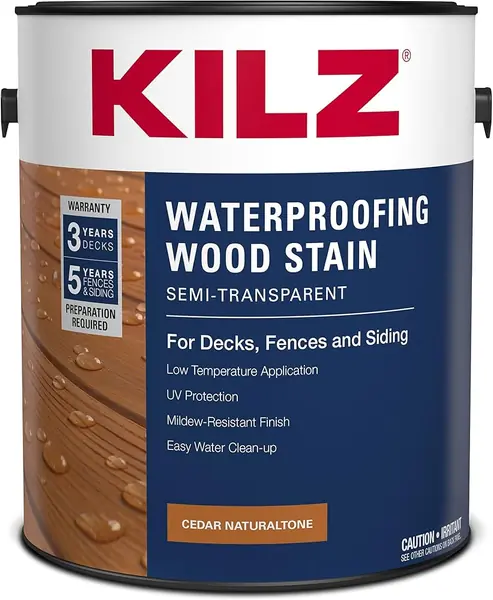
KILZ Waterproofing Semi-Transparent Wood Stain in Cedar Naturaltone, one-gallon can with satin acrylic finish

Decks and fences

Shop Score 93/100
Coverage
250-500 sq. ft.
Base
100% acrylic
Opacity
Semi-transparent
Warranty
3 years on decks, 5 years on fences and siding
View on Amazon

Coverage is the first number we check on a deck stain, because a gallon that quits at 150 square feet turns one weekend into three. KILZ lists 250 to 500 square feet per gallon, which puts a small deck inside a single can and a large one inside a can plus a finish coat. It is a 100% acrylic semi-transparent stain that colors the boards and lays down a waterproofing, UV-resistant film in the same step, so there is no separate sealer to buy.

That combination is why we made it the top pick. The film is built to shed rain and snow, resist fading and mildew, and hold its color through a full year of sun, and the warranty runs three years on decks and five on fences and siding, longer than anything else here states. For someone about to spend a Saturday up a ladder, that kind of written commitment is worth more than a nicer label.

Semi-transparent is the right amount of color for wood that is still sound. Pigment evens out the tone while the grain and the texture of the boards keep reading through, which is what most people picture when they decide to stain instead of paint. KILZ rates it for new to moderately weathered wood, roughly the first decade of a deck's life, across decks, fences, railings, shingles and wood patio furniture.

The warranty has a string attached: it depends on proper preparation, so the cleaning and brightening pass is part of the job rather than a suggestion. Do it and the finish has a fair shot at its stated span. Skip it and you have paid for coverage you cannot use, which is the mistake we see most often on a first deck.

Worth Noting

  • Offered here in a single color
Our Verdict

We recommend it as the default exterior stain for most decks and fences: one acrylic coat colors the wood, blocks water and UV, and carries the longest stated warranty here.

Check Latest Price
2.

Cabot Australian Timber Oil Best Penetrating Oil for Hardwoods

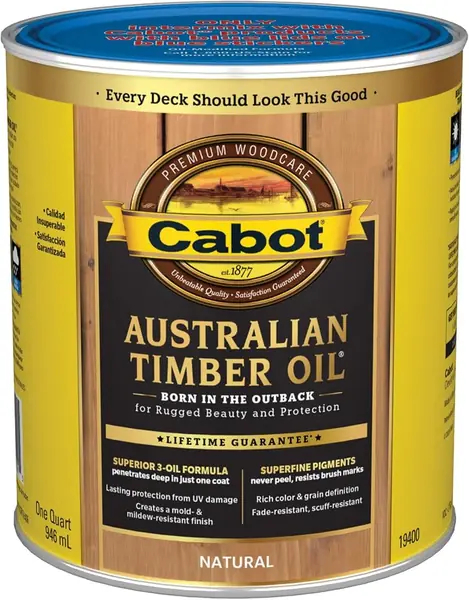
Cabot Australian Timber Oil water-reducible stain in a one-quart can, natural translucent tone

Dense hardwood decks

Shop Score 92/100
Size
1 quart
Coverage
Up to 200 sq. ft. per quart
Base
Linseed, tung oil and alkyd blend
Opacity
Translucent
View on Amazon

Cabot's Australian Timber Oil exists because dense hardwoods do not take a surface film well. The blend of linseed oil, long-oil alkyds and tung oil was formulated for resin-rich timbers like tallowwood, cambara and merbau, and it soaks in rather than sitting on top, which is exactly what ipe, teak and mahogany want. It is our pick for hardwood decking and for outdoor furniture that should look oiled instead of coated.

Translucent iron oxide pigments carry the color and absorb UV, so the wood darkens and warms without the grain disappearing. Applied with a fine brush it leaves a soft satin surface with no brush marks, which is why we like it on a dining table or a set of teak loungers where the finish is part of the furniture. A quart covers up to 200 square feet.

Two practical notes. It is not intended for interior surfaces, so this is an outdoor-only product. And the water-reducible version cleans up with soap and water and stays low-odor while you work, a real convenience when you are refinishing furniture on a porch rather than in a spray booth. A large deck takes several quarts, so the container size is the first thing to plan around.

Worth Noting

  • Premium price for a quart
Our Verdict

We keep this one for dense hardwoods and outdoor furniture, where a penetrating oil beats any film; it costs more per quart and earns it on teak and ipe.

Check Latest Price
3.

Thompson's WaterSeal Solid Color Stain Best Solid Color for Worn Wood

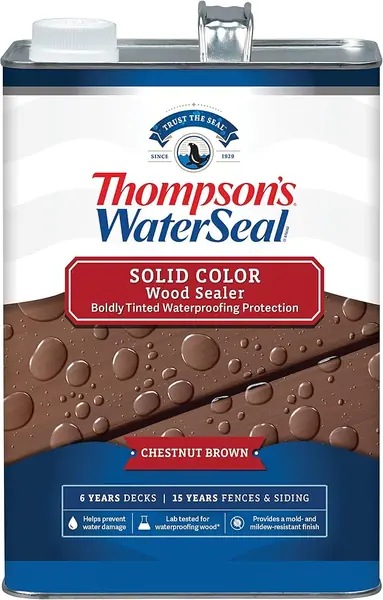
Thompson's WaterSeal Solid Color Waterproofing Wood Stain and Sealer gallon in Chestnut Brown

Worn gray decks

Shop Score 91/100
Size
1 gallon
Coverage
150-400 sq. ft. per gallon
Opacity
Solid
Waterproofing
Exceeds ASTM D-4446
View on Amazon

There comes a point where a deck is past saving with a transparent finish. The boards have gone silver, the checking runs deep, and a see-through stain only highlights all of it. Thompson's WaterSeal Solid Color is the answer to that deck: a flat, heavily pigmented film in Chestnut Brown that goes over the damage and leaves one even surface instead of a mosaic of old and older boards.

It is the most forgiving finish here to apply. It goes onto damp or dry wood, so a morning shower does not cost you the day, and it takes a brush, a roller or a sprayer without complaint. The polymers are there to hold the color against UV, and Thompson's states the coating exceeds ASTM D-4446 for waterproofing, which is the kind of reference you can at least look up.

We keep it for two jobs: a deck that is too worn for anything translucent, and an addition to an old deck where new boards have to blend with weathered ones. Coverage runs 150 to 400 square feet per gallon depending on how thirsty the surface is, so buy by the square footage you are actually covering rather than the label's best case. Rough or checked boards often take a second pass to come out even.

Worth Noting

  • Hides the wood grain entirely
Our Verdict

Our pick when the wood is too far gone for a see-through finish: solid color covers the damage in one flat coat that goes on damp or dry.

Check Latest Price
4.

Eco Wood Treatment Best Weathered Gray Finish

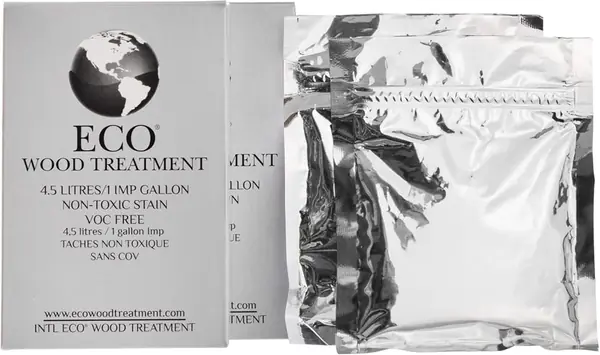
Eco Wood Treatment two-pack powder concentrate, non-toxic mineral stain that ages wood silvery gray

Weathered gray look

Shop Score 90/100
Size
1 Gallon (Pack of 2)
Coverage
Up to 150 sq. ft. per gallon
Color
Silvery patina
Form
Water-mixed mineral powder
View on Amazon

Mix this powder with water and brush it onto new cedar, and the wood ages to the silver-gray of driftwood instead of the honey of fresh lumber. There is no pigment to fade and no film to peel: the mineral treatment migrates into the wood as it cracks and stays put, so it is sold as a once-and-done rather than a recoat-every-few-years finish. Nothing else here works that way.

What sold us is how harmless the whole process is. It is a powder of mineral and plant substances with no solvents, so drips on a patio or into a garden bed are not a cleanup emergency, and the runoff leaves nothing behind in soil. For raised beds, fences, birdhouses and anything that should look like untreated wood left out in the weather, that combination is hard to argue with.

Our advice is to buy it for the look rather than for tinting. It produces weathered silver and nothing else, so if you want warmth or depth in the color, this is the wrong jar. Mix it thoroughly and give the powder time to go fully into solution before you load a sprayer. Applied with a brush or a roller, it is about as simple as an exterior finish gets.

Worth Noting

  • Only the weathered silver-gray look
  • Modest 150 square feet per gallon
Our Verdict

This is the one for raised beds and fences where the weathered silver look is the goal and recoating never is.

Check Latest Price
5.

Old Masters Gel Stain Best Gel Stain for Vertical Work

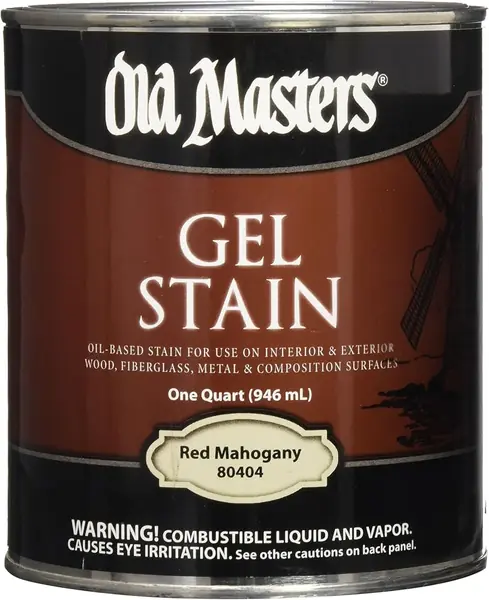
Old Masters Interior/Exterior Gel Stain in Red Mahogany, one-quart can with a smooth matte finish

Doors and trim

Shop Score 89/100
Size
1 quart
Coverage
100-150 sq. ft.
Color
Red Mahogany
Finish
Smooth, flat gel
View on Amazon

Doors, shutters and trim are where a run of stain shows worst, and a gel is the fix. Old Masters' gel is thick enough to hold its place on a vertical face while you work, so nothing sags down the panel you just finished. It is rated for interior and exterior use, and it grips fiberglass, primed metal and composition surfaces as well as wood, which is why it is our pick for a front door that is not wood at all.

A quart is about the scale of a door and its surrounding trim, so treat this as a can for projects rather than whole houses. The gel wipes off evenly, and that is what lets you control the depth of the color instead of accepting whatever the first pass hands you: wipe sooner for a lighter Red Mahogany, leave it longer for a deeper one. Build a second coat if you want more.

It is a vertical-surface product. On a broad flat deck the thickness works against you, and a thinner stain like KILZ or Thompson's spreads and levels far faster across a board. If you plan to seal over it, test your clear coat on an offcut first, since an oil-based one can shift the color. For everything standing up, we have not found a better-behaved gel in this group.

Worth Noting

  • Only 100 to 150 square feet per quart
Our Verdict

We choose this gel for exterior doors, shutters, and trim, where its thickness stops drips and its color wipes down to the shade you want.

Check Latest Price
6.

Retique It Wood'n Stain Best for Non-Wood Surfaces

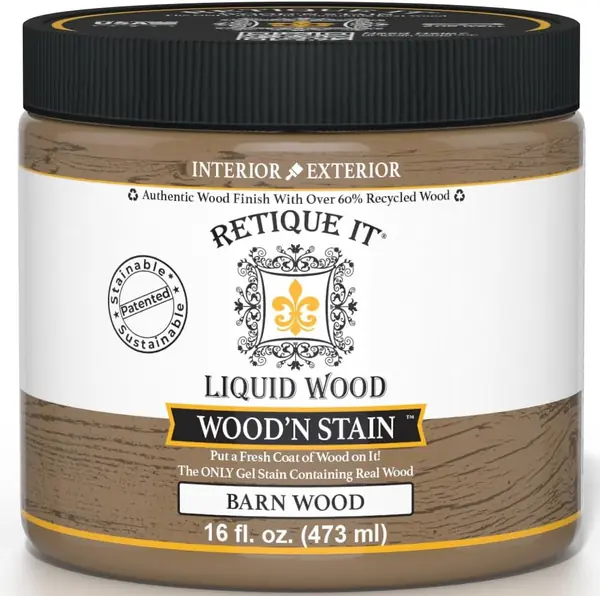
Retique It Wood'n Stain water-based liquid wood coating in 45 Barn Wood, sixteen-ounce jar

Non-wood surfaces

Shop Score 88/100
Size
16 fl oz
Base
Water-based
Color
45 Barn Wood
Surfaces
Wood, metal and other hard surfaces
View on Amazon

Wood'n Stain is not a stain you wipe into bare boards. It is a water-based coating with real wood in it: brush, roll or spray it on and it leaves a wood layer that looks and feels like wood because that is what it is. On a steel door, a composite panel, or a cabinet run that needs a barn-wood face, nothing else in this group does that job.

We treat it as a problem solver rather than a finish for a whole deck. One coat covers the way a gel stain does and lets some of the surface read through; two or three coats build a complete new wood face, which is the version we prefer on flat panels where a thin coat lets an uneven base show. The colors lean toward reclaimed and barn-wood tones, and the water-based formula keeps the odor low and the cleanup to soap and water.

Worth Noting

  • Sixteen-ounce jar goes only so far
Our Verdict

We buy it for steel and composite doors that should read as wood; it is a specialty coating, not a deck stain.

Check Latest Price

How We Tested Exterior Wood Stains Through Sun, Rain, and Foot Traffic

We started by reading spec sheets rather than labels: exterior rating, base and film type, coverage per container, and the exact terms of any warranty, since most warranties hinge on prep the front of the can barely mentions. Anything not rated for exterior use came off the list before testing began. Twelve stains made it into testing, and we bought them at retail the same way you would.

Over nine months, we put them on a shared deck, a fence line, garage-door trim, raised garden beds, and a couple of non-wood surfaces, working in the same scraps of time a homeowner has — an afternoon here, a second coat the next morning. We brushed most of them and rolled the flat deck boards, watching for lap marks where a wet edge dried, drips running down vertical trim, and how far a quart actually stretched on a first coat. Each container got measured against its stated coverage, and we noted how much grain and texture still showed once the film cured, since that's where transparency lives.

Anything solvent-based went on outdoors with cross-ventilation and well away from the grill, and we noted how sharp each one smelled at the brush; every oily rag got spread flat on the driveway to dry before disposal. We poured a cup of water on each finished section to see whether it beaded or soaked in, timed recoat windows against a real weekend, and checked back at three, six, and nine months for graying, scuffs in the traffic lanes, and peeling at board ends. We also held each cured panel up to its swatch in daylight, which is where most color arguments get settled.

How to Choose an Exterior Wood Stain

Opacity Decides More Than Color Does

Opacity is how much pigment is left on the wood once you have wiped or rolled it out, and it sets both the look and how much of the grain survives. A semi-transparent like KILZ colors the boards while the grain and texture still read. A translucent oil like Cabot mostly enriches what the wood already has. A solid like Thompson's leaves a flat film with no grain showing through at all. Same category, three different rooms.

Our rule of thumb: if more than a few boards have gone silver or mismatched, go solid and stop fighting it, because no semi-transparent will pull uneven weathering back together. If the wood is still sound and you like the figure, semi-transparent keeps it in view.

Match the Finish to the Surface, Not Just the Color

Vertical work and flat work are different problems, and this is the trap that catches most first-time buyers. On a door or a shutter gravity is the enemy: a thin stain runs, so a gel like Old Masters is the smarter tool. On a deck that same thickness turns into a liability, because it is slow to spread over a wide board and shows every overlap. Furniture and dense hardwoods want a penetrating oil that soaks in rather than a film sitting on the surface.

There is one more case worth planning for: wood you never want to touch again. A raised bed or a fence line that should weather to gray is where a mineral treatment like Eco Wood Treatment makes sense, and no pigmented stain will imitate that result.

Read the Warranty and the Prep It Depends On

An exterior stain's warranty is a promise about a properly prepared surface, not insurance against neglect. KILZ warrants three years on decks and five on fences and siding and states that preparation is required; Thompson's cites ASTM D-4446 for waterproofing. Those numbers are the honest measure of how long a finish is expected to hold, and they are written for wood that was cleaned and opened up first.

So we count the prep as part of the product's cost rather than an optional extra. A Saturday spent cleaning and brightening is the difference between a coating that reaches its stated life and one that peels in two seasons.

Do the Square-Foot Math, Then Add a Coat

Coverage figures are the most optimistic number on any can. KILZ is rated 250 to 500 square feet per gallon, Thompson's 150 to 400, Cabot's quart 200, and Eco's gallon 150. The spread exists because wood is thirsty: rough, weathered cedar drinks far more than a smooth new board, and a first coat always disappears faster than the second.

Our habit is to measure the area, double it, and buy in gallon containers where the price per square foot drops. Running out mid-deck is how you end up with a visible seam where the second trip to the store begins.

Frequently Asked Questions

Final Verdict

For most decks and fences, KILZ is the exterior stain we point to: one acrylic product that colors, waterproofs and carries a three-year deck warranty, at a coverage that can finish a deck out of a single can. Do the prep it asks for and it is the least fussy way to protect outdoor wood.

Two situations change the answer. If the boards have already gone silver and checked, Thompson's solid color covers what a semi-transparent cannot. If you are finishing teak furniture rather than a deck, Cabot's penetrating oil is the better tool.